
Today in Mid-Century Gimmick Baits we’re going to look at a few snake-oil baits from the 1940s through the early 1960s. Roland Martin’s Helicopter Lure and the King of Bass’ Hover Lure weren’t the first gimmick bass lures to hit the market by any stretch of the imagination. Gimmick lures have been with us since since the dawn of fishing. Someone is always going to develop something, not necessarily to take advantage of anglers, but sometimes so.
I don’t have too many magazines from the 1940s but I have a fair share. Enough to have found four different ads from 1940 to 1946, all featured in Hunting and Fishing magazine. I’m not sure if the Big Three avoided ads like these but they were few and far between. One thing for certain is most of these ads were in multiple issues of the year, not just a random issue here and there.
American Tackle Co. Bleeder Bait Mid-Century Gimmick Baits
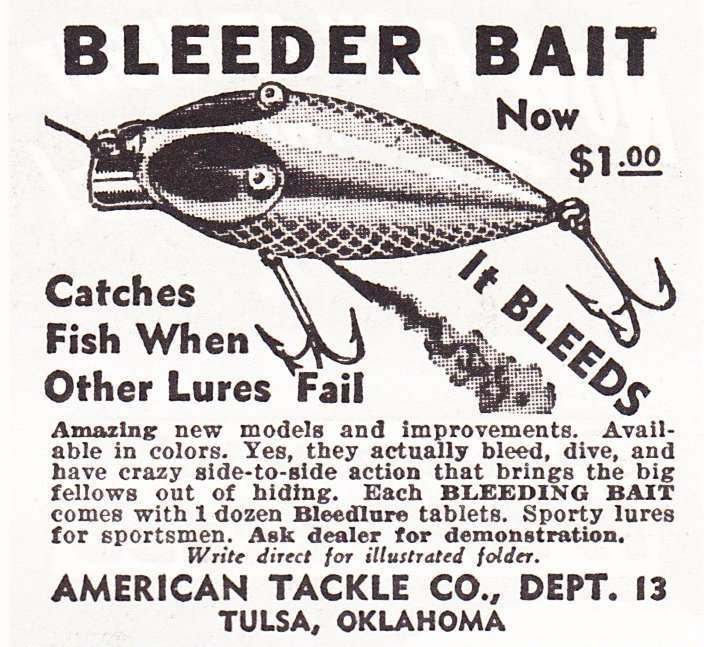
We’ll start off with the April 1940 issue, where I found two different companies pimping their goods. First there was the American Tackle Company and their Bleeder Bait. I looks like a shallow diving crankbait with a nose that resembled a Heddon River Runt.
The ad states that the Bleeder Bait “Catches fish when others fail.” Of course it does.
The description of the lure says there are new models and improvements and that it’s available in colors. I find that statement quite comical.
The lure comes with 1-dozen bleedlure tablets that produces a blood trail that brings the big fellows out of hiding. To top that off, they’re “Sporty lures for sportsmen.” For $1.00 you got one bait and the bleedlure tablets.
This isn’t the first lure that was designed to leave a blood or scent trail in the water, and I’m sure it won’t be the last. I wonder how many sold and if any of them are still in existence.
Dillon-Beck Quiver-Lure Mid-Century Gimmick Baits
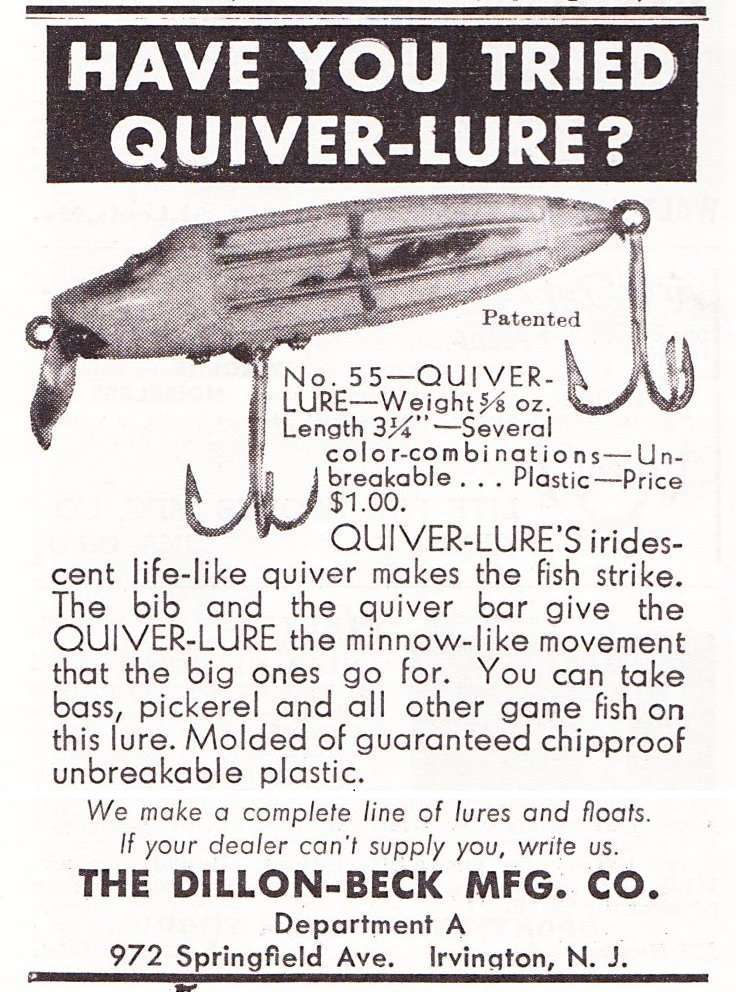
Next in line from the same magazine issue was the Dillon-Beck MFG Quiver-Lure. This lure is made of clear plastic and comes in several different color patterns, although they don’t state what colors. It was 3 1/4-inches long and weighed 5/8-ounce, a popular size for the day.
Dillon-Beck states that the bait produced a “life-like quiver” in the water that makes fish strike. I’m not sure what that means. Does it quiver on retrieve or when at rest? Maybe both?
The quiver is imparted by the integral bib and “quiver bar,” which gives the bait “minnow-like movement that the big ones go for.” It was also made out of chip-proof, unbreakable plastic.
Taking a deeper look at the bait, it appears that the bait had a twisted metal strip in the center that is positioned within the bib. The bar pivots in the bib, creating a quivering motion in the bait when it’s moved and probably continues to vibrate after the bait is stopped. If the metal strip was polished, this would provide a shimmering effect, if the water was clear enough. In dirty water, it wouldn’t be seen, but it’d probably be felt.
The design may not be worthy of gimmick status as it has some traits of successful baits today. Still because Dillon-Beck isn’t making them today and no one else continued on with the baits, I have to say they lost due to the gimmicky vibe the ad gives off.
Croix Bait Co Neon Fire Fly Mid-Century Gimmick Baits
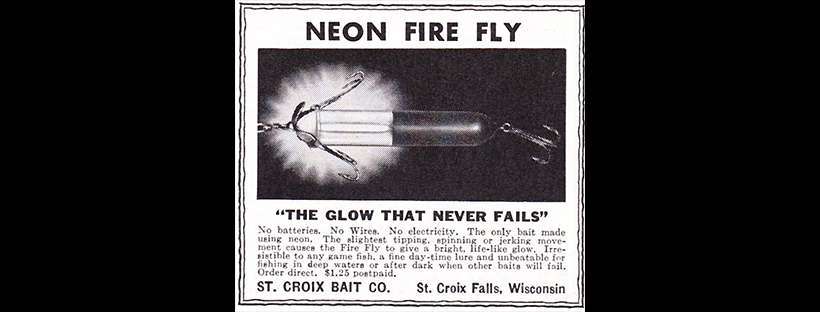
When I hear the name St. Croix, my mind instantly goes to that phenomenal rod company out of the city with the same name. So, as I’m thumbing through the June 1940 issue of Hunting and Fishing and see this Neon Fire Fly and looked for the company who made it, I was dearly disappointed a city of such renown would allow something like this to be manufactured and sold.
The Neon Fire Fly looks to be a glass tube with a metal harness to hold hooks. Inside the tube is filled with the noble gas, neon (Ne for you geeks out there). What’s confusing about the ad is it says there are no batteries, no wires and no electricity. This seems impossible to me since a neo light requires electricy to operate.
The ad goes on to say that any movement will make the lure light up, which makes me think there might be a static electricity producing mechanism in the lower end of the lure. In that case, it might work.
The St. Croix Bait Company states that the lure is good for daytime, nighttime, and fishing deep waters anytime. And, for $1.25, you can be the owner of one.
Glo-Lure Company glow lureGimmick Baits
In keeping with the glow-in-the-dark concept, I found this bait, the “Blinkin’ Beauty” from Glo-Lure Company in the July 1946 issue of Hunting and Fishing. Glo-Lure doesn’t state how their bait works but it appears the body could be painted with a glow-in-the-dark paint. Then, as the spinner spins around the body, gives the illusion of a light blinking.
Glo-Lure Co. states that they’ve run tests and have proven that their “finny friends simply can’t resist this ingenious, devastating device.”
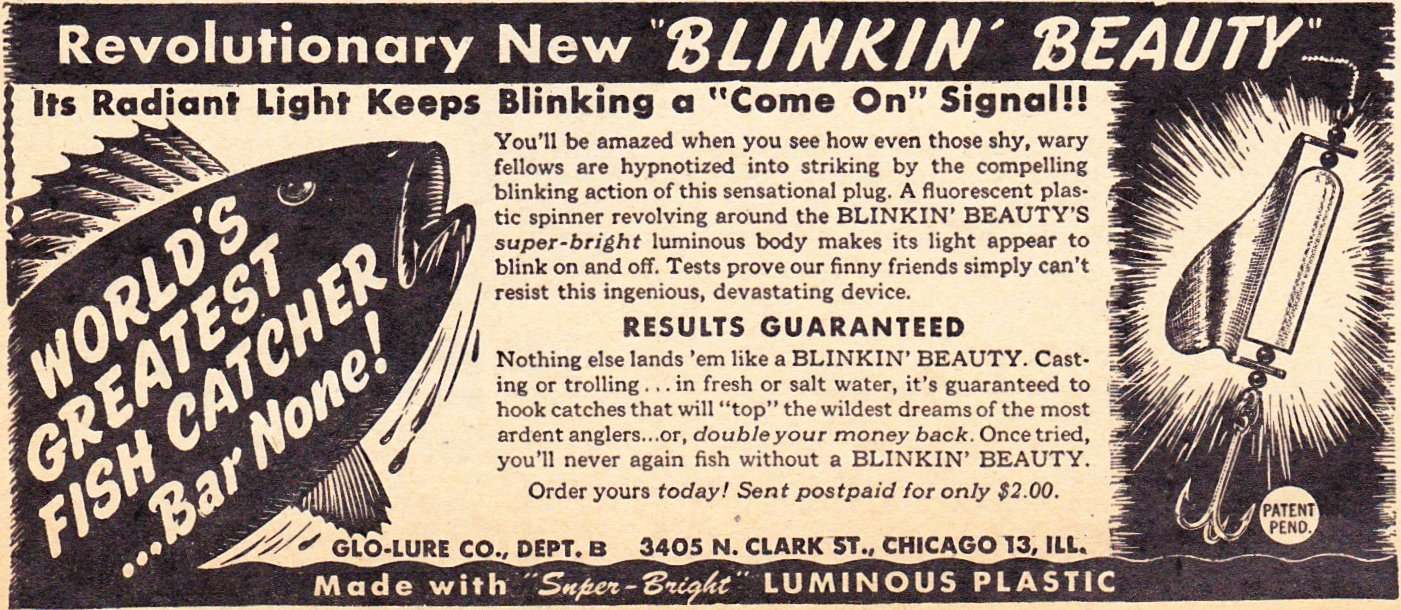
They go on to state that, “nothing else lands ‘em like a Blinkin’ Beauty. Casting or trolling … in fresh or salt ware, it’s guaranteed to hook catches that will top the wildest dreams of the most ardent anglers … or, double your money back. For $2.00 in 1946, you could stand to make a decent return if you bought five of them and returned them.
Presto Dyechem Company collectors
The final ad and lure, which came from the December 1961 issue of Outdoor Life, I have has no name. How on earth does a company come out with a lure and not name it. Made by the Presto Dyechem Company, Yonkers, New York, their claim to fame is the first motor-powered lure that , “Swims like a live minnow, buzzes like a bee … for 4 hours without changing battery.
The ad provides a cross-section view of the bait that shows the on-off switch, the battery, the miniature marine motor, rudder and propeller. A standard flashlight battery provides energy.
The only thing that Presto Dyechem provides that the other companies didn’t was a lit of colors the lure came in. At $4.95 each, which was still steep in 1961, I doubt many were sold. But then again, a fool is born every day.
Collectors collectors collector collectors
All of these companies probably folded within a year or so of these ads as you don’t see them often from year to year in the magazines. This has made a market for collectors of old gimmick lures like the ones shown here. I attended my first NFLCC tackle show this past January and saw a few collectors and their collections of old gimmick lures. I have to say they’re pretty fun to look at and marvel how or if they ever did work.
As hokey as they may seem, some angler wanting to change the face of sportfishing spent a lot of time and effort into designing these things. You also have to remember, back in this time science and technology was booming with new discoveries happening weekly. What better way to test them out on the development of a new lure. At least if you’re a fisherman with a little scientific background you just might invent the newest catch-all.







Fun article. These old ads for gimmick lures always put a smile on my face. On the other hand, I think of the studious inventor angler who came up with a newfangled lure he was sure would set the fishing world on fire, only to turn to the bottle after another failed attempt at invention superstardom.
Then I think of the guy who bent a bottle cap, stuck a hook on it, and caught a ton of fish.
I think one of my favorite gimmick “lures” was the electronic fish caller from, I think, the 1970s or 80s. I’ve got two of those old gadgets. I believe one was sold by Sears.