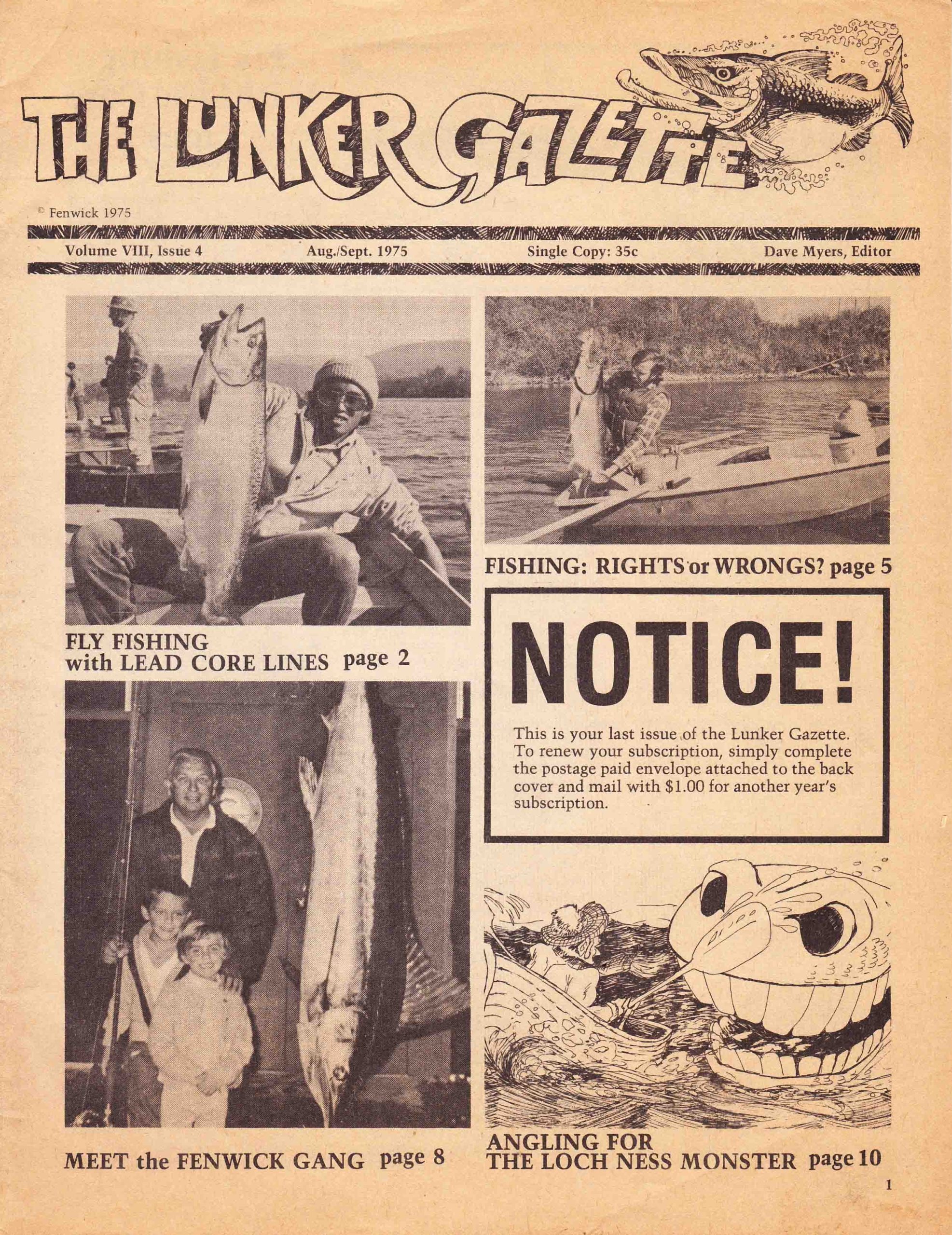
Last week, longtime southern California writer, bass angler, and the producer of annual West’s Top 40 Anglers, George Kramer made a comment on one of our Facebook posts about a man named Dave Myers. Today in The Fenwick Lunker Gazette, we’re going to look a little deeper into Dave Myers and his effect on fishing.
As stated above, Kramer made a pretty lofty comment about Myers when he said, “Few I’ve ever met in the fishing world were as talented as David Myers. From the surf band leader, to the fly fishing guide, bass club officer to corporate president, to charter operator and discerning writer, I think his resume is unmatched.”
The thing is, Kramer wasn’t exaggerating. During the early 1970s after Fenwick moved from Washington state to southern California, Myers took over the helm of the day-to-day business at Fenwick. He was the R&D department, the manager, the public relations rep, the prostaff manager, and, as you can see here, the editor of the Lunker Gazette.
Myers’ Contributions
Mayers was also an officer in the Saddleback Bassmasters and had his fingers on the pulse of the early western bass fishing scene. Myers was a busy guy to say the least.
Myers also helped design and debut the new Fenwick graphite rods at the 1973 American Fishing Tackle Manufacturers Association (AFTMA) show in Chicago and worked with another southern California angling legend, Larry Hopper, in that development.
But Dave’s most important contribution to the sport of bass fishing is most likely when he went in, lock stock and barrel, on a new fishing concept in 1974. That concept would become what is known today as Flipping.
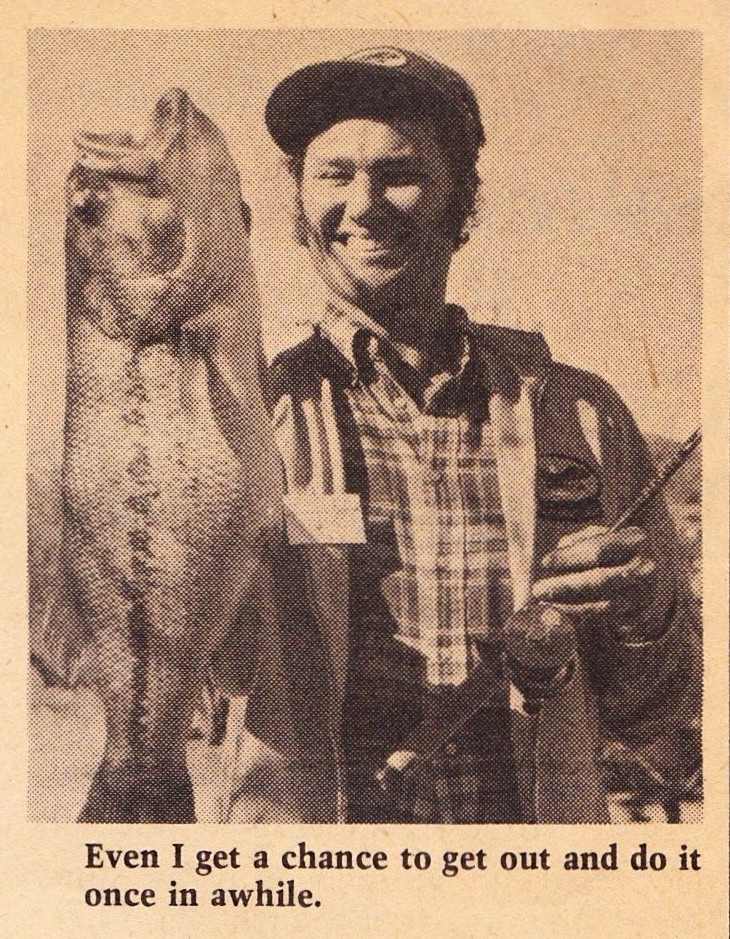
Myers and Dee Thomas
At the time in the northern part of the state, there was an angler who was beginning to kick butt on the fledgling Western Bass Fishing Association’s (WBFA) tournament trail. He’d been banned by the organization from using a 12-foot Lew’s Hawger tulle dipping rod, even though he placed guides and a reel on it as per the rules.
So, like any angler in need, he went home, took a Fenwick striper rod, cut it down to 7-feet, 6-inches and started playing around. While learning the new setup, he figured out a way to present a bait accurately by stripping line off the reel, using his left hand to hold the line, and with a soft, pendulum swing to present the bait with precision.
Because he no longer had a fixed length of line attached to the tip of the rod, he had more control over the fish and could also make presentations at varying distances from the boat.
That angler was Dee Thomas. The father of flipping.
When Myers heard of Thomas and his new technique, he contacted him and asked about his needs in a rod. Thomas explained to him what was needed. A 7-foot, 6-inch rod per the new rules he’d worked out with Wayne Cummings (WBFA tournament director), the rod needed to be heavy in the tip to set the hook instantly but it also needed to be moderate in the mid-section of the rod to have some give when fighting a fish.
Myers took those requirements, went to the office, and rolled several prototypes for Thomas. Twenty or so blanks later, Myers sent them up north and waited for Thomas’ assessment.
Next Myers visited Thomas, but this visit was more than to talk rods. It was to bring Thomas into the Fenwick corporate fold. The problem was, Thomas had a reputation for being a gruff dude.
Myers told Thomas that Fenwick was willing to give him a prostaff position under the conditions that Thomas had to be respectful to everyone and if they got one bad word from anyone, his position would be terminated. Thomas gladly accepted.
From there Myers signed Thomas up for the 1975 Bassmaster Louisiana Invitational as well as a seminar speaker touting the new technique and rod. Thomas’ first Bassmaster event at Sam Rayburn didn’t end well. He wanted to quit. But Myers encouraged him to go to the next event at Bull Shoals. Thomas agreed and won the event by 10 pounds. Flippin’ was on the national map.
Enter Dave Gliebe
Myers’ ability to see excellence in anglers wasn’t lost on Thomas. When Thomas told Myers he didn’t want to travel and would rather fish locally, Myers understood. That’s when he found another young up-and-coming angler, Dave Gliebe.
Gliebe had taken to bass fishing and the Flipping technique and was beginning to make a name for himself on the western trails. Myers and Fenwick placed him on the prostaff and soon he was fishing professionally all across the nation. It didn’t take long for him to start winning with the long rod in his hands.
In 1977 Gliebe won three events, all held by different tournament organizations in Texas and Florida. His wins were so lopsided, none of his competition could poo-poo Thomas’ win at Bull Shoals as a fluke.
Thomas may have been the first to win a national event flipping, but it was Gliebe who put the technique and Fenwick’s new rod on the professional bass fishing map. All because of Myers’ ability to read anglers and give them the opportunity to do what they did best.
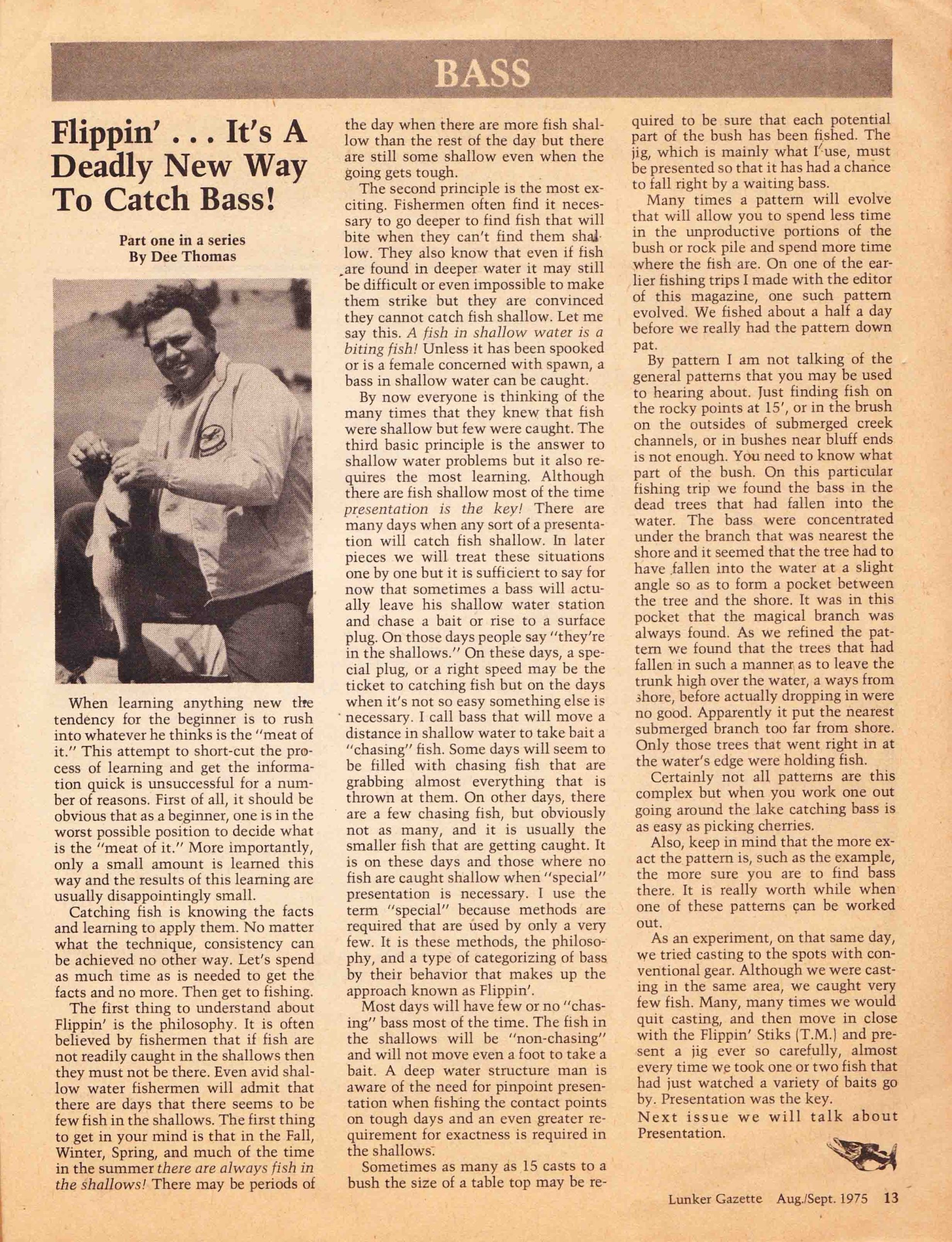
Below is the first installment of Dee Thomas’ series on Flippin’ that was published in The Lunker Gazette. The article is one of the first on the technique.
More to read on Dave Myers and Dee Thomas
New Western Technique, Controlled Structure Fishing, Sure to Sweep the Country




Nice post, Terry, remembering Dave Myers and the legacy of Fenwick. In the 1970’s Fenwick rods were one of the elite brands and much more ubiquitous than they are today. I still own 2 of the original fiberglass flippin’ sticks with the retractable handles. I used one of them to land my PB of 11 pounds, 12 ounces on a live shiner at Lake Toho in 1983. Quite a thrill.
Hey Mike! Thank you! Yeah, gone are the days when Fenwick was the upper bar with regards to rods. It was hard to watch that happen. Like so many great companies, they were bought by a company that didn’t care about R&D and meeting anglers’ needs.