

After running this site for a while, it’s obvious that people like looking at old bass boat ads and catalogs. Of all the posts we make on here, some of the most read are posts about the old boats we used to fish from. Today, I’m posting a couple catalogs that are near and dear to my heart. Sea Nymph Boats mid-1970s.
Sea Nymph started manufacturing aluminum boats and canoes in 1946 out of Syracuse, IN. By the 1970s they had a plant in Woodland, CA and in the mid-70s started manufacturing aluminum bass boats. The reason Sea Nymph holds a place in my heart is it was the first bass boat we owned, purchased in 1976. The boat was a JB-150 Bass’n John, 15-feet in length and fitted with a 35-horsepower Johnson and a 28-pound thrust Shakespeare trolling motor. That was it.
In 1976, the total cost for the boat was less than $3,000 with a monthly payment of $35 on a 10-year note. Within a couple months we placed a Lowrance LFG 300 on the console and another year later one on the bow. This boat kept us on fish from 1976 through 1980/81 when we purchased our first fiberglass bass boat, a MonArk V-16.
Although the dates are not anywhere within the two catalogs posted here, I’m pretty sure the first catalog was printed in the 1975/76 timeframe and the second catalog was printed in the 1976/77 timeframe. I believe this is true because the JB-150 isn’t in the first catalog but it’s in the second one. Both catalogs utilize the same picture on the covers, the earlier catalog being printed in blue and white.
Sea Nymph produced mainly canoes, john boats and v-hulls. In the mid-70s, they jumped into the bass boat market and started using their john boats and v-hulls as the foundation for their bass boats. We’ll concentrate on the bass boats they offered during the day in this article but each catalog in its entirety is posted below in the gallery.
The first catalog features their Sea Nymph Fishing Machines on page 6. The boat was built using their 16R hull and outfitted in two configurations, the SS-160 and SS-161. The boats were 16 feet in length with the difference being the SS-160 had raised casting decks along with a 7-foot rod locker. Both models came in either a brown paint scheme or plain aluminum finish.
Page 7 of the catalog shows their JB-140 bass boat seems to have been built off its own platform as none of their standard john boats have the same dimensions. It was 14-feet 1-inch in length, had a 55-inch beam and came in two models, one with a 16-inch transom height rated for a 20-horse motor and the Deluxe Model rated for a 35-horse motor.


Moving on to the second catalog, which was a fold out, Sea Nymph was still offering their SS-160 and SS-161 Fishing Machines as seen on the back cover. This year, though, they had added a Fish and Ski model based off the same hull. Back in this time period, nearly every boat manufacturer offered a fish-n-Ski version in order to placate the needs of the angler who also needed to please the whole family. This boat was made off the same platform as the SS-160/161 but was rated for a 90-horse motor. I assume this was due to the extra weight this boat had due to its interior.
Page 3 of this catalog featured the JB-140 and JB-150 Bass’n Johns. The JB-140 now was only offered in one model, the 16-inch transom height, and rated for a 20-horse motor. The JB-150 came in two configurations, one with a 16-inch transom and the other in a 20-inch transom rated for 25- and 35-horse motors respectively.
As stated above, it was the JB-150 rated for the 35-horse motor that we owned. The boat came in the brown and orange paint scheme like the SS-160/161 Fishing Machines and had a livewell under the driver’s seat. The livewell could hold ten 2-1/2- to 4-pound bass comfortably and rigged with an aeration system could keep the fish alive long enough for us to transport them from the lake to the local park ponds around my house. Yeah, I was guilty of being a bucket biologist back in the day.


Sea Nymph made a heck of a boat back in the 70s. Their construction was top notch, they used heavy aluminum and double rivets and their bass boat models were quiet and efficient. I will never forget the first time out in our JB-150. After fishing out of glass covered wooden rental boats rigged with a 4- or 6-horse motor for five years, the maiden voyage in the Bass’n John was a dream. We couldn’t believe how quiet the boat and motor was and how fast it would go.
Sometime around the mid- to late-1980s, Sea Nymph sold out to Lowe Line. Lowe Line, known as Lowe today, started business in 1971 and also produced a quality aluminum bass boat back in the day. Lowe Line’s purchase of Sea Nymph continued the Sea Nymph name up until the late 90s when all their boats took on the Lowe signature. Today Lowe is owned by the Brunswick Boat group, makers of both the Crestliner and Lund boat lines.
I hope you enjoyed this look back at some early aluminum bass boats. We’ll be posting more manufacturers as time permits and as I cover more of these catalogs.

Mid-1970s (possibly 1975/76) Sea Nymph Boat Catalog Front Cover.

Mid-1970s (possibly 1975/76) Sea Nymph Boat Catalog Page 1.

Mid-1970s (possibly 1975/76) Sea Nymph Boat Catalog Page 2.

Mid-1970s (possibly 1975/76) Sea Nymph Boat Catalog Page 3.

Mid-1970s (possibly 1975/76) Sea Nymph Boat Catalog Page 4.

Mid-1970s (possibly 1975/76) Sea Nymph Boat Catalog Page 5.
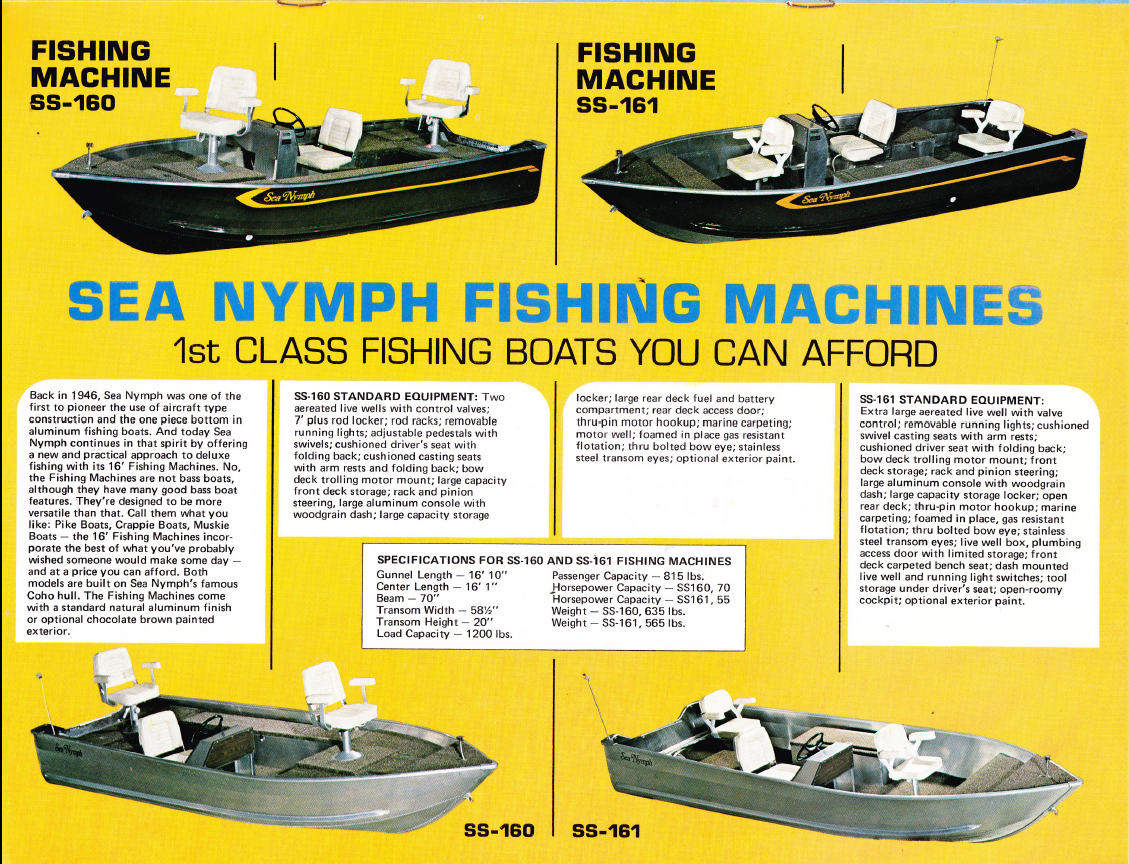
Mid-1970s (possibly 1975/76) Sea Nymph Boat Catalog Page 6.
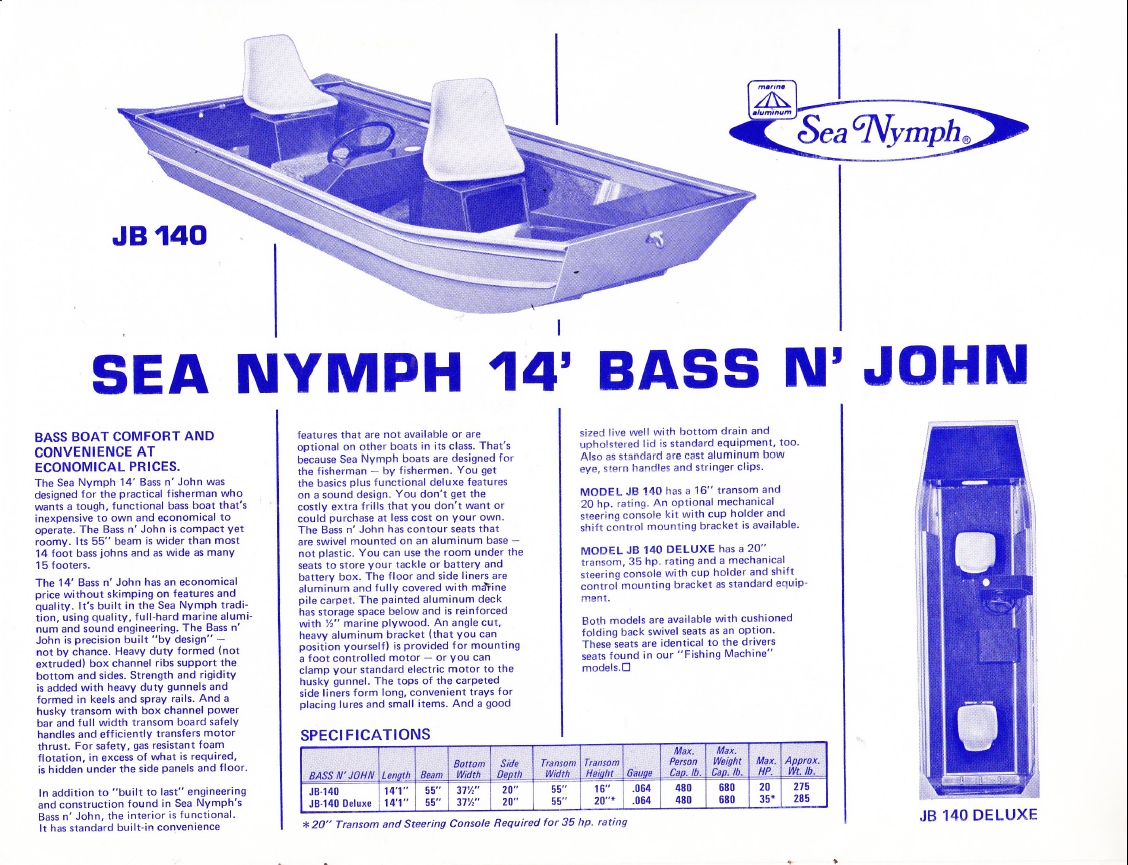
Mid-1970s (possibly 1975/76) Sea Nymph Boat Catalog Page 7.

Mid-1970s (possibly 1975/76) Sea Nymph Boat Catalog Page 8.

Mid-1970s (possibly 1975/76) Sea Nymph Boat Catalog Page 9.

Mid-1970s (possibly 1975/76) Sea Nymph Boat Catalog Page 10.

Mid-1970s (possibly 1975/76) Sea Nymph Boat Catalog Back Cover.

Mid-1970s (possibly 1976/77) Sea Nymph Boat Catalog Front Cover.

Mid-1970s (possibly 1976/77) Sea Nymph Boat Catalog Page 1.

Mid-1970s (possibly 1976/77) Sea Nymph Boat Catalog Page 2.
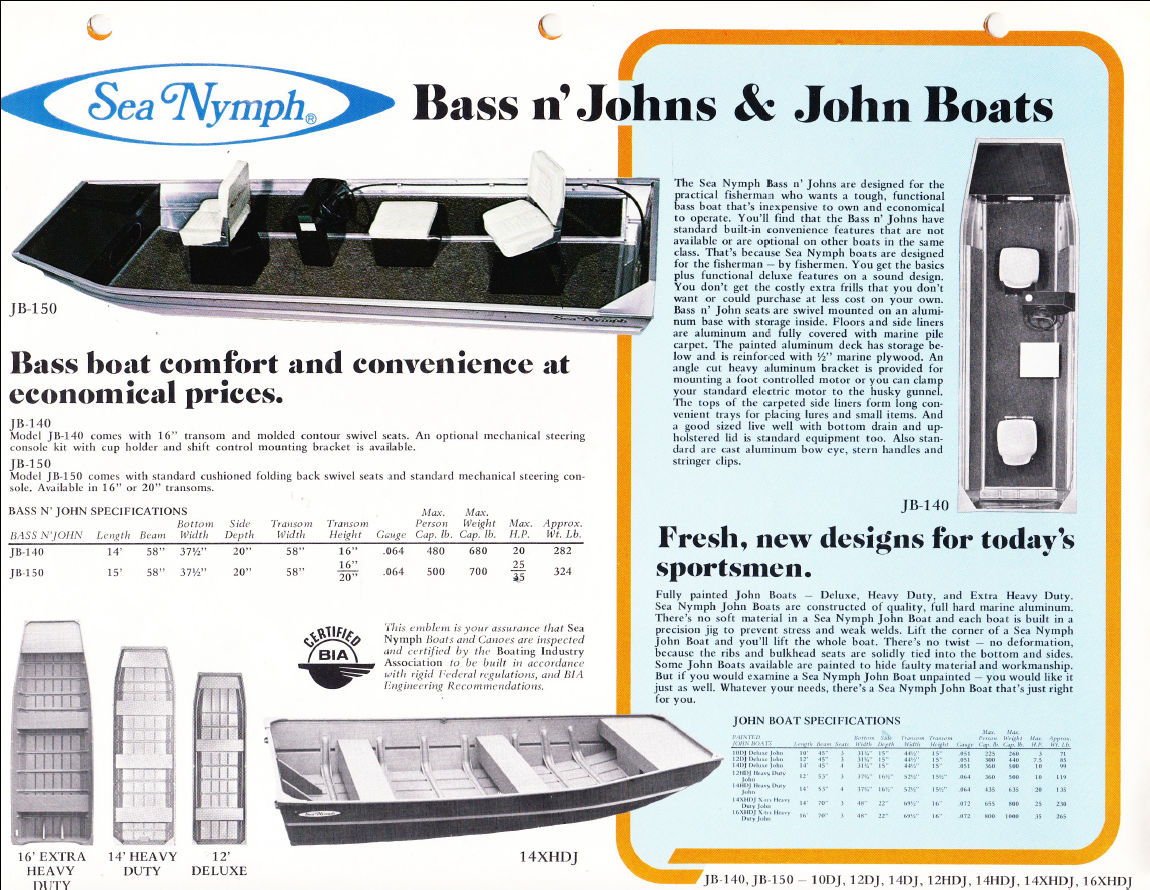
Mid-1970s (possibly 1976/77) Sea Nymph Boat Catalog Page 3.

Mid-1970s (possibly 1976/77) Sea Nymph Boat Catalog Page 4.

Mid-1970s (possibly 1976/77) Sea Nymph Boat Catalog Page 5.

Mid-1970s (possibly 1976/77) Sea Nymph Boat Catalog Page 6.
Mid-1970s (possibly 1976/77) Sea Nymph Boat Catalog Back Cover.





I have a 1970 sea nymph and I would like to know all about it!
Hi Rebecca, Thank you for the comment and if we ever get a 1970 catalog, we’ll surely pos it for you to check out!
I too have a sea nymph 12A car topper where is the hull id number found ?
Tim, the Hull ID should be back either on a plate on the transom or stamped on the tramson itself. I haven’t owned my Sea Nymph since 1981 so it’s been a while.
Could you tell me where the 1994 Sea Nymph was manufactured? Looking for operating licence. Thank you so much.
Connie, at that time the boats were made in Lebanon, MO.
i have a sea nymph 14s i cant find any thing 100%
I had a Sea Nymph 14′ w/ an 18HP Evinrude (would have liked a 25 or 30HP, but as a teen mowing yards and cutting coconut trees i simply couldn’t afford more HP..) vintage 1969.
This was tiller steering (sooo much simpler and ith a more direct effect..) and absolutely maintenance-free. I paid $500 for the new boat itself and $1300 for the motor. It took about 2&1/2 years to save up, but I got there and paid cash.
I didn’t have a trailer, as it was ‘lake-locked’ around Lake Okeechobee. I kept it at my grandparent’s home which had a boat lift and a boat slip. My grandparents and aunt used it during the week when I was in school and working part-time.
Unfortunately, a relative (Old Man..) sold the boat without my knowledge, and I can’t remember the feeble excuse for him doing this. It may have been a mortgage situation, car insurance, whatever…I was never told why!
BUT- when I moved ‘back home’ to the Everglades 30+ years later after an Air Force career and work as a Professional Pilot, I noticed that the Sea Nymph brand had been bought out by Lowe. I thought; “Great; these boats will be around forever…!”
I went to the Florida Boat Registration office, and asked them to run my old Sea Nymph’s rego number (FL3989AJ) , and amazingly, it was still on the books 34 years later!
I wrote to the owner and asked if he was interested in selling it to me, but the answer was no as it was being used as a tender in the Tampa area.
For a while, Lowe had their brochure of the Sea Nymph 14′ and 16′ models.
I once encountered the owner of a 16′ Sea Nymph w/ tiller steering when I was locking-thru Taylor Creek with my airboat in 2002.
I asked him if he would consider selling the boat in the near future, and he had no plans to do so at the time, but I gave him my business card anyway so he could contact me in the event he was ready to sell.
His Sea Nymph was exactly like my 1969, except for 2 feet longer, and with a 40HP Merc.
Now living in New Zealand, I have found that almost all of the aluminum boats here are welded.
Sea Nymphs were riveted, and there is a structural advantage to rivets over welded joints and seams. Rivets are easily removed, and repaired. Split and broken welds become difficult and may not be as strong after a heliarc or tig weld repair.
The science between welded and riveted is an amazing study…
https://www.youtube.com/watch?v=9HY_rVZWWGs
https://www.youtube.com/watch?v=qnhhsDwBEkQ
I was out on Lake O early one afternoon, and noticed a line of alto cumulus to the northwest. The wind from the southeast began to pick-up and I headed in.
My neighbor came to us just after I slipped-in, and said her partner wasn’t back off of the lake, and assumed that he had broken-down in his 35 year old riveted Alumacraft, and could I please go and look for him.
With Orlando under a weather warning, I was reticent to go back out, as the waves on Lake O were running 3′ with white caps.
I added bow ballast, and took off for the open water.
The Sea Nymph handled the rough conditions in spectacular fashion, and-
I eventually found my neighbor who had engine problems.
We flooded and kedged his boat so it wouldn’t get blown-out into the open lake, and then started back home to Buckhead Ridge. While I had the sea to my stern, the waves were about 3 & 1/2 feet, occasionally 4 feet, with 35-40 mph winds.
We arrived home just as a squall line hit.
I would never have put back out into rough conditions unless in the Sea Nymph.
Look past the grassy bar / barrier, and see the waves on Lake Okeechobee…
https://www.youtube.com/shorts/-52kuy_s7qo
But now, it looks as though the Sea Nymph line has disappeared… :-(…so that rules-out shipping one to New Zealand…