
No doubt a high percentage of anglers under the age of, say, 40 years or so, would be surprised to learn that a number of modern companies at one time also sold fishing supplies. Companies like J.C. Penney, Abercrombie & Fitch, Sears, and Montgomery Ward all had strong fishing divisions. Stores like these had fishing departments right next to their men’s and women’s clothing, dress shoes, housewares and kitchen supplies. There was also a time when companies distributed mail order catalogs illustrating their product lines. I happen to own a fascinating 1949 Montgomery Ward Fishing Catalog, and today we’re going to take a select walk through this 124 page treasure.
Montgomery Ward was founded in 1872 and grew to become one of the biggest, most powerful retail outlets in America. Retailers such as Montgomery Wards came under siege with the advent of “big box” stores like Walmart and the changing buying habits of Americans. Practically all of the giant retailers had to substantially redefine their product lines (Abercrombie & Fitch is a good example of a business that successfully redefined itself) or face dissolution. Montgomery Ward filed for bankruptcy in 2000 and closed 250 stores. But in their heyday they produced some fantastic mail order catalogs. This post-WWII Montgomery Ward Fishing Catalog is a visual feast for aficionados of vintage fishing gear. And at 124 pages it provides a lot of fuel for daydreaming.
Because there’s just too much in this catalog, we’re not going to go through everything with this article. I think I’m going to break this up into a series of three articles. In this first piece we’ll look at the lures, line and tackle boxes offered. The pages with images of lures are really why I acquired this catalog. They’re gorgeous and are, for the most part, the only color pages in the catalog.
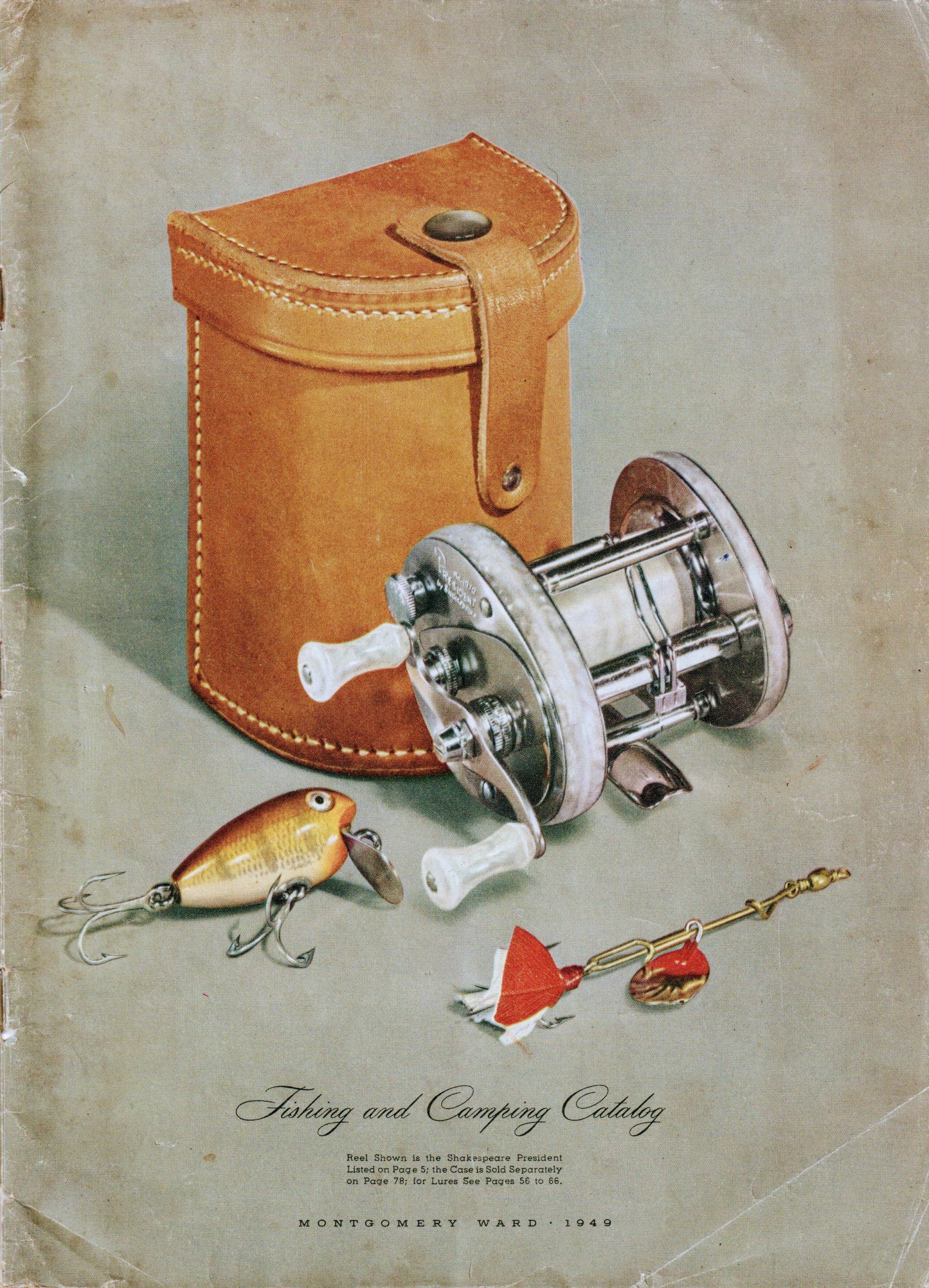
The front cover of the Montgomery Ward Fishing Catalog is pure elegance. Positioned against a light gray background is a simple still-life of two lures and a baitcast reel with its leather case. The reel is a silver Shakespeare President Model 1970 with mother of pearl handles and side plate inlays. The lures appear to be a Shakespeare Grumpy in yellow perch, and a Skinner Fluted Spoon spinner. Below the image in light ornate cursive script are the words “Fishing and Camping Catalog.” Below that are the pages where these items may be found, and at the bottom in small print, “Montgomery Ward 1949.” The cover gives you the impression that the items you’re about to shop for are high quality and even elite.
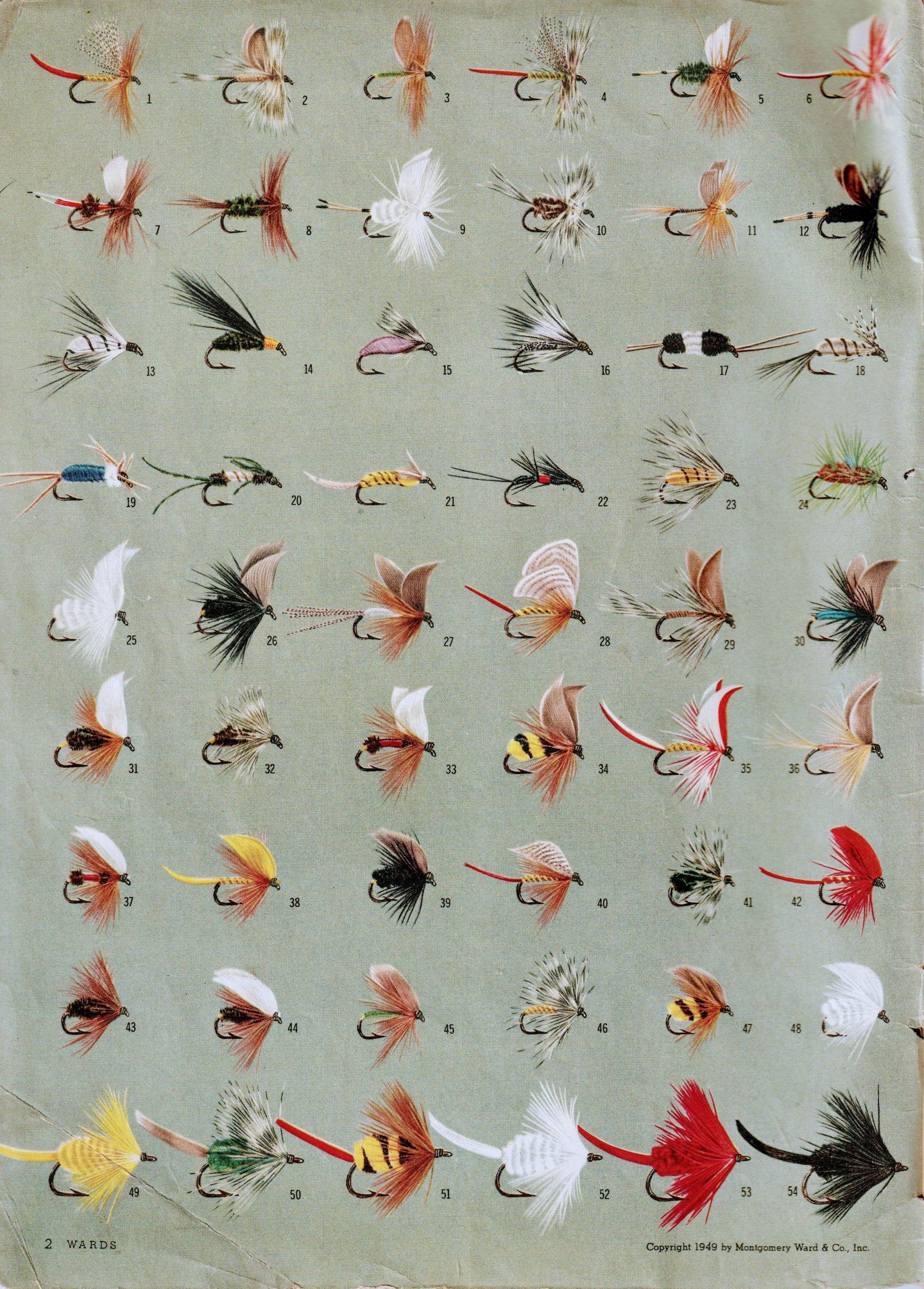
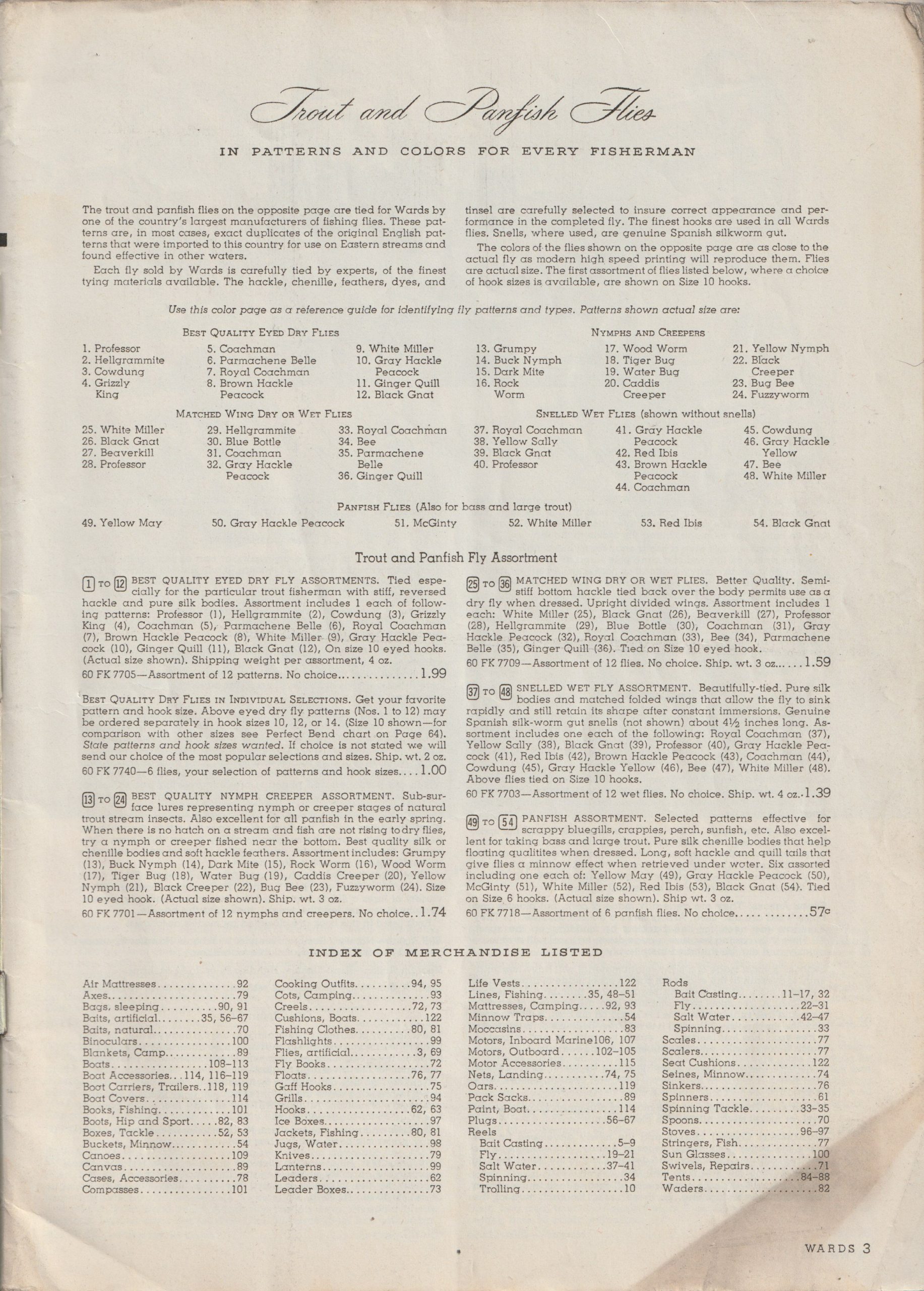
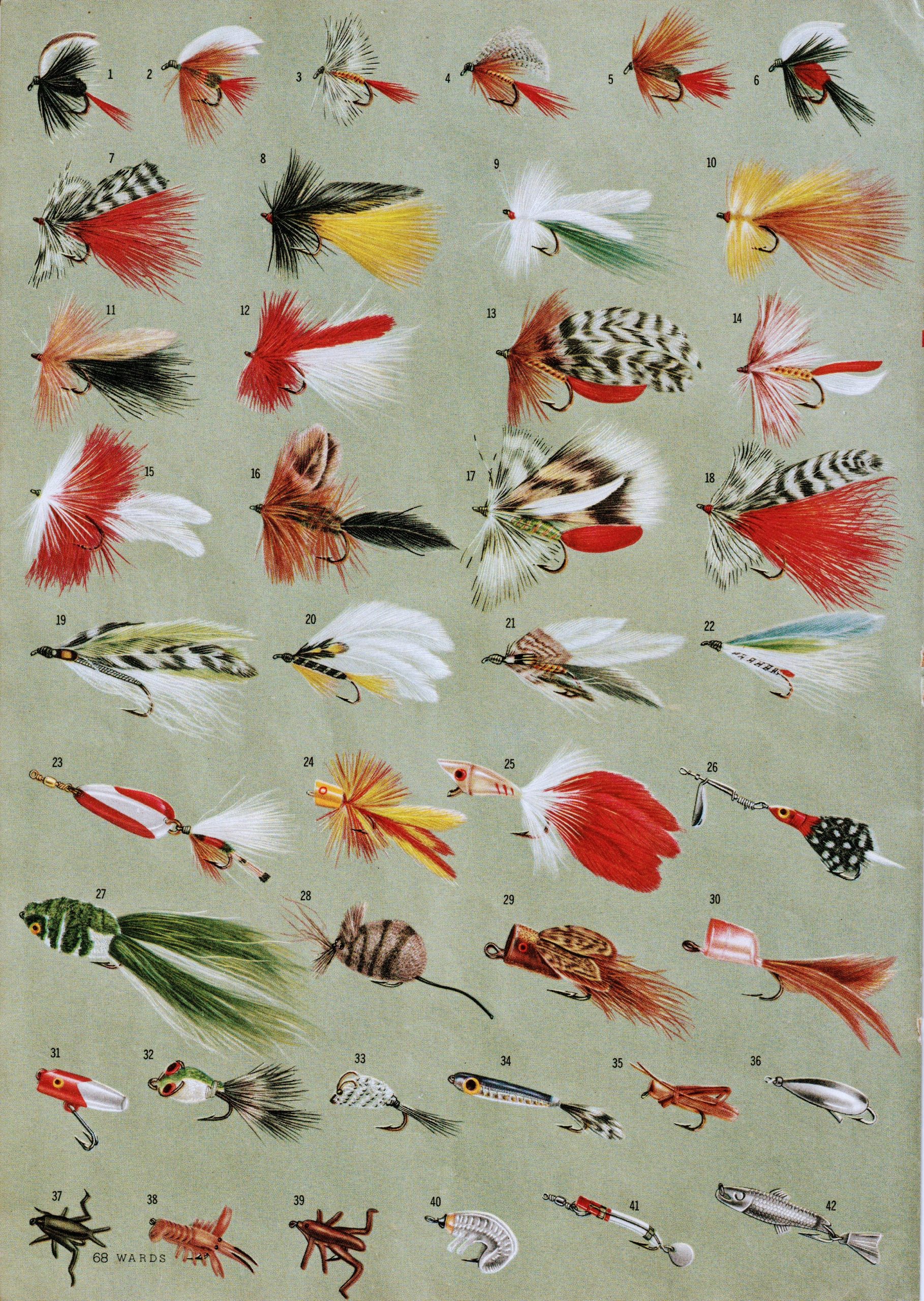
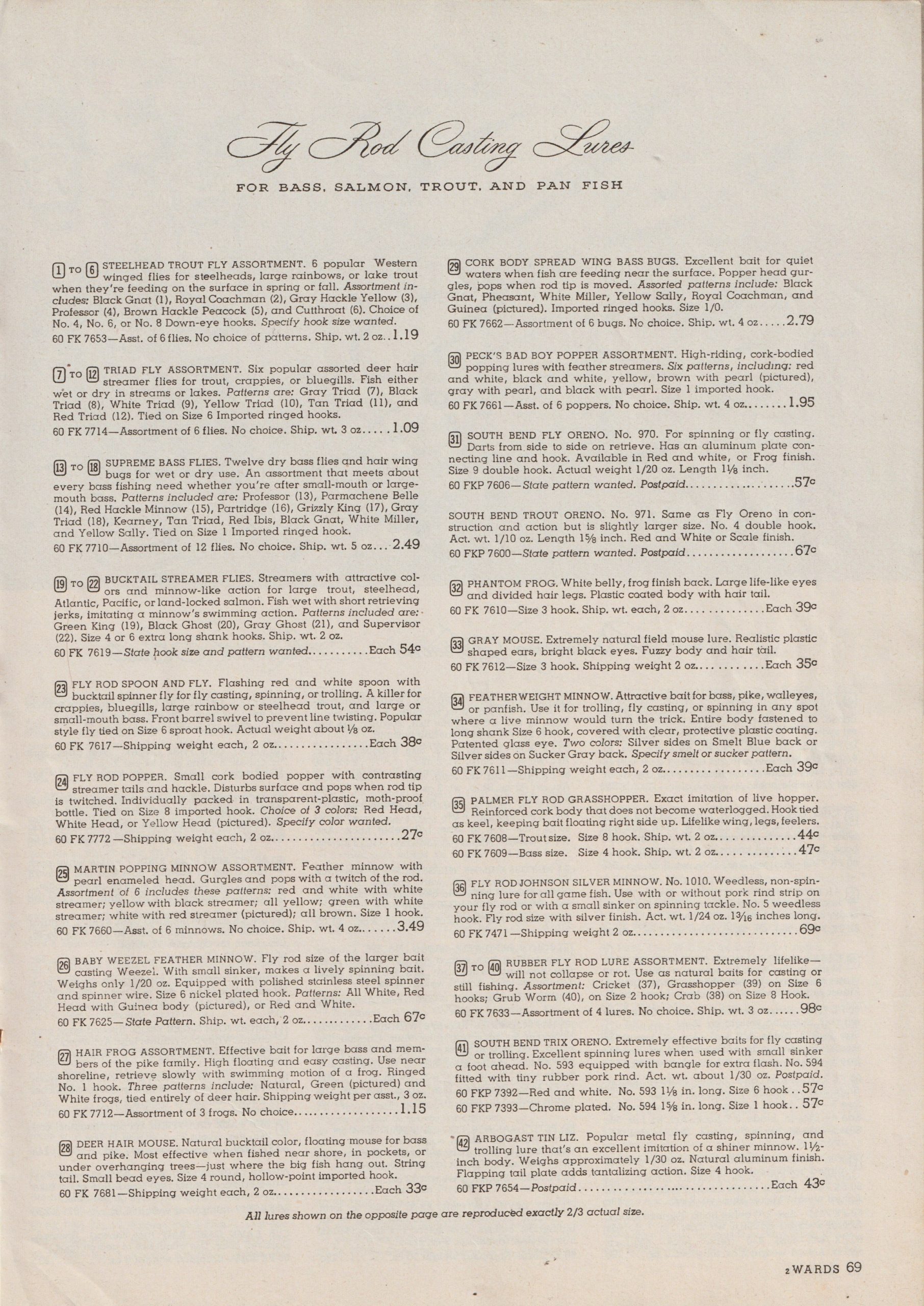
The first page of lures is actually a page of trout and panfish flies on the inside front cover. Although I own fly fishing gear and have given it a try a few times, I am in no way a fly fisherman. But I’ve always been attracted to the flies and fly tying. The variety of lures as well as the skill and creativity involved in making flies is fascinating to me. But that’s another rabbit hole that I’m purposely avoiding.
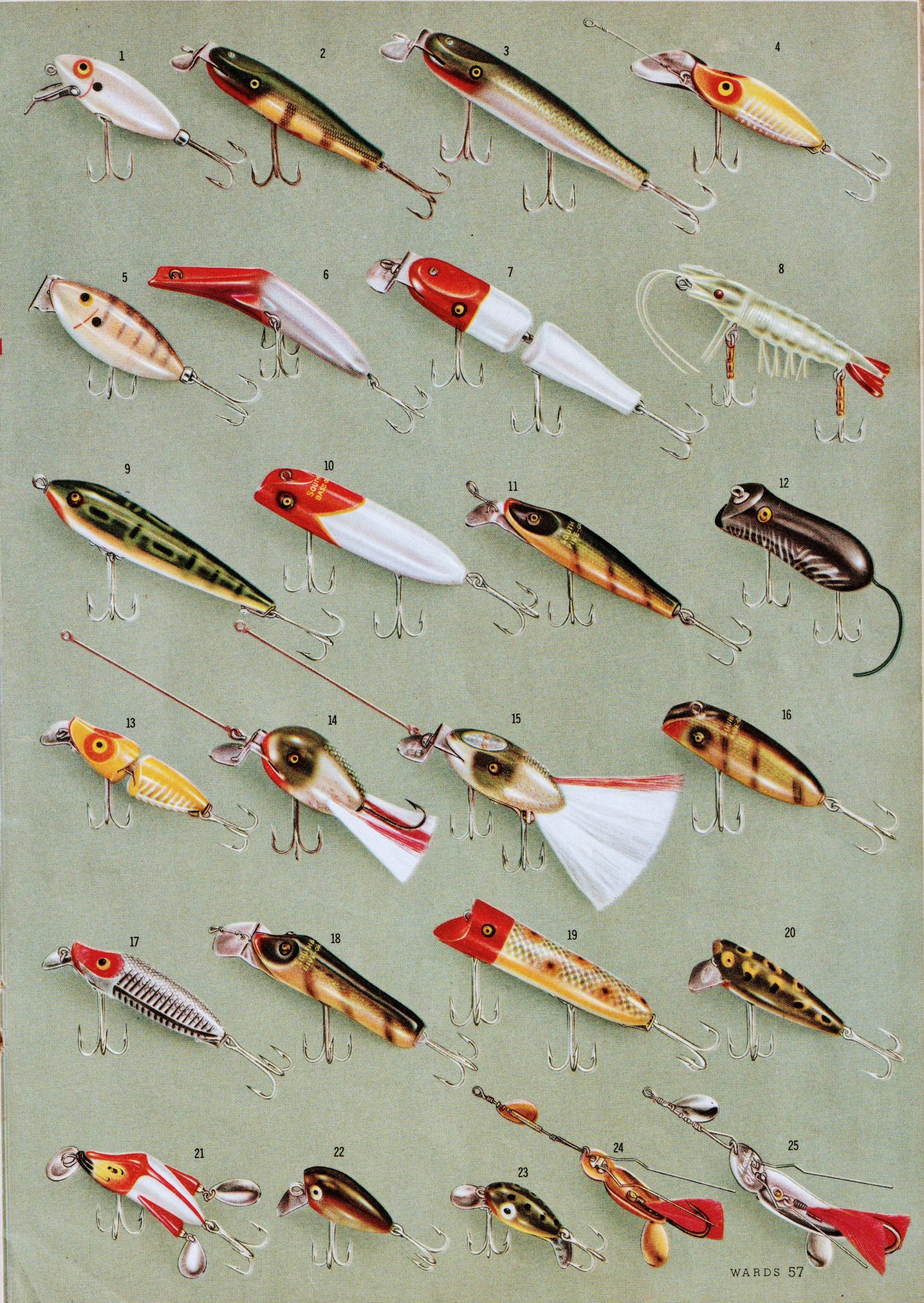
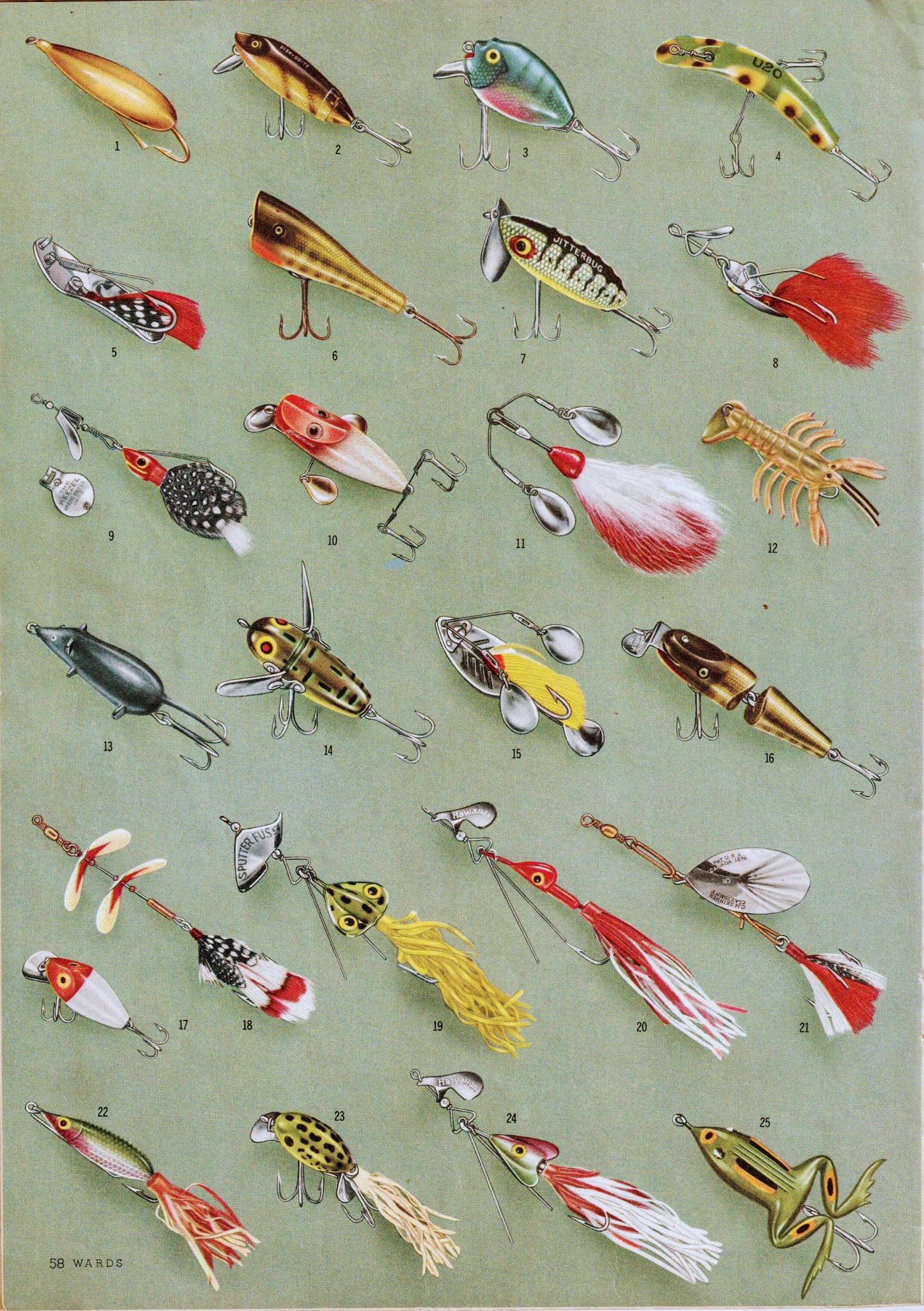
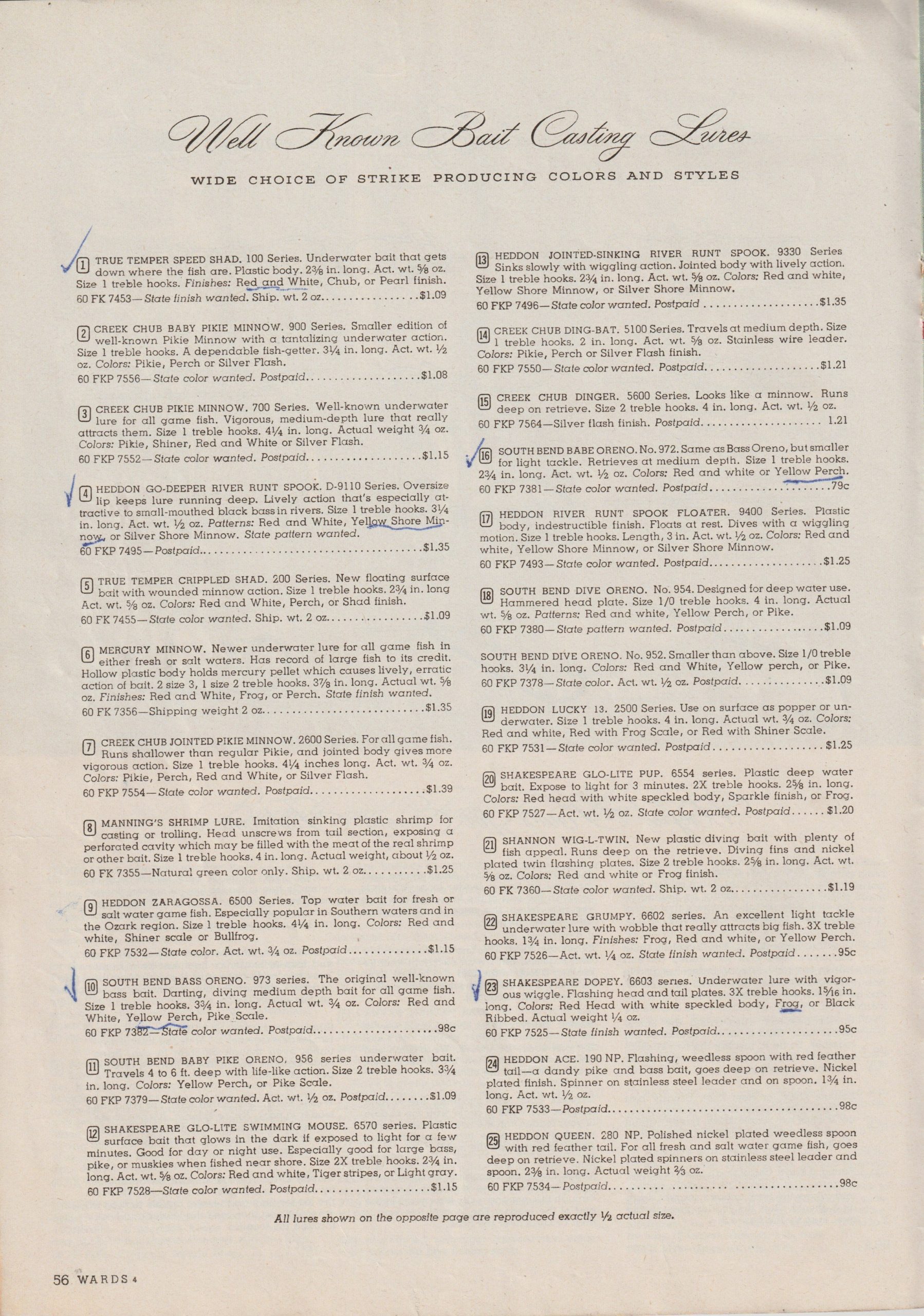
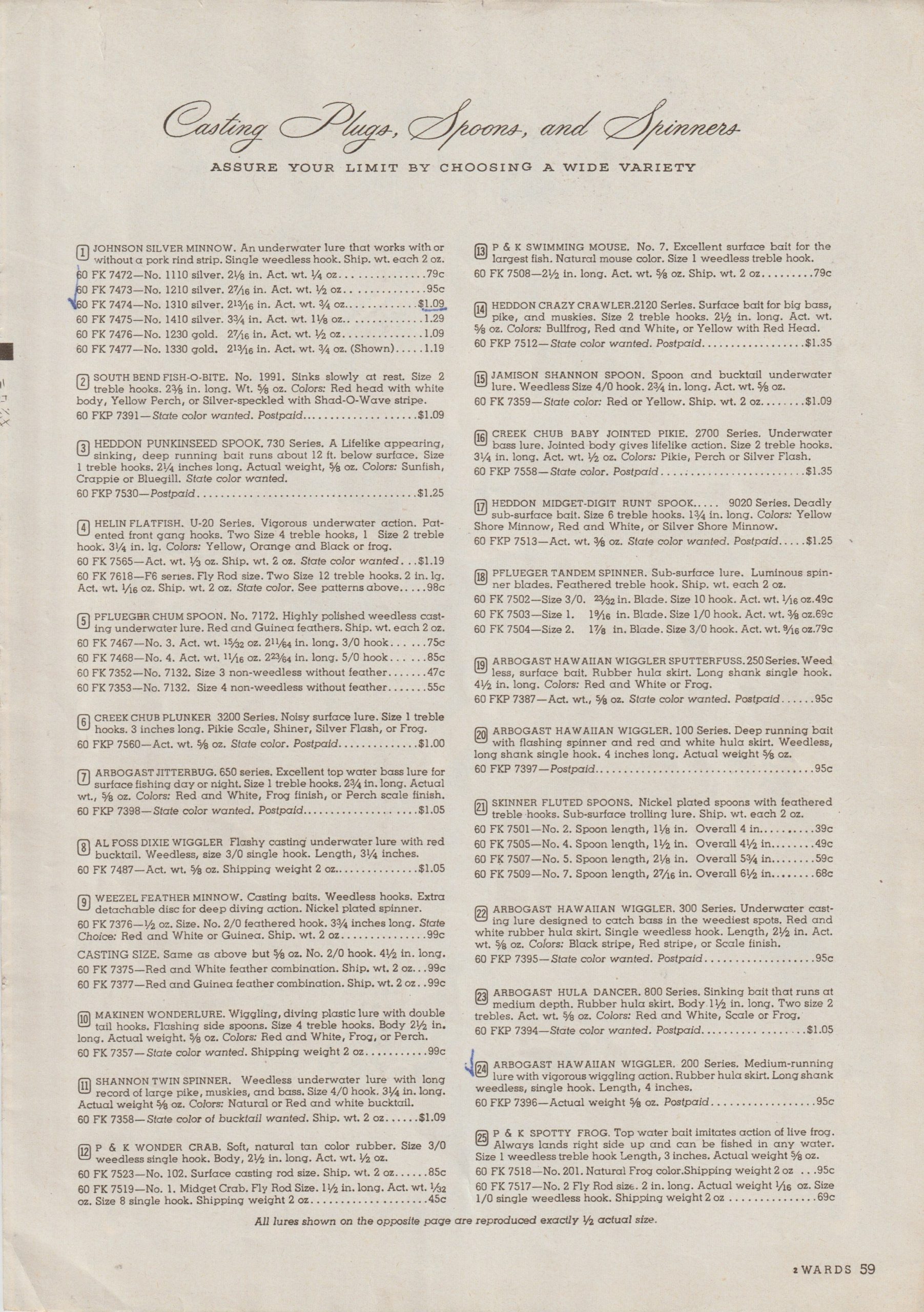
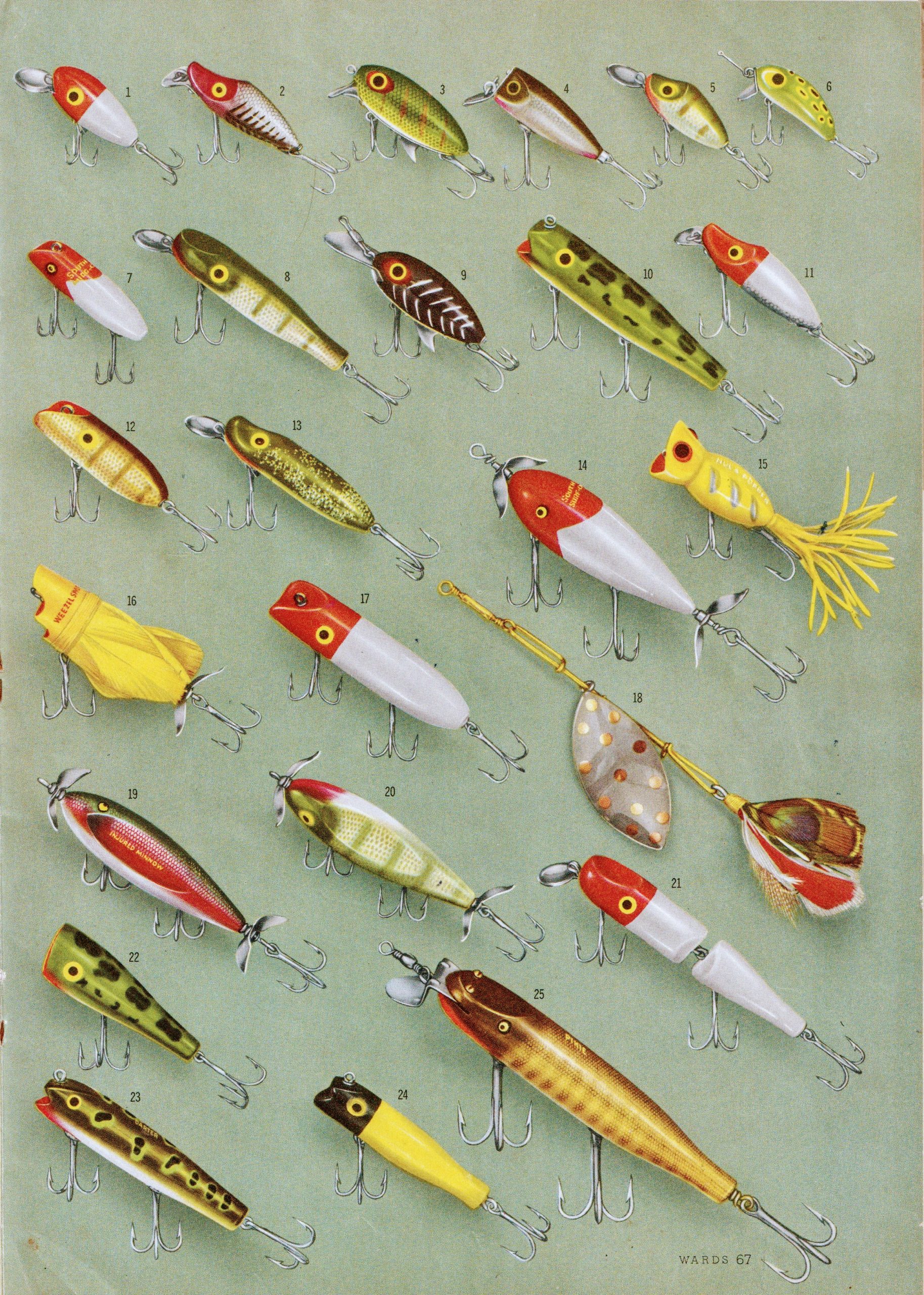
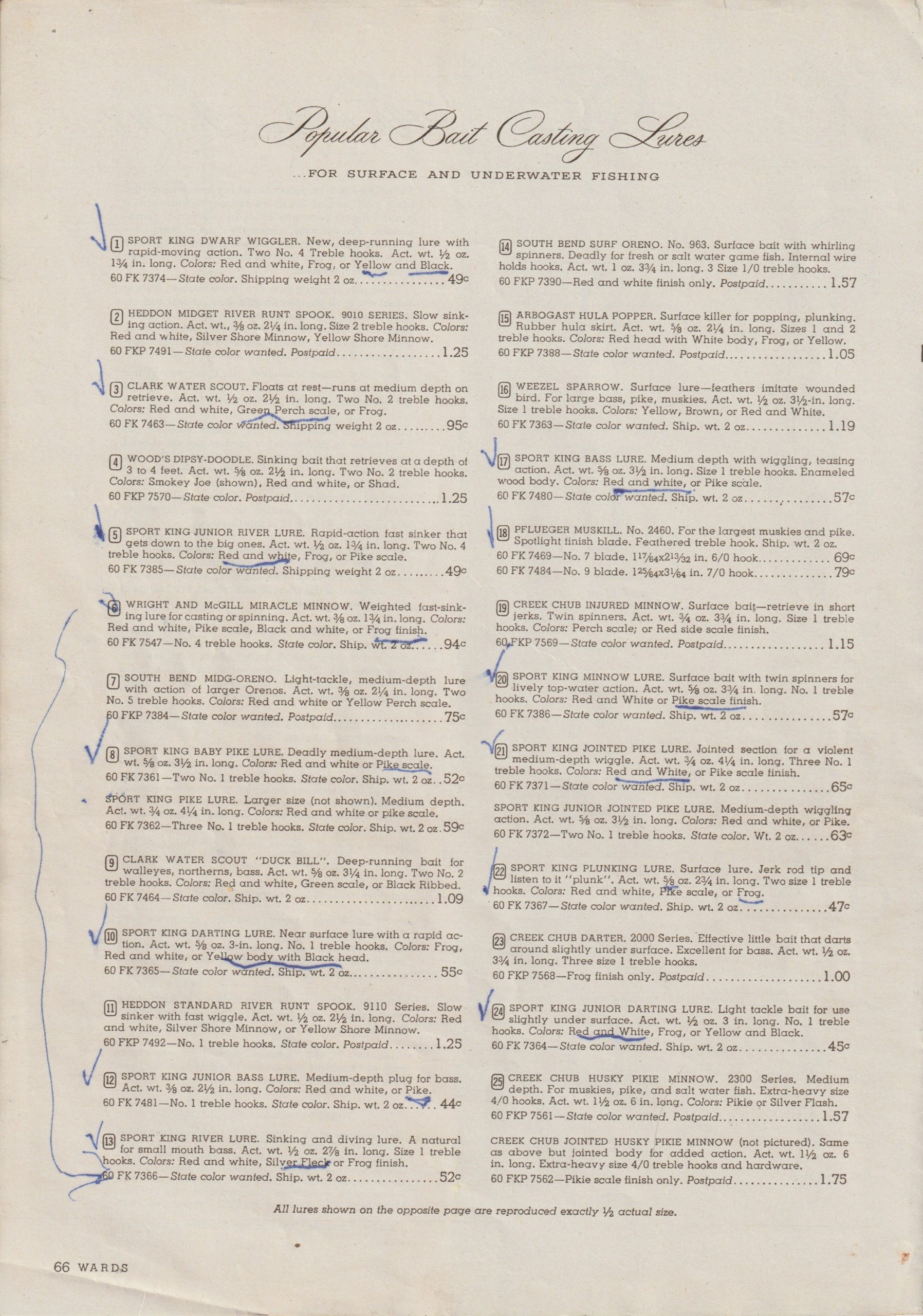
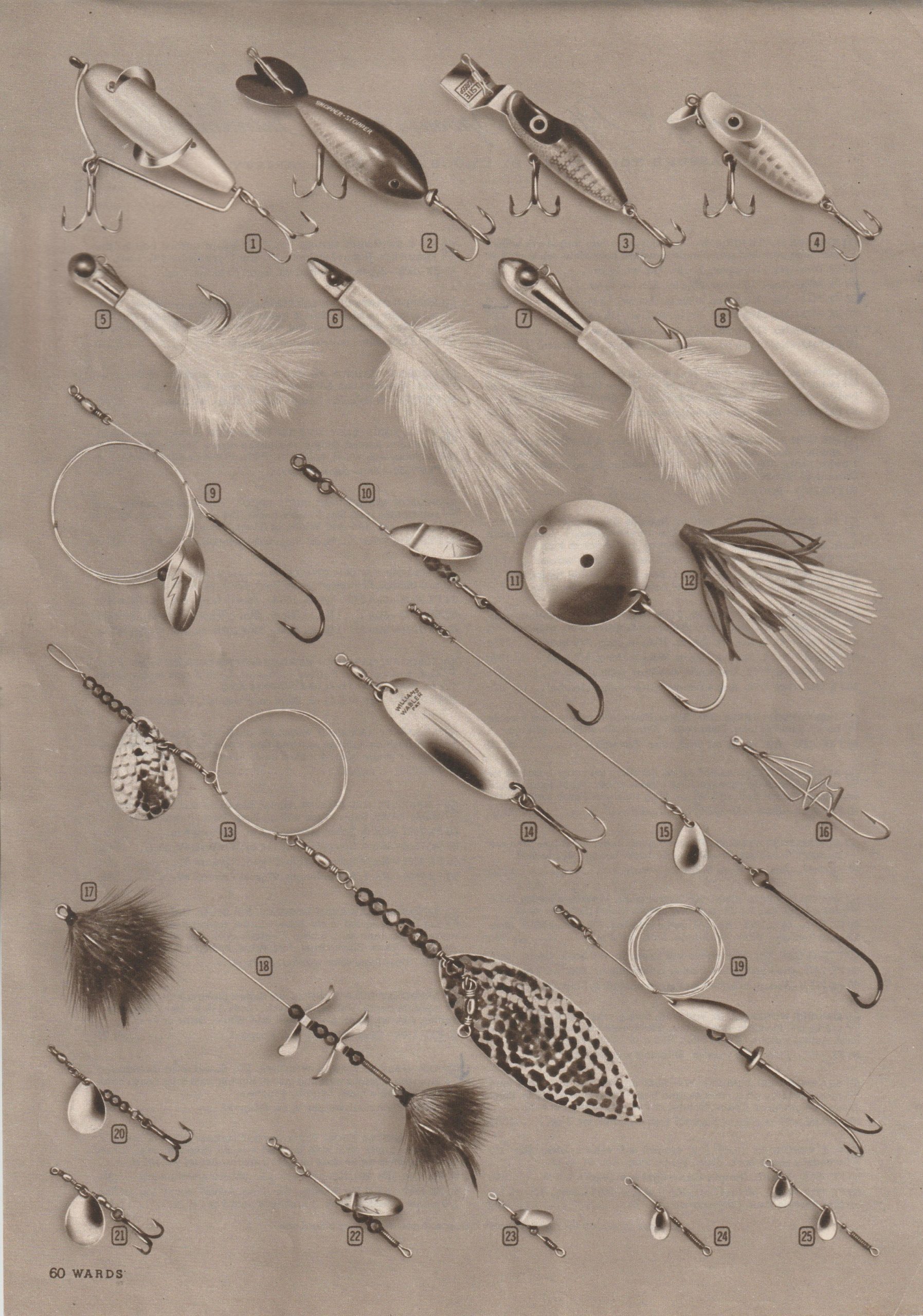
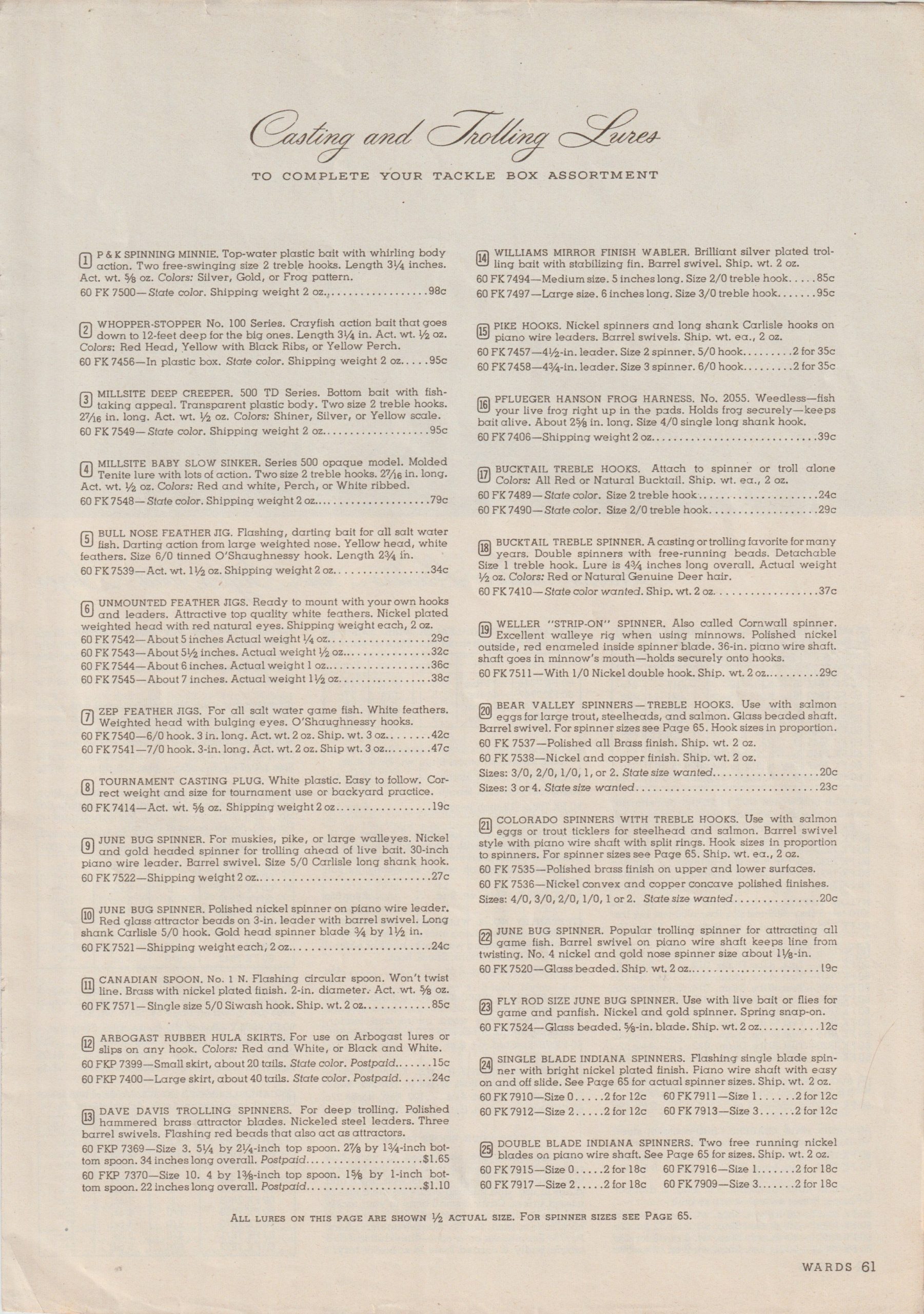
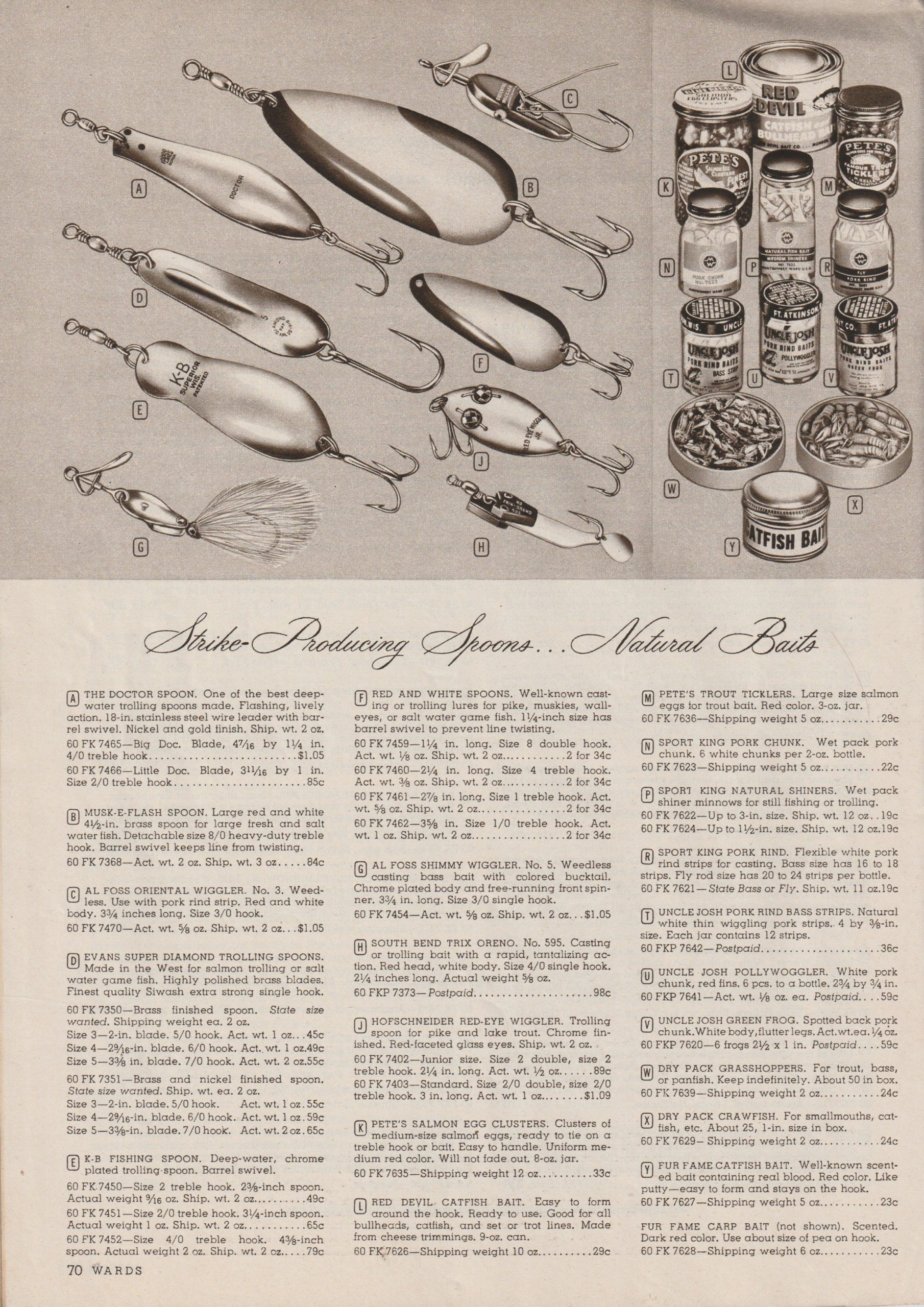
But it’s the pages with the bait casting lures that are the most photogenic and alluring. Anytime I see displays of vintage bass lures I get drawn in like a moth to a porch light. The ones in the Montgomery Ward Fishing Catalog are even better than the lures shown in the Sports Afield Baitcasting Lures 1951 story I wrote several months ago. Just look at these gorgeous color pages (below) filled with all of the most popular wood, metal and hard plastic baits of the time. Creek Chub, Heddon, South Bend, Shakespeare, Arbogast, Millsite, and more of the top lure making companies of 1949 are beautifully represented here in nearly photographic renderings. And the colors! You can bet that I’ll be framing copies of these pages for the wall.
The prices are mighty interesting too. You could get a South Bend Bass Oreno for .98 cents, or a Creek Chub Ding-Bat for $1.21. In today’s money that would be close to $13 and $16 respectively, but .98 cents and $1.21 sounds more appealing, even if you do consider the rate of inflation. FYI, I’m going to print copies of the price pages too, and attach those to the back of the framed images.
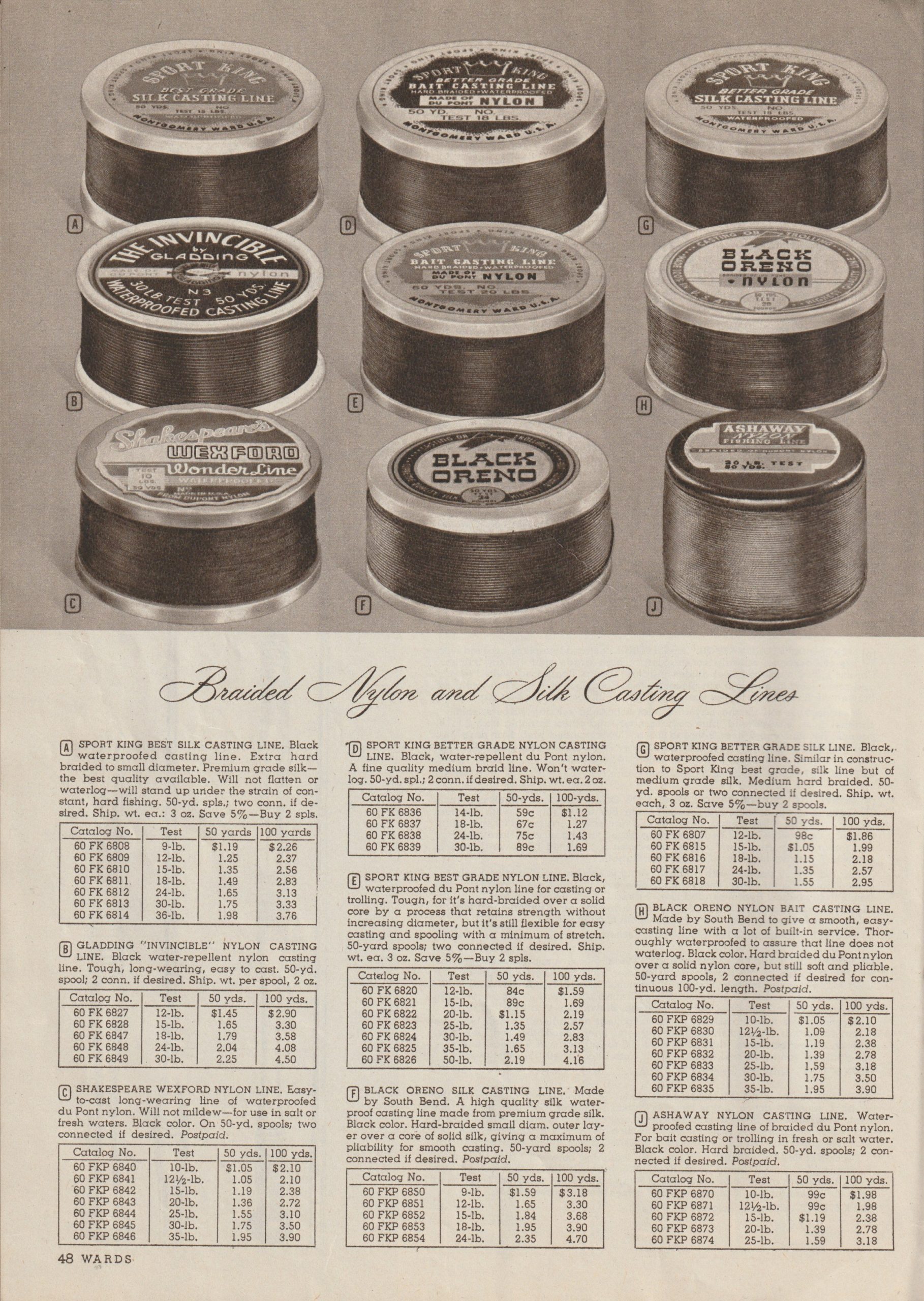
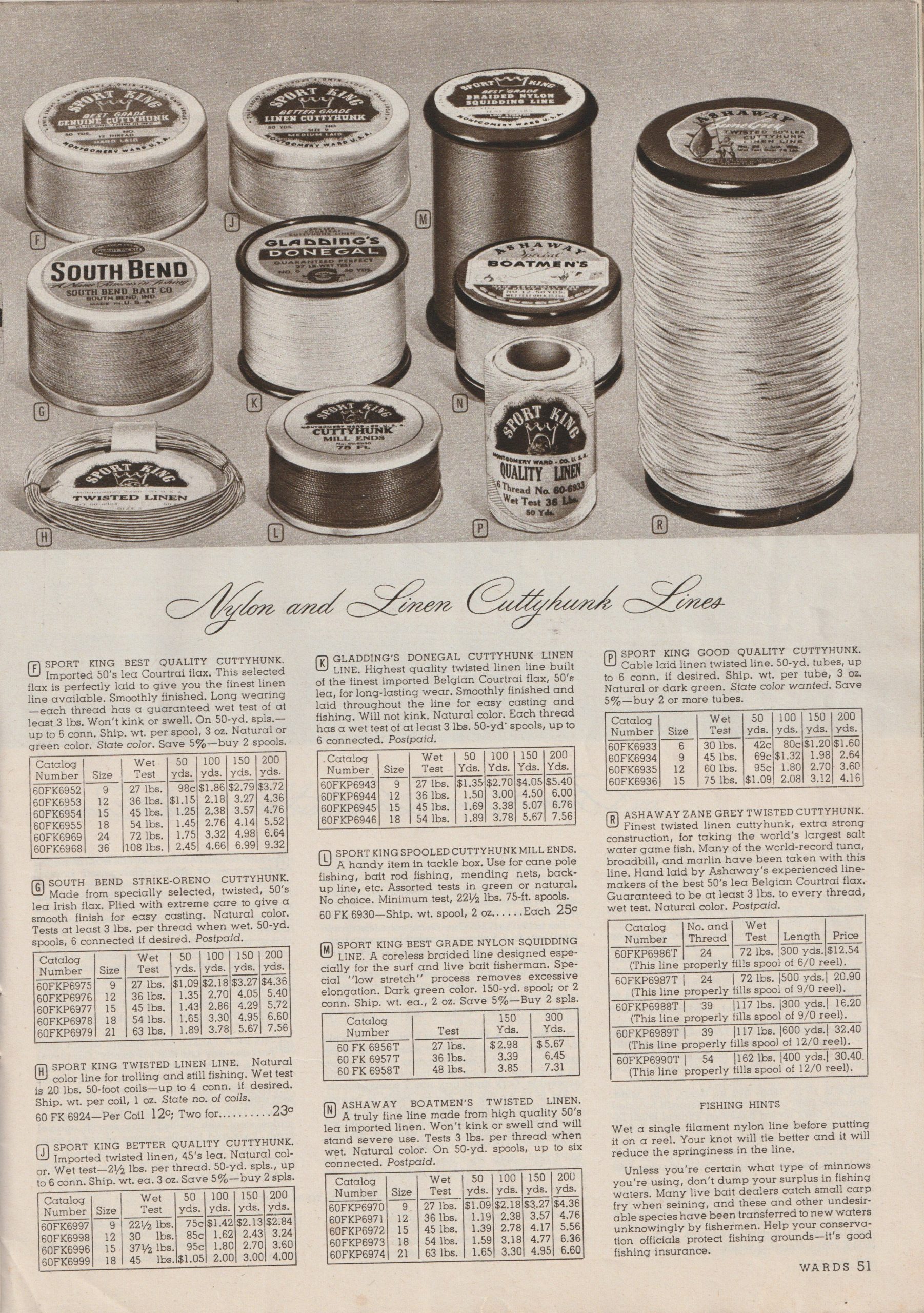
The fishing lines offered in this catalog were not nearly as diverse in composition as they are today. The braised nylon and silk casting lines came in 50 or 100 yard lengths. These lines came on wooden spools and were adorned with ornate labels. They weren’t cheap either. For example, 100 yards of 15 lb. Black Oreno Nylon Bait Casting Line cost $2.38, or $31.42 in today’s money. 200 yards of Gladding’s Donegal Cuttyhunk Linen, wet test weight 36 lbs., cost $6.00. That would be $79.20 in today’s money, for 200 yards. Different times, folks.
The test describing these lines is also interesting and not a little confusing to modern ears. On the Gladding Donegal mentioned above:
“Highest quality twisted linen line built of the finest imported Belgian Courtrai flax, 50’s lea, for long-lasting wear. Smoothly finished and laid throughout the line for easy casting and fishing. Will not kink. Natural color. Each thread has a wet test of at least 3 lbs.”
What that all means would have been common knowledge to anglers back then, as would the extra steps to care for one’s fishing line after a day’s fishing.
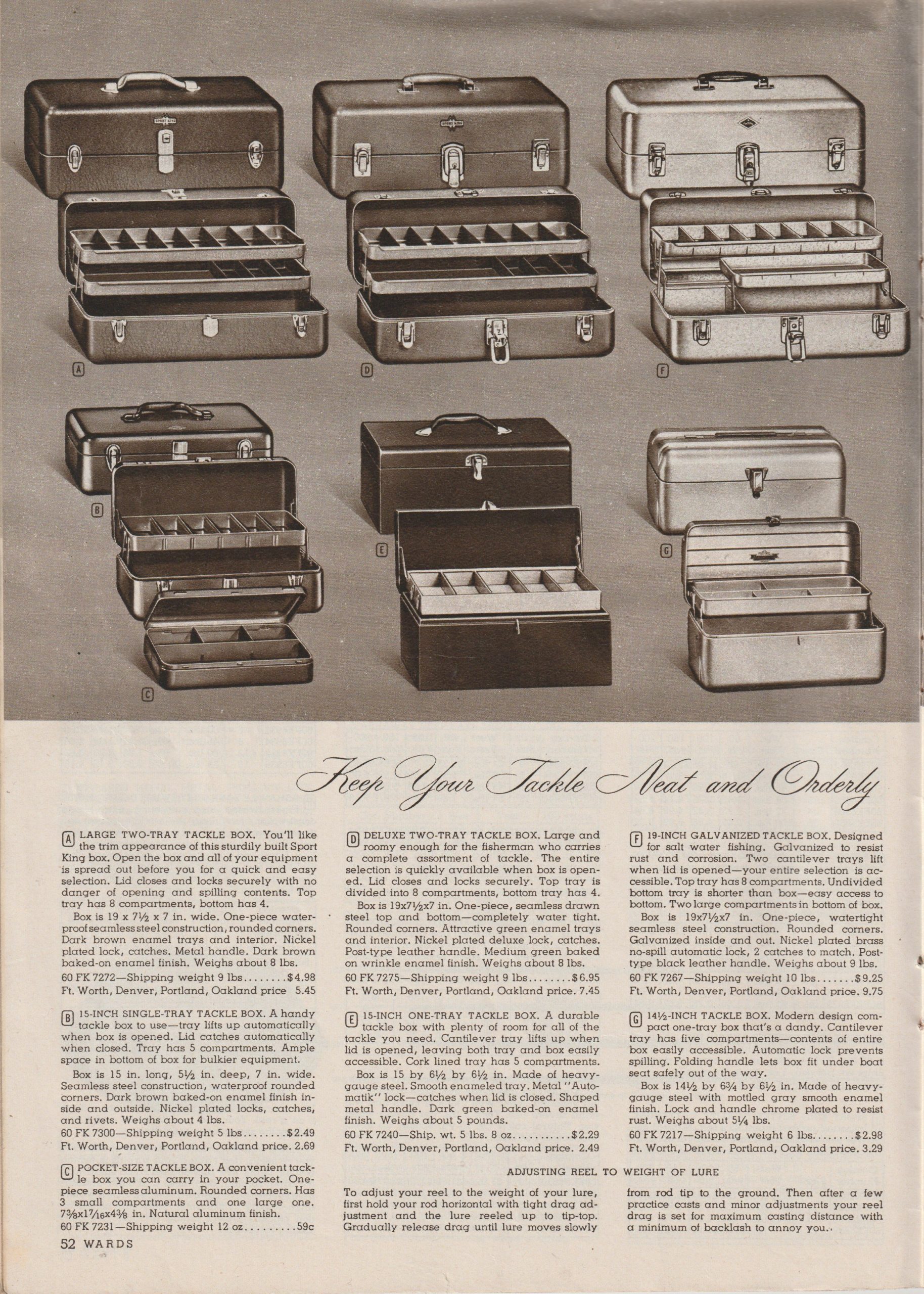
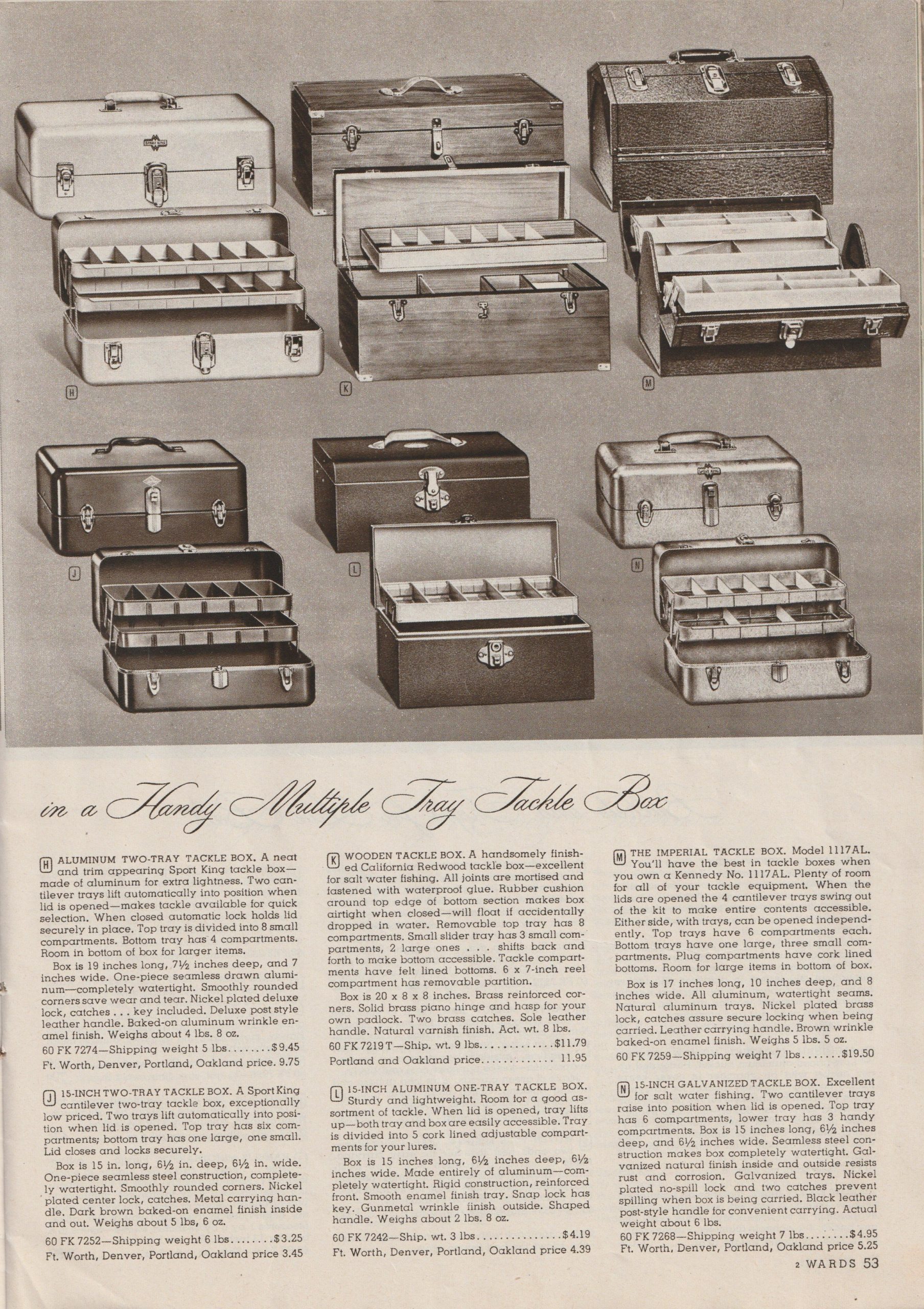
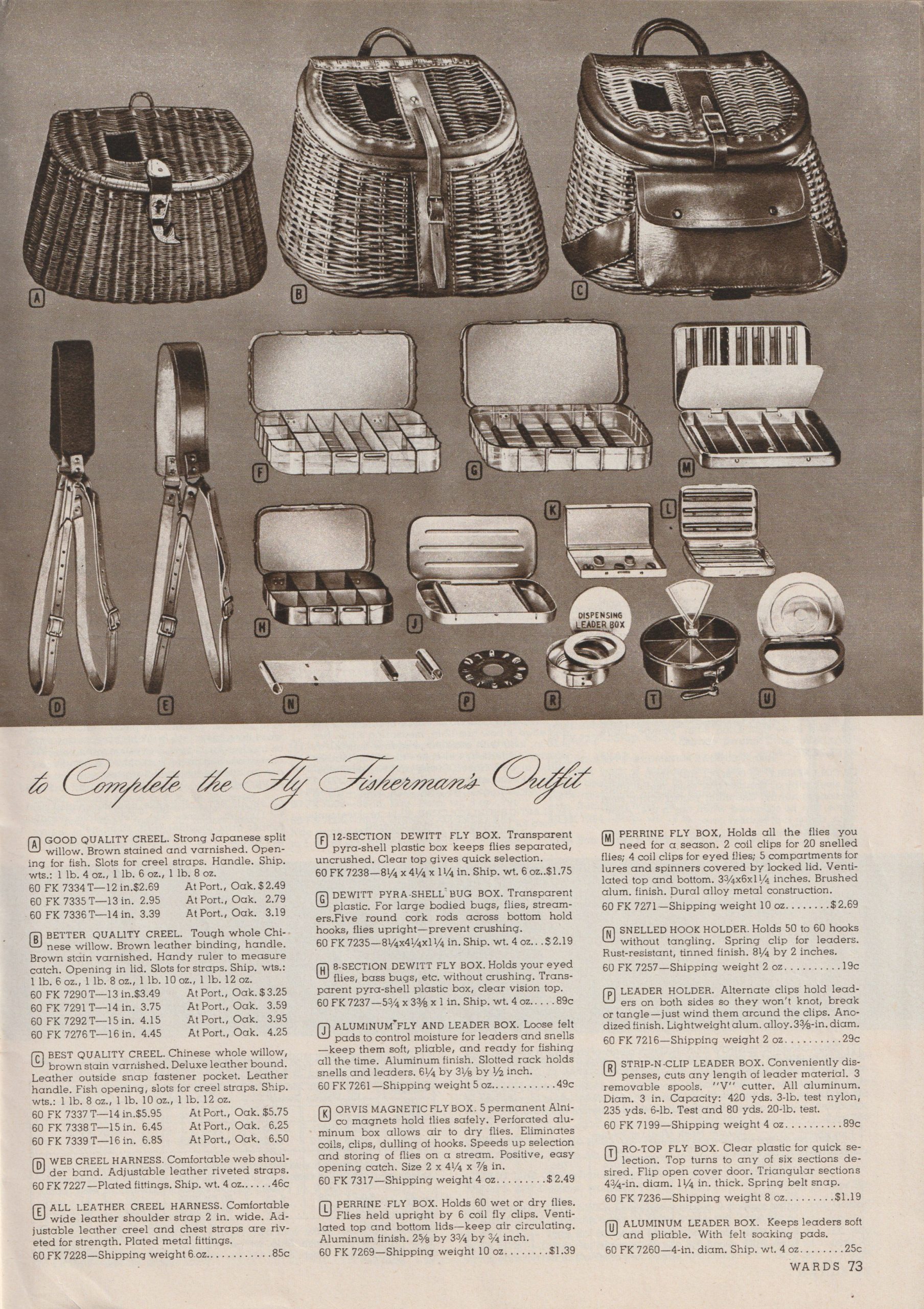
Tackle boxes were heavy, metal affairs (with one wood tackle box, which must have been beautiful), generally with one or two cantilevered trays. The Imperial Model 1117AL, however, was a metal box with four trays, two on each side. The two top trays had six compartments, the bottom two held four compartments. Anglers apparently didn’t carry a lot of lures with them in 1949 (with the price of line they probably couldn’t afford many lures!). Most of the compartments in these tackle boxes were lined with cork, a lining that I much prefer even in modern plastic tackle boxes. I like the retro look and feel of cork.
We hope you got a kick out of seeing the lures and baits in this 75 year-old Montgomery Ward Fishing Catalog (technically it’s a Fishing and Camping Catalog, but the camping section is so small compared to the fishing content). I have two more articles planned for this catalog: one, on rods and reels, and two, on boats, motors and associated gear.






Another great historical post, David, and only part one! I remember the last remnant of the days when the big department stores sold fishing gear. 1949 was obviously when these days were in their prime and this catalog has an abundance of some of the finest lures of that time.
As an interesting side note, Montgomery Ward had their own brand of lures marketed as “Sport King.” These lures were actually primarily manufactured by Creek Chub via their “budget” brand, Shur-Strike. Shur-Strike lures, sharing the pedigree and heritage of Creek Chub, were very well made and a great value. If you check the catalog details on some of the similar lures you will see Sport King lures selling for just about half the price of their more famous counterparts. For example, page 66 of the catalog(for lures illustrated on p.67) shows the popular Creek Chub Injured Minnow at a price of $1.15, and the Sport King Minnow lure at a price of $.57! Great quality at a great price!
Thanks Mike! And thanks for adding the great historical side note about Creek Chub and Shur Strike/Sport King. This is an important addendum and part of the Montgomery Ward/Creek Chub story that I, absent-mindedly, neglected to bring into it. Thank you so much for fleshing out that important part of the Montgomery Ward fishing story. Much appreciated! In fact, I think I’m going to use your comment in one of the two succeeding BFA entries on this catalog.
Somewhat surprised to see Clark’s Waterscout plugs in the catalog. Clark dealt almost exclusively through small independent bait shops. The Shakespeare President reel on the cover was Shakespeare’s first teardrop-shaped reel. Nylon gears for these reels followed the next year. I am familiar with this 1947 model with its large perforated forward brass gear. Without exception, they emit a very high-pitched whine when cast that is unlike any other reel I know of. The nylon gears put a stop to that and Shakespeare made a major point the next few years with “LQT” (light, quiet, tough) nylon gears in these reels which they christened “direct drive” as the crank was mounted at the end of the levelwind threaded shaft, thus eliminating a gear.
Very interesting, Bill. Thanks for the further education!