

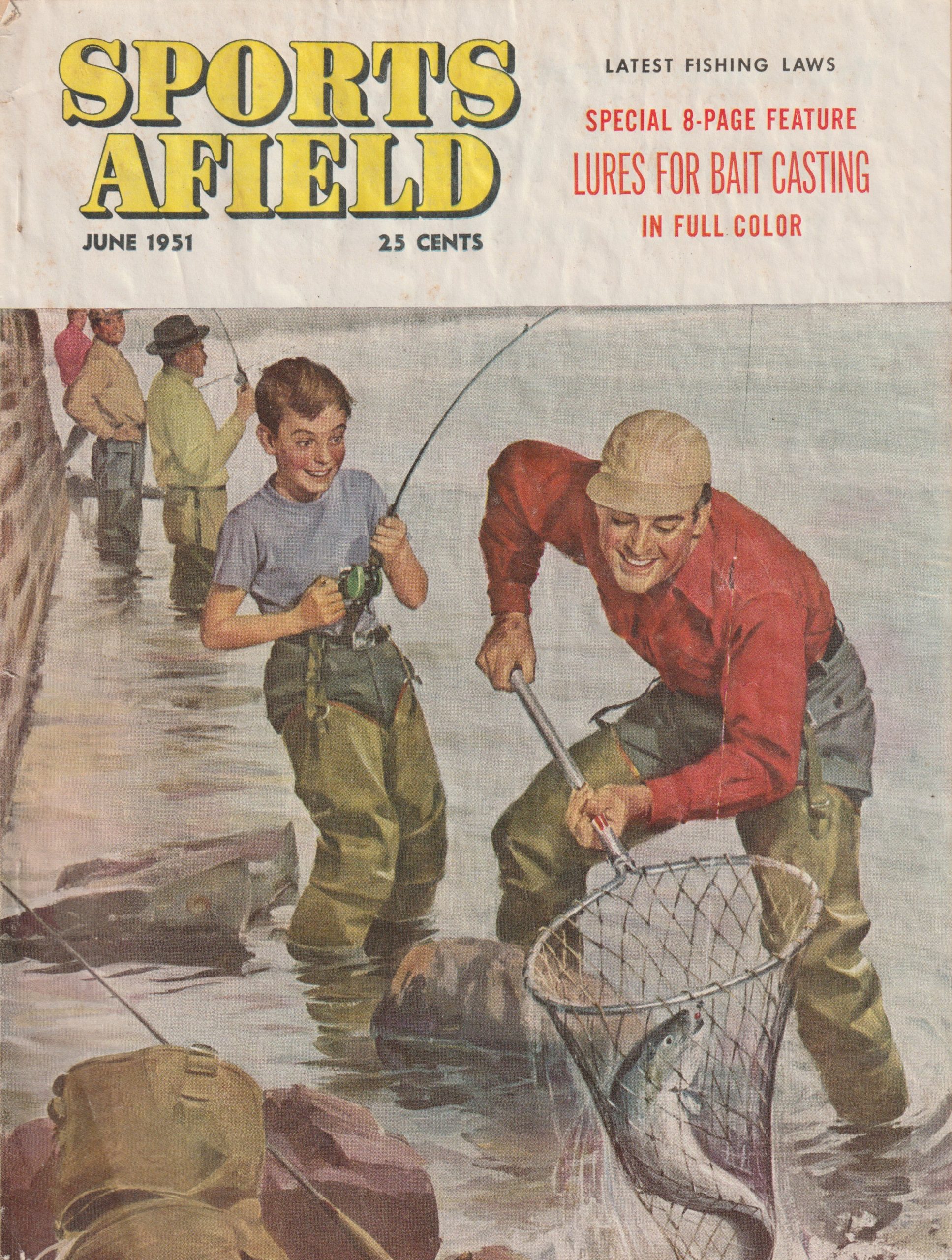
“Sports Afield Baitcasting Lures 1951” is just about what you’d think it is, a multi-page pictorial of the most popular lures of 1951, as judged by Sports Afield magazine (June issue). I picked up this old, somewhat beat-up copy of Sports Afield as soon as I saw the front page leader.
SPECIAL 8-PAGE FEATURE
LURES FOR BAIT CASTING
IN FULL COLOR
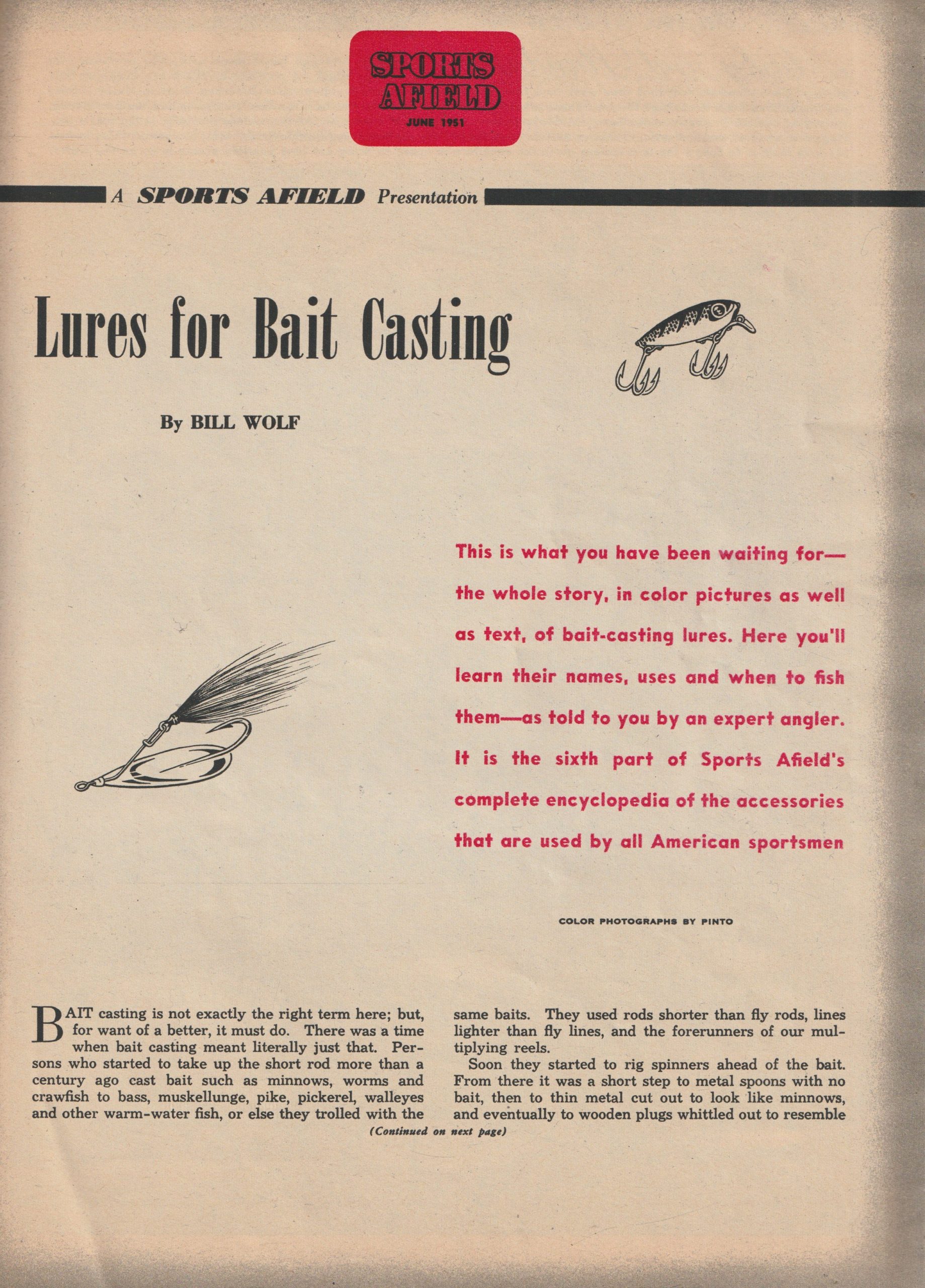
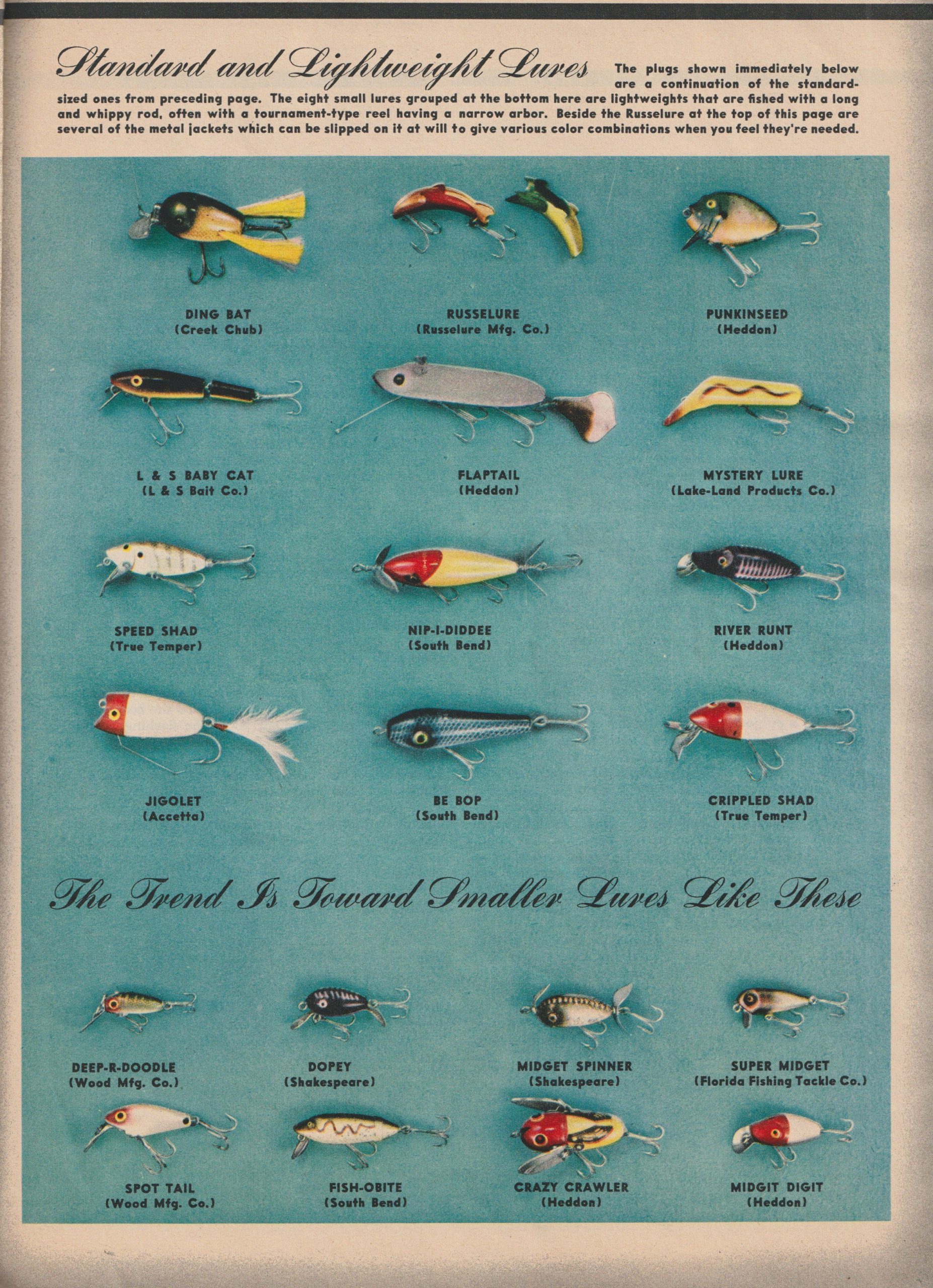
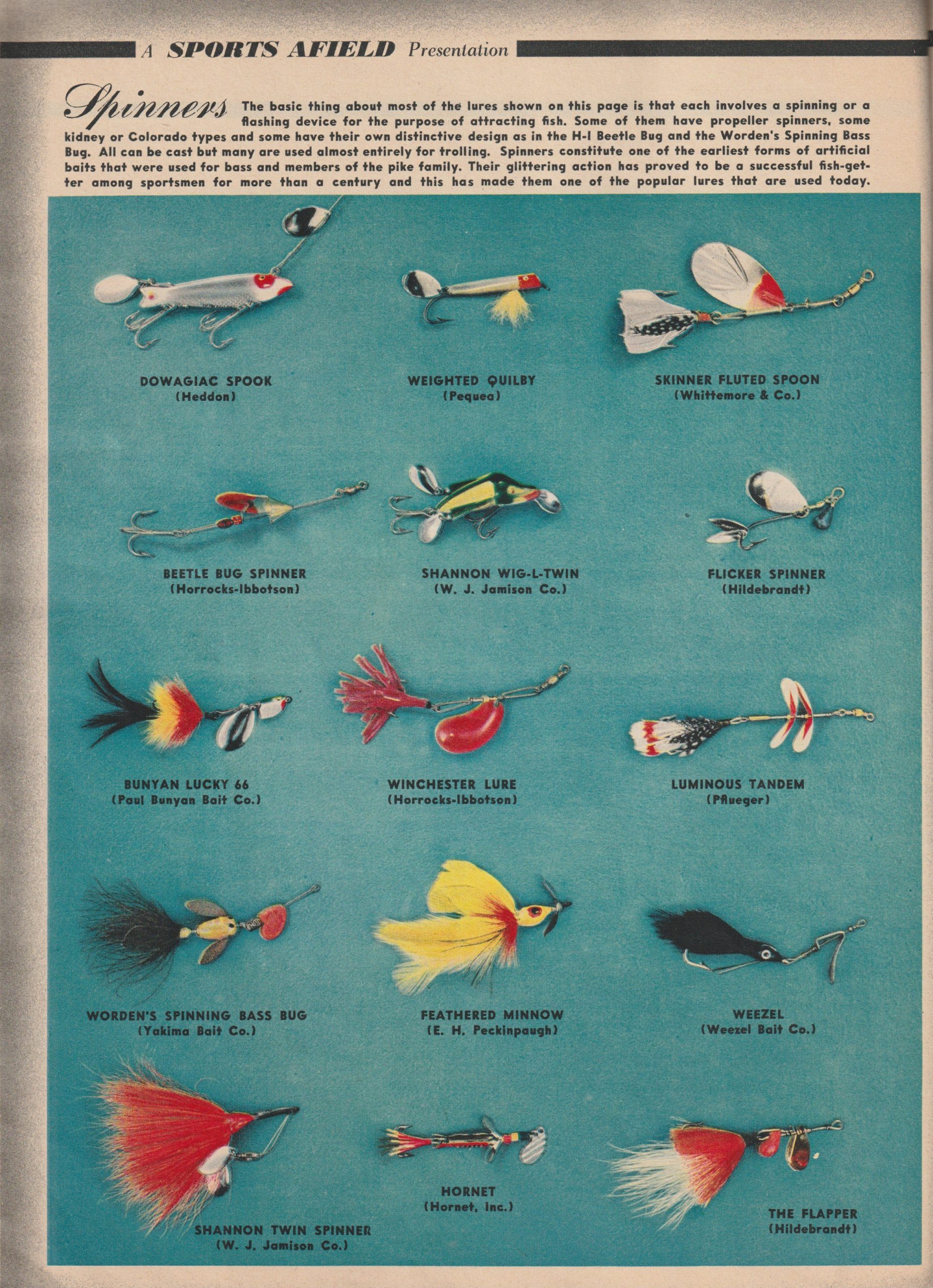
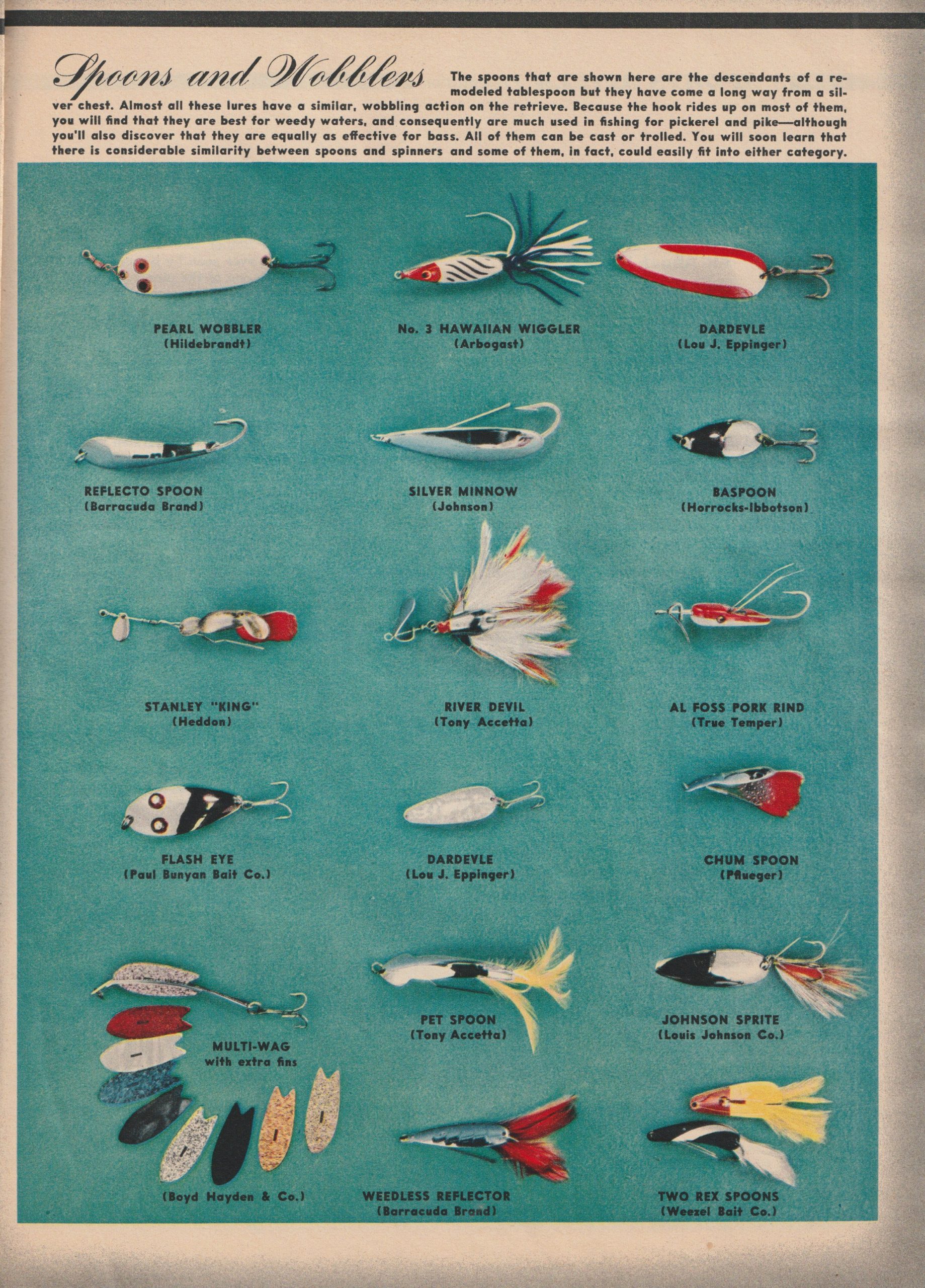
Inside I discovered four beautiful pages of displayed bass-catching lures (along with four pages of text, but let’s be honest, the lure displays are much more interesting than the text). Each page of lures is headed by a descriptive cursive script: 1) Musky and Standard Lures, 2) Standard and Lightweight Lures, 3) Spinners, 4) Spoons and Wobblers.
You’ll probably easily recognize a lot of the lures pictured, and I’m betting that a few will be unfamiliar. Anything by Arbogast, Heddon, South Bend or Creek Chub will likely bring a smile of familiarity. Some might even be lying in your boat’s tacklebox right now. But a couple might have you shaking the dust off the back of your brain: Pequea’s Weighted Quilby and the Weezel Sparrow?
Another question for BFA readers: When you see a Musky Jitterbug, do you automatically think big bass lure? I know I do, especially after watching a few episodes of The Big Bass Podcast where Ken Duke and Terry Battisti, and their guests, reinforced that the Musky Jitterbug has accounted for more giant bass than you can shake a stick at.
It’s worth mentioning Bill Wolf’s associated text. His writing perfectly describes how these lures were popularly used in 1951. For example, spinners could “be cast, but many are better fitted for trolling.” That was the conventional wisdom of the day. You’ll notice that there are no Mepps, Rooster Tails or Blue Fox spinners depicted. Also, feathers were a much bigger hook dressing than they are today. And “wobbler” has pretty well gone out of popular use when describing spoons. Even “plug” seems slightly archaic nowadays.
Wolf writes,
“We are concerned here with the lures used in bait casting. This is a subject fraught with the possibility of utter confusion. Almost any small object fitted with hooks will catch some fish if cast into a lake or stream and retrieved. This has led inventors to invent furiously, and there are thousands of artificial lures on the market today, all more or less effective. New ones appear each day, it seems, and the end is nowhere in sight, more than a hundred years after the first ones were invented.”
“The variety staggers the beginner, and even the veteran…”
Wolf was all too right with his assessment. Lure designs come and go constantly, often only to be tweaked and modified years later and then appear on the scene again. What we might find in the aisles of Bass Pro Shops today will almost certainly be different, though vaguely familiar, from what lines the pegboard 20 or 30 years from now. Although I’m betting that some lures, like the Jitterbug, will still be around and catching both bass and anglers.
“Even on the accompanying four-color pages, it was possible to picture only a relatively few lures. Not all manufacturers are represented, and certainly not all the lures. However, the photos do show most of the types. Fortunately, there are not many specific types, just lots of variations.”
We hope you enjoy these four pages of gorgeous old Sports Afield Baitcasting Lures from 1951. These are frame-worthy pictures.




I count 16 in there that are still in my tacklebox.
I only have around eight in my regular tackle box: Dardevle, Silver Minnow, Crazy Crawler, Midget Digit, River Runt, Jitterbug, Flatfish and Accetta Jigolet (just added these two this month because I want to give them a good workout). Did have a bunch of the others in there too, up until a couple years ago when I really began to fear losing them. lol. But this is the year to try some new old baits.
I wish I could count…….
As a 4-year old, I don’t remember any of these. But from my 20’s on to the present, if I were to stop by, it feels like I should see many of these at Thrifty Drug. Unfortunately, like Neapolitan ice cream, they’re not there anymore.
LOL GK. Neopolitan ice cream…… I think these lures are a bit better than Neopolitan ice cream. :-) Thanks for bringing back a memory from childhood.
My father was Bill Wolf! It was great to see some of his writings included in your article. Up until maybe 10 years ago, I had many of his lures and flies that he tied. I am trying to find some of his articles as I am his only remaining family…at least of this generation :-) and want to be able to pass some down to the next 2 generations.
Sara (Wolf) Rudolph
What a wonderful comment, Sara. Thank you so much! If you wish to further preserve those articles from your father please consider forwarding them to Bass Fishing Archives (via scans or listing). Thanks again.
Hi Sara, David and I spend a lot of time going through old magazines. If we run across any more of your dad’s wrk, we’ll let you know.