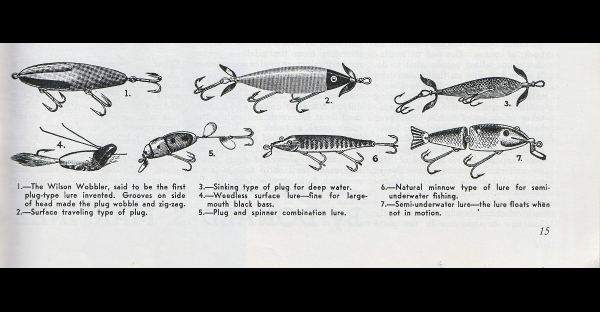
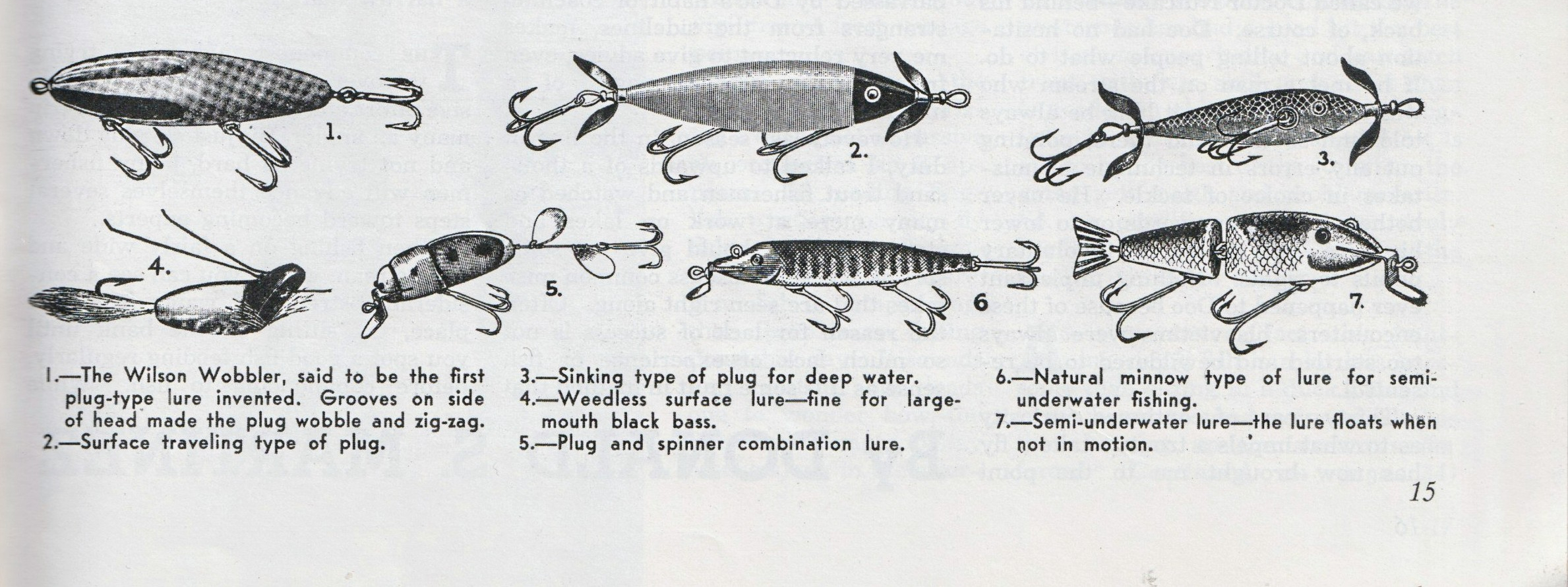
This is the second installment in a brief series discussing articles in the 1940 Sports Afield Fishing Annual. I’m planning on doing at least one more in this series. Today’s piece looks at plug fishing in 1940, in an article titled “Methods of Fishing the Artificial Plug,” written by Sports Afield Angling Editor Cal Johnson. Last time we looked at “The Art of Pop-Fishing” by Robert Page Lincoln in this Fishing Annual. That article explored the relatively new, to the North part of the country anyway, methods of fishing popping lures (or “bubble bugs,” as Lincoln also called them) on the water’s surface. In this story by Johnson, he expands Lincoln’s list of surface lures to include the semi-surface plug and the underwater plug.
Surface plugs, Johnson explains, travel on the surface of the water at all times, semi-surface plugs float when not in motion and dip “a few inches underneath the surface when retrieved,” and underwater plugs sink when not in motion and travel deep when retrieved. Johnson maintains that an angler should have each of these three categories of lure in his or her tackle kit.
But let’s back up a few paragraphs to Johnson’s introduction, where he mentions the Wilson Wobbler as the first legitimate plug-type lure on the market. Bill Sonnett recently wrote a nice article highlighting the Wilson Wobbler and a few of its variants. Be sure to check out Bill’s story, titled “Groovy!” on the BFA site. The slow wobbling Wilson Wobbler came onto the scene less than 30 years before Johnson’s story in the 1940 Fishing Annual. In the intervening three decades lure makers introduced a large number of new lures that, according to Johnson, had actions that “wiggle, wobble, zig-zag, splash, pop, plunk, skitter, skoot, dart, chug, dive, spin, shimmy and flap. Others kick and some travel in wide, sweeping motions – and one of the newer creations even rattles.” But even that plethora of lure styles has nothing on the almost infinite variety of artificial lures available in 2025.
Johnson discusses the locations, season of year, and species of fish each of the three lure types is most effective for. These are predictable and very much what any experienced angler would expect. But while his explanation is basic, even simplistic, Johnson’s writing style and creative knack for language gives this elementary discussion some much welcome flair. Who else would describe the underwater/deep diving plug as appropriate for walleye, but rather than simply writing “walleye,” instead write “these gelatine-eyed subjects of Father Neptune’s aquatic village.” That’s hilarious! I almost always find something in Cal Johnson’s writing that makes me smile or chuckle.

Johnson does spend a fair amount of time on lure color, but he says plainly that color is likely more important to the angler than to the fish. Confidence in color, regardless of what that color may be, is of supreme importance in the success of any lure. But he does also say that red and white is, in 1940, the most popular color combination for a reason. He surmises that red sparks a reaction in fish, as it tends to denote challenge or injury, while white is more easily seen by the angler upon retrieval. “Therefore we might come to the conclusion,” he says, “that the red portion of the bait is for attracting the fish and the white coloring for the benefit of the fisherman’s sight. That, however, is merely a theory, not necessarily a fact. It’s something to think over, at that.”
Surface and semi-underwater plugs, Johnson says, are best in the early season in shallow to semi-shallow water. “Any plug that represents a large water-bug, shore minnow or crawfish will prove successful.” He continues,
“During mid-summer the underwater or semi-underwater plug representing a small minnow or crawfish is the ticket. Later in the season when the surface waters become cooler and the waters clearer, the surface plug generally proves best. Both large and small-mouth black bass frequent the shallower waters during spring and early summer, the deeper waters and spring pools during the warm weather period, and back to the shallow and semi-shallow waters throughout the autumn period and on to freeze up. This knowledge tells the fisherman where to cast the plug and what type of lure to use for the best success. Minnow-like plugs are usually best for deep water casting, while the frog and crawfish types are better for shoreline casting. The new beetle-like plugs should also be worked along the shoreline and around weed-beds.”
Johnson then gets into a bit of bass behavior as it relates to how the fish react to plugs at different points during the time the lure hits the water to its final retrieval at the boat. One technique he mentions is probably the first real tip I recall my Dad telling me when I was a kid. Once the plug hits the water, if a fish hasn’t immediately engulfed it, let it sit motionless for up to a minute before moving it ever-so-slightly. My father would work this technique to great advantage when casting a Shakespeare Swimming Mouse. The explosions, when they came, were exciting and violent. Johnson mentions the mouse plug specifically, and now I wonder if my Dad had read Johnson’s advice back in the day. More likely that was just common knowledge amongst bass anglers.
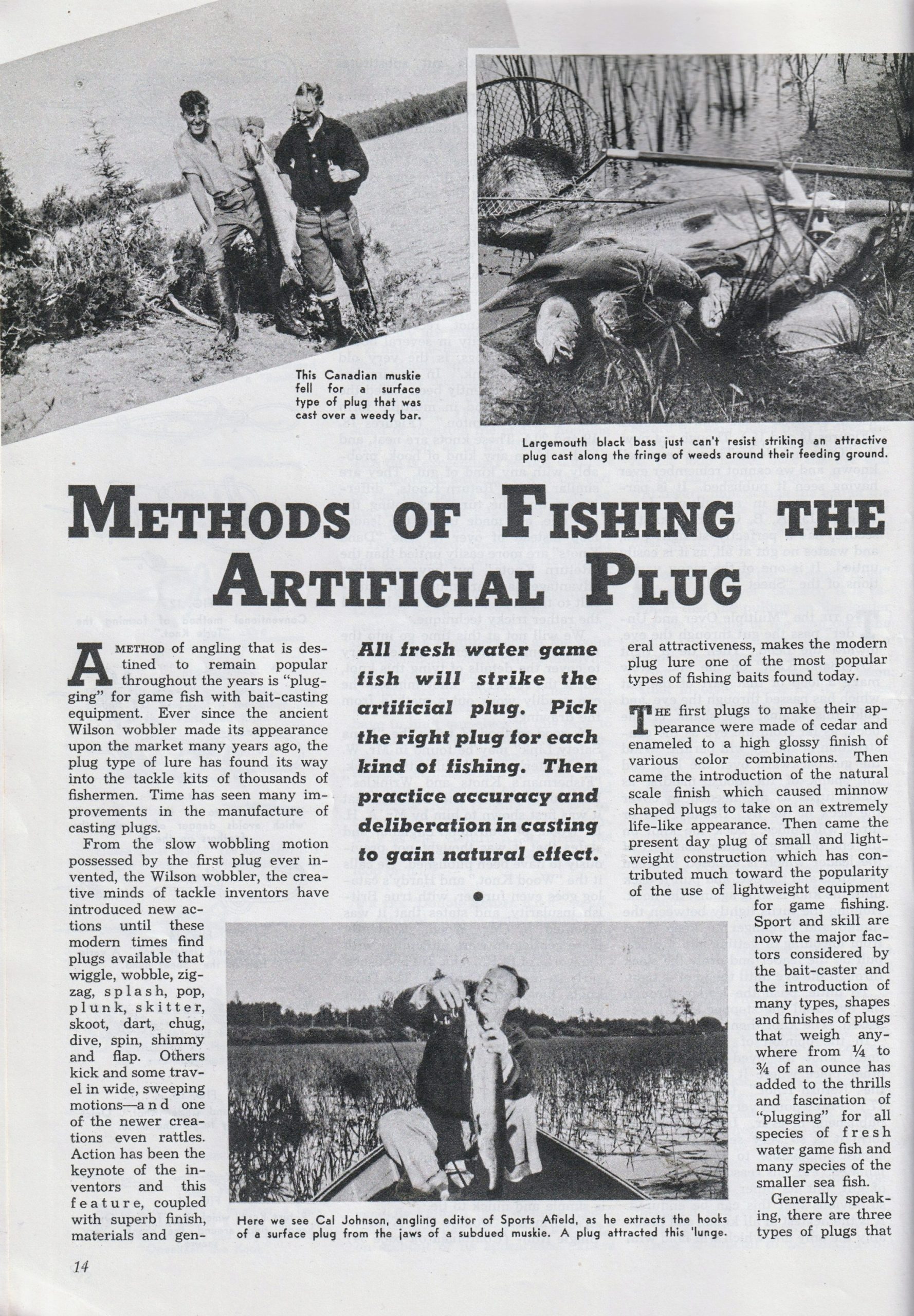
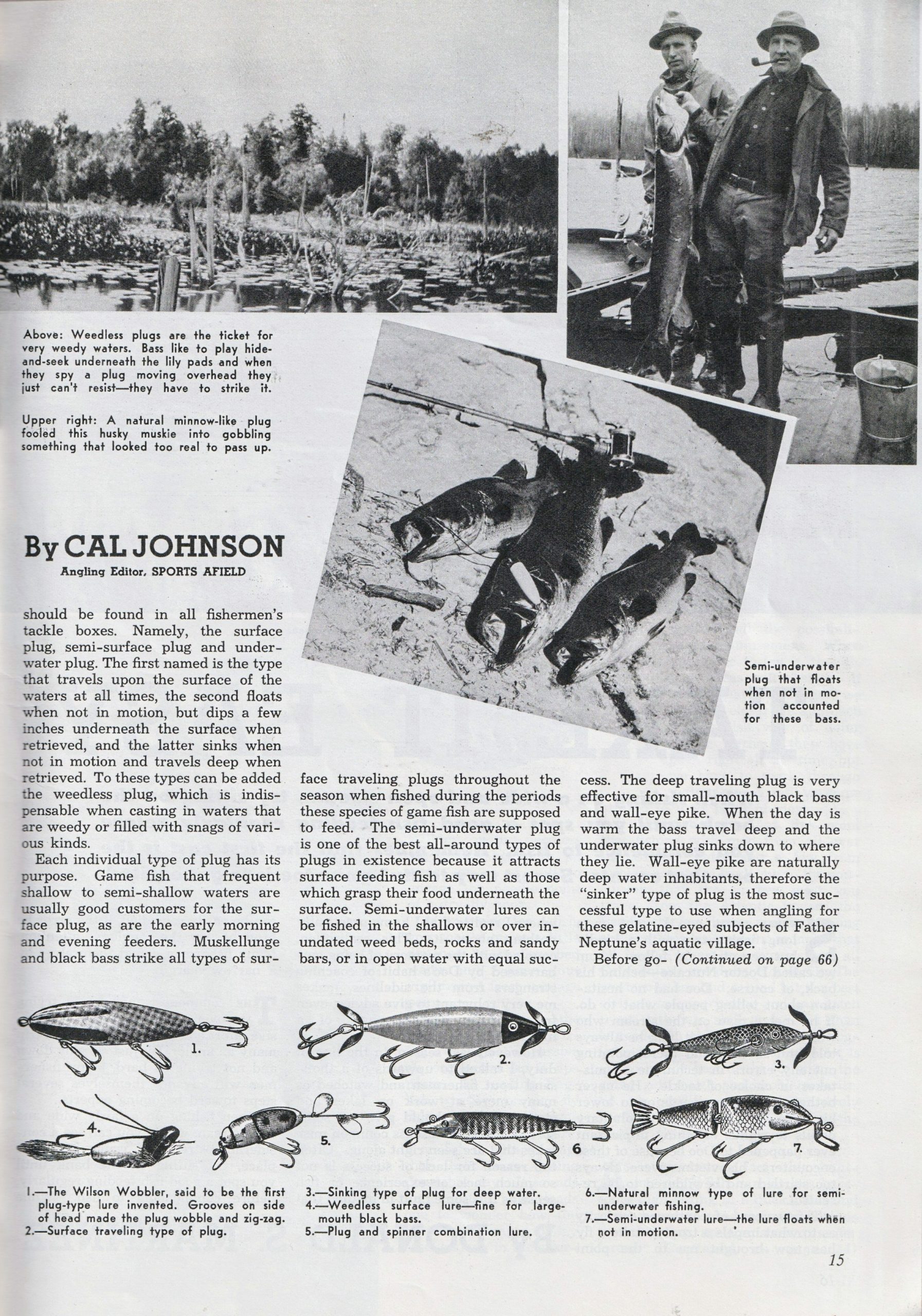
Interestingly, given my story last week about Robert Page Lincoln’s essay on “pop-fishing,” Johnson also mentions this relatively new lure:
“A type of plug that has become extremely popular the past few years is the ‘popping’ or ‘plunking’ type of lure. …The plug can be made to resemble a frog and is exceptionally effective during late summer when the small green meadow frogs are seen along the shore.”
He concludes with the usual rod, reel and line recommendations.
As I did in the first story from this 1940 Fishing Annual, let me share a few more of the ads from the magazine. First up is a great full-color, full page ad on the inside cover. It’s from the Millsite Tackle Company and features the very rattling lure Johnson spoke of earlier, the Rattlebug. The description of the new Rattlebug reads, in part, “It makes them fighting mad. They go for it like fury.” That’s some persuasive marketing there.

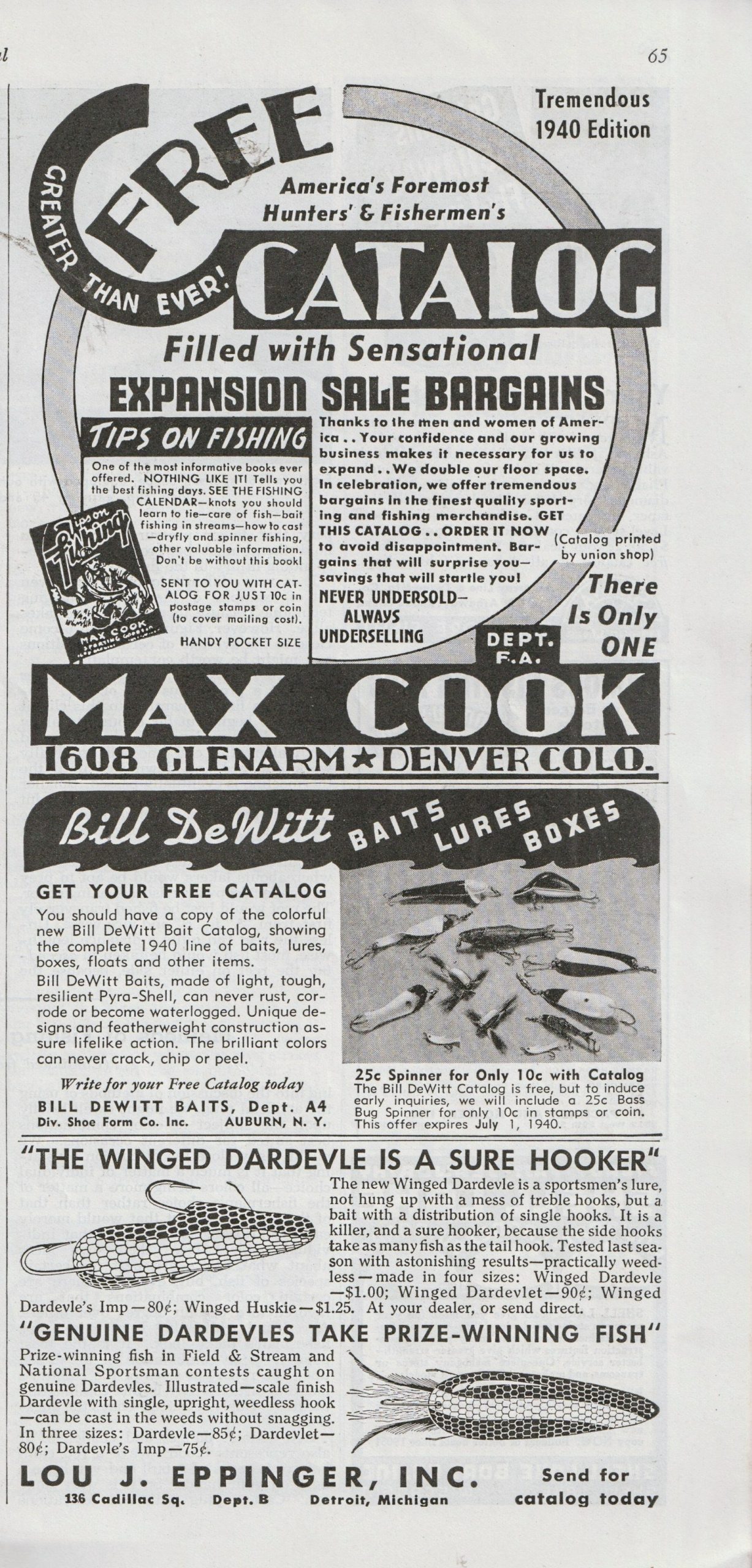
Next we have a horizontal panel of ads with the Eppinger Winged Dardevle at the bottom; a Shakespeare Wondereel ad that allows you to fish at night because the reel is backlash free (so it says); and an ad for the South Bend Bait Company.
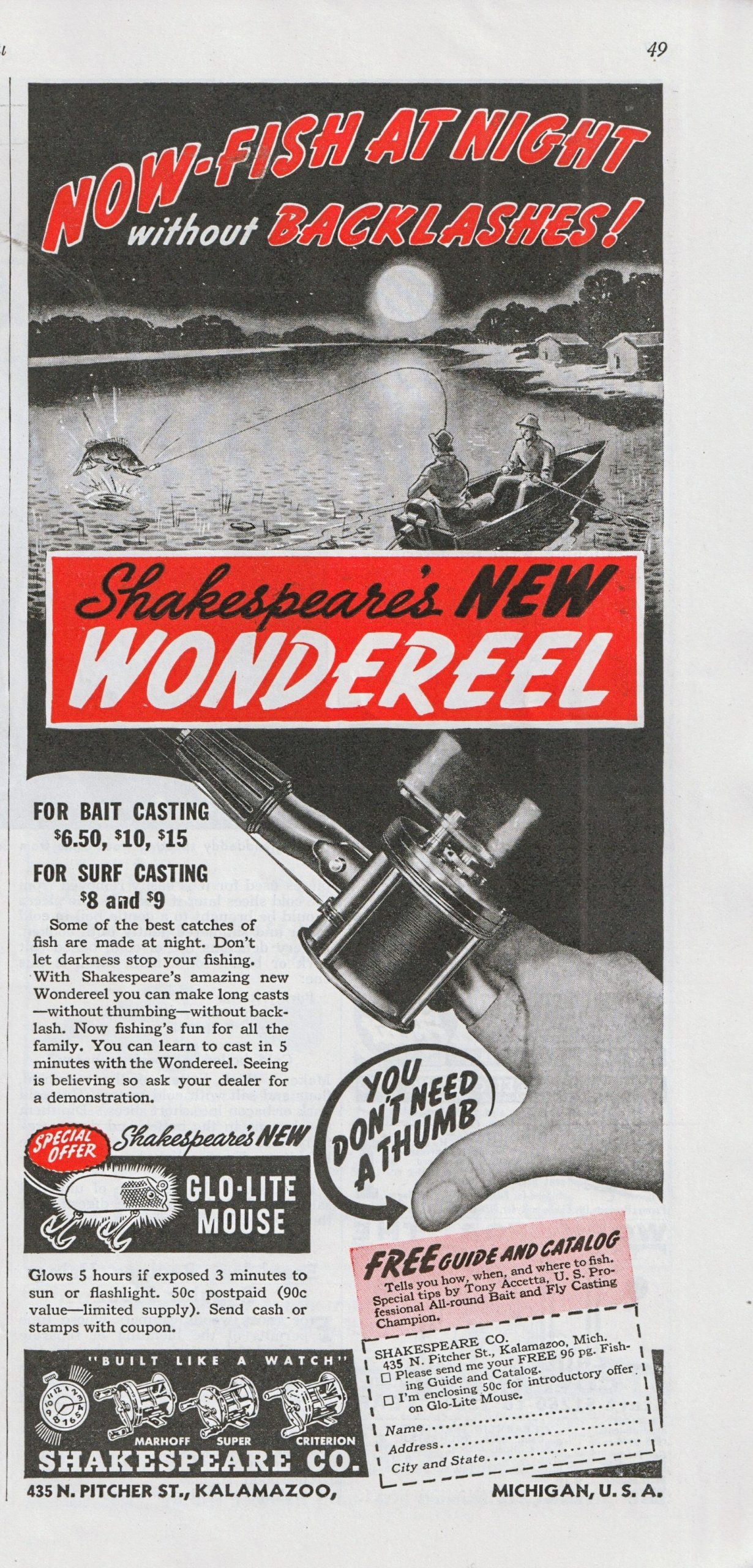
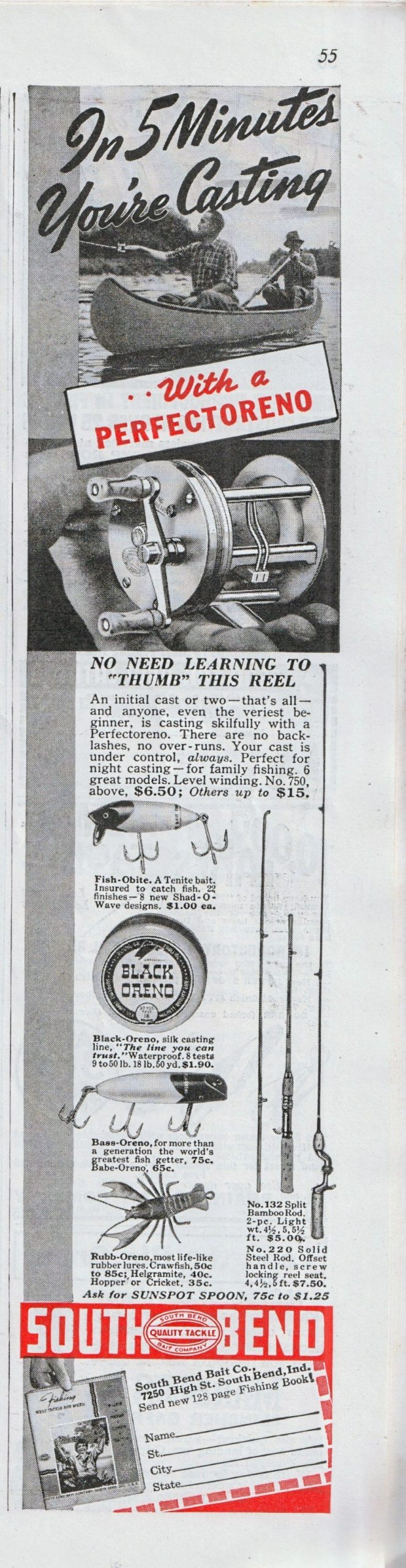
Next, we have a full page ad from Creek Chub Baits. This one shows a mess of popular Creek Chub plugs and features a photo of the then-world record musky holder, John Coleman, and the 60½-pound fish he caught on a Creek Chub Pikie Minnow just a year before, in 1939. There’s a nice symmetry to this and my article on Cal Johnson today, because nine years later, in 1949, Johnson would break Coleman’s musky record by catching a 67½-pound musky on a similar plug, a South Bend Pike-Oreno.

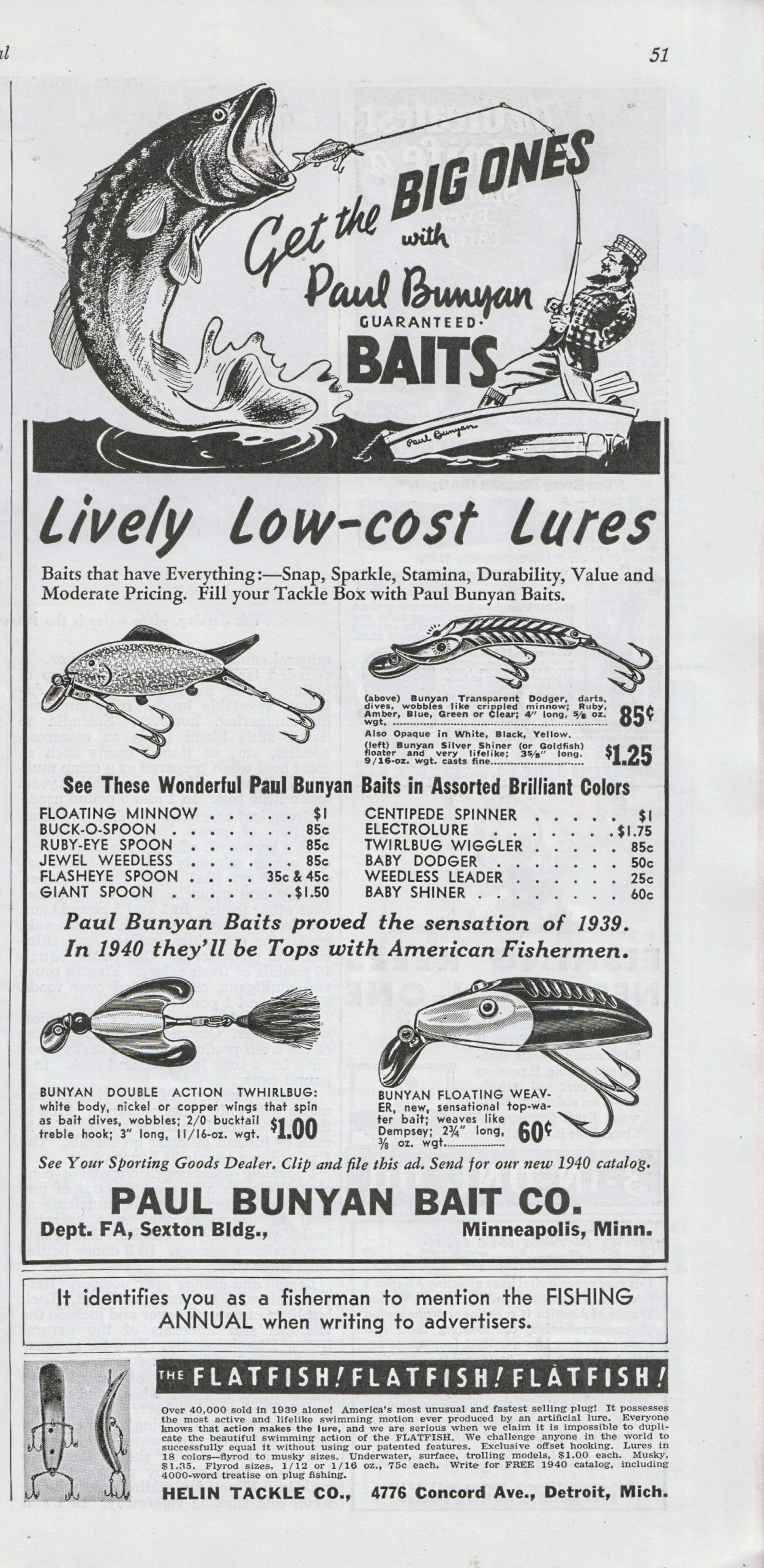
Then we have a nice ad from the Paul Bunyan Bait Company out of Minneapolis, featuring the mythical lumberjack fighting a strange bass/sturgeon/walleye hybrid(?), and several Paul Bunyan lures.
Finally, there’s a small 2” x 2.5” ad that I almost missed, at the bottom of the conclusion of Johnson’s article. It’s from the Delta Electric Company, advertising their electric lanterns. The little ad also solicits the reader to write for their free 72 page booklet, Night Fishing, written by Cal Johnson. That’s pretty cool, because I wrote a story on this very booklet just a few months ago. Check it out here.