Around 1952 I was enjoying one of my boyhood walks along the shore of the Lake where my Grandfather lived when I saw a man in his fifties casting from shore with an outfit that looked to me as if it could have just arrived from outer space. One must remember that at this time I had never seen a spinning reel and the tackle I was familiar with was a cane pole and a baitcasting outfit.
I sat and watched the man make several casts before getting up nerve to ask him what sort of rod that was that he was using. He greeted me with a smile and asked me if I would like to take a couple of casts.
He explained how the reel worked, and I made a cast. I was amazed how easily I could cast with no problems. I told him that I really wished I had a reel like his, and he paused and said that he was an engineer and went on to explain that this reel had a huge design flaw. I listened to his explanation, but it rolled off me without making a dent in my desire for such a reel.
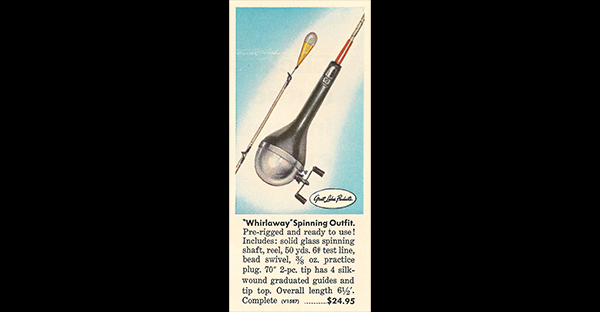
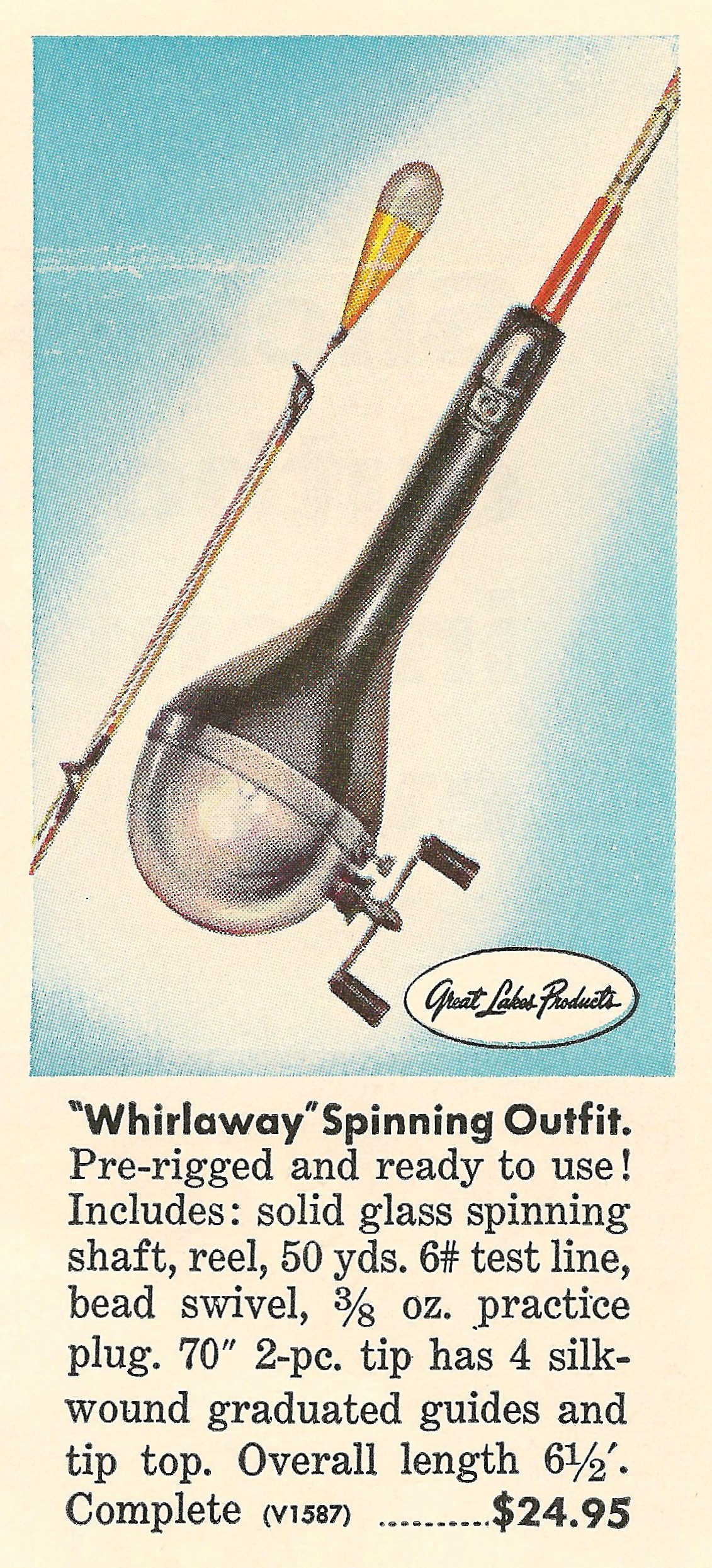
The reel he had was the “Whirlaway” shown above in a Western Auto catalog of the day.
Fast forward five years and in 1957 my father’s best friend was rooting through tackle in his garage under my curious eye when he pulled out an identical outfit to the one I had encountered that day on the shore. It so happened that he also was an engineer and when asked about the reel he immediately went into a speech about how it was a worthless piece of junk that he wished he had never bought.
It was not until many years later that I understood the problem with this reel. It is the same problem that had plagued the very earliest spinning reels before the invention of the bail. The bail is the gadget that winds the line back on a spinning reel’s stationary spool in the same way it came off.
The Whirlaway had the early pre-bail mechanism wrapped up in a very modern looking case. When cast, the line slipped off the end of the fixed spool in the same manner as all spinning reels. The spool was then rotated 90 degrees and the spool itself then turned in the same manner as a baitcasting reel as it wound the line back in.
There is a big problem with this method that is not apparent until one takes a few casts. Each full turn of line that comes off the spool of a spinning reel puts one full twist in the line. These twists are taken back out as the bail winds the line back on the spool. In the Whirlaway as the spool rotates and the line is reeled in, all the twists that were put in the line on the cast are preserved on the spool. The spool is then rotated back into the spinning position for the next cast and that cast adds an entire new set of twists into an already twisted line.
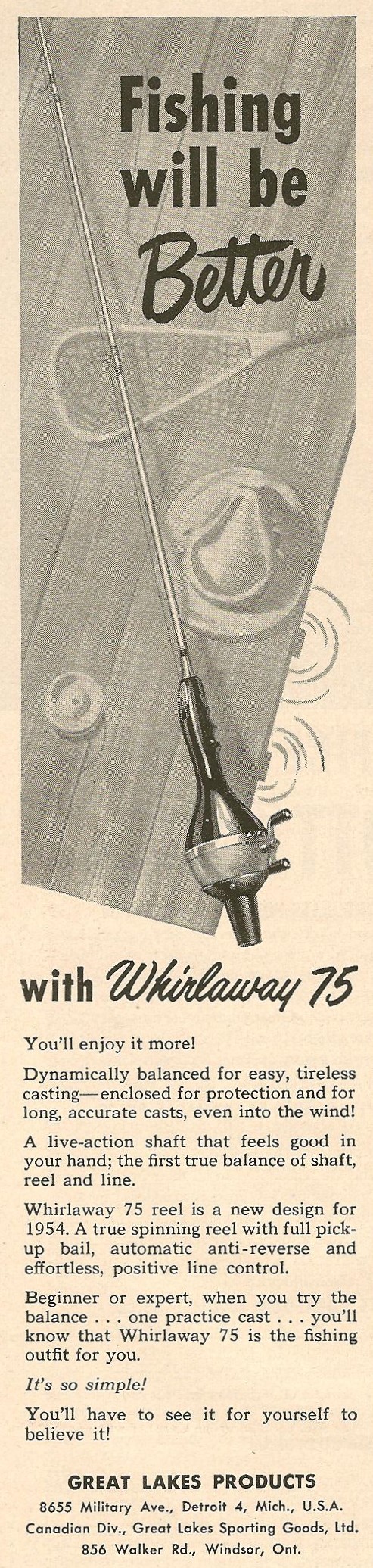
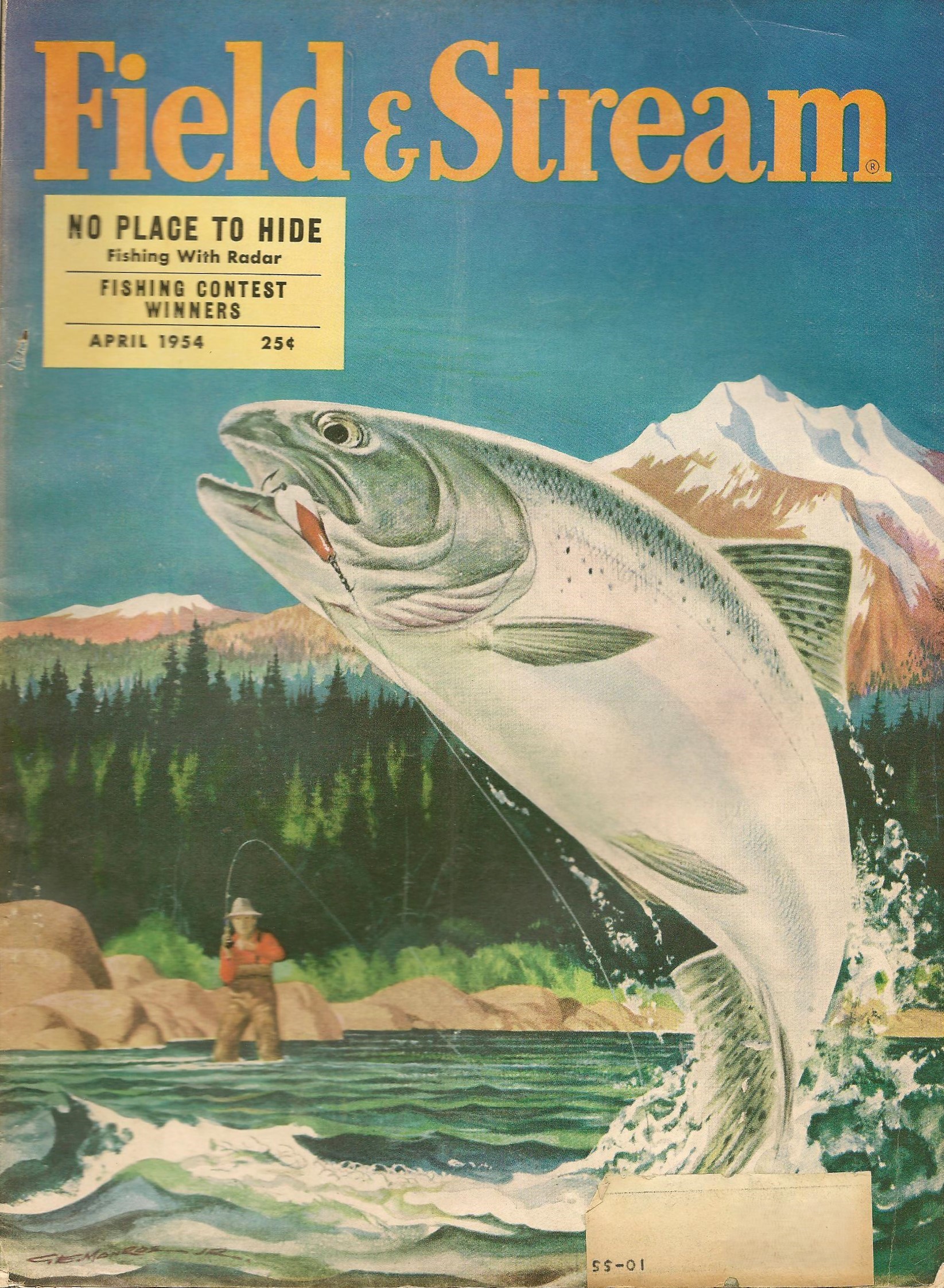
As an example of how bad this problem is, let’s say that 6 inches of line comes off the spool for each wrap during the cast. A 50-foot cast would put 100 twists in the line. These are not all that noticeable at first, but each 50-foot cast adds another 100 twists to the line. In 100 casts that’s 10,000 twists! One doesn’t get to 100th cast before the line looks like one of those rubber bands wound up in a model airplane. Needless to say, the popularity of this model was short lived. As seen in the following ad from the April 1954 issue of Field & Stream, Great Lakes Products brought out a new model, the “Whirlaway 75” in 1954. The new model addressed the problem with an internal bail system similar to that in today’s closed-face reels.
My good friend (and long-time fishing apprentice) Warren Platt used this model for several years as a young man and sings its praises today as a spinning reel that makes it easy to accurately control distance during a cast as the line flows out under one’s thumb. I’m taking his word for it.
During a recent ORCA (Old Reel Collectors Association) National Meet in Texas, Warren stepped up to the line (amid snickers of disbelief) in the vintage spinning reel accuracy contest with a Whirlaway 75 in hand. The judge in charge of the contest allowed that he hoped Warren didn’t win or everybody would show the next time with “one of those contraptions”. Warren proceeded to win the event going away, with a near perfect score!
If you’d like to read more of Bill’s stories from the past, please click this link.