I may not be a fan of real-time sonar, but I can appreciate technology and those engineers and physicists who seem to keep pushing the envelope. On the other hand, as I dig through old magazines looking for content, it never ceases to amaze me that supposed new ideas and technology really aren’t new at all. Today in Side Scan in 1986, we’re going to look at just that. Old tech that didn’t make the first cut but when given another chance, changed the face of fishing.
This isn’t a subject we’ve never covered before. Most recently in “Live Sonar in 1954” we introduced you to the first real-time sonar units that were developed through World War II tech and within a decade had made it into the commercial salt water industry.
Then in Forward Facing Sonar in 1979, we featured an ad from B.E.F. MFG Co. where the inventor had designed a transducer mouth that fit on the trolling motor and allowed the angler to angle the transducer into a forward-facing mode. This was an interesting concept and one I’d heard Roland Martin using in the mid-1970s.
Finally, in Before There Was 360-Imaging, we featured the Stembridge Products Aquascan, the first 360-degree imaging system brought to anglers by the company who made FlipTail worms. This unit relied on old “flasher” technology, which made it difficult to decipher what was around the boat. Still, it showed there was something around the boat.
What all these technologies were missing at the time, at least for freshwater application where there is a lot of cover around, was a way for the unit to decipher the echoes and paint a good picture the angler could make heads or tails of. In other words, it was all about computing power, electrical power, and the size of the processors.
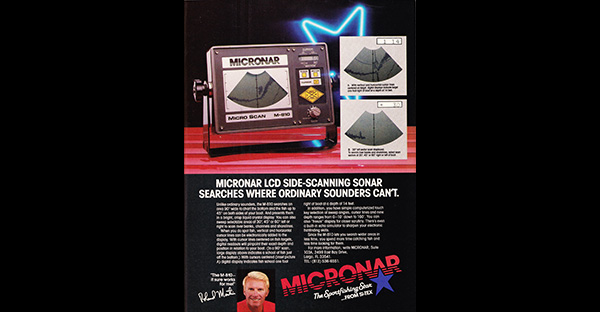
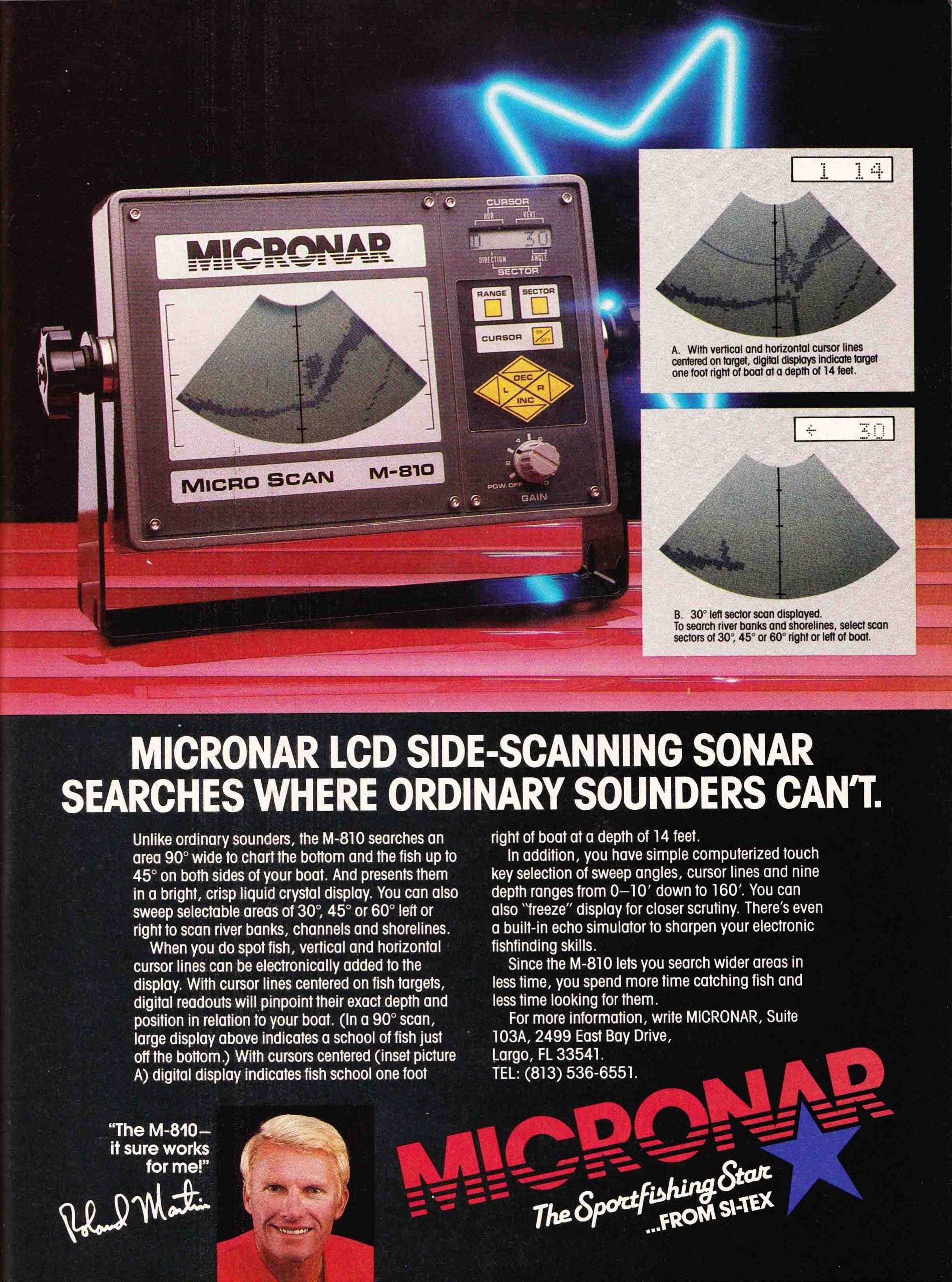
So, let’s get into today’s ads from 1986. As usual, I was scanning through old Bassmasters and ran across this Si-Tex ad featuring Roland Martin. The weird screen is what caught my attention and then, below that I saw the words, side-scanning. I had to read the whole ad.
The ad talks about the unit’s ability to show depth as well as an area 90° wide and anything between the bottom and surface. It also featured a variable scan angle from 90° to 60°, to 45°, or 30° on either side of the boat.

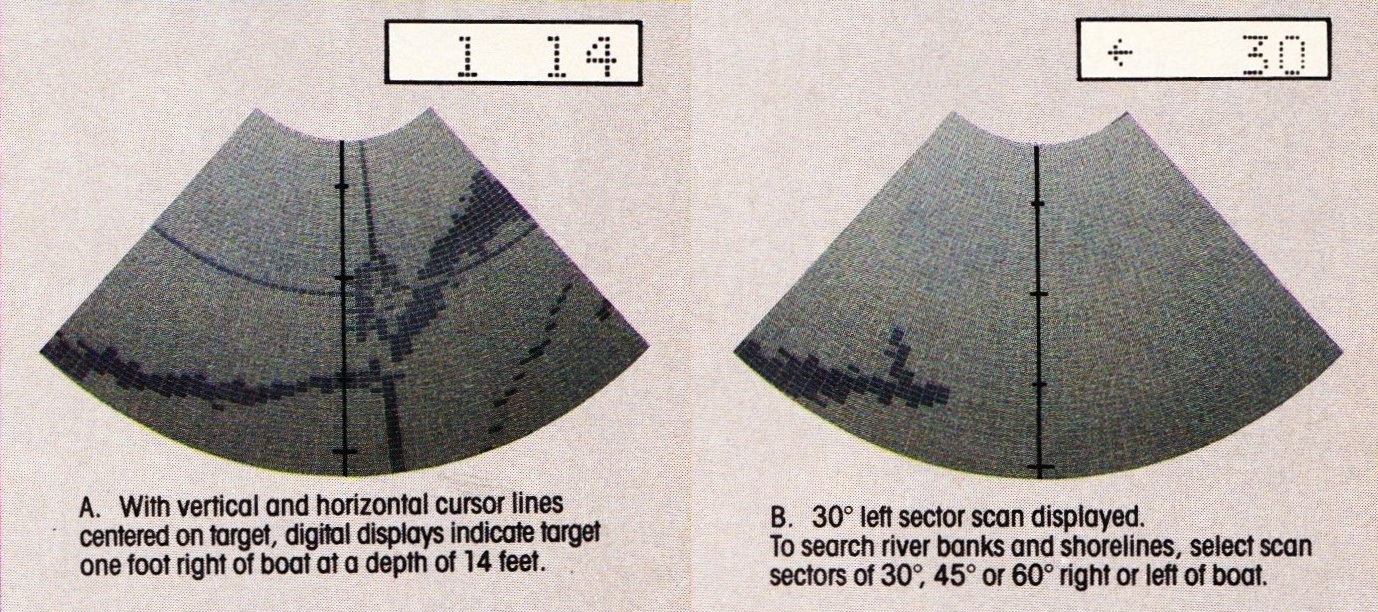
Taking a closer look at the unit itself, you can see the resolution is about as good as you’d expect from the mid1980s. In fact, at the time, Si-Tex was one of the world’s best companies providing depth finders, plotters and other electronics to the salt water industry. It’s no surprise the resolution they had on this unit was this high compared to the competition.
What confuses me about this unit is they don’t say if this is a bow mount or stern mount finder. Secondly, the arc of the unit, the 90° field of view on the face of the unit, appears to be upside down. In other words, the center of the arc should be on the bottom, not the top.
If the unit’s transducer was meant to be mounted on the trolling motor, this could cause great confusion to the angler as he or she would have to think backwards. I can barely think forwards and using this unit I’d probably fall out of the boat trying to get my bearings.
On the other hand, if the transducer is meant to be mounted on the transom, what you’re looking at is behind the boat. What good is that to an angler in the front? Like I said, without any explanation, this unit is confusing at best.
I’d really be interested in getting more information on this unit and find out how it worked. So, if any of you out there owned this unit, please leave a comment below.
From the second ad shown here, it’s obvious that Si-Tex was serious about getting into the freshwater field. Just look at their prostaff. Roland Martin, Larry Nixon, Ricky Green, Tommy Martin, and Charlie Campbell. This prostaff would be equivalent of having Jacob Wheeler, Ott DeFoe, Dustin Connell, Ben Milliken, and one of the Johnson brothers.
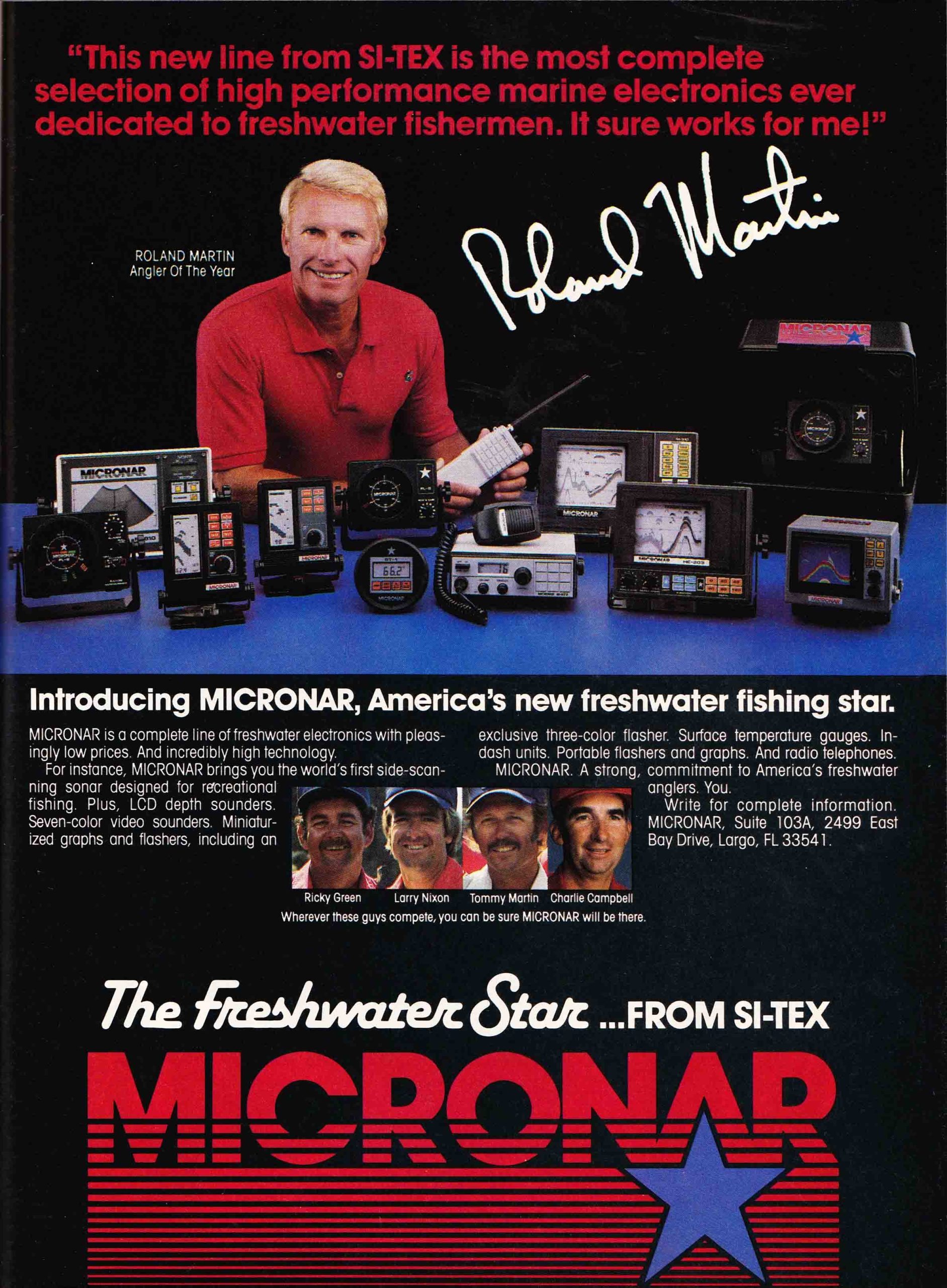
Green and Nixon were part of the prostaff for at least five years so you know Si-Tex at least made a good flasher, what most pros relied on at this time.
The other thing about this second ad is the breadth of products that Si-Tex made. Paper graphs, LCRs, flashers, radios, etc. They were taking all of their knowledge from the salt and trying to get into the bass market. Still after a good amount of time, you rarely saw anything on any serious bass angler’s boat that wasn’t Lowrance, Humminbird, or Vexilar.
The idea for a scanning sonar was there, it just wasn’t the right time with respect to technology.