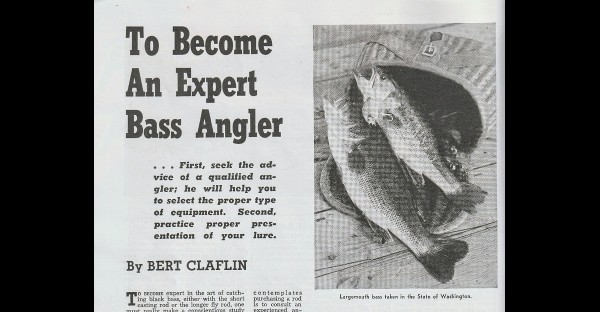
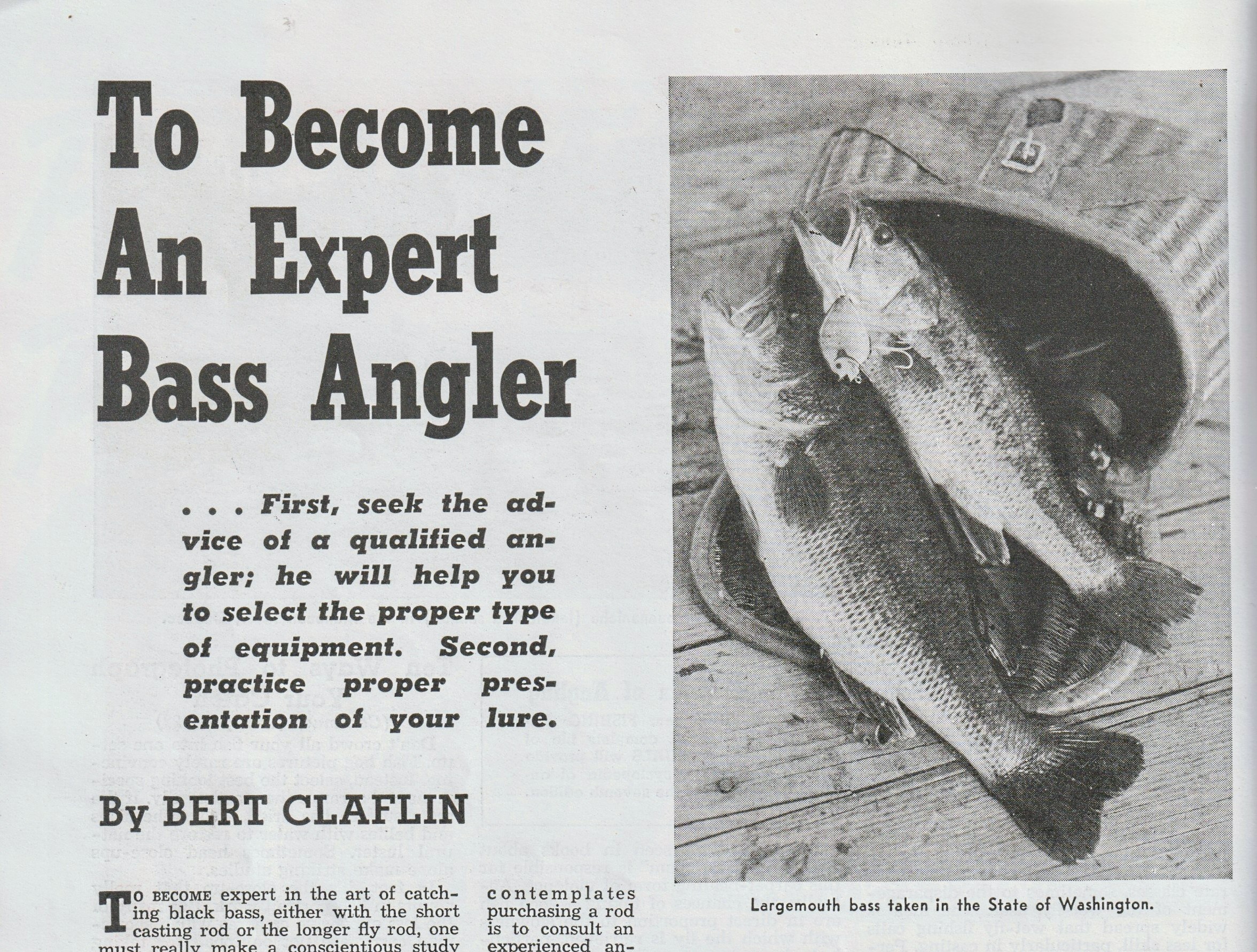
Part three in my recent series on bass fishing articles in the 1940 Sports Afield Fishing Annual comes to us from the desk of Bert Claflin, and is titled “To Become an Expert Bass Angler.” The first installment in this series discussed Robert Page Lincoln’s “The Art of Pop-Fishing.” The second reviewed Cal Johnson’s “Methods of Fishing the Artificial Plug.” Each of these men were celebrated writers of their time. We here at Bass Fishing Archives have given a good account of both Lincoln and Johnson in several articles, but we’ve only given brief mention of Claflin.
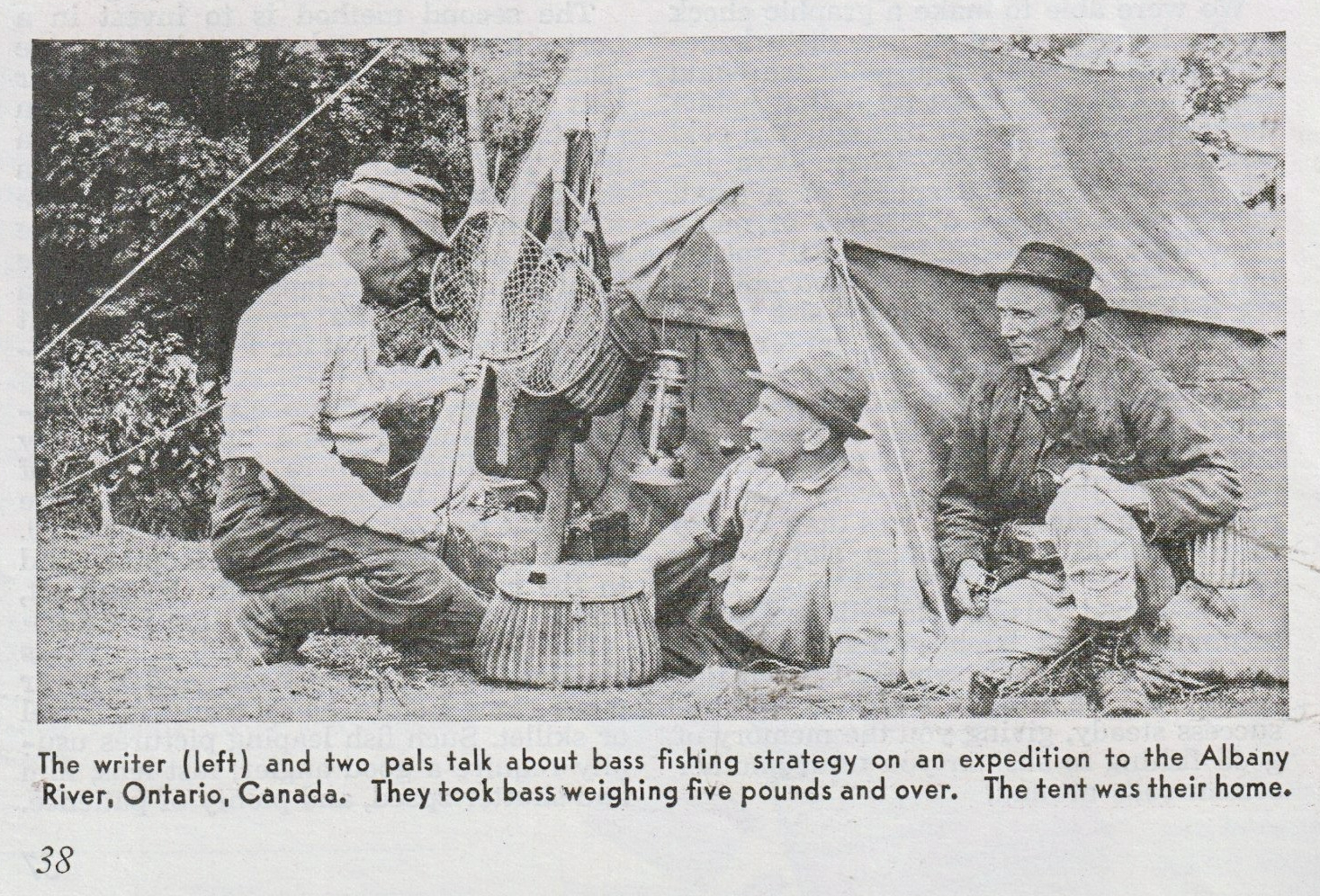
Bert Claflin was a prolific outdoor writer, angler, hunter and competitive trap shooter. Here’s some biographical information from a couple 1937 newspaper articles: Claflin was originally from Milford, Wisconsin and served as the Outdoor Editor of the Chicago Herald & Examiner, Green Bay Press Gazette, and Milwaukee Sentinel. He also contributed to Field & Stream, Outdoor Life and other national outdoor magazines. He authored several books on fishing and hunting, including Muskie Fishing in 1948, which is still considered by many to be the definitive volume on the subject. Claflin had radio broadcast programs on several stations around the country, and was a champion trap shooter as well. He passed away in California in 1956 at the age of 85.
Claflin writes in a straightforward manner and he wastes no time in relaying what he believes it takes to become an expert bass angler. The first tip he immediately offers the beginner is to connect with an experienced bass angler and follow his advice. The experienced mentor will be able to help the beginner select and set up a balanced rod and reel for the kind of fishing desired. He also warns that selecting effective lures is a task that is open to potential “humbuggery.” In other words, a beginning bass angler can easily be deceived by outlandish marketing claims of bait companies or the seductive appearance of “pretty ‘barber poles,’ frogs that look more like miniature monkeys…gadgets ingeniously constructed, but possessing no attractions for fish, and multi-colored contraptions that are effective only in a shop window.”

He advises the new angler to stock his tackle box with “two surface plugs, two underwater wooden or metal lures, a couple of small, green rubber frogs (for largemouth bass), two weedless lures with feather accessories and a half dozen spinners with buck or squirrel tail hair, the spoons not to exceed an inch in length.” Claflin also recommends as essential the use of a “single-piece leader not less than four feet in length when casting artificial lures with the short rod.”
He also recommends, as did most every other angling writer of the day, imitating nature as much as possible when fishing artificial lures. Claflin offers an interesting example of the extent one might go to in pursuing this deception game. He declares that, for example, in the evening when frogs leap from the bank into the water, the sound they make is a “plunk” or “dull ‘plop,’” and he suggests casting your rubber frog in such a manner that you imitate that sound. Or an angler might cast his lure onto the bank and pull it into the water, to better still imitate the sound and appearance of a live frog.
Claflin also suggests retrieving a jointed wooden plug slowly, as a jointed plug more closely resembles an injured minnow, while a one-piece plug should be retrieved with haste, as it represents a healthy minnow.
He emphasizes that checking the stomach contents of any bass you catch is a wise practice, as it will inform your choice of which lures will best imitate what the fish are feeding on. This, he says, is a common practice for effective fishing in different lakes and even at different times of day in the same water.
Claflin concludes by summarizing his tips:
“First, consult one with experience before buying your equipment or adding to that which you already have; buy and use only such lures as qualified anglers assure you will take the fish; use a one-piece, four-foot leader with your short casting rod; on days when a wind prevails work the shores against which it is blowing; practice proper presentation of your lure, no matter what type used; retrieve jointed plugs slowly and one-piece lures, rapidly; examine stomach contents of fish taken; work shallows along shores after sunset; and, above all, strive to imitate nature at all times. Follow these precepts and you will not fail to become an expert bass angler.”
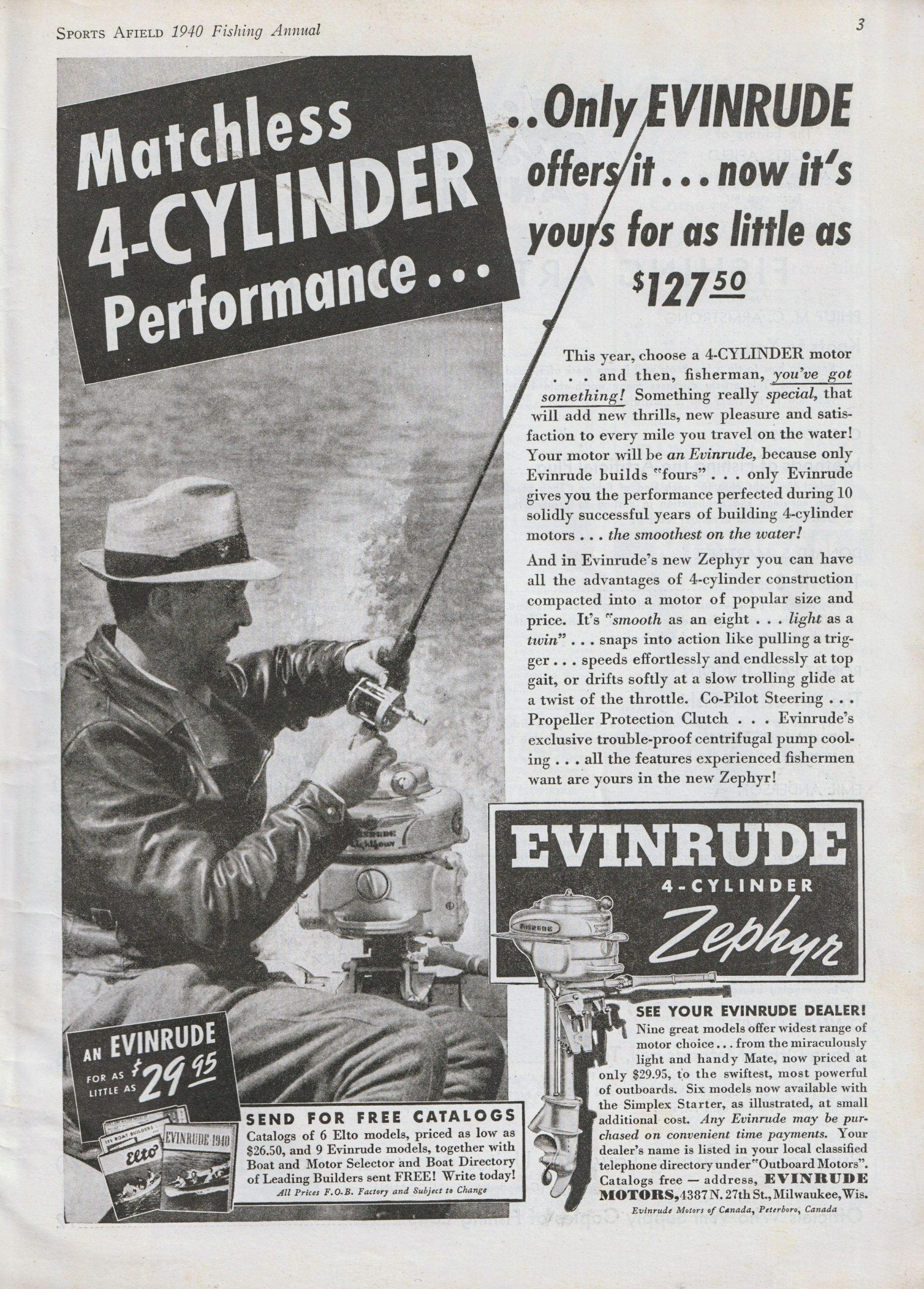
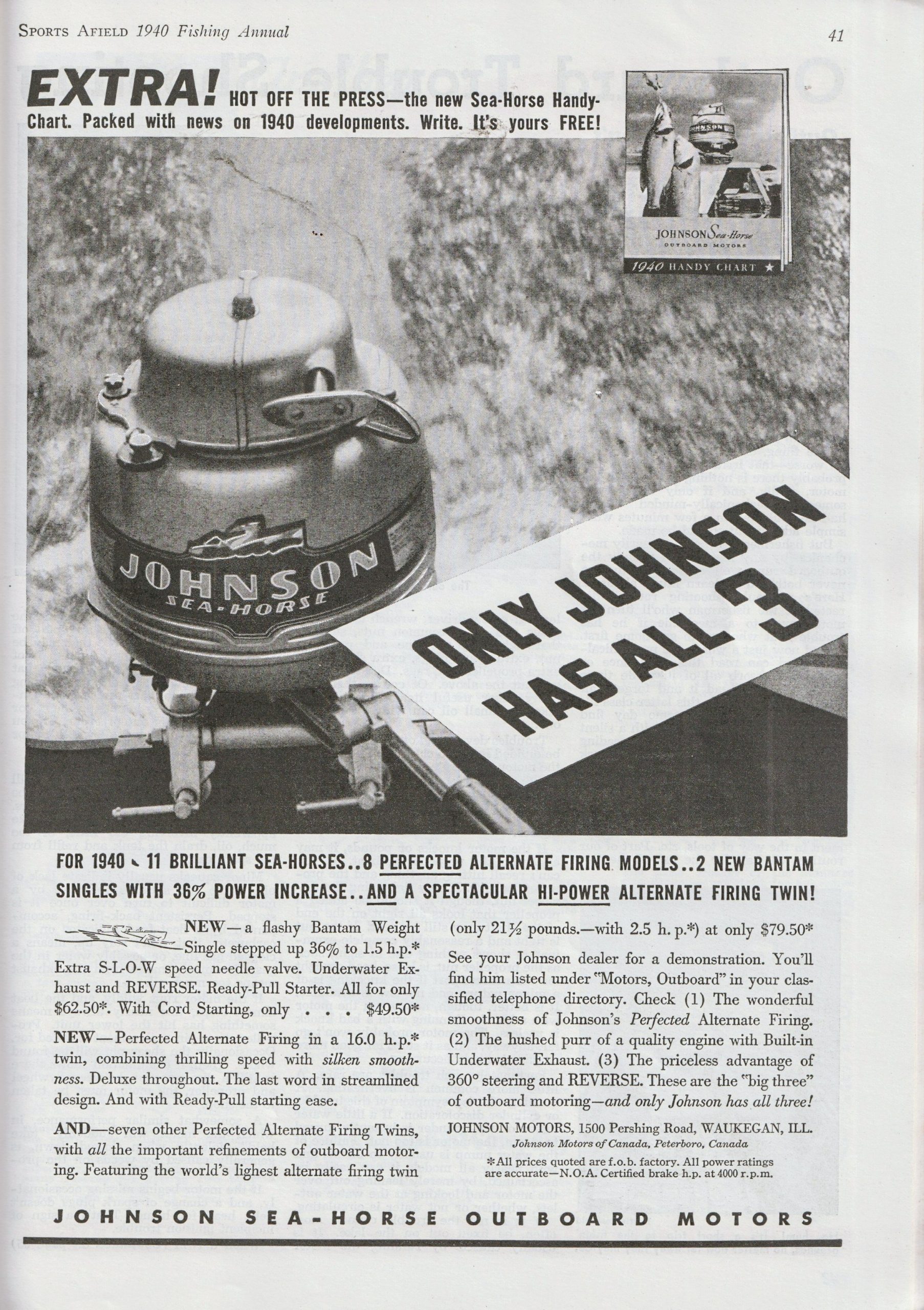
Ok, let’s look at a few great old ads! First up, here are two ads from Evinrude and Johnson Motors. The Evinrude ad is, in my opinion, much more effective than the Johnson ad. It highlights and emphasizes fishing with Evinrude Motors, with a smiling angler in front of the motor. The Johnson ad, on the other hand, is initially confusing. A big placard reads “Only Johnson Has All 3.” All 3 what? You’ve got to read the smaller print to find out. Still, that motor does look pretty cool.
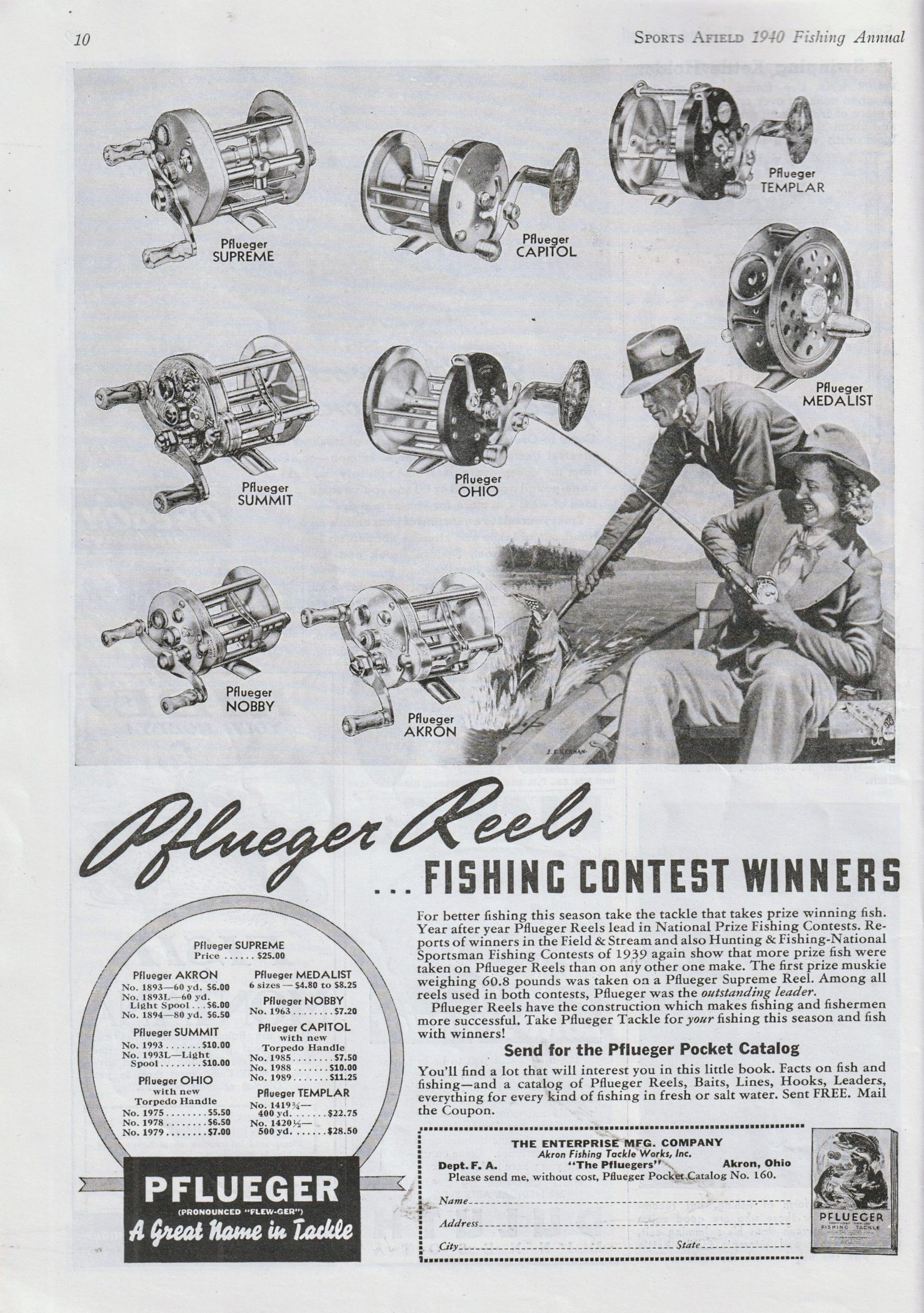
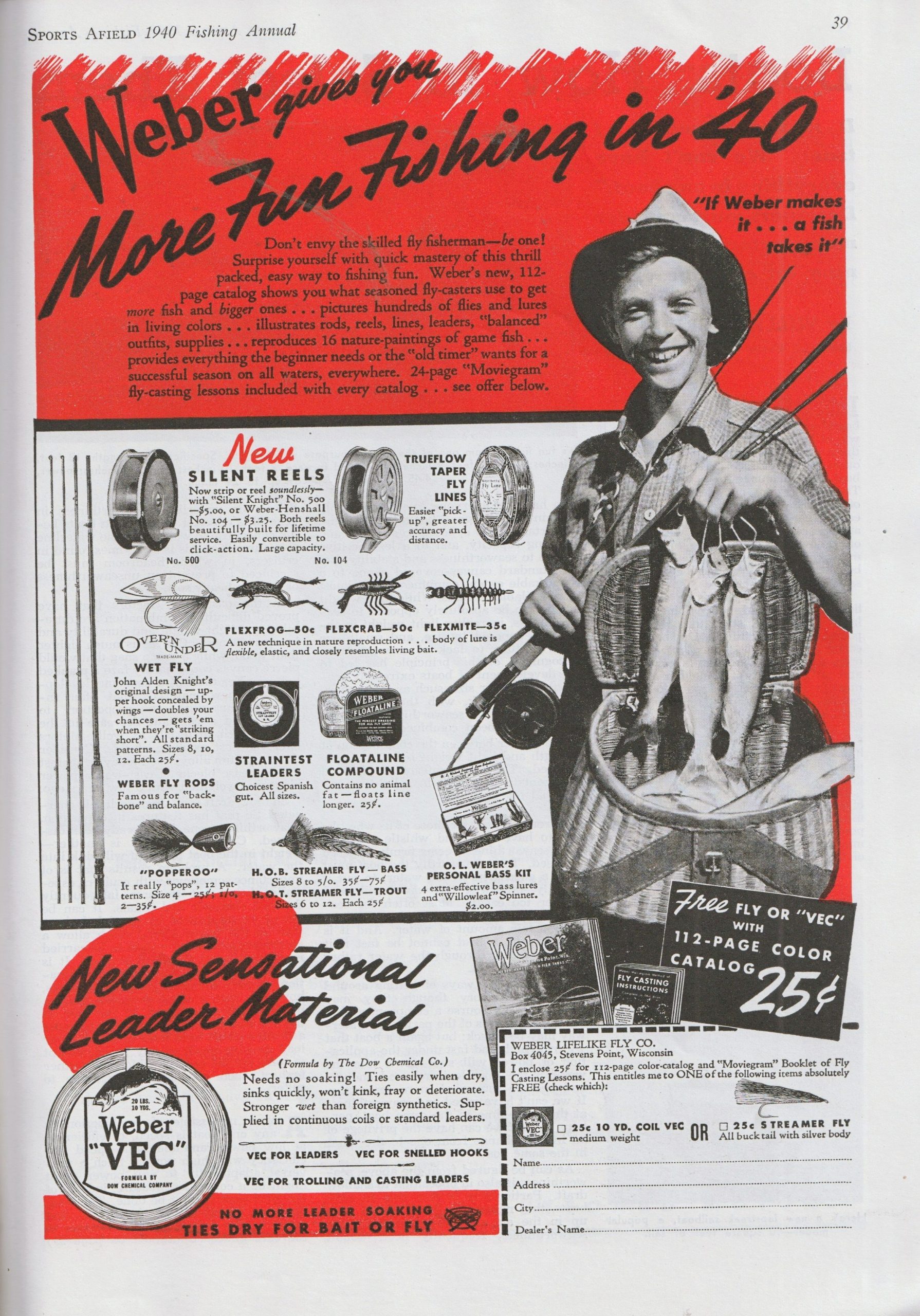
Next we’ve got two full-page ads from Pflueger and Weber Tackle. Both are pretty straightforward, with both showing multiple products and happy anglers associated with those products. The large swath of red in the Weber ad doesn’t hurt either.
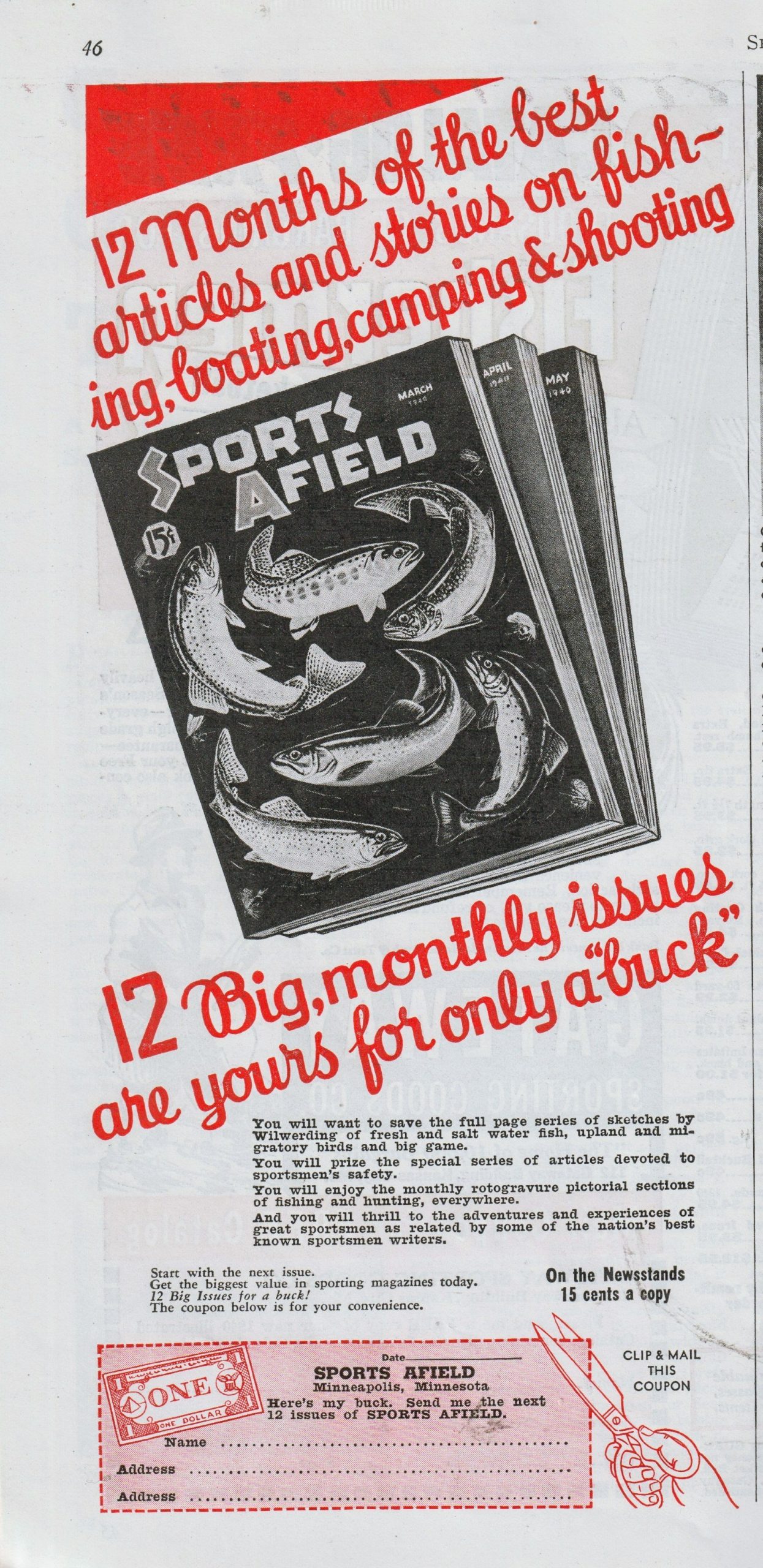
Here’s a subscription ad for Sports Afield magazine. This one is eye-popping to our 2025 sensibilities, because it offers a year’s worth of issues – 12 magazines – for even less than the .15 cent cover price. 12 issues “for a buck!” I know that a dollar was worth more in 1940 than it is in 2025…but a dollar?! Holy cow, sign me up!
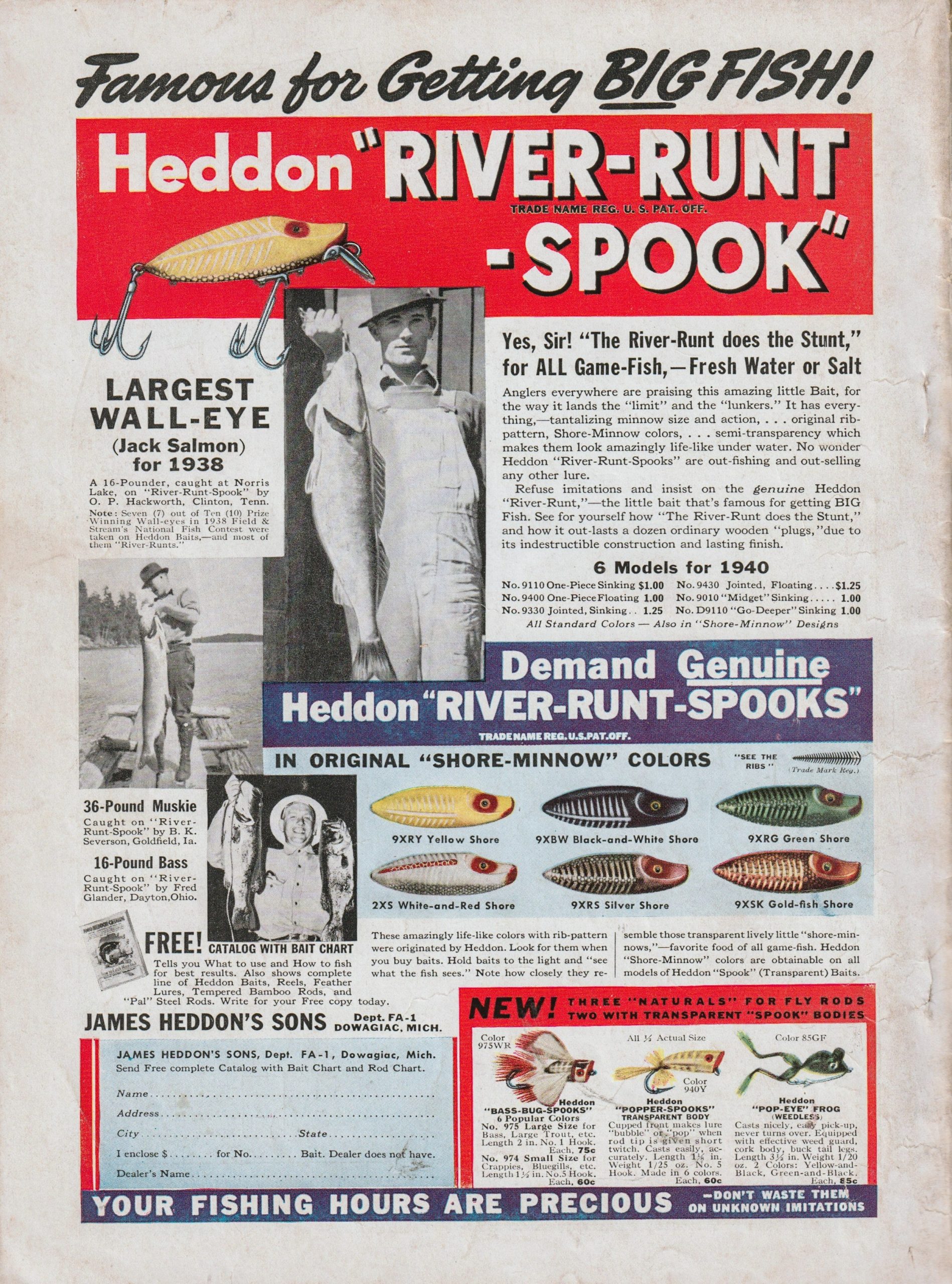
And finally we have the back cover ad, from Heddon. This wordy and image-laden ad highlights the popular Heddon River Runt Spook. Old company ads like this offered anglers a lot to read and a lot to daydream about, with their photos of successful anglers and text that described their products in detail. And there doesn’t appear to be too much “humbuggery” going on in this ad!