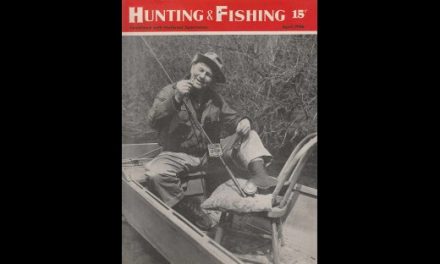

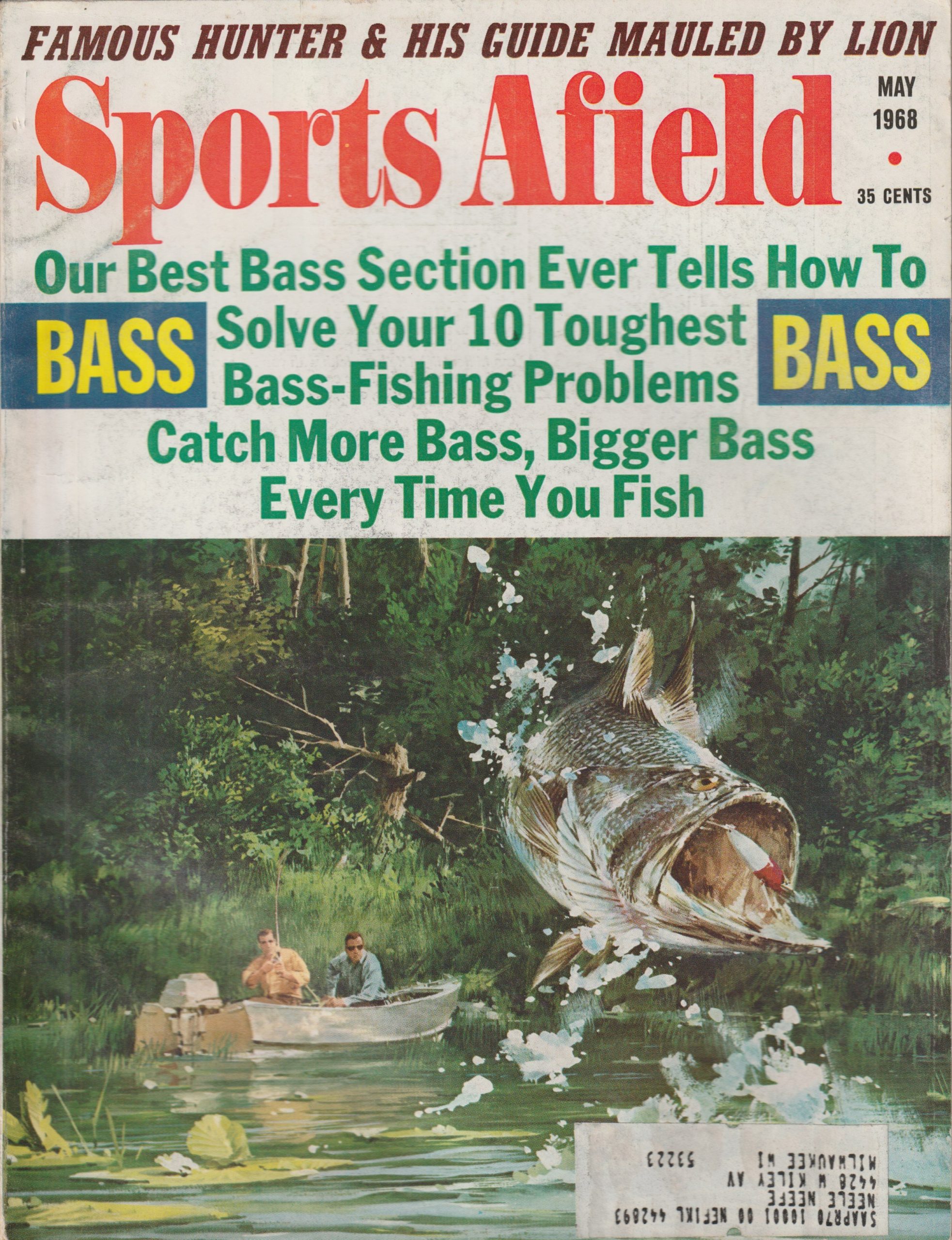
Homer Circle was a bass fishing icon, and one of the most influential writers of his era. As a kid, long before I discovered and knew of Jason Lucas (who Circle succeeded as Sports Afield Angling Editor), I knew of Homer Circle. He was the most popular angling writer of the 1970s through the 1990s. I have the May 1968 Sports Afield magazine, which was the issue introducing Homer Circle as their new Angling Editor. Circle held that position for 34 years, from 1968 to 2002. Terry Battisti provided a snapshot of Homer’s career in “Uncle Homer Through Garcia Corp,” so I won’t repeat Circle’s accomplishments here. But I will share with you this first issue’s impressive introduction of Homer Circle to the outdoor readership.
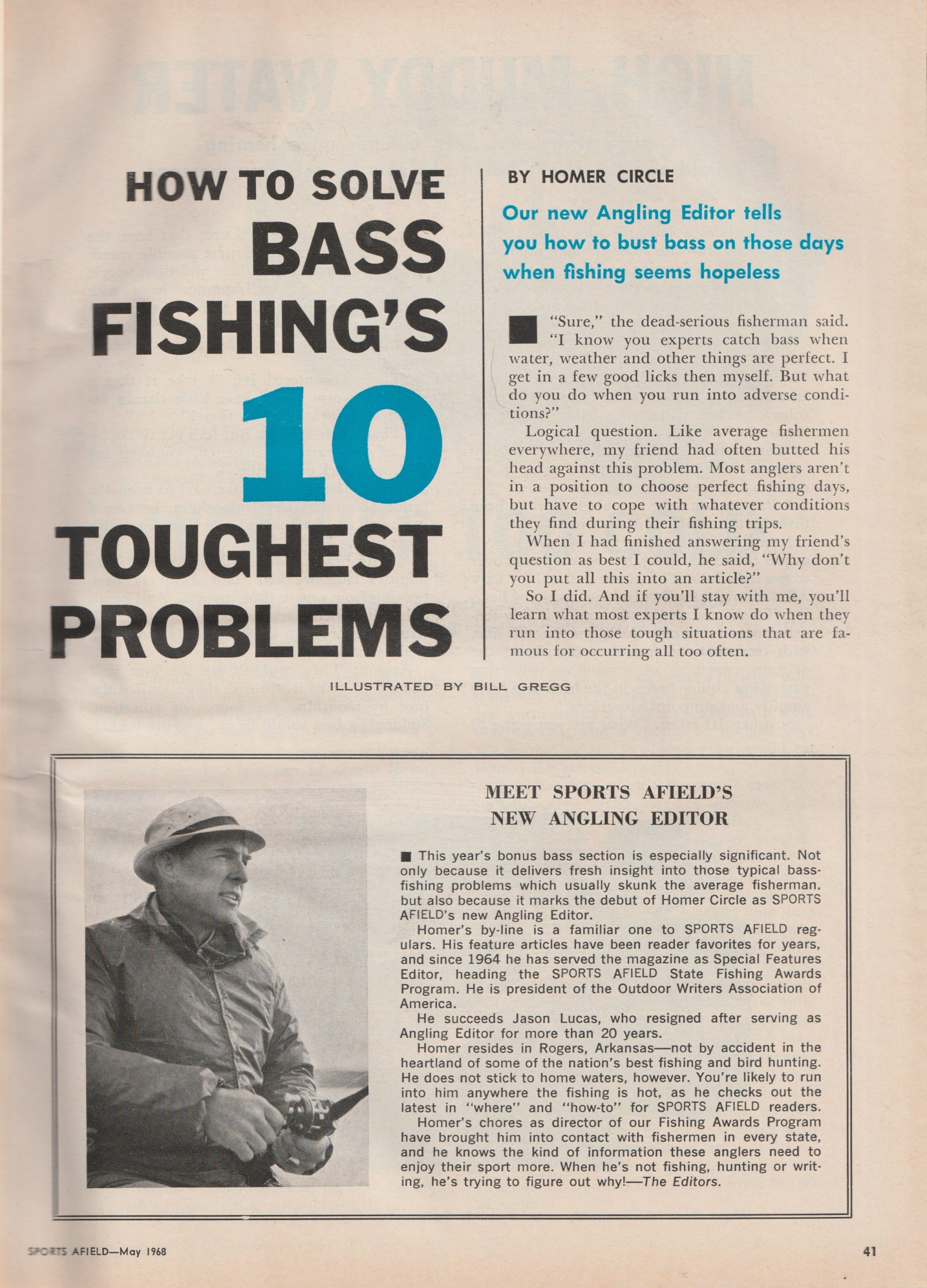
The cover highlights Circle’s contribution and impact with a big, bold header announcing “Our Best Bass Section Ever…” and a leaping bass cover illustration. Homer’s introductory article consumes 11 consecutive, full pages in the middle of the magazine, and is titled “How to Solve Bass Fishing’s 10 Toughest Problems.” This piece set the stage for what would be Circle’s main focus and passion over the next 30+ years: bass fishing. He would, of course, write about many other topics and species, but with this first article Sports Afield let it be known that their new Angling Editor was first and foremost a bass man.
The first page of Circle’s spread announces “Our new Angling Editor tells you how to bust bass on those days when fishing seems hopeless.” It includes a text box at the bottom introducing Homer Circle with a photo and “Meet Sports Afield’s New Angling Editor.” But readers were already familiar with Circle, as he had written several feature articles and served as the magazine’s Special Features Editor for several years prior to this new appointment.

The spread includes a page for each condition or “tough problem,” with excellent line drawing illustrations by artist Bill Gregg. The 10 conditions include:
- High, Muddy Water
- Weather Too Cold
- Weather Too Hot
- Lake Too Busy
- Fishing Unknown Waters
- Low, Clear Water
- Early-Winter Doldrums
- When Fish Go Deep
- When A Norther Moves In
- Too Much Wind
The first condition, “High, Muddy Water,” kicks off with what was Circle’s trademark sense of humor and easy-going, accessible writing style. He opens with “Driving a long distance only to find your favorite bass waters muddy is about as inviting as being in the bush for two weeks, then bursting through the door to find your wife with a mudpack on her face and her hair in curlers!”


Circle wrote in a way that not only brought a smile to the reader’s face but also instructed and educated him. That was probably at least partially why he earned the moniker of Uncle Homer. That and what by all accounts was his joyful, appreciative and friendly manner with all who knew or encountered the man. Writer Jay Cassell recounted longtime Sports Afield Executive Editor Ted Kesting saying of Circle, “There are two things you can always count on with Homer: 1) a ‘G or G’ joke — you’re either going to grin or groan at the inevitable joke when you pick up the phone and hear, ‘Oh Fritz, did you hear the one . . .’; and 2) ‘You can count on Homer always being there for you, in good times and bad.’”
Cassell continues with some thoughts from famed underwater filmmaker Glenn Lau:
“For 30 years I have had the privilege of seeing people light up when they meet this man. Everyone, from all occupations, feels honored when Uncle Homer takes the time to listen to their stories and share some of his own. He is without a doubt the finest humanitarian that I’ve ever met. He is what many of us would like to be, open and receptive to everyone.”
Bill Gregg’s illustrations are the perfect accompaniment to Circle’s writing. Their style speaks to the 1960s and early 1970s, and embody the kind of action and dynamism that reflected Homer Circle’s writing. I especially like his illustration for “Low, Clear Water,” with a bank angler caught in mid-cast from behind a tree as he tries to reach a prime bass spot.


Ray Scott also sung the praises of Homer Circle, saying,
“The bottom line is Homer Circle was an integral part of the success of BASS and bass tournaments because of his trust and faith in what I was doing. Ultimately he affected the whole sport. Thanks to him virtually every top writer of the time marched to the table. If Homer believed in it, it must be okay. People just didn’t think twice. He had that kind of following.”
“Really, there is no way I can measure Homer’s impact on me and the bass world. He was one of those indispensable figures that, luckily for me, appeared at the right place and the right time with the right stuff.”