Back a couple weeks ago we posted a piece on some of the bass lures of 1949. In that post we showed that copying in the industry is as old as the industry itself. Today in Eppinger and Johnson 1940, we’re going to dive a little further into two of the companies mentioned in that post.
The previous post opened with an ad from Tony Accetta and his Weed Dodger spoon. We then went into a new spoon that Eppinger designed called the Weedless Dardevle. I wasn’t able to find a patent for the spoon but I did find a patent for another spoon that was released in 1939 and posted the patent drawings with that article.
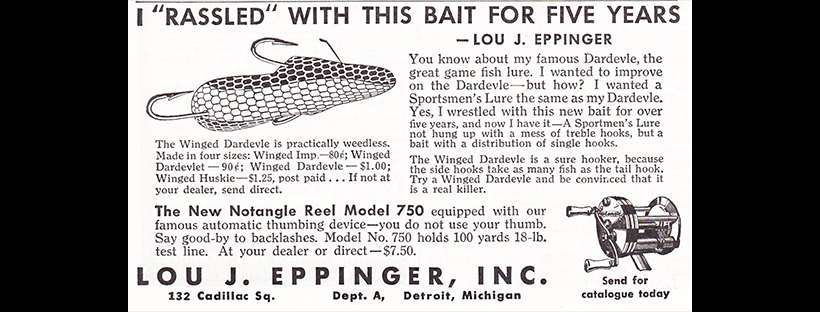
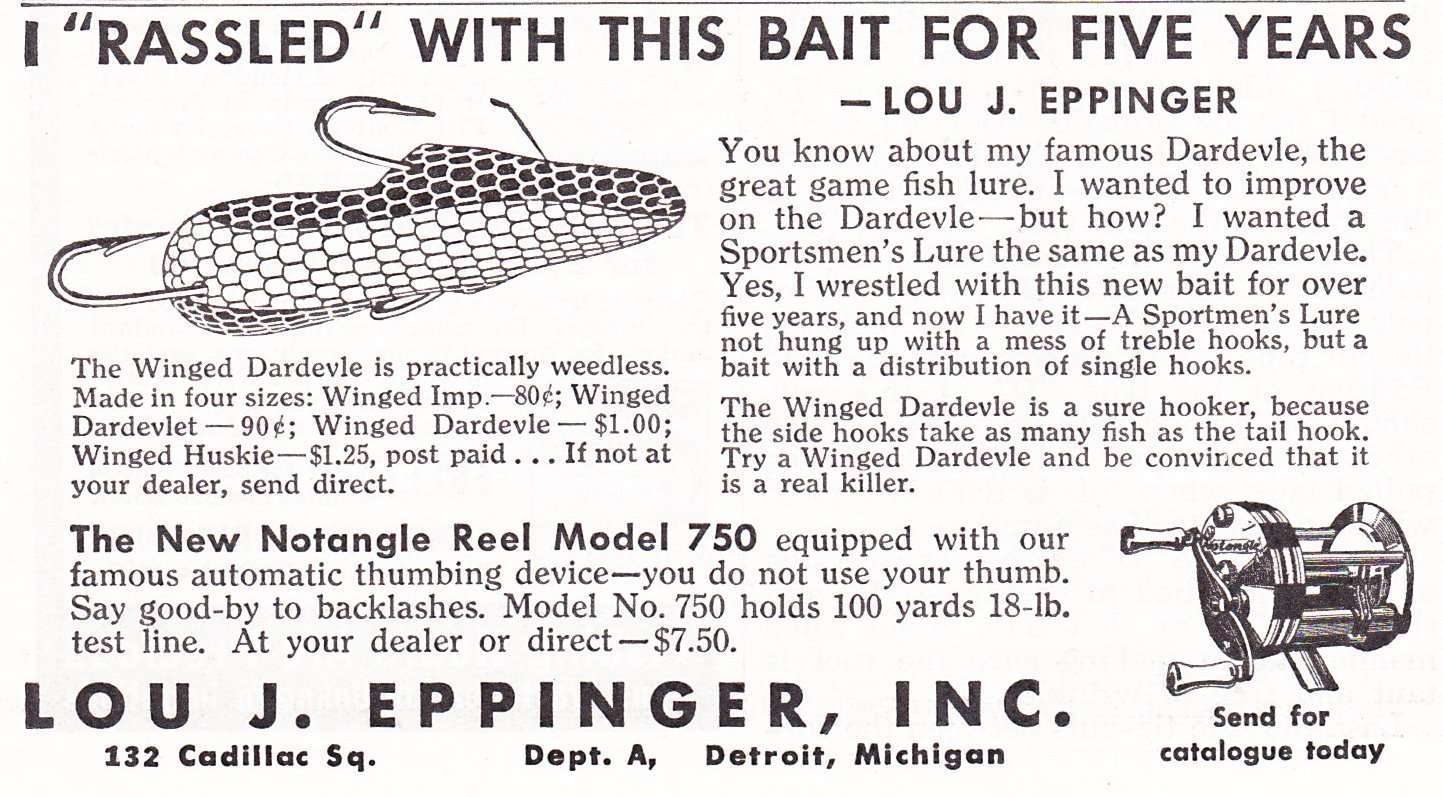
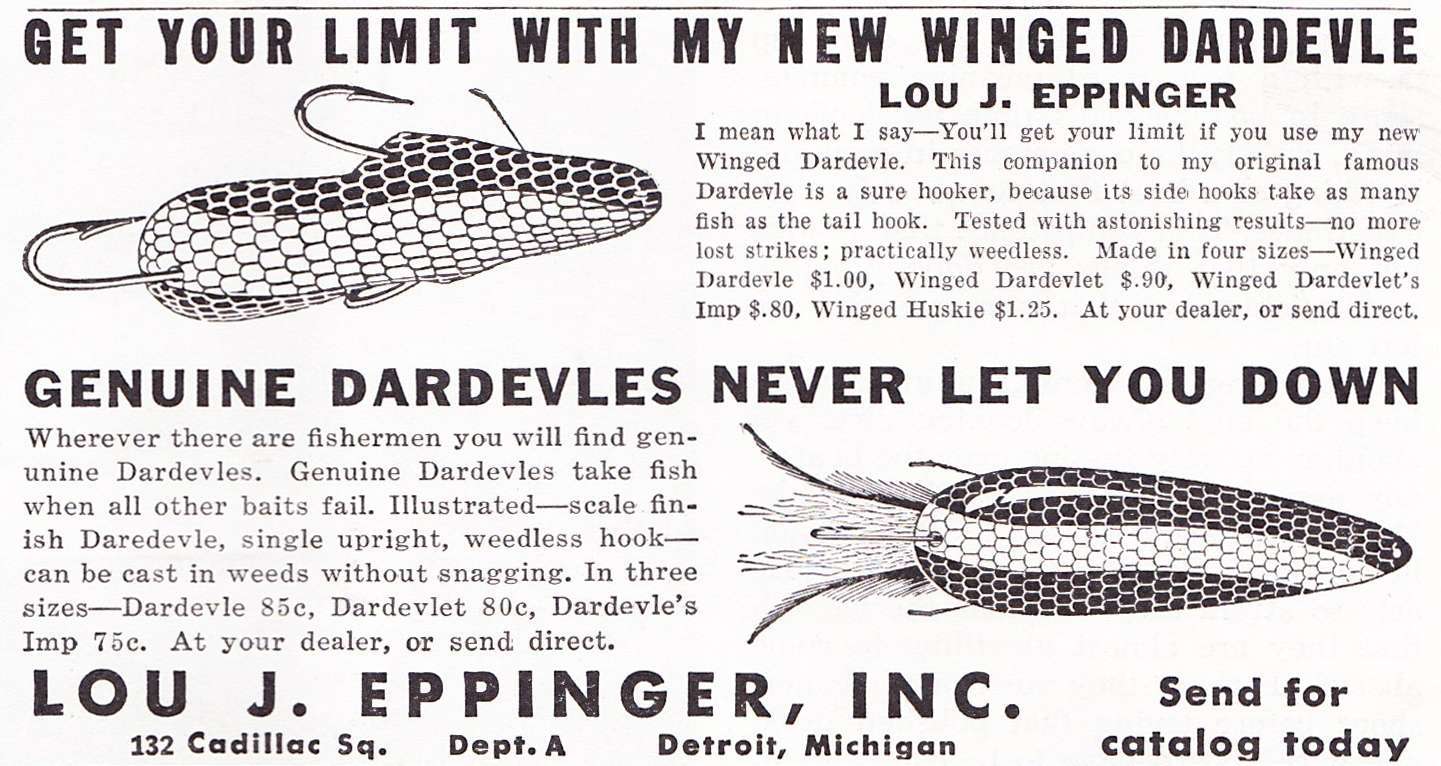
Today I have two ads associated with the Winged Dardevle. One was in both the May 1940 issue of Outdoorsman Hunter Trader and Trapper as well as the March issue of Sports Afield. The second ad was found in the June 1940 issue of Sports Afield.
According to the first ad, Lou Eppinger “Rassled” with the Winged Dardevle for five years before he was able to get it right.
Eppinger stated he wanted a “sportsman’s” lure that didn’t have a mess of treble hooks on it. His solution was a spoon like the Johnson Spoon that had wings and three single hooks. The bait also needed to be weedless and as he states in his ad, it was practically so.
This spoon deviates from Louis Johnson’s spoon in several ways. One, it’s a wider-bodied spoon the hooks are screwed into the spoon instead of welded, and the line tie is just a hole punched into the front of the spoon, where a snap or snap swivel could be added.
The second item in the first ad was for Eppinger’s new 750 Notangle reel. Eppinger reels are rumored to have been manufactured by Shakespeare. Although Eppinger had several models of reels, the reels are hard to come by and have become collectors’ pieces. So, if you find an old Eppinger reel, hang on to it.

The second Eppinger ad I found from 1940 also featured the Winged Dardevle but it also featured the Weedless Dardevle we discussed in the post from July 24, 2023. In that post we stated from the ad that this lure was new for 1949. Well, here’s an ad from 1940 that proves the weedless spoon was around at least nine years prior to that ad from 1949. Obviously more digging is going to have to be conducted.
The second company I wanted to I wanted to discuss was Louis Johnson and his Silver Minnow. This ad was prevalent in all the magazines I looked through for the year 1940. The standard for weedless spoons from its advent in 1923, through today, the Johnson Silver Minnow was the spoon everyone wanted to copy. It was that effective.
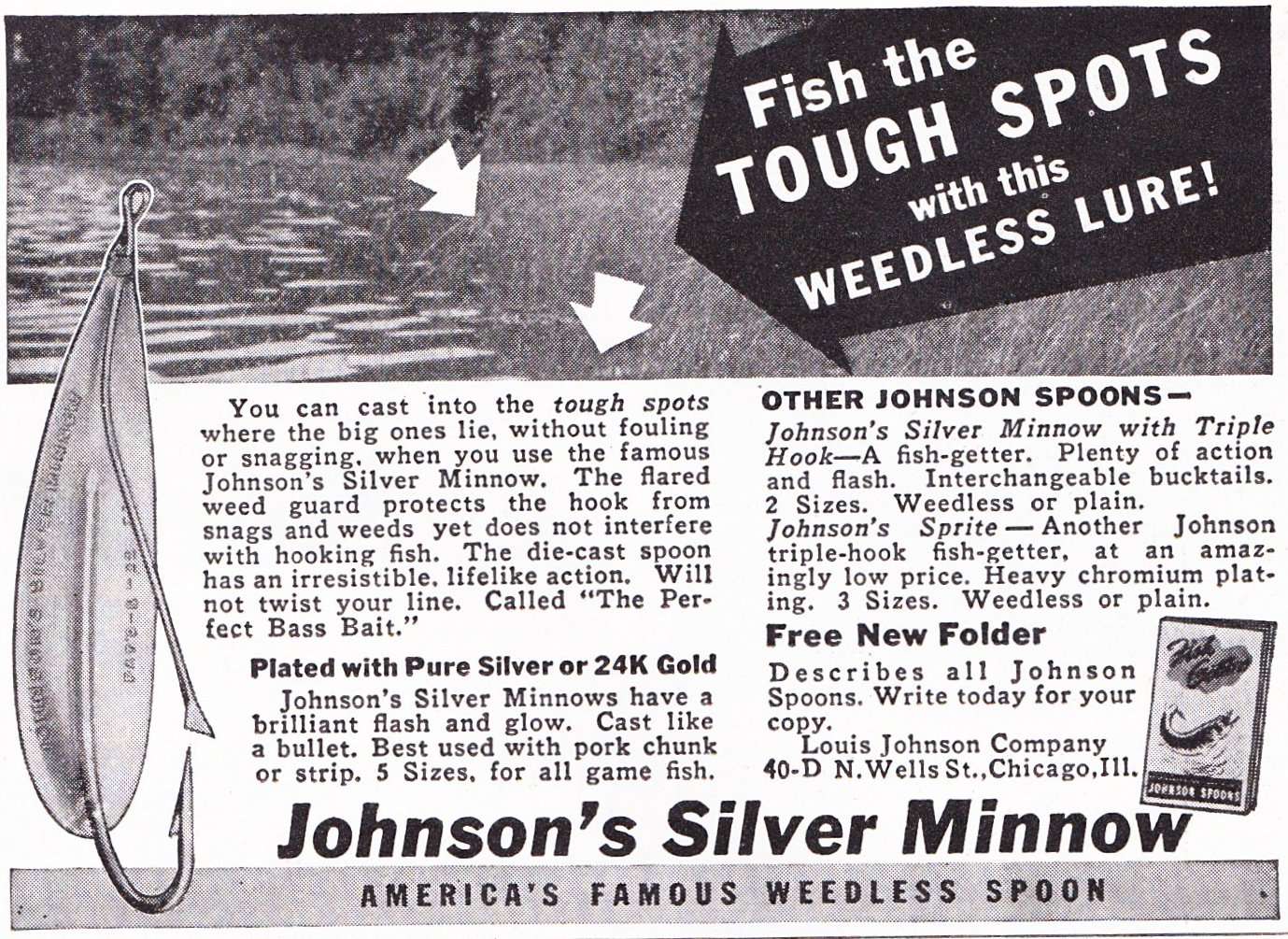
Johnson’s design was never fully copied to my knowledge. The hook was silver soldered onto the concave side of the spoon and the line tie was integrated with the weedguard and soldered onto the nose of the bait. This design feature put the line directly on the spoon without use of a moving snap or snap swivel. The spoons were then plated with silver or gold, including the hook.
Looking at the ad, you see Johnson is showing the prospective buyer exactly what kind of cover their spoons shine in, aquatic vegetation. No angler would ever throw a plug or a standard spoon into this type of cover without knowing they’d be getting hung up. But the Silver Minnow was made for this.
The weedless spoon is one of those baits that has lost a following over the last few decades. Its last glory was the 1978 BASS Masters Classic where Bobby Murray won the event using a rig called the Arkansas rig, which incorporated a Johnson Silver Minnow with a Hildebrandt spinner wire attached to it. Since then, the spoon has been relegated to old tackle boxes owned by anglers in their late 50s or older. Ask an angler who’s been at the game for maybe the last two decades what a Silver Minnow is and I bet you’re met with a blank stare.


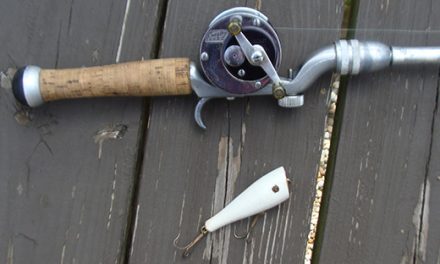



The Johnson Silver Minnow with an Uncle Josh Pork Frog was one of my dad’s favorite and most productive baits. They would still be effective today if only more anglers used them. Only issue with this bait was trying to get those plated hooks sharp!!