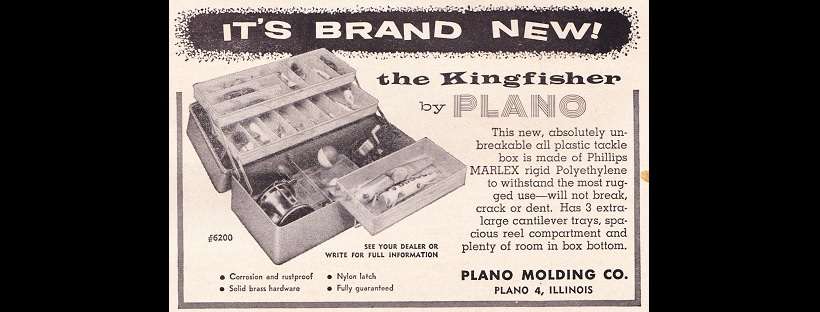

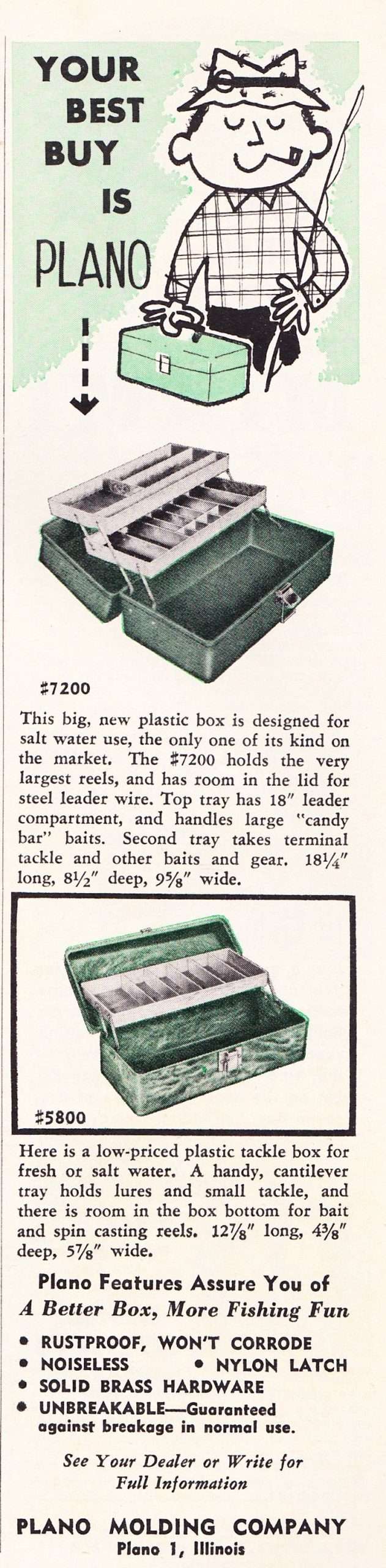
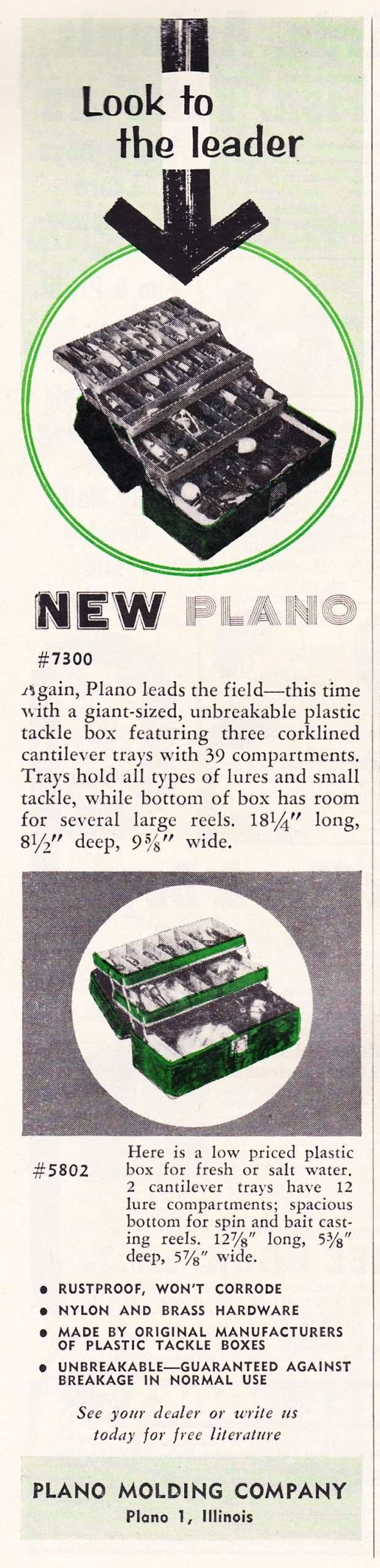
Today in Plano Molding 1958-61 we’re going to investigate one of the giants in tacklebox history and their offerings from the late 1950s to early 1960s. Through these four ads you’ll see the state-of-the-art in tackle management at the time.
Tackle boxes are both the bane and blessing of a well-organized angler. Over the course of the last 40 years, tackle management has taken on its own life in the industry, all to help anglers efficiently store tackle. But prior to the 1970s, tackle storage was limited mainly due to the lack of gear anglers carried.
In this era, bass anglers may have 10 plugs, a couple spinners, a few cards of plastic worms and some hooks and sinkers. All of which would easily fit into a simple toolbox style tacklebox. Of course there were expert anglers such as Jason Lucas, Homer Circle, and Stan Fagerstrom who carried multi-level hip-roofed boxes but anglers of that caliber were on the short list.
From the onset of the 20th century, most tackleboxes were fashioned from either metal, wood, or leather. Metal boxes were rugged but heavy and prone to rust. Wood boxes were also heavy and if not maintained properly would tend to rot over time. Leather was generally reserved for fly storage pouches and on the rare occasion a wealthy angler’s physician’s bag sort of tackle bag.
This sort of design carried on through the end of World War II until the use of plastics were brought into the fold. Prior to this there were a few companies that ventured into plastic tackleboxes, mostly for fly storage.
Plano started injection molding plastics in the late 1930s, eventually making the first recognized plastic box from rigid polyethylene in 1952. By 1958 they were the leader in plastic tacklebox manufacturing. Their designs were nothing new, taking the concept of cantilevered drawers from the metal and wood box companies and blending them into their plastic boxes.

How their boxes differed, though, was in their weight. They were much lighter that their metal and wood competitors, except for maybe the companies that produced aluminum boxes. But here they competed by having a better price point.
Plano’s claim that their boxes were unbreakable was a little extreme but where they did shine was in their ability to fight rust. They used brass fittings for hinges and hard nylon for latches, creating a rugged box for both fresh and saltwater use.
The next improvement Plano made wouldn’t come until 1974, and it was a much-needed improvement.
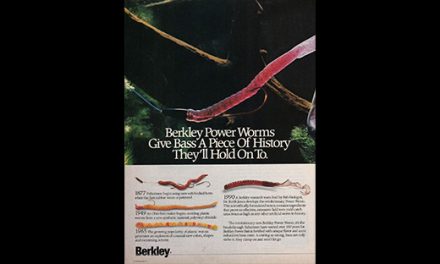
In 1949, Nick and Cosma Creme arguably invented the plastic worm out of polyvinylchloride, or PVC. The plasticizer used in this new genre of baits wreaked havoc on the new plastic boxes of the day, melting them into a sticky mess. Then in 1974, Plano started making boxes out of Acrylonitrile Butadiene Styrene, or ABS. This polymer was impervious to the plasticizers used in PVC and thus would not melt in the presence of what was now the ubiquitous plastic worm.
Still, in 1974, the design of tackleboxes had not changed much since the late 1950s.
Then in 1976, with the burgeoning bass craze hitting and a more diverse set of storage requirements needed, Plano came out with their sliding drawer-style boxes. From there they started manufacturing what would become known as single- and double-sided utility boxes as well as specialty boxes for crankbaits and spinnerbaits.
Since the 1980s and through today, more single sided utility boxes are sold compared to all other boxes combined. This is singlehandedly because of the advent of bass boats and their storage requirements. I often wonder what Jason Lucas would think looking into the storage compartments of today’s bass boats and the volumes of tackle held within their confines. Would he smile in agreement or would it be a cynical smile. I’m thinking the former due to the size of the box he used to use.




Being a somewhat OCD/anal organizing weirdo, I have a genuine love for tackle boxes and storage/organizing systems. I’d love to see more articles on the history and development of tackle storage systems (I know you’re saying to yourself, maybe I shouldn’t pine for them but should just do some research and writing myself! Okay, okay!). This article is excellent – concise, to the point, and really laying the foundation for more tackle storage pieces. Tackle boxes are a very cool collectible in their own right (I’ve always got my eyes open for old tackle boxes when I’m flea marketing or thrift store shopping), and their development traces one of the parallel arcs through the history of bass fishing. Really great stuff, Terry.
Hey, David. Sounds like you and I both have a tackle organization sickness. I couldn’t agree with your comments more. At least we are in good company, the late( and great) Aaron Martens shared the same tackle fetish we are afflicted with. I always say, if you can’t go fishing, puttering around with and organizing your tackle is the next best thing!