
Over the course of time we have posted several articles on bass rods and reels from our past. Today we’ll add to that list of growing articles with a piece titled, Unique Bass Rods 1949.
So, what makes a rod unique, you might ask. To every angler today that’s under the age of 40, pistol grip rods, which dominated the sport from the early 1900s through the 1980s, are most likely unique. To me and every angler over 40, they’re tools that worked exceptionally well.
Another example might be some of the old materials used to make rods, such as bamboo or steel. Or what about the use of the spiral wrap, also know as the Roberts Wrap, on casting rods.
What we’re going to cover today are three ads, taken from Sports Afield’s 1949 May and October issues. These ads really show some unique rod concepts that never really took hold for more than a few years. There’s one of them that I’d like to get, just to have, and maybe even fish a little with. The other, well, I’d just hang it on the wall as a conversation piece.
Let’s get on with the ads.
Markle Featherlite Unique Rods and Reels 1949
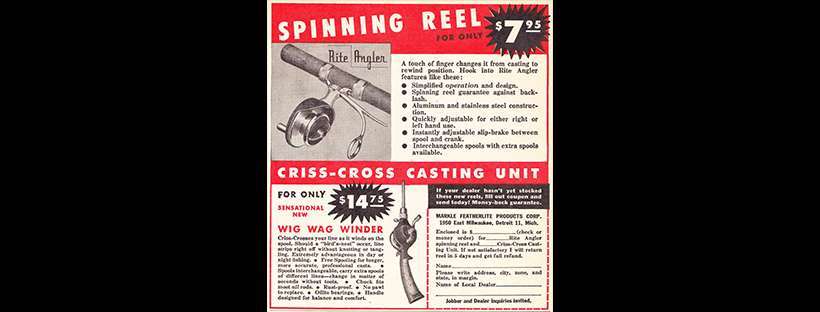
An oxymoron in today’s world of 2-ounce rods and 7-ounce reels, Featherlite was a big player in the industry in the 1940s through the 1960s. In fact, most custom rod builders in the day used Featherlite pistol grips on their rods because they were so durable and light. The lead-in ad for this piece features two products by Featherlite guaranteed to make your bassin’ better.
First off, we have the Rite Angler spinning reel. I’ve seen this little critter in person before but haven’t had the opportunity to cast it. It’s essentially a spinning reel spool placed on a post that flips 90 degrees through a lever.
To cast the reel, flip the lever and the spool goes into position like any other spinning reel. To reel in, flip the lever again and the spool turns 90 degrees allowing the angler to use the handles to reel in the line. Simple concept.
The problem I see with this reel is the gear ratio, or lack thereof. For all intents and purposes, it is 1:1 all day, every day. The other inherent problem was with the mechanism that rotated the reel from casting to reeling position.
During my tenure at the tackle shop, we had a few of these reels come in for service and repair. In the late 1970s the reels were around 30 years old and had seen good use. Invariably the spring and mechanism that allowed the spool post to rotate was either clogged with dirt, had dried out grease, or the spring was broken. Sometimes all that was needed was a good cleaning and lube, but even then, the reel didn’t like to lock in either position. Maybe this was due to wear or a worn spring.
The next contraption Featherlite is trying to sell is their integrated pistol grip and reel, also known as the Criss-Cross Casting Unit. This one was new to me. I’ve never seen one let alone fished with one. The ad states that the CCCU would fit the ferrule of nearly all casting rods on the market.
The ad states that the CCCU has a Wig Wag Winder, in other words a levelwind. that evenly distributes line on the spool. This allowed a “bird’s nest” to be stripped right off without knotting on tangling. I don’t buy it. As respected as this company was during the day, I think they let this get away from them.
They say there is no need to ever carry extra pawls as the reel doesn’t utilize them. But what about the mechanism for the Wig Wag Winder? That must be more complicated than a standard Marhoff levelwind system. I would like to see one just so I could take it apart and see how it worked.
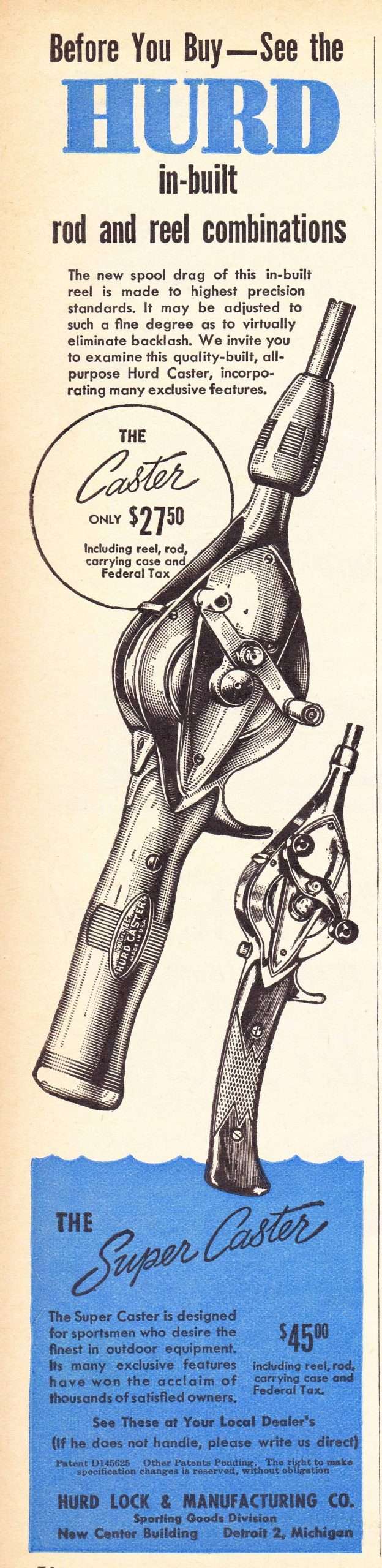
Hurd Caster and Super Caster Unique Rods and Reels 1949
The next ad was from a company called Hurd Lock and Manufacturing and they were selling their two rod/reel combos, the Hurd Caster and Hurd Super Caster. Now this rod/reel combination looks an awful lot like the Featherlite Criss-Cross Casting Unit with the Wig Wag Winder and Kung-Fu Grip, but it is not.
This integrated rod and reel were top quality and from the anglers who I have spoken with who used them all swore they were great to fish with. They don’t say in the ad what the rod itself is made out of but a quick Internet search confirmed my suspicion it was made of steel.
The rod came with three guide and a tip top and, of course, the rod/handle combination. Like I said above, I have talked with several people who used this rod and each one of them said they were well built and served their function well.
The company made the two rods from 1940 to 1951, and I would assume that there weren;t many made during the war. Wood scales were placed on the Super Caster handle from 1945 to 1946 and after that they were replaced with plastic scales, most likely made from Bakelite.
The rod itself was made from surplus World War II tank antennas and the reel was made from aluminum and steel. What I’ve found searching the Internet, the reel was as good as any made in the day, rivaling those made by the Kentucky watch makers, only this was made by lock makers.
I couldn’t find out why the company stopped making the rod/reel, so any answer is a guess. On thing is for certain, it is unique makes me speculate whether Featherlite copied the concept from Hurd to make their crazy reel/handle.
Waltco Products
The next company I’d like to introduce is Waltco, not to be confused with Ronco. The Waltco Stubcaster casting and trolling rod was beyond unique and featured a short, steel coiled rod shaft. The rod and pistol grip measured out at only 21 inches in length and had only one guide, the tip top.
One of Waltco’s claims was the “patented coil spring gives thrilling, live 5 ft. action.” Uncoupled from the handle, it broke down to only 14 inches in length.
Another of their claims was the shorter casting arc meant more accurate and longer casts. I might bite on the accuracy claim but the distance claim, no way.
I looked for some info on the rod and couldn’t find anything in my reference books or on the Internet so I hit up my friend and historian Bill Sonnett, to see if he knew anything about this unusual rod. His reply was this.
“The Stubcaster was made by Waltco–the same people who brought you the Ny-o-Lite spinning reel (see page 56 Vol. Two, of my book, Deconstructing Old Ads). That should tell you all you need to know.”
Bill’s experience with the Waltco Ny-O-Lite reel wasn’t good. His best friend’s brother had purchased one in 1957 and Bill had the opportunity to cast it a few times on one of his fishing excursions. Bill’s description of the reel, taken from his book was:
“It sounded like one of those small grinders my mother used to chop nuts.”
Bill, was that with or without the nuts in the grinder?

After reading the ad and talking with Bill about Waltco and their products, it made me wonder if Walt and Ron Popeil were related. Popeil’s Pocket fisherman, although developed some 15 years later, would have fit in nicely with these unique rods and reels from 1949.
That about does it for today’s post. Tomorrow we’ll get back to some real rod and reel ads from 1949. Unique Rods and Reels 1949