

Here’s a piece I’ve been wanting to write for a while now. I frequently get into discussions about when swimbaits or big baits were first made and often a French lure is mentioned. Today in Vivif 1960 we’re going to talk about this unique French lure and its contribution to the tackle industry.
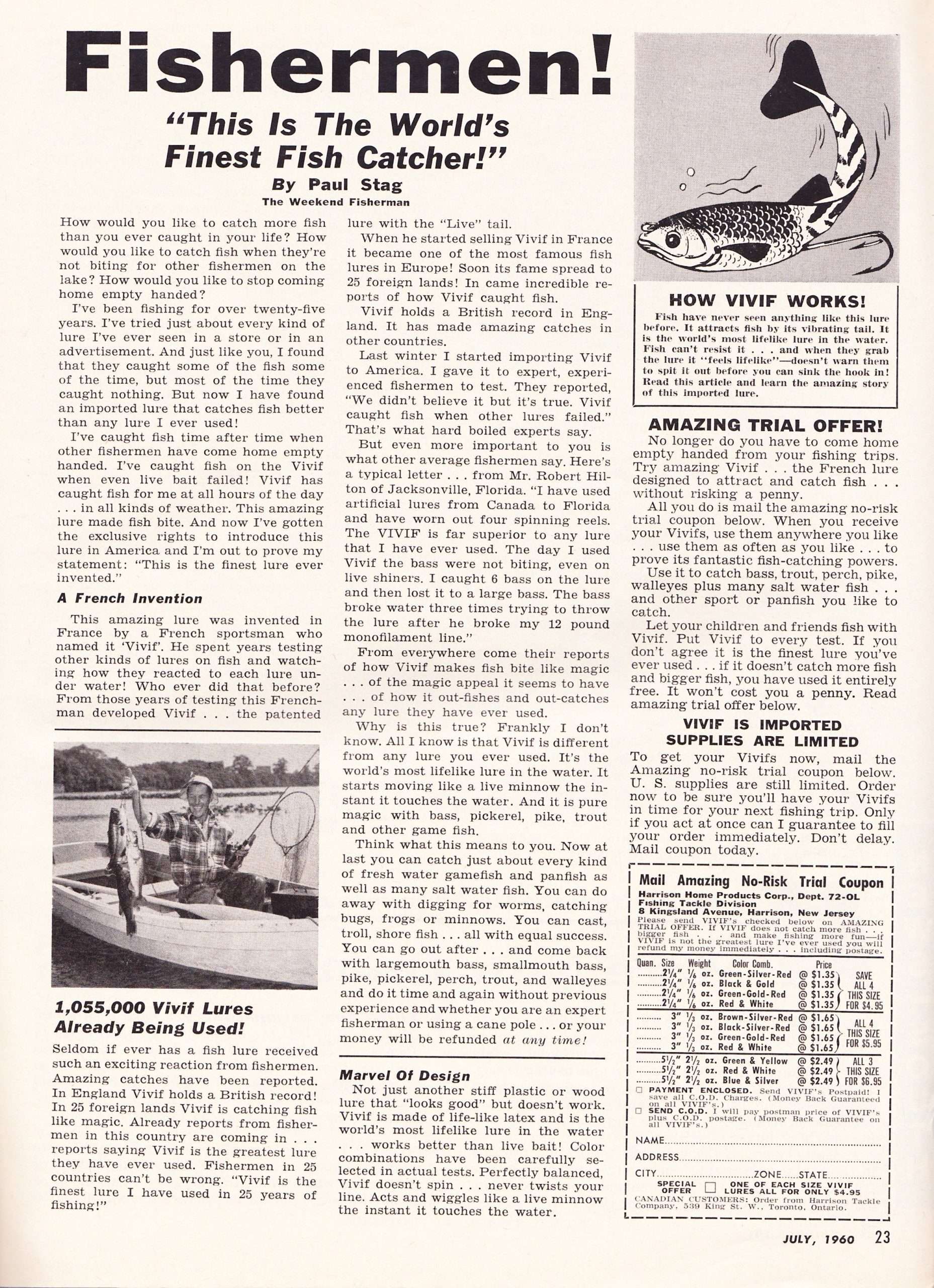
The ad referenced in this post date from 1960 and was found in the July issue of Outdoor Life. According to the ad, the Vivif was imported from France by Paul Stag, an outdoor writer, the winter prior to this ad. The year of the development of the bait is not given.
In the write-up, Stag states that prior to bringing the bait in volume to the U.S., he had expert and experienced anglers try the lure out with great success. But where he gets a bit cheeky is in the paragraph below when he states:
“But even more important to you is what other average fishermen say. Here’s a typical letter … from Mr. Robert Hilton of Jacksonville, Florida. ‘I have used artificial lures from Canada to Florida and have worn out four spinning reels. The Vivif is far superior to any lure that I have ever used…..”
First off, I bet Mr. Hilton didn’t like being called an average fisherman, and second, it’s presumptuous for Stag to consider himself an expert. But we have to remember, this was back in the day that outdoor writers were considered the experts and those who weren’t writers were novices. How things have changed.
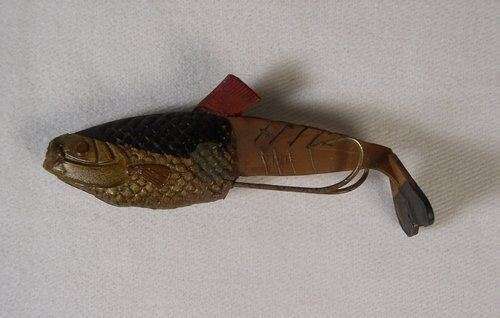
The Vivif was arguably the first boot-tail bait to be manufactured. It was cast out of latex rubber with a weight in the body for ballast and a through hole to tie onto the double IP hook that was provided. It was made in three sizes from 2 1/2 inches to 5 1/2 inches in length.
It was touted as both a fresh and salt water lure, although the heavy Mustad double IP hook didn’t really lend itself well to setting the hook with light lines.
I have no doubt the bait caught fish and I know people who swore about its effectiveness in the saltwater. I just never heard of anyone using it for freshwater bass.
The only baits I saw as a kid, which were probably at least a decade old, hung on the wall at the tackle shop I worked at as a kid. Rigor mortis had set in on these baits years before I became acquainted with them, to the point they were brittle and bending them would cause cracks in the latex.
They just hung on the wall for years, having birthday after birthday. Every once in a while, a customer would comment on them, how they used to catch fish in the ocean fairly well “back in the day,” but that was about all I heard about the lure.
At this time, Mister Twister had come out with the Sassy Shad and its effectiveness was being proven all over the southland. In fact the 3-inch Sassy Shad became a staple flipping bait at Lake Elsinore, which has a huge population of shad.
That about sums up my knowledge of the Vivif.
Then around 1986 a few local anglers started catching big bass on 12-inch Worm King Dinosaur boot tails. These baits were made for the saltwater but due to the local trout plants, anglers started experimenting with the overgrown Sassy Shads. And they worked.
From the mid-1980s through the early 1990s big baits became a secret weapon of trophy hunters in southern Califorinia. There was the softbait crowd, the hardbait crowd, and the anglers that used both. Eventually the name swimbait was adopted for both hard and soft baits.
The old forgotten Vivif, the first boot tail, would never have been considered a swimbait due to its size. There was an unwritten requirement for a bait to be considered a swimbait. It had to be at least 8 inches in length and resemble a trout.
Then starting around the early 2000s, tackle manufacturers jumped on the “swimbait” bandwagon. Due to their need to sell product on a national basis, they defined the swimbait as anything that was shaped like a fish, didn’t have a lip, and /or had a boot tail. It didn’t matter if it was 2-inches long or 10-inches long.
Still today I get into discussions as to whether the certain old lures, like the Vivif, were the first swimbaits. In fact, my buddy Ken Duke, considers some of the early Creek Chub lures swimbaits. Of course he’s wrong. But I don’t let that hinder our friendship.
The Vivif, although arguably the first boot tail softbait, is not a swimbait by the true definition. But it did change the face of lure design, albeit it took a couple decades to catch on.




I saw these advertised in the early 1960s and just had to have one. I was 13 at the time and would get money for lures by scrounging and returning those old green coke bottles. Well the lure cost $1.65 as I recall. Big money for me back then when crank baits and stick baits ran $1,10 to $1.25. Well I got one, took it to the 4-5 acre pond in the cow pasture behind my sub division and tried it out. My first couple of fish produced nothing but the third trip I caught what back then was a trophy for me, a fat three pound bass. The biggest I’d ever caught up till then. Unfortunately I lost it shortly after that, hung on a snag, and decided it wasn’t enough more effective for me to invest more in them, especially since, being young and broke, my favorite lures, were 25 cent nickel plated spoons. I caught a bunch of fish on them.