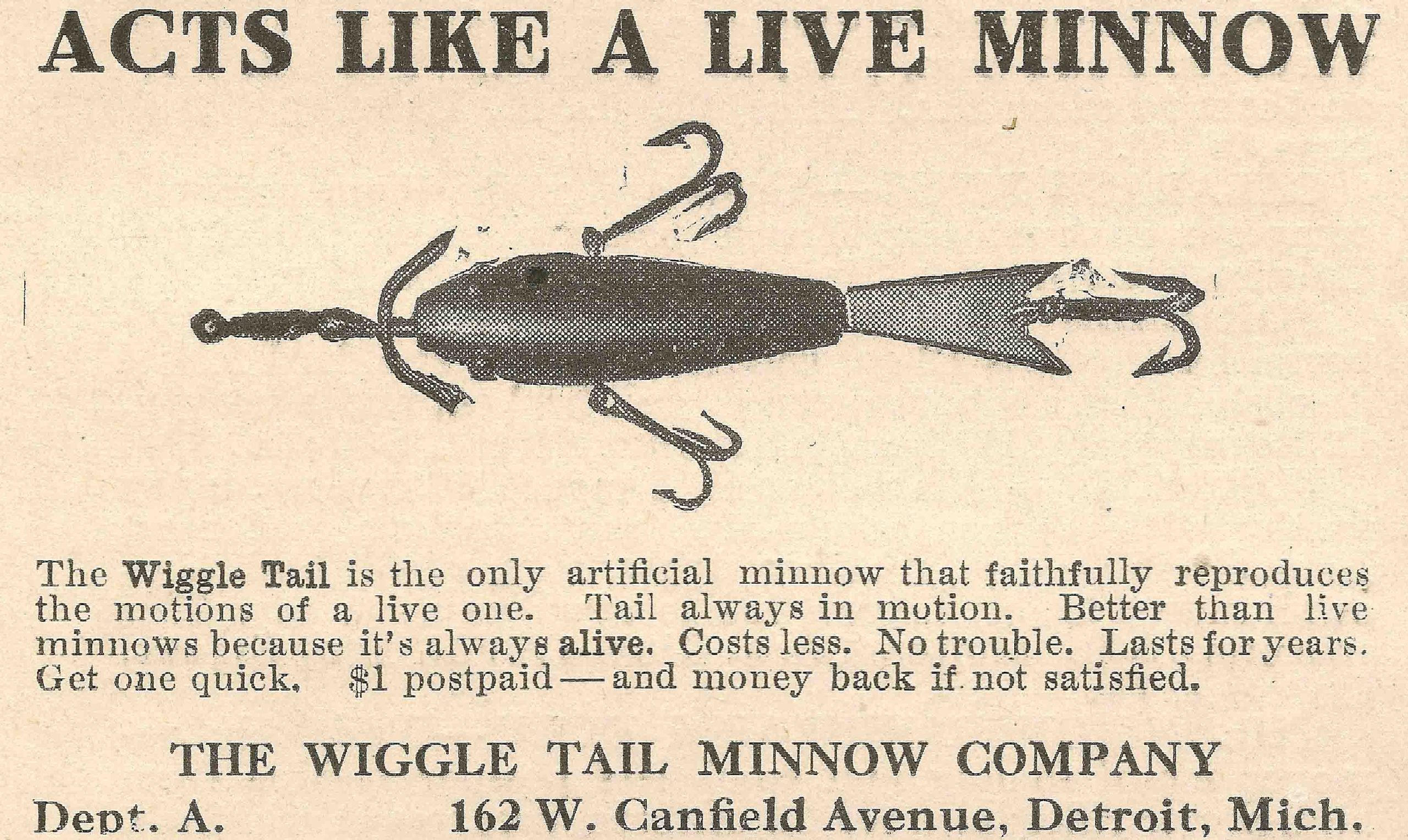
About three years ago, at a Northwest Ohio lure show, someone asked me to look at an early wooden minnow that an antique dealer had in their case. After looking at it, I was initially puzzled by its odd appearance and size. The strange, elongated aluminum tail made the bait seem much larger than it was. It was only after a few minutes that I began to connect the dots between this bait and a somewhat mysterious advertisement that appeared quite often in 1912-era outdoor magazines.
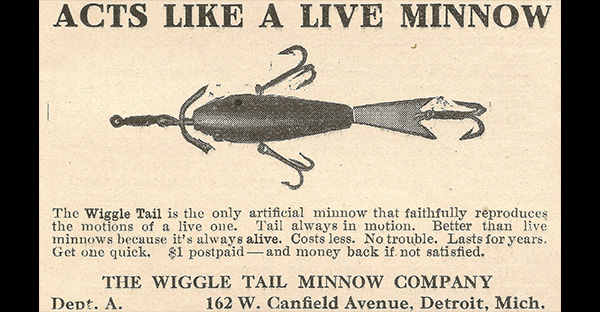
I had been asked not long before that time by a collector of early outdoor magazines if I had ever seen the bait called the Wiggle Tail Minnow. I admitted that I had never seen the minnow and, in fact, at that point I knew of no examples. We both were scratching our heads over the fact that though this advertisement appears over and over in 1912, one never sees the bait.
One of the aspects of the actual minnow I was holding that made it seem different than the one in the advertisement was its size. The advertisement itself is always small and contains nothing to indicate how big the bait in the photo is. It had always seemed to me to be a fairly small lure.
The part of this encounter that I valued was to see just how the bait worked. This is something that is only hinted at in the advertisement. The front spinner did not rotate freely on a shaft as in most baits of the era, but was fixed to the shaft, causing the entire shaft to turn freely through the length of the wooden body. The large aluminum tail piece was fastened to the other end of the shaft at the back end of the wooden body. The tail turned with the shaft and was fastened to it in a fairly loose fashion that would cause it to “wiggle” (more like flutter) in a somewhat frantic fashion. Hence the name “Wiggle Tail”. Though the bait came with a box swivel on the front, experience would indicate that the rotating shaft with the fixed spinner would make this lure a “line twister” of the first order.
After asking many knowledgeable collectors about the Wiggle Tail Minnow it appears there are less than a half dozen known in collector’s hands. The natural question is how could a bait advertised so often be so rare? I believe the answer involves several things. Some that we seldom take into consideration these days.
The price of the Wiggle Tail is given as $1 in the ads. In that same year of 1912 one could order a beautifully finished Heddon #150 (a popular 5-hook underwater minnow) postpaid for 75 cents. There was absolutely no comparison in finish and overall quality between these two baits.
The average plumber, shoemaker, lumberman, farmer, and factory worker in 1912 made approximately $600 a year. Society was very stratified by income, and outdoor magazines tended to cater to a particular segment of society. National Sportsman Magazine, where most Wiggle Tail ads appear, was the magazine of the common man. A 1912 dollar has been calculated to be worth about $32 in today’s world. I don’t know many people today willing to spend $32 on a lure they are planning to fish with, and at present the so-called “middle class” (who could afford it) is a much larger portion of American society.
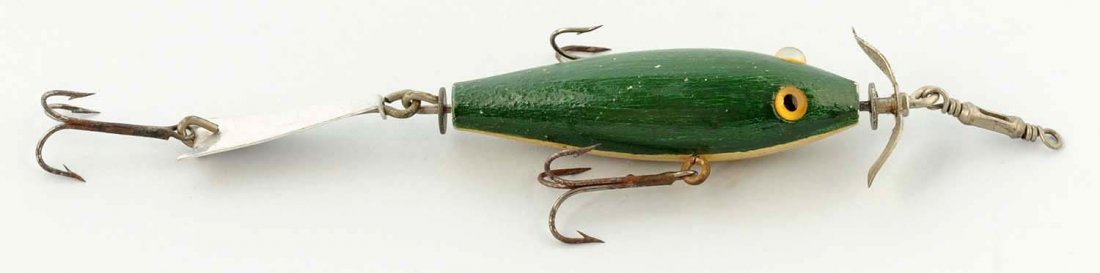
So, we have a somewhat roughly finished, overpriced bait made in an obscure (probably back room) shop for not more than a year or two at most. Combine that with a fairly uninspired advertising campaign and you have a recipe for few sales. All this, of course, means that those collectors who are interested in early baits (and who can afford it) get very serious when such a bait comes to the market.
At the October 2015 Morphy’s Auction a near-mint Wiggle Tail Minnow was offered, and the pre-auction estimate was $8,000 to $10,000. I thought at the time that this seemed high. To show what little I have learned about auctions in over 50+ years of collecting vintage tackle, I was stunned along with many other collectors, when this example sold for more than $23,000!
Tight Lines,
“Wild” Bill
If you’d like to read more from Bill, please click this link.