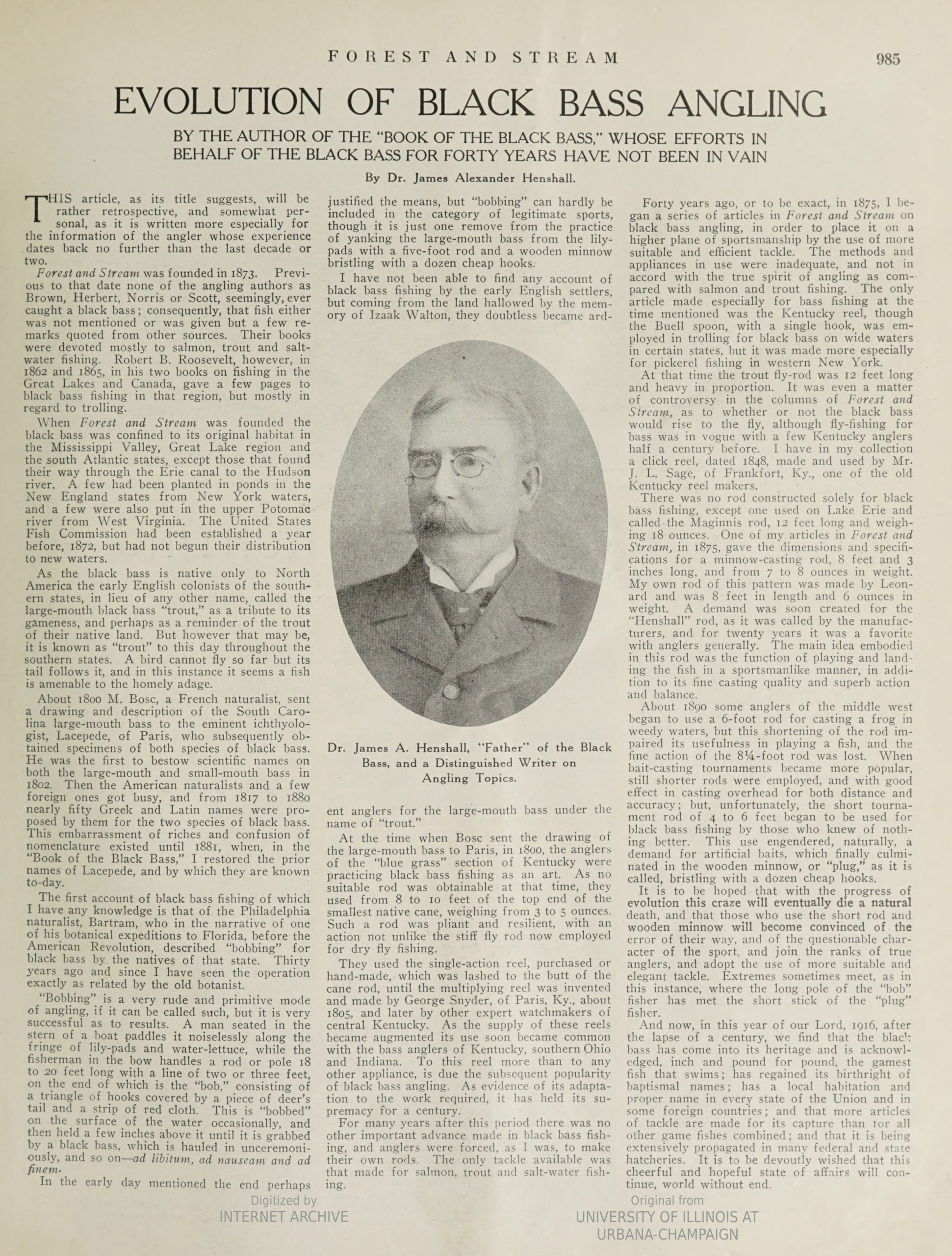
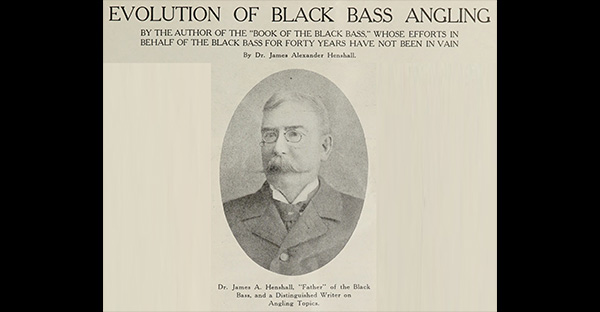
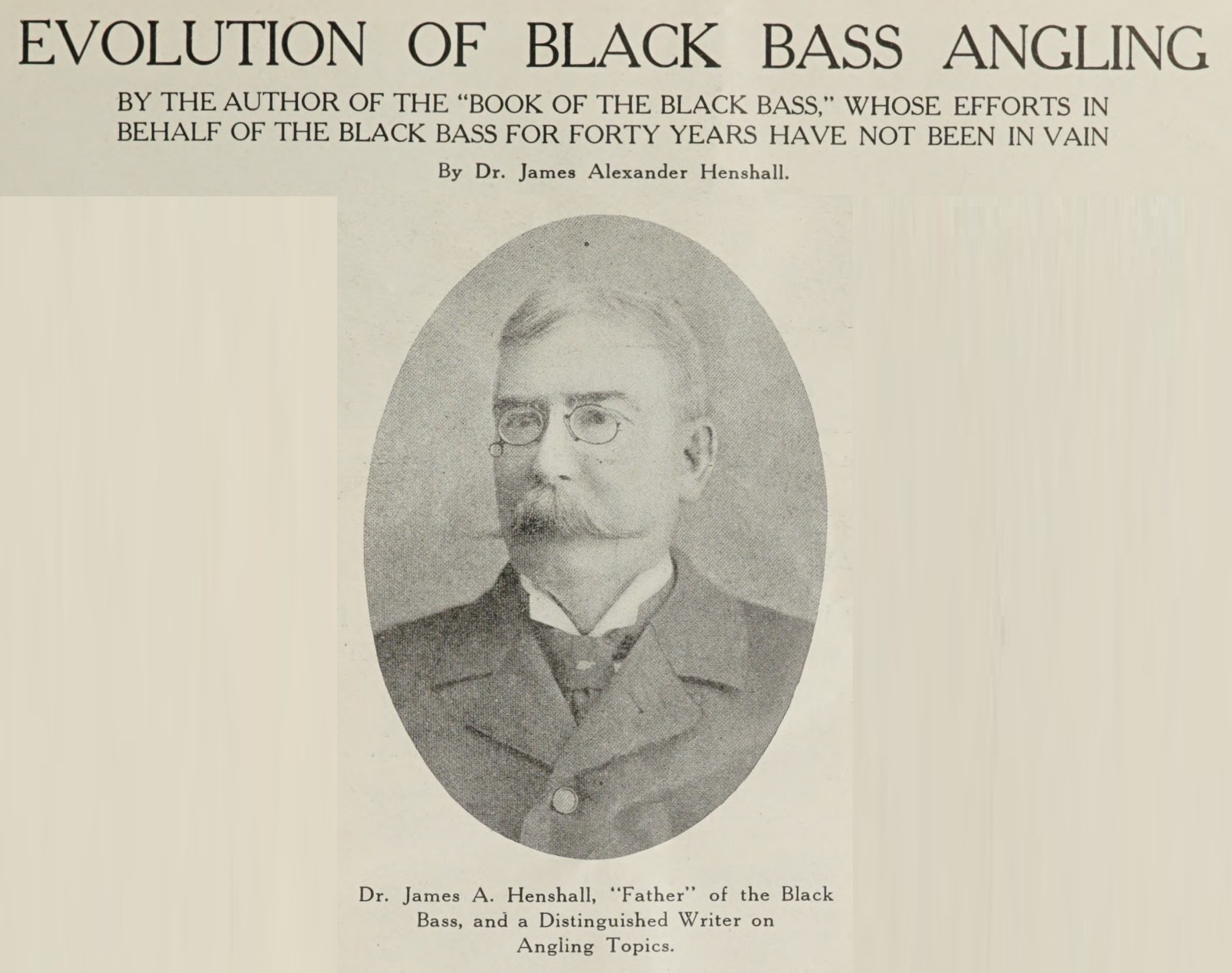
In today’s post, The State of Bass Fishing 1916, we’re going to look at an article published by Dr. James A. Henshall. The article was published in the June 1916 issue of Forest and Stream and gives Henshall’s opinion of the evolution and state of bass fishing at the time.
If you’ve hung around here very much, you know we are sincere supporters of Dr. James A. Henshall and all he did to make the black bass not only America’s fish but America’s predominant game fish. His phrase, “Inch for inch, pound for pound, the gamest fish that swims,” is the most repeated quote in the sport and is what set the bass on a trajectory way beyond the weaker trout.
Without argument, Henshall is the father of modern bass fishing. His dedication to bring the bass to the forefront of the public angling eyes is cataloged in his writings and his physical works. His books, Book of the Black Bass (1881) and More About the Black Bass (1889), were the first of their kind on the species and launched Henshall’s quest to glorify the black bass.
In his books and the hundreds of articles he wrote on the subject, Henshall talked about the black bass as the most cunning of sport fish. He designed rods specifically for catching them, leaders, casting techniques, and provided seasonal tactics for both still waters and rivers.
He lifted the work of the Kentucky watchmakers who invented the baitcasting reel into the public eye. In fact, it was most likely Henshall himself that coined the term “bait casting.”
But reading Henshall’s take on the state of the sport in 1916 kind of left a sour feeling in my soul.
The article, Evolution of Black Bass Angling, isn’t what I’d call a talk on the evolution of bass fishing. More so, it’s a show of disgust at how bass fishing had developed over the years since his treatises were written.
Henshall even writes in the first few sentences that the article was, “retrospective and somewhat personal.”
There’s no doubt it was personal.
By 1916, Henshall was 80 years old, was still with the U.S. Fish Commission, and with failing eyesight, still writing for angling magazines. In other words, he still has his finger on the pulse of bass fishing.
Hence his sour taste.
Henshall was committed to the bass and felt that because of their lofty stature, should be angled for with respect. His Henshall Rod, which was 8-feet, 3-inches in length, provided an action more like a fly rod. He was a light tackle addict before light tackle was cool. He believed a fish such as the black bass should be fished with light gear, so as to give them a chance.
Henshall would lob cast minnows under bobbers for bass, and play them for as long as 10 minutes before bringing them to net. He practiced catch and eat, but after a couple fish in the creel, released everything.
So, in the early 1900s, when tournament casters figured out that shorter rods were more accurate, anglers started utilizing them for fishing. Then the advent of the plug, often adorned with up to five treble hooks, made its way into the bass fishing lexicon.
Henshall despised both.
Not only did Henshall despise short rods and plugs, but he also wasn’t a fan of the cane pole and “bobbing” (jiggerpoling), the first form of bass fishing known to exist.
I was talking with Ken Duke about this article a couple days ago and his response was, “sounds like the forward-facing sonar arguments today, only a lot less important.”
I agree with Ken on that synopsis. Folks for forward facing sonar say, “the old people just don’t like change.” The folks against it say, “it’s not fair chase.”
In Henshall’s eyes, the plug “bristling with a dozen cheap hooks,” tied to the end of a short rod with lots of leverage and heavy line wasn’t fair chase. Imagine how he’d react if he was able to watch a bass angler today, scoping down a fish, and throwing a plastic minnow within its strike range.
I can see the ground rumbling at Spring Grove Cemetery in Cincinnati right now.