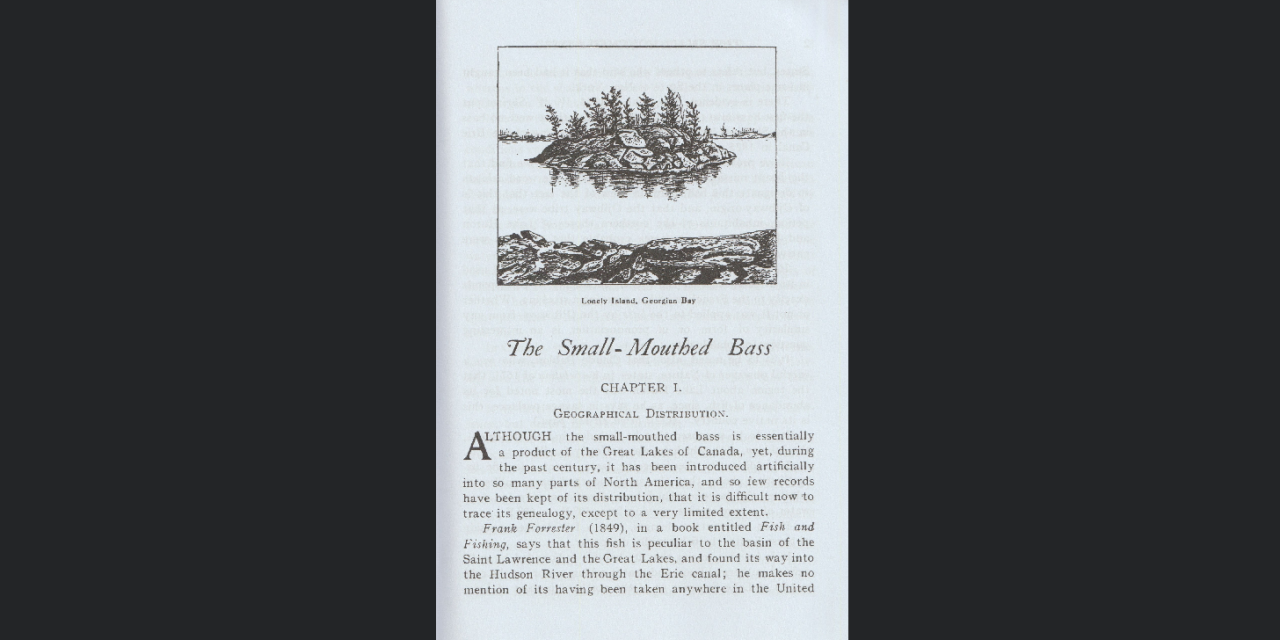
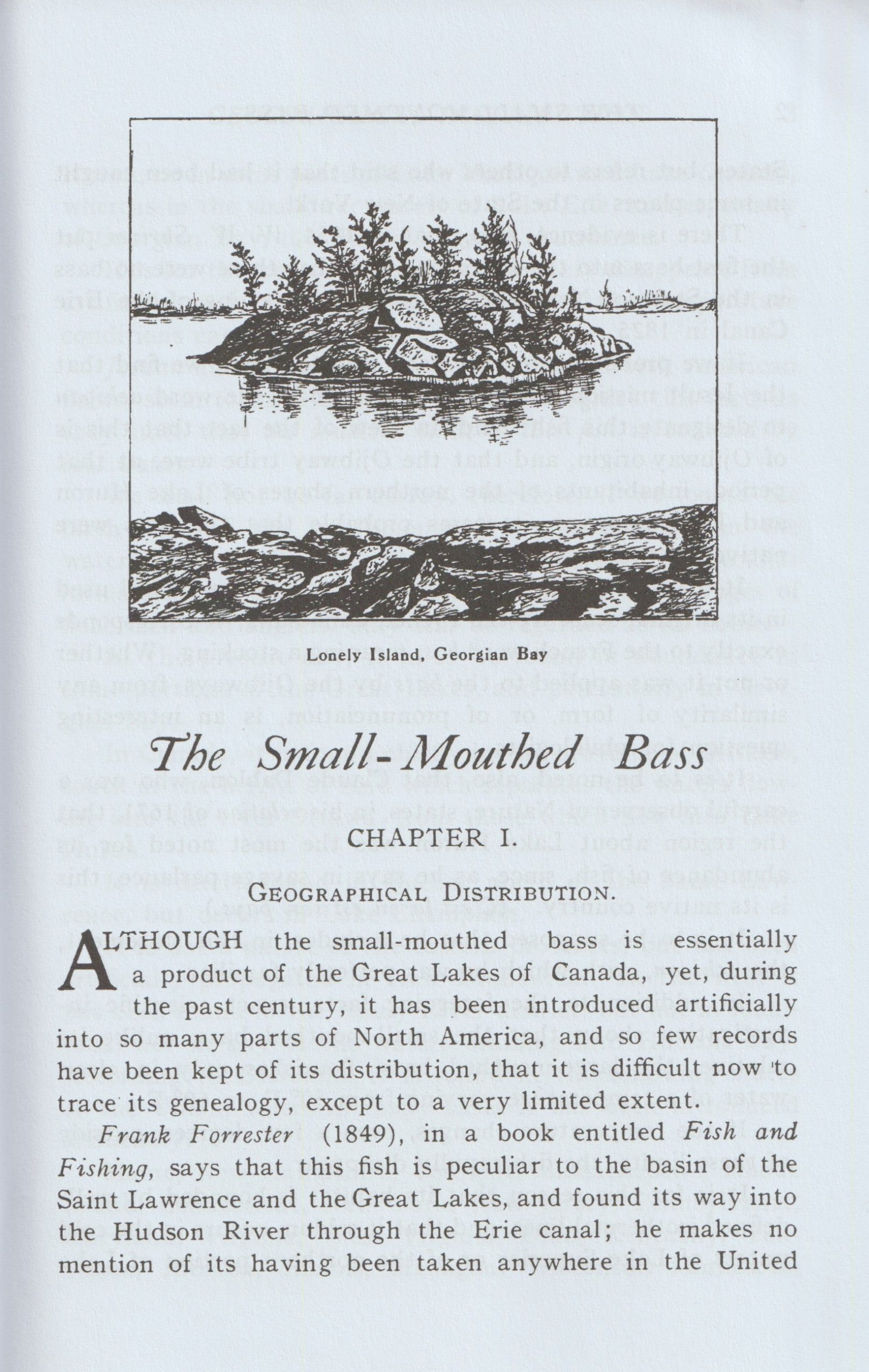
I’m not sure if The Small-Mouthed Bass, by W.J. Loudon, is the first book ever written that is dedicated primarily to the pursuit and biology of the smallmouth bass, but given that it was first published in 1910, surely it is one of, if not the first.
Loudon’s admiration for the scrappy smallmouth is apparent, as he waxes between studious, scientific observations on the fish, and lyrical, even rhapsodic, ramblings. His writing makes for some wonderful reading. He loves everything about the fish: pursuing and catching them; studying their habits, diets and environments; propagating and raising them; cooking and eating them; drawing them.
The copy I purchased is a Classic Reprint Series from Forgotten Books, and it was pretty reasonably priced. Loudon’s volume has been republished by various publishing houses since 1910, and can be purchased in some really lovely formats, including leatherbound hardcover. If you search an online ‘old books’ source, such as AbeBooks, you’ll find any number of releases, at several price points.

Unlike Billy Westmorland’s homespun stream of consciousness treatise, Them Ol’ Brown Fish, published in 1976, Loudon’s book is more scientific in approach, though just as engaging and personable in its own way. Here’s an example of Loudon’s writing where he seems to get lost in the romance of the smallmouth bass (Chapter II, Habits):
“In running streams they may be seen on bright days, their heads directed toward the current, their golden fins ever wavering to and fro, their mouths half-open, and their crimson gills moving gently in and out, reveling in the clean water and liquid motion; and they will keep themselves suspended in mid-stream apparently for the pure pleasure of living in aerated water.”
That’s practically poetry! As I said earlier, this kind of daydreamy prose is balanced with more matter-of-fact observations, particularly when he gets into the chapters on propagation and transplanting. It is also telling of the time, when Loudon, who was an actual physicist, references and quotes the work of other authors and researchers of the day. For example, he refers to Tisdale, 1869; Henshall, 1880; Goode, 1884, and others as he discusses the then-current scientific knowledge concerning the fertilization of smallmouth bass. This is really great stuff, very interesting, and gives a good view as to what the zeitgeist was in the early 20th century, where a scientist/angler could write a book that covers a number of bases and appeals to both interests, interweaving scientific observation with angling how-to and personal anecdote. Loudon’s The Small-Mouthed Bass is part science, part romance (with a fish), part personal story, part fishing how-to, part cookbook.
One section I found extremely interesting is where Loudon recounts his own attempts and observations at propagating smallmouth in the wild. He selected a small bay in Georgian Bay, Lake Huron, in Ontario, and installed a wire mesh screen at its entrance. He then removed the fish in the small bay, presumably by fishing and/or netting. Next, he caught 33 smallmouth bass, about half females and half males, and transplanted them into the bay at the end of September. In the spring he observed at least a dozen nests and, later, schools of hundreds of small bass, one to three inches long, swimming in the shallows. He then removed the screen and allowed the bass to return to Georgian Bay. Such was Loudon’s dedication to learning all he could about the bass.
It’s also interesting to note that in discussing this experiment, Loudon also mentioned that he found the smallmouth to be “peculiarly susceptible to changes of temperature,” something that Billy Westmorland also emphasized in his book 65 years later.

As for cooking and eating, his short section on “How to Cook the Bass,” covers scaling, cleaning, storing and shipping, and cooking. Such is Louden’s fondness for smallmouth that he declares, if treated properly, “it is unsurpassed in flavour by any fish, even the speckled trout.”
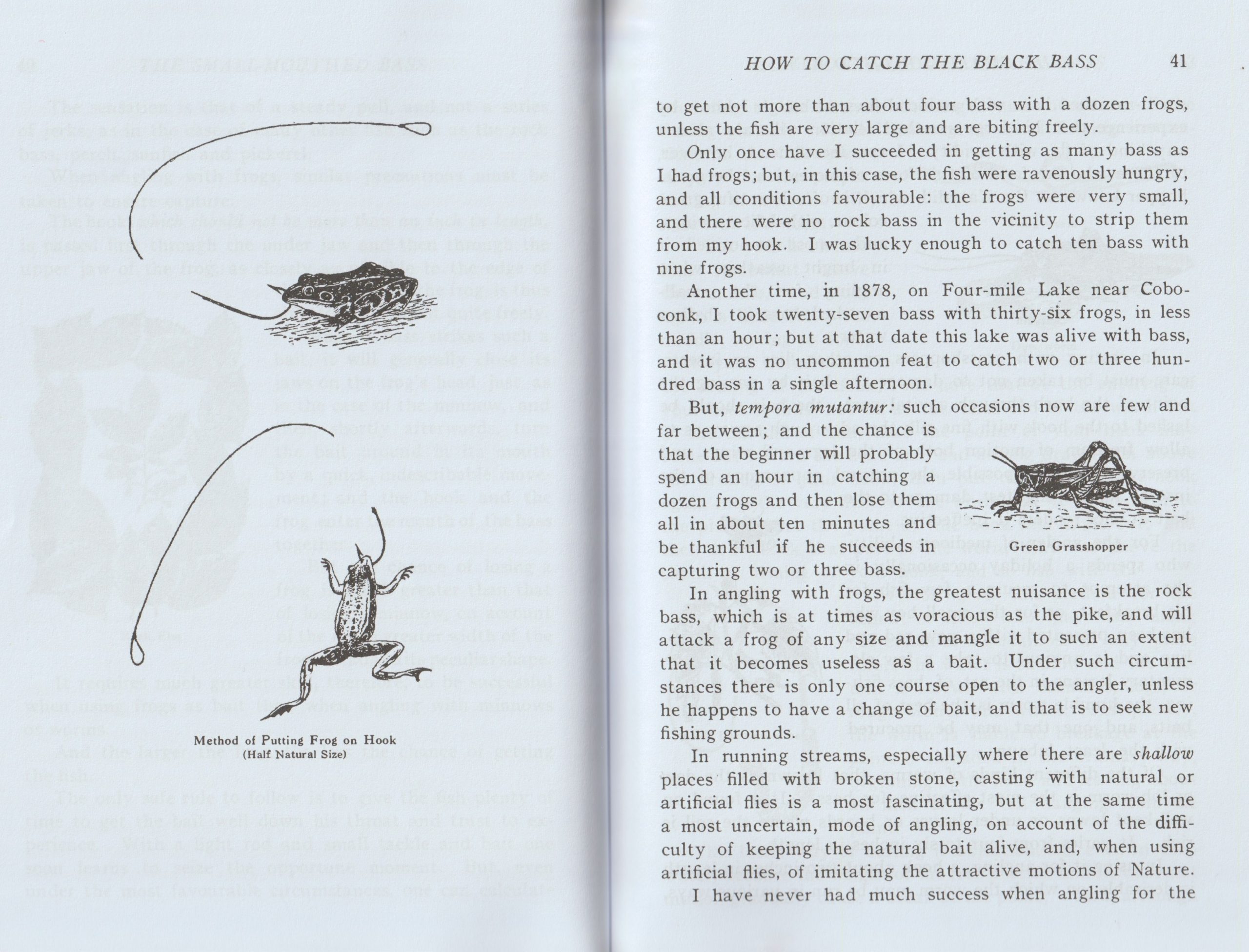
The book is also peppered with hand-drawn illustrations throughout. I believe that Loudon did these drawings himself – he alludes to that in the preface – and they are quite good. Illustrations are of the flora and fauna of the Georgian Bay area, and include different species of fish, insects, trees, flowers, landscapes, etc.. He also has a couple of drawings and a discussion on how to catch frogs. He believed frogs were an excellent smallmouth bait.
In addition to offering advice on how to catch smallmouth, Loudon was an advocate for conservation, as you would expect. He campaigned for tighter fishing regulations, more game wardens or fisheries inspectors, and increased scientific study of the fish.
He ends with a section titled “Hints to Anglers,” and the hints are really old school! For example, in hint #1, he talks about hooks, saying, in part,
“One good hook with double gut should catch one dozen (?) bass; it should then be inspected, and, if the point be dull, thrown away.”
“Hooks which are a year or more old, even if they never have been used in the water, will not last as long as those freshly made, the gut becoming brittle, and the shellac about the shaft disintegrated.”
“The best hooks are those prepared by the angler himself, wound with silk and black shellac, from the best quality of gut.”
And in hint #3, talking about line, he says,
“Any kind of woven line may be used, provided it is durable and not too coarse. Fine braided line is the most economical, although it rots easily, if not carefully dried before reeling up.”
“Be sure to test your line, foot by foot, before you go on a fishing expedition. It only takes a few minutes, and will save you many an anxious moment.”
“Braided silk is the best line of all, but not easy to procure in a uniform state throughout. Oiled silk is apt to have weak spots, as the oil seems to rot in places.”
“All lines, after being in the water, should be dried, if possible, in the sun and wind, before being reeled up. Nothing rots a line so soon as reeling it up tightly when wet and then allowing it to remain in that state for two or three days, especially if the air be hot and humid.”
Makes you grateful that you can fish using all of the modern technology we have available today, or even 50 years ago.
The Small-Mouthed Bass is a wonderful book. It’s short, entertaining, informative, and speaks to a time when folks who labored over beakers, test tubes, and chalk boards in the morning, could grab a rod, reel and creel and hit the stream in the afternoon, and then write a book about both pursuits with equal passion.