

The more I research the history of the sport and its lures, the more I am amazed at how little I know. A perfect example of this has to do with today’s post, The Bumble Bee Bee-O crankbait. Built by Bill Huntley, of Bumble Bee spinnerbait fame, the lure was created to take advantage of the Big-O craze.
Having known Bill and interviewed him several times, I had never heard of this bait, and he never mentioned it in any of our conversations. It’s a bait that I would venture to say, not many people, even collectors, know existed.
I happened to come across the collection through collector Joe Damron. Joe is an old-school tackle collector who is an authority on Fred Young’s Big-O, but more so, an authority on Mike Estep’s Big-E.
Joe was at my friend Pat Tierney’s house this weekend for a project we’ve been working on for close to a year. Joe had brought several of his shadow boxes filled with baits and when I walked into the living room, this little box caught my attention instantly. There’s no mistaking the Bumble Bee logo.
Joe explained to me what he knew about the crankbait, that this collection was a complete set of colors produced, but he didn’t know its name or when it was made. The baits have an impression of the Bumble Bee heart on the lip, distinguishing them as made by Huntley. Each bait also has a definitive line on top and bottom going from the tail to the head of the bait.
Joe told me the baits were made from foam and injection molded, which accounts for the seam on top and bottom. It’s hard to tell what the bill is constructed of due to the paint, but it’s most likely circuit board. Being that it’s injection molded, and by the looks of the hook hangers and line tie, I also believe it is of through-wire construction.
So, I have this amazing collection of baits in front of me from a company that I am well versed in, and I’m baffled. Let’s see what we can find about the bait in the literature.
Scouring my magazines from 1973 to 1975, the time when these baits would have come out, I find nothing. This led me to the newspaper archives.
One thing is for certain. Bill Huntley was a stud on the Tennessee River and between 1965 and the 1980s, the local Florence, Alabama and Middle Tennessee newspapers were flooded with his exploits as well as the performance of his Bumble Bee lures. It didn’t take long to find 100s of articles about Bill and his lures.
Unfortunately, it took a while to come up with anything on the crankbait. But the crankbait was mentioned. Bingo!
The first article I came across was from the Knoxville News Sentinel dated 1 April 1973. The title of the article was, “Red-Hot ET-Made ‘Big-O’ To Be Sold.
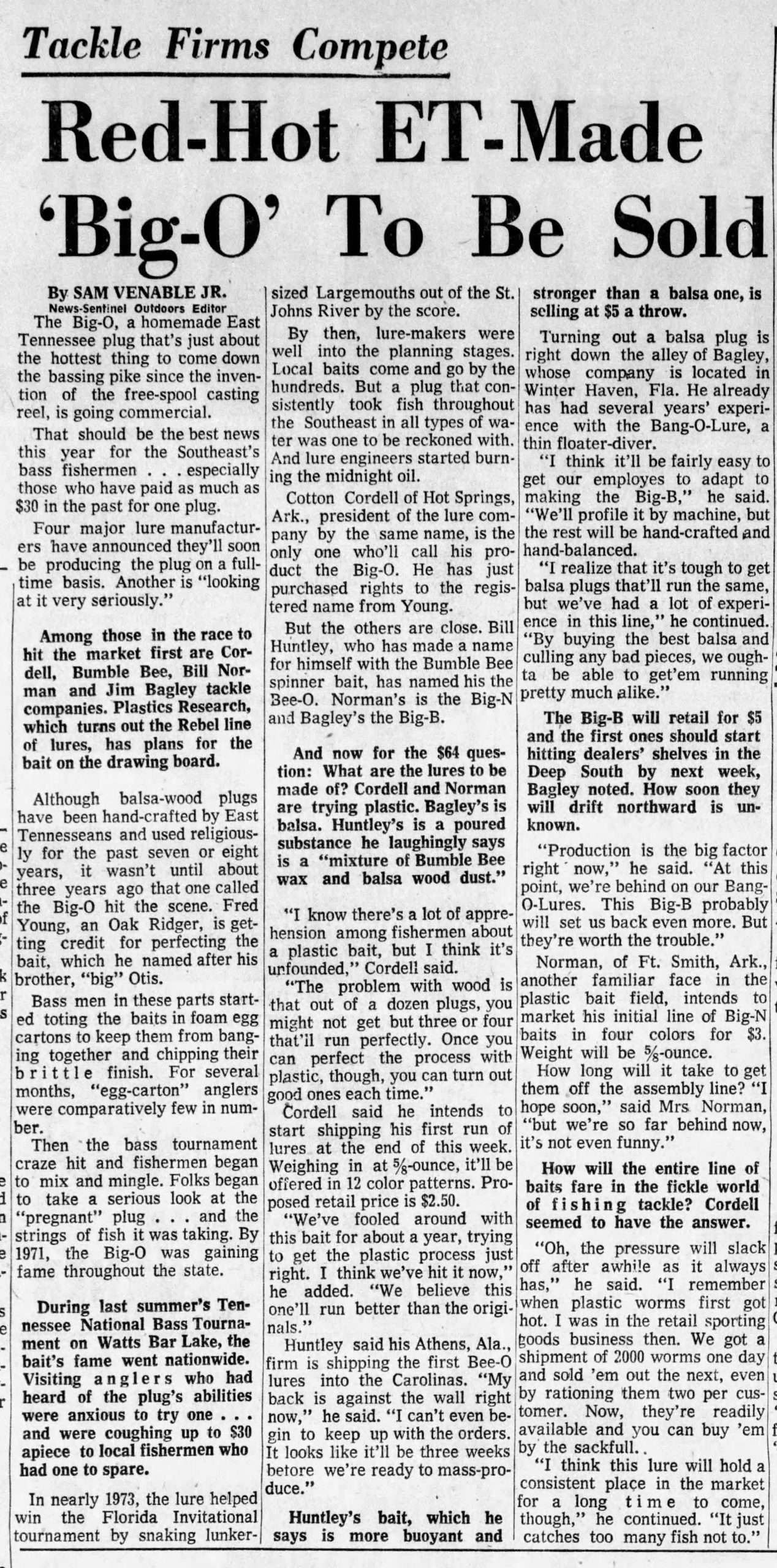
The article starts out saying that the Big-O was going commercial but four other major lure companies had announced that they’d be producing the plug too. The companies mentioned were Cordell, Bill Norman, Bumble Bee, and Bagley’s. It is also mentioned that Rebel had a new bait “on the drawing board.”
Further in the piece it states that “(a)lthough balsa-wood plugs have been hand-crafted by East Tennesseans and used religiously for the past seven or eight years, it wasn’t until about three years ago that one called the Big-O hit the scene. Fred Young, an Oak Ridger, is getting credit for perfecting the bait, which he named after his brother, “big” Otis (sic).
This puts the first Big-Os out around 1970. By 1971 the Big-O was winning local Knoxville-area events.
Then in 1972, at the Watts bar Bassmaster Trail event, the bait gained national fame. Scanning the September/October 1972 issue of Bassmaster Magazine, I found the tournament report and the only mention of the Big-O was where Walt Sawicki caught the big bass of the event, a 7-pounder, on the lure. Roland Martin was reported to have caught some of his fish off a Hellbender in five feet of water with brush, which doesn’t make much sense. Talking to Roland over the years about this event, he’s told me he caught his fish on Mike Estep’s Big-E.
I believe there is a lot of angler coverup in this tournament report. But that would get blown out of the water a few months later when Larry Hill won the first event of the 1973 season on the St. Johns River in Rodman Pool.
The Knoxville Sentinel then goes on to discuss Cordell’s licensing of the bait as well as what the other companies were doing with respect to their imitations.
Bill Huntley was quoted as saying his baits would be made out of “Bumble Bee wax and wood dust.” Jim Bagley was obviously making his baits out of balsa wood, while Norman and Cordell’s baits would be made out of plastic. The names would be, the Bee-O for the Bumble Bee, Big-N for the Norman, Big-B for the Bagley’s and Big-O for the Cordell bait.
Now we have a name for the Bumble Bee bait. Unfortunately, what Huntley made the Bee-O out of isn’t discussed at all.
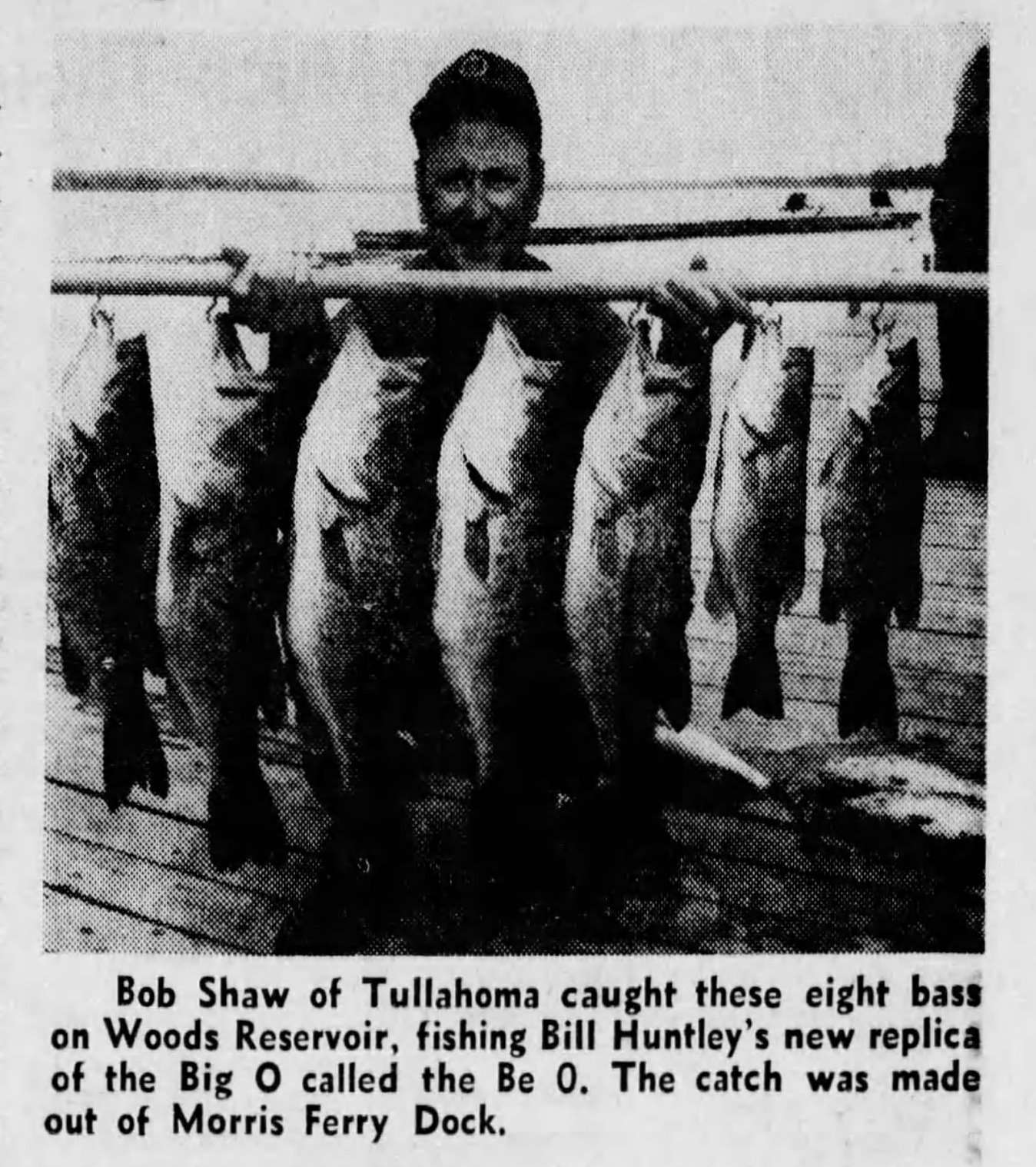
The next article I found that mentioned the Bee-O was from The Tennessean dated April 8, 1973, just a week after the first article. In this piece it was reported that Bob Shaw caught a 40-pound, 7-fish limit out of Woods Reservoir on the Bee-O. Alongside that, Jim Cole and partner J.C. Garner caught double limits from 2- to 6-pounds on the new Big-O impersonator.
I find this report quite curious because the article from the prior week didn’t mention that the bait were in production yet. Were these prototypes?
The next article was from The Anniston Star, dated April 15, 1973, and mentioned the Bee-O only once. But it stated that the bait had not been mass produced at this time. There is a lot of other material that is very important to the alphabet-lure craze that we’ll be presenting soon.
The final mention in the newspapers I found was from The Tennessean, dated February 17, 1974. It was a show schedule for the Nashville Great Lakes of the South Outdoors Show being held February 19-24, 1974. The schedule provided the booths and a little description of who would be in each booth.
Booth 27 would feature local Tennessee angler and lure maker Bill Huntley. He’d show his full line of Bumble Bee baits including his spinnerbaits as well as his new Bee-O.
It can’t be stated any clearer that Fred Young’s Big-O had a profound impact on the bass fishing industry. In fact, Cotton Cordell stated in the April 1 article presented above that he thought “this lure will hold a consistent place in the market for a long time to come.” How prophetic is that. Today the squarebill is one of the top producing baits still, and a direct descendant of Fred Young’s creation and all alphabet baits that followed. We’ll be covering the other baits that were spawned by the Big-O in time.




Excellent story! From your initial discovery of that little shadow box of lures you created a solid historical and well-researched foundation for a lure that, like you say, probably has been long forgotten or never even known by most anglers. Fascinating!
Thank you Stuompjack! This was a fun one and I couldn’t wait to get back home to write it up and put it on the site!!
I own a set of Mike Estep numbered and sign collector set of fishing lures, #55, 56, 57, 58, 59 & 60 of 1500. I had the pleasure of working with Mike at the Oak Ridge facility and fished with him occasionally. I would like to talk with Joe Damron or anyone who could help me to determine the worth of my collection.
Harold, contact me at terry.battisti@gmail.com. I’ll get you hooked up with someone.