The reason I fell in love with bass fishing was the challenge. Compared to trout fishing, panfishing, catfishing, and even ocean fishing, in my opinion, bass offer the greatest challenge. The reason I say this is in mathematical terms, all other fish are like solving a series of two algebraic equations. Find the two unknowns and you catch fish. Bass, on the other hand, are like solving a series of up to 10 equations where you need to figure out 10 unknowns before you can start catching. Today in The Bass Attacked Us, we’re going to delve into that a little more.
As you might expect, the team here at the Bass Fishing Archives reads a lot. Books, magazine articles, catalogs, and anything else that has the written word about bass and bass fishing.
In my case, I try to read as many articles as possible in the old magazines but there are times when I just don’t have the time. If an article sticks out, like today’s piece by Hart Stilwell, that was published in the April 1954 issue of Field & Stream, I’ll take the time to read it.
I’m glad I did.
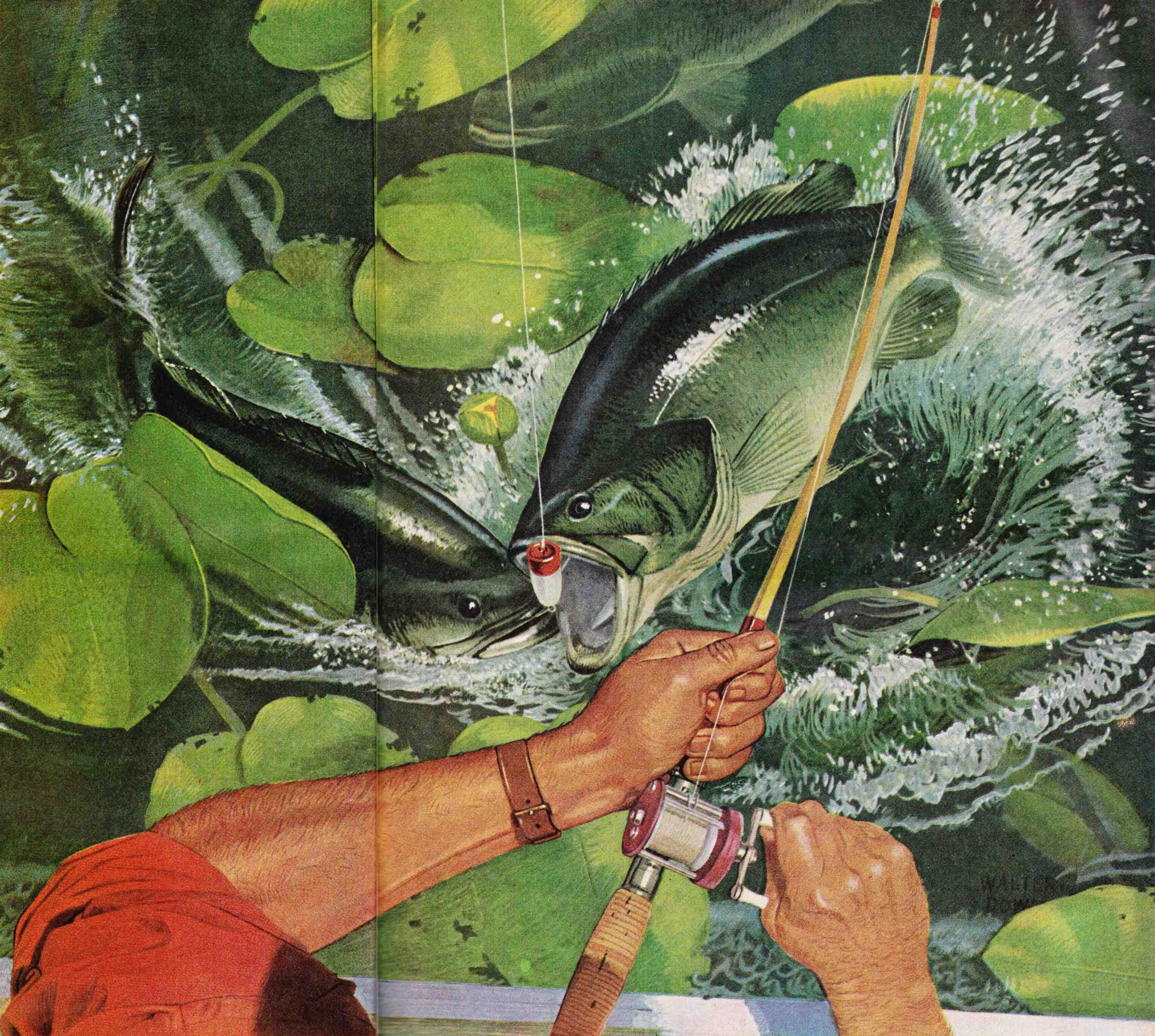
What caught my eye at first was the artwork done for the lead-in for the article. Walter Dower, illustrator at the time, painted this amazing rendering of two big bass hooked on a single red and white plunker, coming through a pad field. If this artwork doesn’t grab you, you must be dead.
Next, I saw the title of the article, The Bass Attacked Us, and had to read it.
The article was about a trip to some lake in the Texas/Oklahoma region the author and his fishing buddy had recently taken. The subject, big bass schooling.
It sounds like the phenomena of big bass schooling was new to anglers back then. Stilwell talks about small bass doing it and it being common. But big fish, in the four-pound and bigger class, schooling like smaller bass was uncommon.
At the time, in that area of the country, the big Texas reservoirs were being created and offered bass fishing beyond comprehension. Limits of big fish were commonplace in the newly inundated reservoirs, and growth rates were off the charts.
We know now, based on all the research done from the 1950s through the 1970s, that new lake effects can bring amazing angling to a new fishery, but also resurrect an old fishery. This is what Stilwell, and his partner were experiencing when they happened upon a school of four to five pounders one hot summer afternoon.
The conditions couldn’t have been worse. Hot summer temperatures, no wind, high water temperatures, and mid-morning sun were what they were faced with. They’d fished all morning with only one fish to show for their efforts, then it happened.
Stilwell talks of his partner hooking a fish and all he had to do was dangle his bait above his partner’s fish and he’d get bit by followers. The action was fast and the fish all big.
What got Stilwell to write this article, though, was the fact he’d never seen big fish like this school in such a way. What he realized after talking to a biologist was these fish were still small – in age. They may have weighed between four and five pounds, but they were maybe two years old and still prone to schooling.
Reading the article made me wonder if this was the first time anyone had written about big bass schooling and why they did it. I also wonder if this was the first time the use of a “follow-up” bait was mentioned.
All of this was very informative from a historical perspective but there were three other sentences that reverberated in my mind that pertains specifically to today. It was in the last paragraph of the article and read:
All of those things help explain the odd actions of bass on rare occasions. But there is no really pat explanation; a whole lot that the black bass does will remain a mystery to the angler, That’s fine – exactly the way it ought to be, for if anglers ever figured out bass entirely, then bass fishing wouldn’t be fun any more.”
That last paragraph hits on a subject we’re experiencing today with forward facing, real-time sonar. Prior to five years ago, there was a body of fish in every lake that was a mystery. Pelagic fish that roamed open waters and were nearly impossible to catch. I know this because of the days and months I’d chase these fish trying to get them to eat.
We all knew they were relating to suspended bait, and you could see them feeding on bait balls on the 2D sonar. You could even watch a bait, vertically fish through them. Sometimes you might snag a fish, or even catch one, but that was few and far between.
As Stilwell said, the fish were a mystery. More importantly, the fish were essentially unbothered by angling pressure. In the spring, they’d move to the shore for their spawning ritual and after that, they’d head back out to their deep-water sanctuary. Some of their spawn would be normal bass, relating to cover and structure, but others would make their way to the depths, just like their parents. I see it as a brood stock of fish never to be harassed.
Unfortunately, with the new advances in sonar, these fish have become susceptible to being caught. No longer are they unmolested, making me wonder if this brood stock will be decimated as time goes on.
Funny how a 70-year-old magazine article can give us a look back to the past but also make us question what’s happening today.
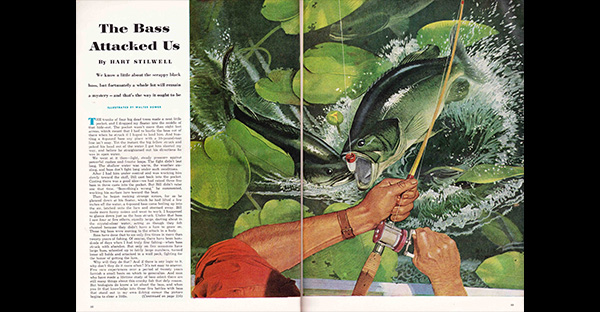
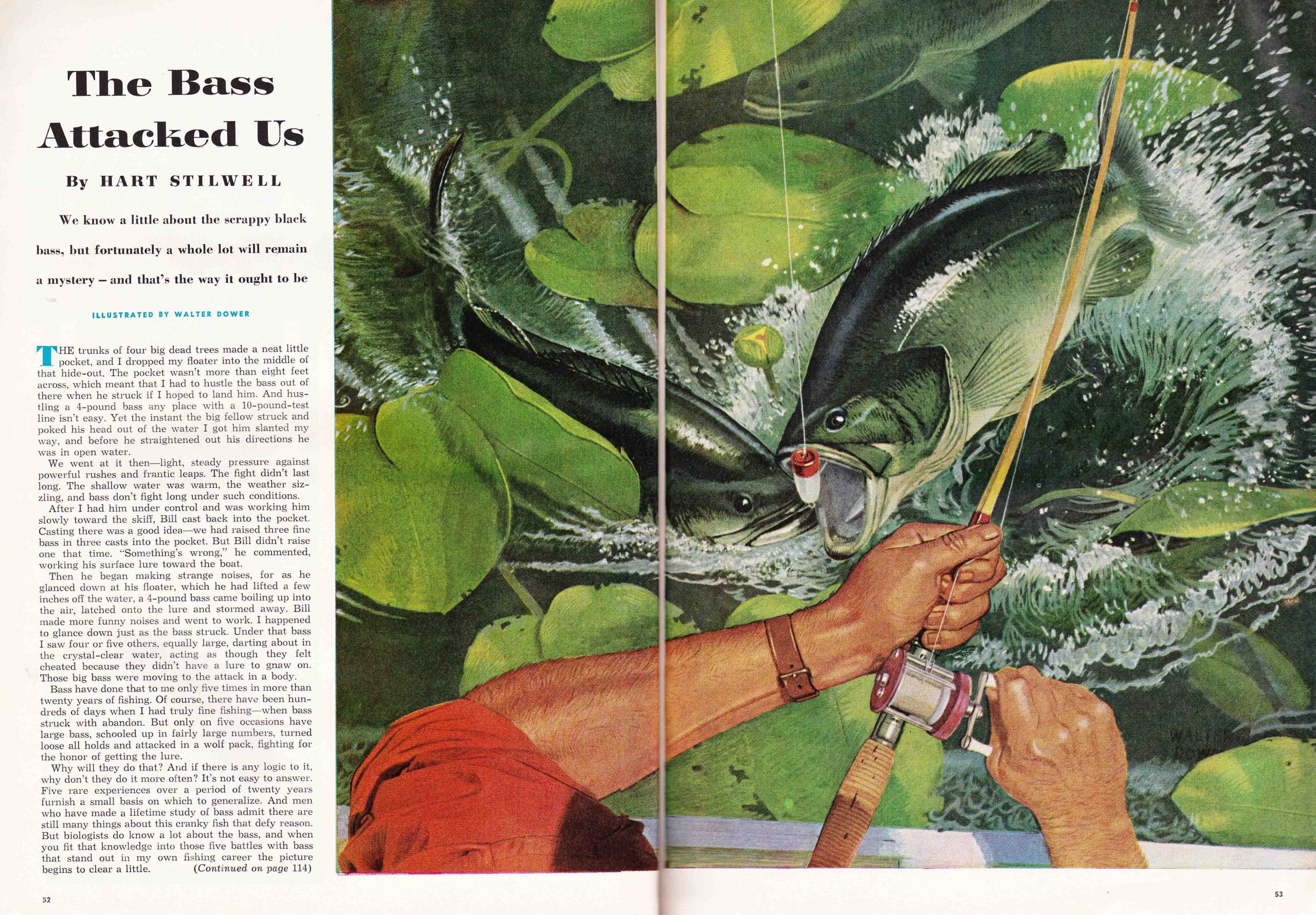
The entire article can be viewed below.






What an illustration! What a title! Instead of Field & Stream it sounds like it could have come out of Argosy or All Man magazines. Maybe F&S was trying to get in on a little of the men’s adventure magazine action. The only thing that would have made that click-bait title and illustration more potent would be if they had shown multiple bass leaping from the water and attacking the angler and his scantily clad female fishing buddy (torn red dress of course…on the edge of revealing too much). The guy is holding a fishing rod in one hand and a hunting knife in the other as he battles the flesh eating largemouths clinging to his bloody limbs. Oh yeah, what an image!
LOL. David, that had me laughing out loud!!!