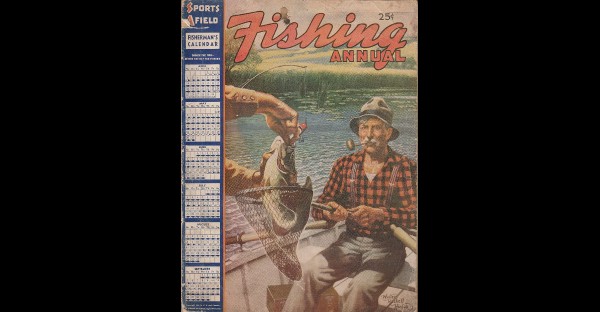

Last week I shared an issue of Sports Afield dated April 1957 that I rediscovered in a storage bin. Today I’m going to share an issue that is, in my opinion, even better, with more celebrated writers and more articles on bass fishing. The 1943 Sports Afield Fishing Annual is a treasure for those reasons, but it’s also a wonderful time capsule because many of the fishing company ads reference the United States involvement in WWII and the company responses to the war effort. First we’ll look at some of the authors in this issue and a few of the articles they wrote. Like the 1957 Sports Afield, this Fishing Annual was in very fragile condition, and I didn’t want to risk damaging it further by opening it up for scanning. Cell phone photos will have to suffice.
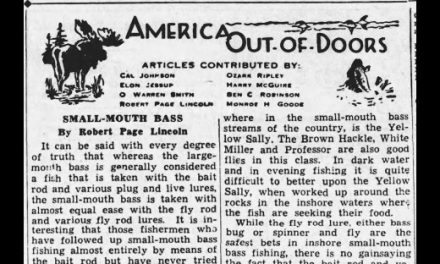
The table of contents is a star-studded line-up of the top fishing authors of the day, with stories by Robert Page Lincoln, Bob Becker, Cal Johnson, John Alden Knight, Bert Claflin, Harold C. Hollis and more. Lincoln was a longtime contributor and editor for Fur Fish Game magazine and would later author Black Bass Fishing, Theory & Practice in 1952. Bob Becker was a prolific writer and also the outdoors editor for the Chicago Tribune for over 30 years. Becker lived an extraordinary life, a little of which I wrote about at the end of my BFA piece “Books for Anglers 1949.” Cal Johnson is a name that, by now, should be familiar to all readers of Bass Fishing Archives. The current holder of the IGFA all-tackle world record musky, Johnson was the most celebrated fishing writer of the first half of the 20th century. John Alden Knight would write his book, Black Bass, in 1949 and was the author of several other fishing and hunting books. Bert Claflin would also go on to publish Blazed Trails for Anglers as well as his excellent Muskie Fishing in 1949. Harold C. Hollis would release Bass: Tackle and Tactics only two years after this Fishing Annual.
Robert Page Lincoln wrote two pieces for this 1943 Sports Afield Fishing Annual, the first titled “Hook, Line and Sinker.” I can’t think of anyone who could write a more thorough treatise on the selection and use of proper sinker technique in fishing than Lincoln. It’s a tour-de-force on fishing sinkers, complete with detailed illustrations. His second piece is a compendium titled “Fishing Hints and Kinks.” Lincoln includes two short pieces here: “Night Crawlers for Smallmouth” and “When Largemouth Bass School Up.” His piece on schooling bass is fascinating, as he talks about fishing a live frog in schools of bass, saying that “the frog lure is in its element and worthy of special consideration” in schooling situations. He outlines the precise way a bass normally takes a live frog and when to set the hook. Interestingly, Lincoln recommends a cane pole and bobber setup for fishing this technique, including using this rig for trolling. He also declares that should an angler hook a musky or large northern pike on the cane pole it is best to avoid fighting it on the pole. “Throw the pole overboard and let the fish wear himself out. The pole always comes to the surface like a bobber!”
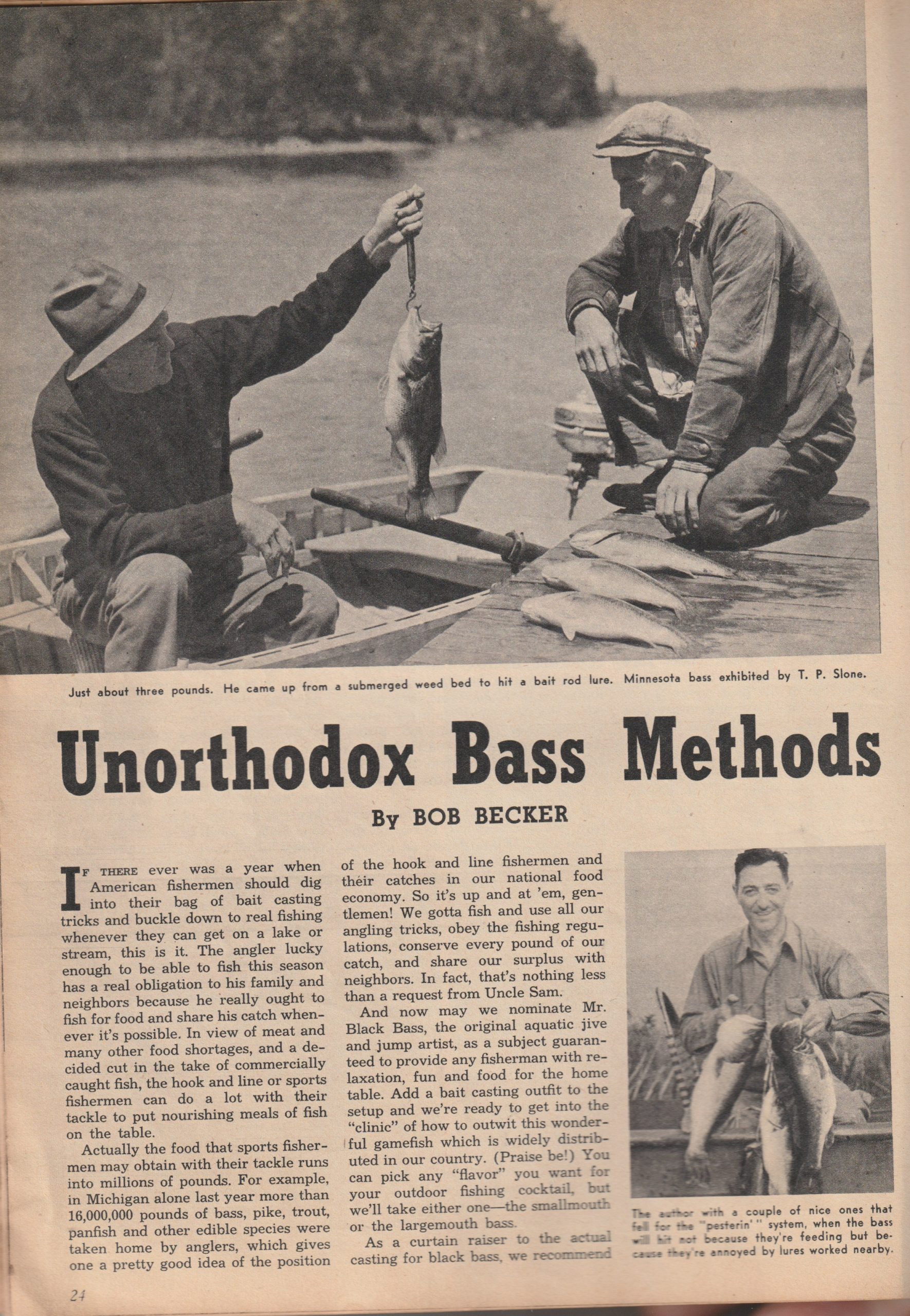
Bob Becker’s “Unorthodox Bass Methods” is a fun, light romp through techniques and practices to try when bass are more tight-lipped than aggressive and easy to hook. Basically, it’s a call to change things up, be it on the retrieve, bait selection or timing. Becker’s advice might be considered orthodox wisdom today, but remember, 80 years ago when Becker was writing anglers didn’t have social media or all of the avenues of information we do today. For example, these days it’s common practice to follow a missed strike on a surface plug with a soft plastic worm. Roland Martin promoted that technique years ago. But in Becker’s day it was probably considered an unusual sequence to follow.
But Becker kicks off his feature with another nod to the war effort and a bit of gratitude to the fighting forces. He begins, “If ever there was a year when American fishermen should dig into their bag of bait casting tricks and buckle down to real fishing whenever they can get on a lake or stream, this is it. The angler lucky enough to fish this season has a real obligation to his family and neighbors because he really ought to fish for food and share his catch whenever it’s possible. In view of meat and many other food shortages, and a decided cut in the take of commercially caught fish, the hook and line or sports fishermen can do a lot with their tackle to put nourishing meals of fish on the table.”
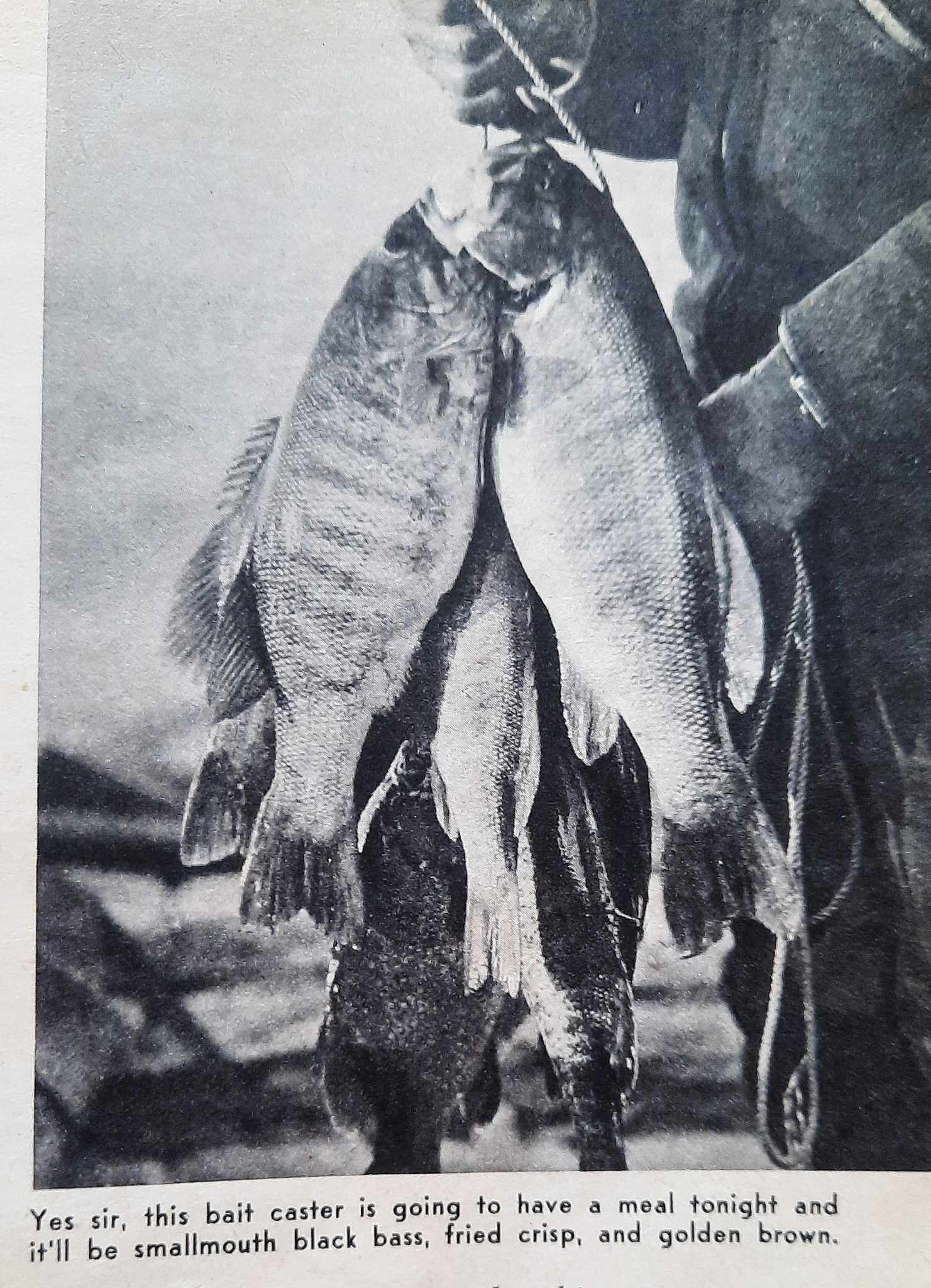
Like Robert Page Lincoln, Cal Johnson also has two articles in this Fishing Annual, a featured story titled “Those Eccentric Bass” and a compendium of shorter pieces under the heading “Go Fishing to Keep Fit.” In “Those Eccentric Bass” Johnson declares that a bass’s ability to inhabit a wide array of locations and adapt to multiple conditions calls for an angler to be versed in a variety of angling methods. “That’s another reason the black bass is always interesting,” he says. Touching on seasonal differences, varying weather conditions, fly fishing and bait casting, southern and northern bass species strains, Johnson really just offers a testimonial for why so many consider bass to be the premier game fish in America. He concludes, “The bass is America’s number one game fish in popularity, and so it should be, for, after all, the bass is a true native of this country and a fish we are all extremely proud to call our own. So let him be eccentric, peculiar, whimsical, strange, erratic and odd–we love him all the better for it.”
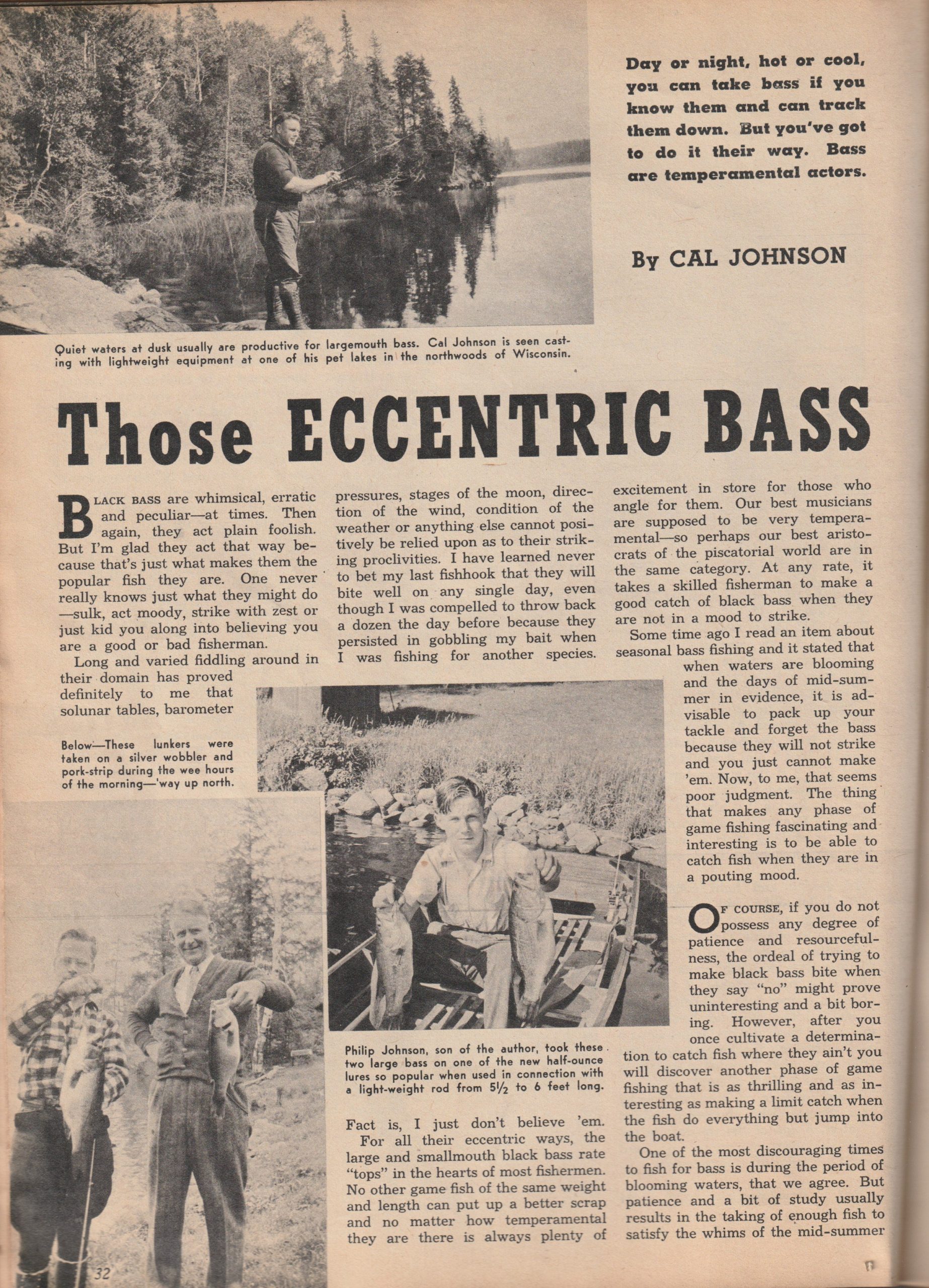
Johnson’s second piece, the compendium “Go Fishing to Keep Fit” also has a subheading that reinforces the country’s communal effort to support the war effort. It reads, “…and use fish for food. Every pound of fish we catch and eat releases that much more food for our fighting forces. The following tips will help you to increase your catch of fish.” His entry “Logy, Black Bass: How to Catch ‘Em” might initially have been part of “Those Eccentric Bass,” as Johnson references logy bass in that feature as well. Logy is a word you don’t see much anymore. It means sluggish or lethargic. This piece discusses ways to catch both largemouth and smallmouth, and where to find them and how they might react, when the mercury rises in the thermometer.

And as he often did, Johnson made sure to insert a plug for fly fishing. Johnson was an expert caster – tournament winning skill, in fact – with both fly rod and bait casting gear. However, I tend to believe his first love was using fly fishing gear. He did, after all, write an entire booklet on that very subject titled The Fly-Rod for Bass. He advised, “One of the most successful ways of taking warm weather bass, both largemouth and smallmouth species, is by fly-fishing for them. All kinds of winged insects are in evidence during mid-summer and the bass love to feed on them. Floating bass-bugs are deadly at times when fished along the shoreline and over weed beds. However, the greatest success with fly-rod lures will be experienced around dusk or later.”
Johnson concludes, “Angling for logy bass is good sport that requires skill, so when you amble back to camp with a few nice lunkers dangling from your stringer during midsummer you really have something to boast about, for it takes a good fisherman to bring in successful catches consistently throughout the warm weather period. Patience is perhaps the greatest essential but even though you possess this great trait you still need to couple it with a bit of piscatorial knowledge and fishing sense if you are to make a successful catch.”
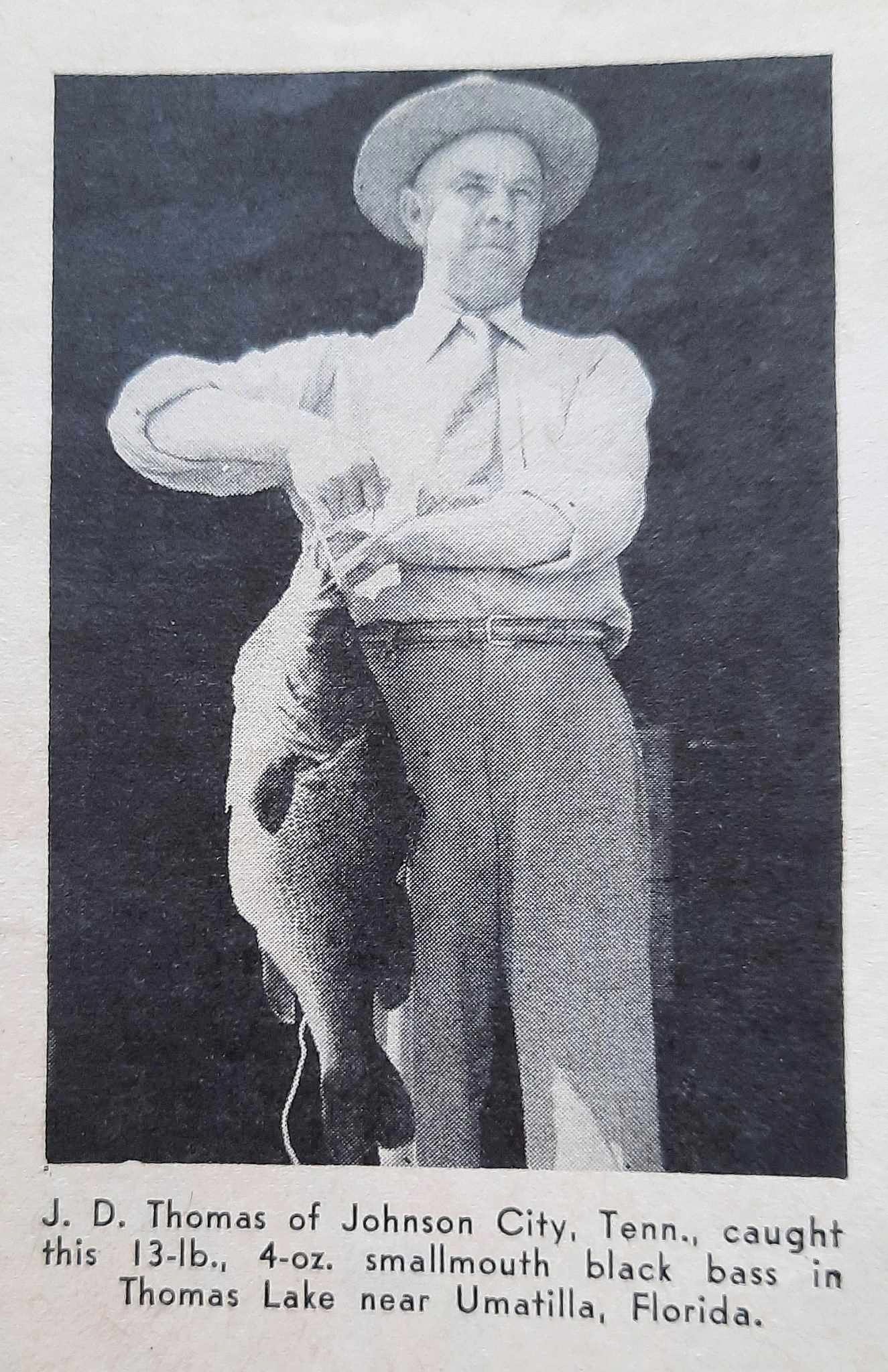
In 1943 Johnson had been the Sports Afield Fishing Editor for several years. He was only two years away from being replaced in that position by Jason Lucas, with Lucas taking over that role in, I believe, January of 1946. Sometime around 1946/47 Johnson was diagnosed with a serious heart condition that suggested that he had only months to live. Whether or not Johnson’s health had anything to do with his being replaced at Sports Afield by Lucas, I do not know. Certainly Lucas’s knowledge and expertise at fishing and writing about it was a deciding factor in his assuming the position of Fishing Editor. But I’d love to know the sequence of events that led to this change, as well as what the two author/anglers thought of one another. Johnson ended up moving to northern Wisconsin, which immediately improved his health. He actually lived for several years longer than the doctors initially diagnosed, and in the interim – 1949 – ended up catching the world record musky to boot!

I love the ads in this magazine. So many of them reinforce the patriotism in America at the time, when it seemed like everyone was of one mind and one purpose, to defeat the evil that was sweeping Europe and the Far East. Factories that just a little earlier had been manufacturing fishing line, reels or boat motors for anglers, were now pumping out parachute cord, weapons and equipment, and parts and engines for military craft. People were growing victory gardens and fishing and hunting to supplement their diets so that corporate agriculture could send more rations overseas. Cal Johnson referenced this very mindset in his “Go Fishing to Keep Fit” column above.
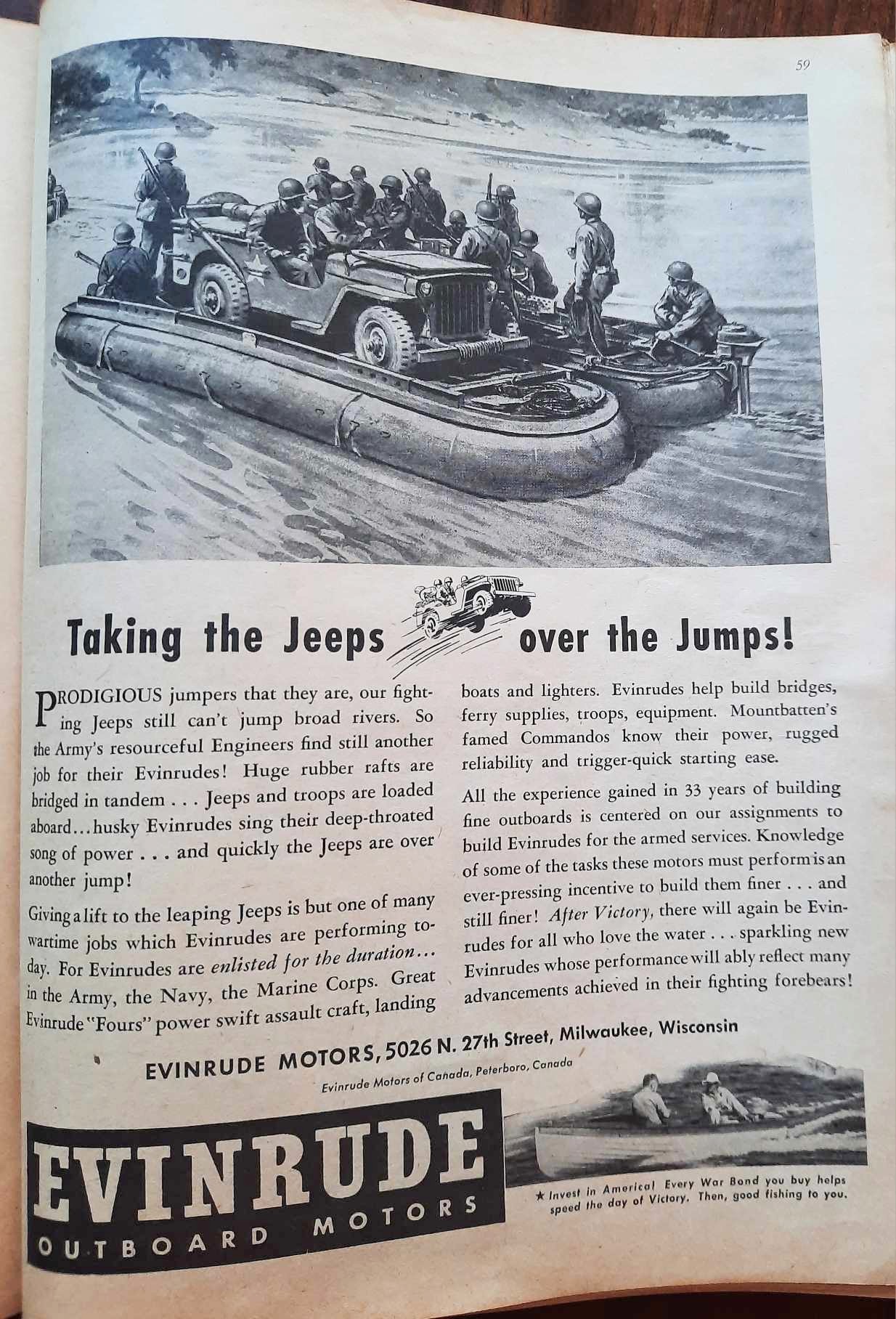
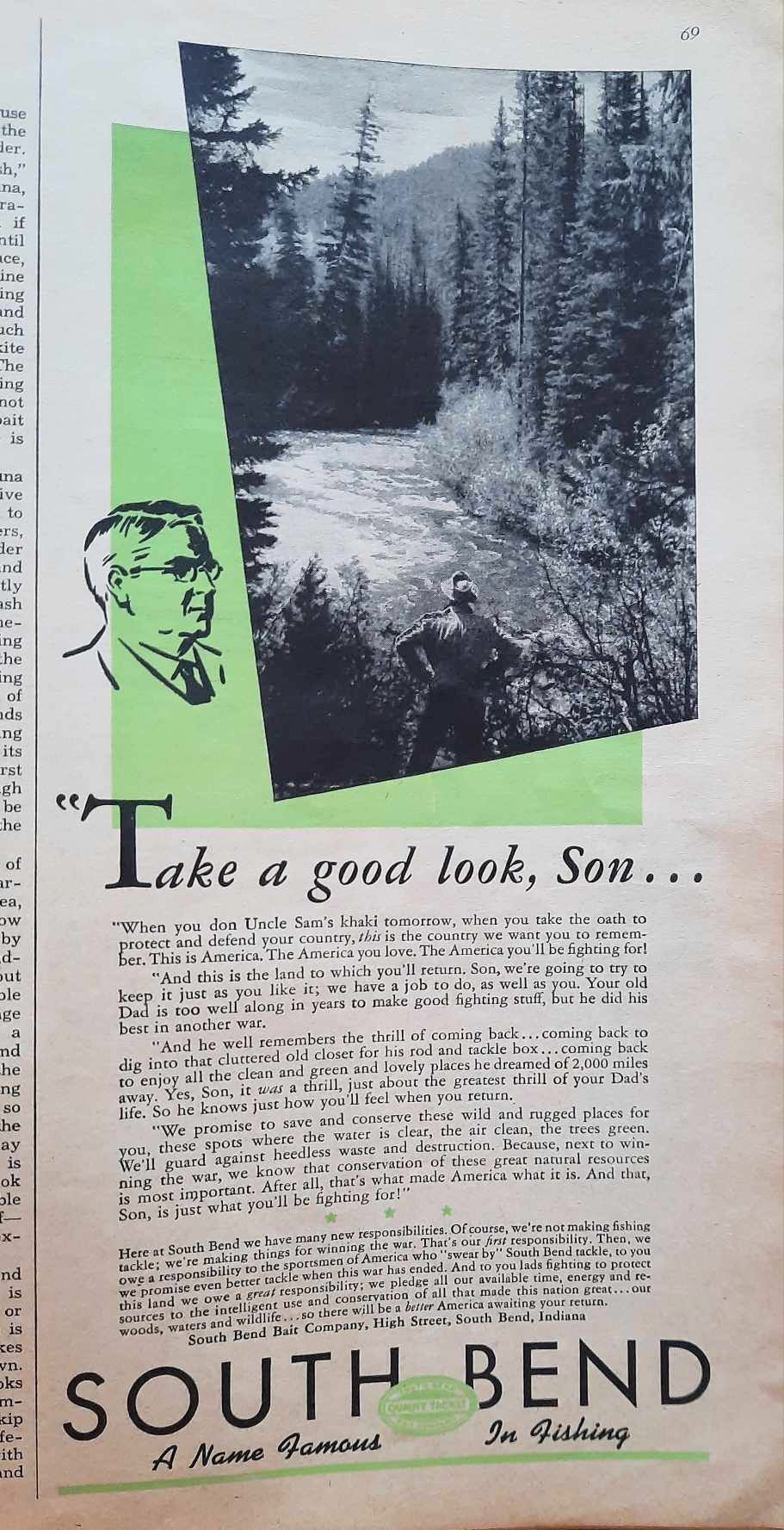
Below are ads for Evinrude, Johnson Motors and South Bend. Evinrude and Johnson were major players in the war, manufacturing motors and parts that would be used to ferry troops and build bridges. The Johnson Motors ad sets the tone for what many people must have been feeling during this time. It shows a haunting image of a rain-soaked angler hunched over in a simple boat, with 4 cane poles and a hand-line set in the water. It reads,
After the war…Will you be fishing for fun, or fishing for food? If we should lose this war, it COULD be that you’ll be fishing for food instead of fishing for fun. And it might be food for somebody else. Freedom from want, freedom from fear, freedom to follow our chosen pursuits–these are what we are all fighting for. And these are the things that move men, money and management to turn out more and more of better fighting equipment. It is our business to normally help you “fish for fun.” We can’t help you to do so now because the Johnson plant is given over to war work–one hundred percent. ‘Sea-Horse Precision’ is now applied to war products. Johnson management and men are working harder at this job than any at which they had ever worked before. All to the end that none of us will ever have to “fish for food.”
Evinrude has a similar ad but talks more specifically about how Evinrude motors are being used in the war effort. And South Bend talks romantically about the promise of America, its wild places and a better future for returning servicemen after the war. I have to admit that these ads are inspiring, and fill me with pride for how this country responded to the call. If you want to know more about boat motor companies and WWII take a look at this interesting story, “How the Outboard Helped Win World War II.”

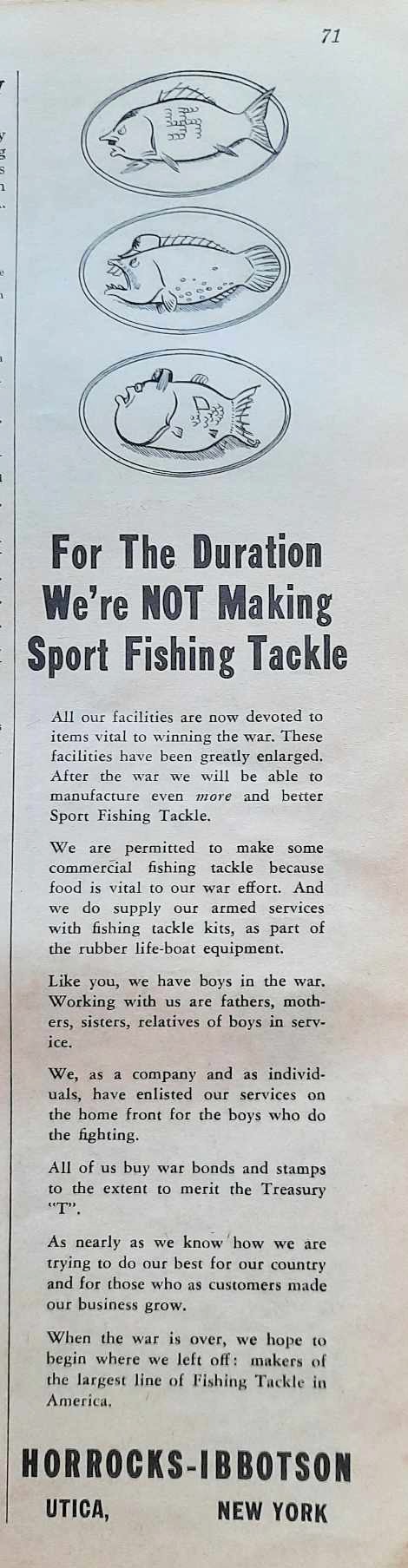
Horrocks-Ibbotson placed an ad explaining that their factories were being diverted from making fishing tackle to making war supplies, and that the company was partnered with the public in their sacrifice to the effort. “Like you, we have boys in the war. Working with us are fathers, mothers, sisters, relatives of boys in service.” Horrocks-Ibbotson also declares that the limited fishing tackle they did make was designated for commercial fishing to help secure food for the war effort, and that they did also supply fishing kits to the troops. They end with a proud exclamation and promise of hope, declaring that “When the war is over, we hope to begin where we left off: makers of the largest line of Fishing Tackle in America.”
The top of the ad is comical but reinforces what the country was up against as well as what Horrocks-Ibbotson was all about as a company, that is, fishing. It’s a cartoon illustration of three mounted fish, fat and bearing the insignia or headgear that identifies them as the big three Axis leaders: Adolf Hitler (Germany) at the top with his little mustache and fish scale swastika on the fish’s body, Hirohito (Japan) wearing the military cap of the Japanese forces and showing the slanted eyes and buck teeth that characterized stereotypes of the time, and the Mussolini (Italy) fish wears the dictator’s fez and has his large chin. That the fish appear to be mounted on a wall also contributes to the idea of what America and the Allies intended to do to those tyrannical leaders.
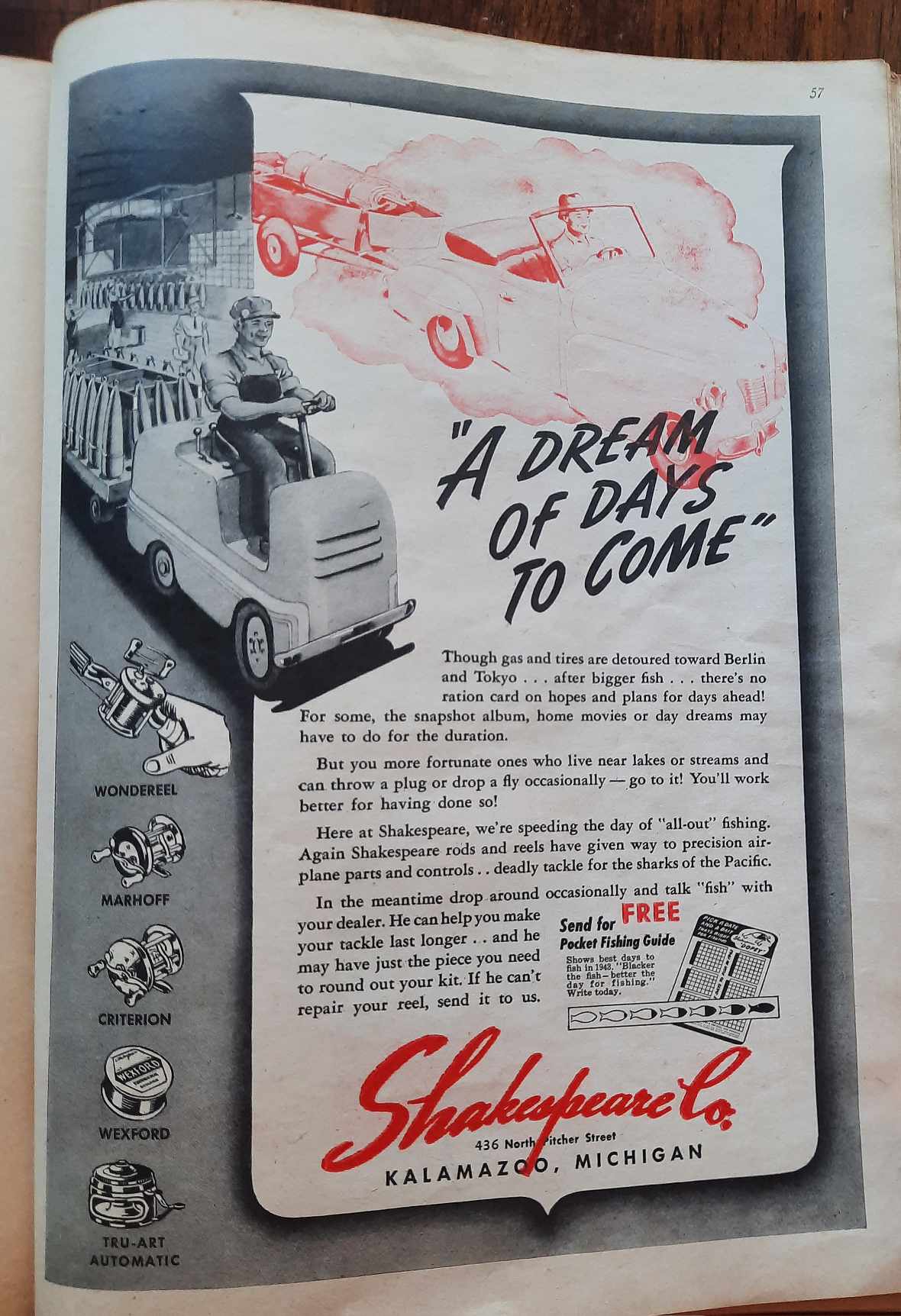
Shakespeare placed an ad that was much like the others discussed above. The text speaks of the manufacturing turnover at the factories and the images reinforce that, with an employee who previously made reels and fishing tackle now driving a cart pulling trailers full of bombs. Other employees work the assembly lines in the background. And as was the case with the other company ads, the text gives a message of hope and a better tomorrow. The tractor-driving employee imagines that time, in a cloud above his head where he tows a boat to a lake to do some fishing and relaxing. It was really amazing how all of these companies, and the country as a whole, got on board with the unified message of the day.
The final pro-war-effort ad I’m sharing from the 1943 Sports Afield Fishing Annual is one of my favorites. It comes from the Creek Chub Bait Co. This ad has it all, and Creek Chub, in my opinion, did a great job in creating a compelling and energetic ad that got the message across about the war effort while beautifully spotlighting their product and confidently maintaining their identity as a dynamic fishing company. The top part shows an actual aerial battle, with planes and ships over the water with a two-tone impact of a bomb exploding in the sea. The text reads, “Keep ‘Em Flying…Goes For Fishing Too!” Below the battle image are five Creek Chub baits, with the top Pikie Minnow declared as the lure that caught “Another World’s Record,” a 19 lb. 12 oz. walleye. And next to that is a photo of Lt. Col. E.B. Maynard, stationed at Fort Oglethorpe, GA, holding a stringer of largemouth and smallmouth bass he caught on a Creek Chub Midget Jointed Pikie Minnow. Even the servicemen testify to Creek Chub lure effectiveness!
And in the mix is a special lure that Creek Chub released during the war, their new Dive Bomber, complete with Morse code “V for Victory” paint job. “The new Dive Bomber has started a revolution in fishing–creating an all-out war on game fish! Marked for Victory–it looks and acts alive–and dares all game fish to strike!” This was a brilliant marketing move by Creek Chub and, frankly, I’m surprised more companies did not adopt it.

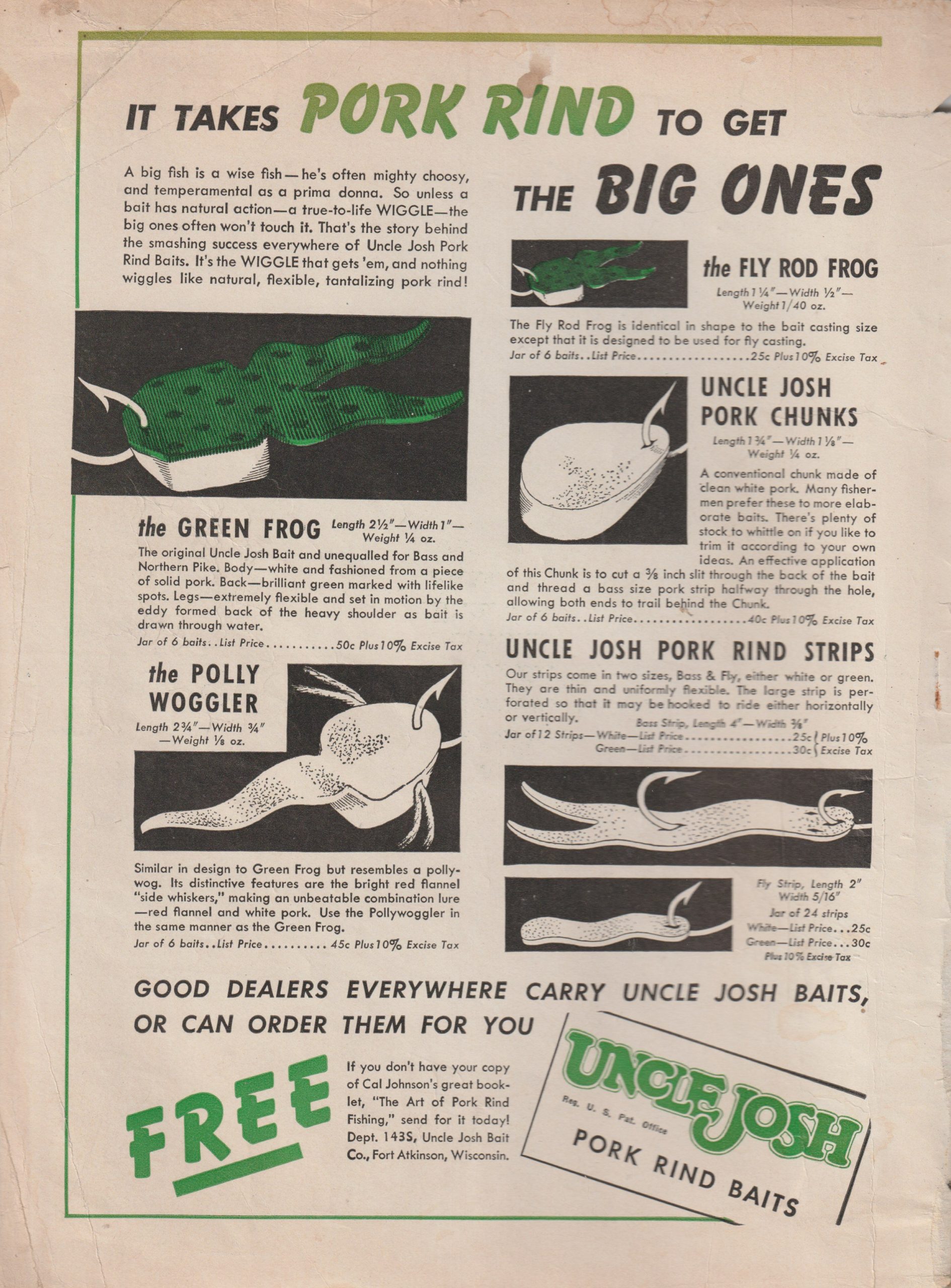
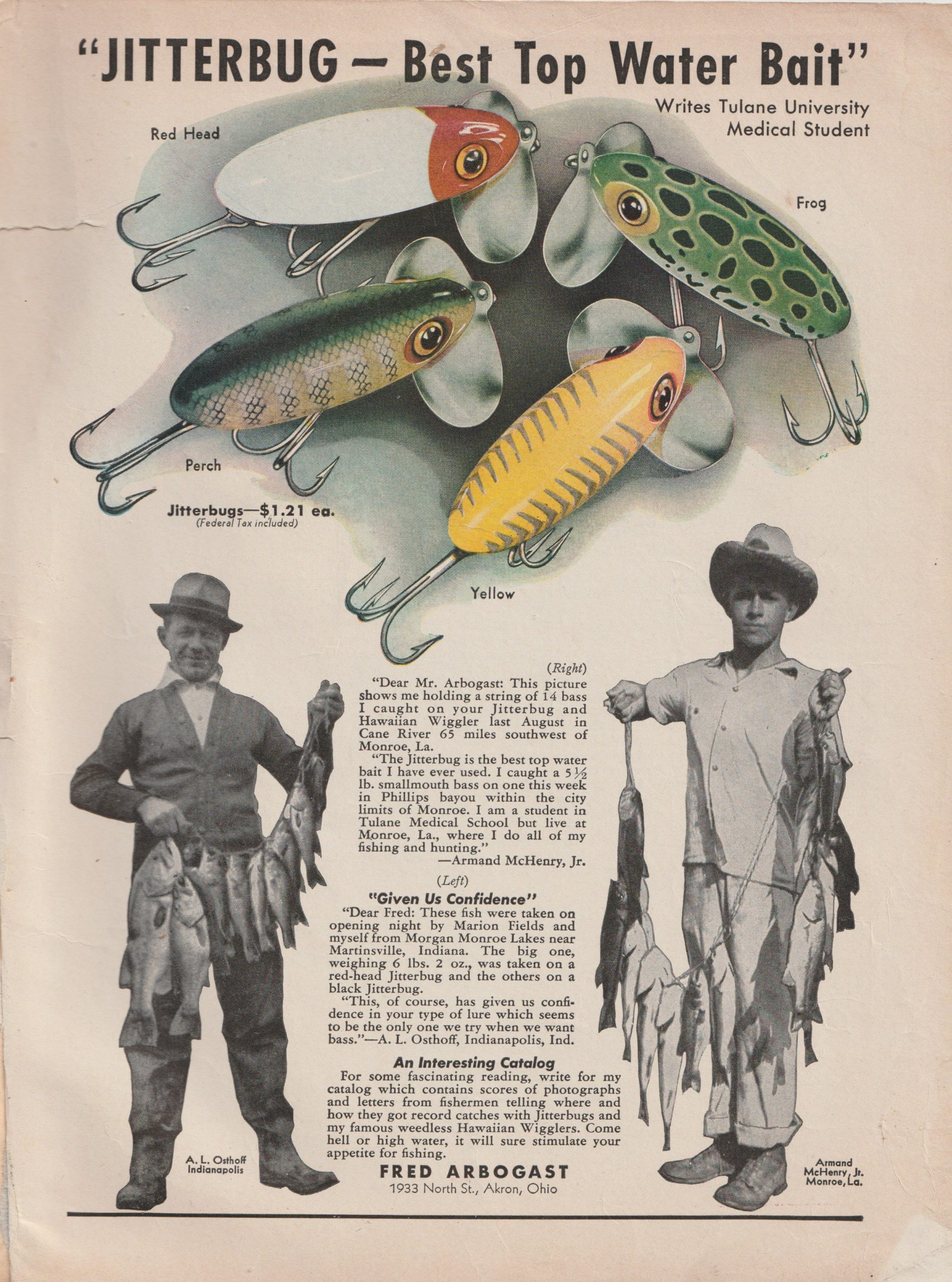
The final three ads are unusual in that they don’t really mention the war effort, but are instead mostly straight fishing lure advertisements, with the exception of Heddon, who make indistinct references to the war. These Uncle Josh, Arbogast and Heddon ads were full page ads on the inside covers and back cover, and were in color. The Fred Arbogast Company ad is interesting, in that it is an ad for their famous Jitterbug, and shows the Jitterbug with its original metal surface lip. That would soon change when metal rationing would become more stringent and Arbogast would replace the metal lip with a plastic lip, until the war was over. Those plastic lipped, WWII Jitterbugs are now highly collectible lures.





Great post David! I love the magazines of the WWII era. And wow, what a lineup of writers!
Thanks Terry! Yes, I was blown away by the number of great writers they had in this issue. Plus, it was a heavy issue as far as bass fishing is concerned. Shoot, even the cover is about catching bass. lol. I wish I could have shared more images but then I’d just be reprinting the whole magazine. Ha!