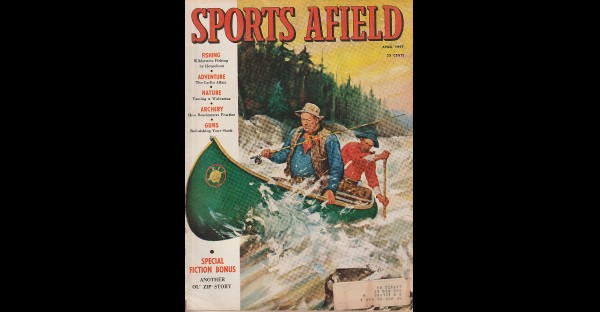

I recently re-discovered a storage bin that contained a collection of old Outdoor Life, Field & Stream, Fur Fish Game, Sports Afield and other outdoor magazines. I had forgotten that I had stored these vintage magazines away years ago, so it was like an early Christmas when I opened the bin. Very exciting! In the coming weeks I plan to share a few of them with Bass Fishing Archives readers. Today we’re going to look through a few pages of the Sports Afield, April 1957 issue.
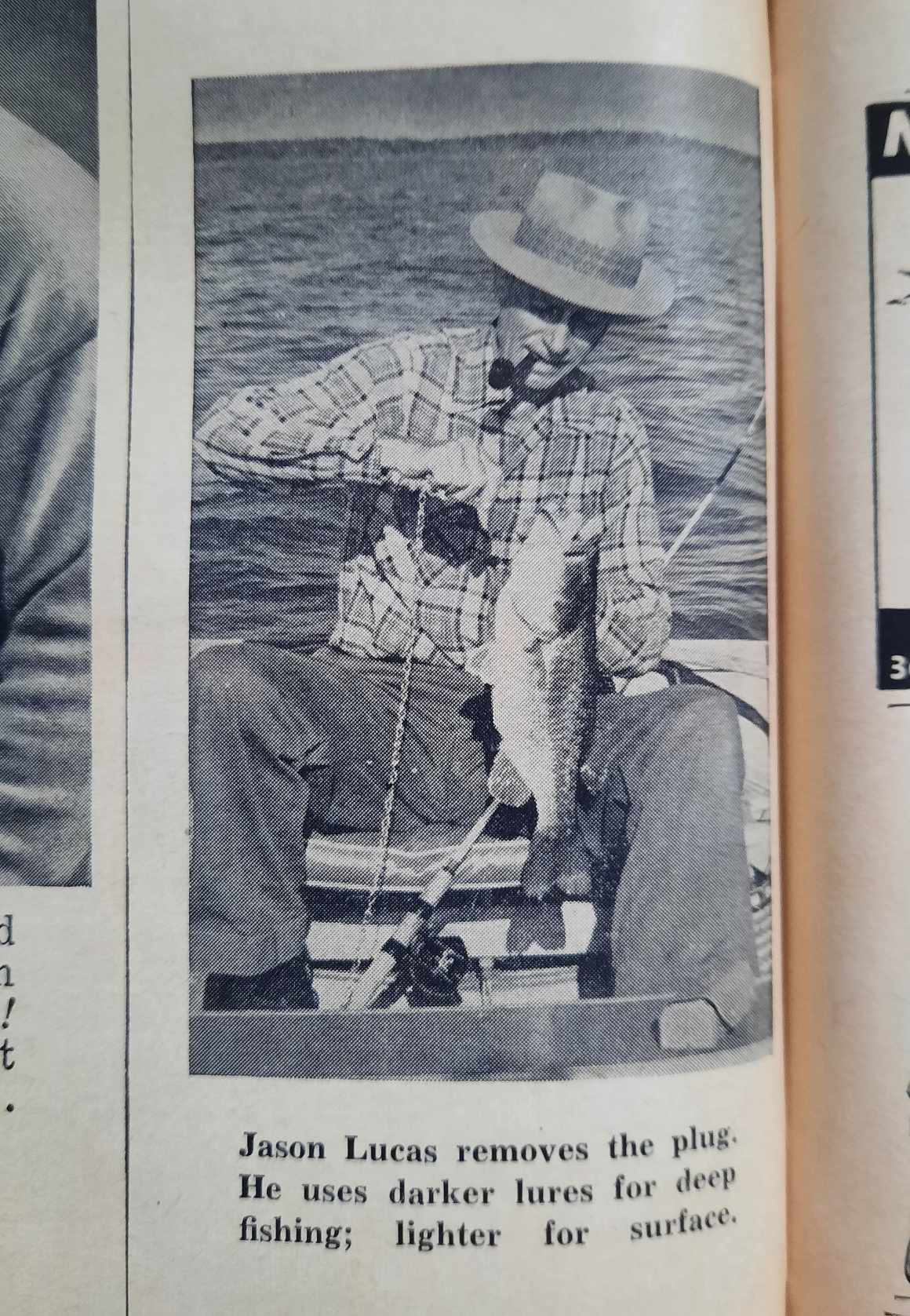
While there’s really only one bass-centric article in this issue, it’s a good one. It’s written by Jason Lucas, author of the influential book, “Lucas on Bass Fishing,” and a writer that we’ve talked about glowingly over the years. Just do a search for Jason Lucas on this site and you’ll find articles on him by Terry Battisti, Brian Waldman and Stan Fagerstrom. Lucas was the fishing editor of Sports Afield for more than two decades, and bass fishing was of course one of his favorite subjects. The story in this April 1957 issue is titled, simply, “Lures for Bass.” But perhaps a more appropriate title would have been “Eyesight of Bass,” because Lucas’s piece focuses almost entirely on how and what bass see, specifically concerning color, movement or action, and size. He goes into a good amount of detail and scientific research on whether or not bass see color, citing some very interesting studies and tests. The conclusion is that bass do, or probably do, see color. Lucas dives into what colors are likely to be more effective than others, depending on conditions. This is stuff that most bass anglers now know and practice. Lucas says, “An ancient rule is to use a bright lure on a dark day or in murky water, and a dull lure on a bright day or in very clear water. I think it’s a good general rule and will work most of the time–but at times when I was catching nothing I’ve reversed that rule, and did nicely. As I’ve said, even the best rule about such matters won’t work always–just most of the time.”
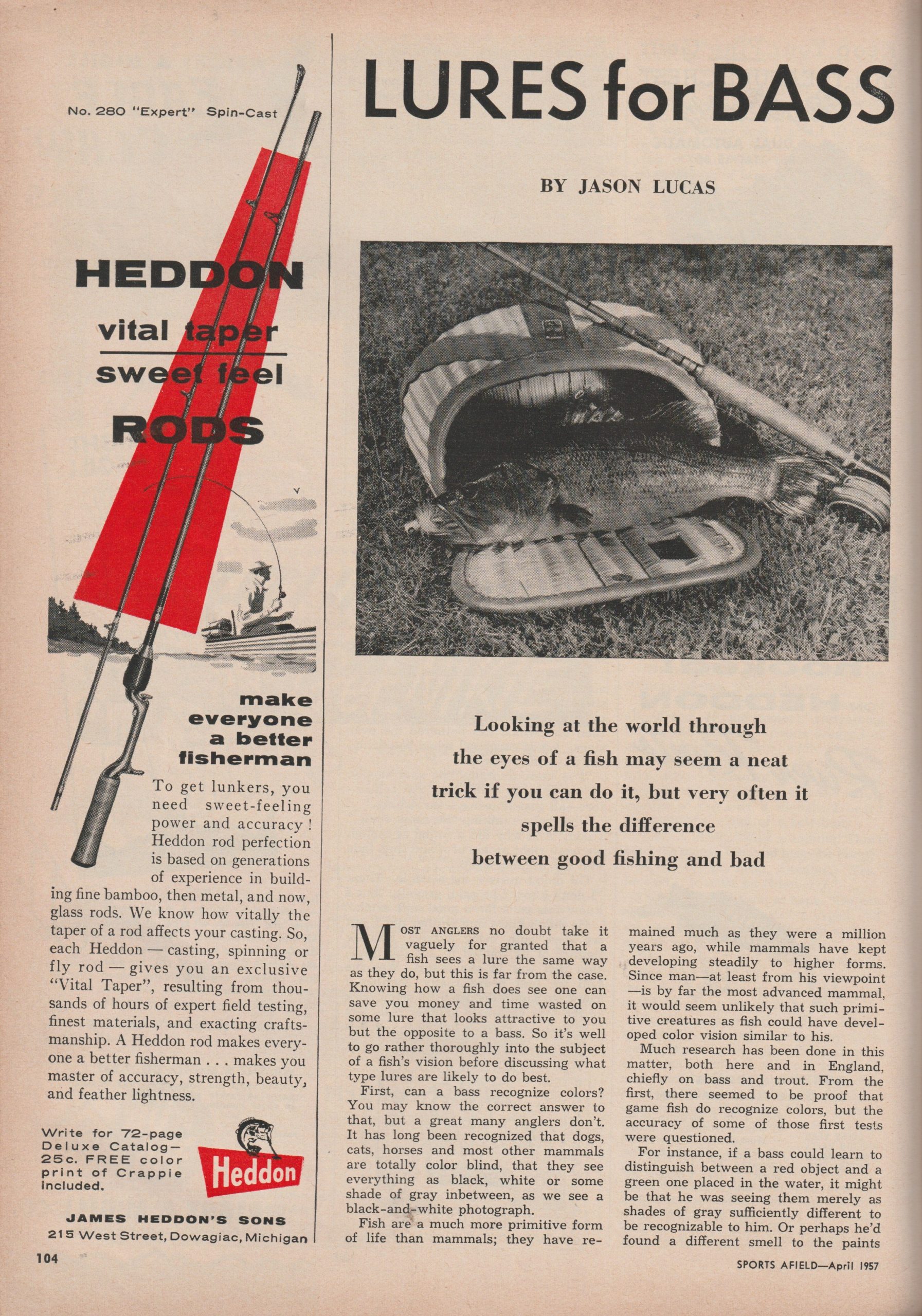
Interestingly, Lucas spends a good amount of time discussing the color red, suggesting that all-red lures rarely perform well while those with a little red do indeed often perform well. He also discusses movement and size of an object. “For if a bass sees something moving in, or on the surface of, the water, he thinks it’s alive. If it looks big enough to be possibly dangerous to him, he gets out of there; if it’s very small he usually pays no attention to it. But if it looks like a fair-to-good mouthful, and he’s reasonably hungry, he’ll grab it.”
He later tells a story of a well-known fly fishing guide who also made fly fishing poppers to sell to the public. The guide took great care in painting his “for sale” poppers, adding eyes and certain feathers. But for his own poppers he didn’t bother with adding eyes and used whatever feathers he happened to grab hold of in the crafting process. He knew that his own crude poppers were effective at catching bass, and he also knew that those simpler poppers would not sell to fly fishermen. Anglers buy lures that attract them more than lures that attract fish, which has always been the case.
From the title I was expecting a treatise on actual lures to have in your tackle box, and what lure to choose for what condition. But Lucas gives a deeper, and more useful and practical education with this article. Every time I read something by Jason Lucas, even if it’s the third or fourth time I’ve read it, I feel I come away a little smarter about fishing.
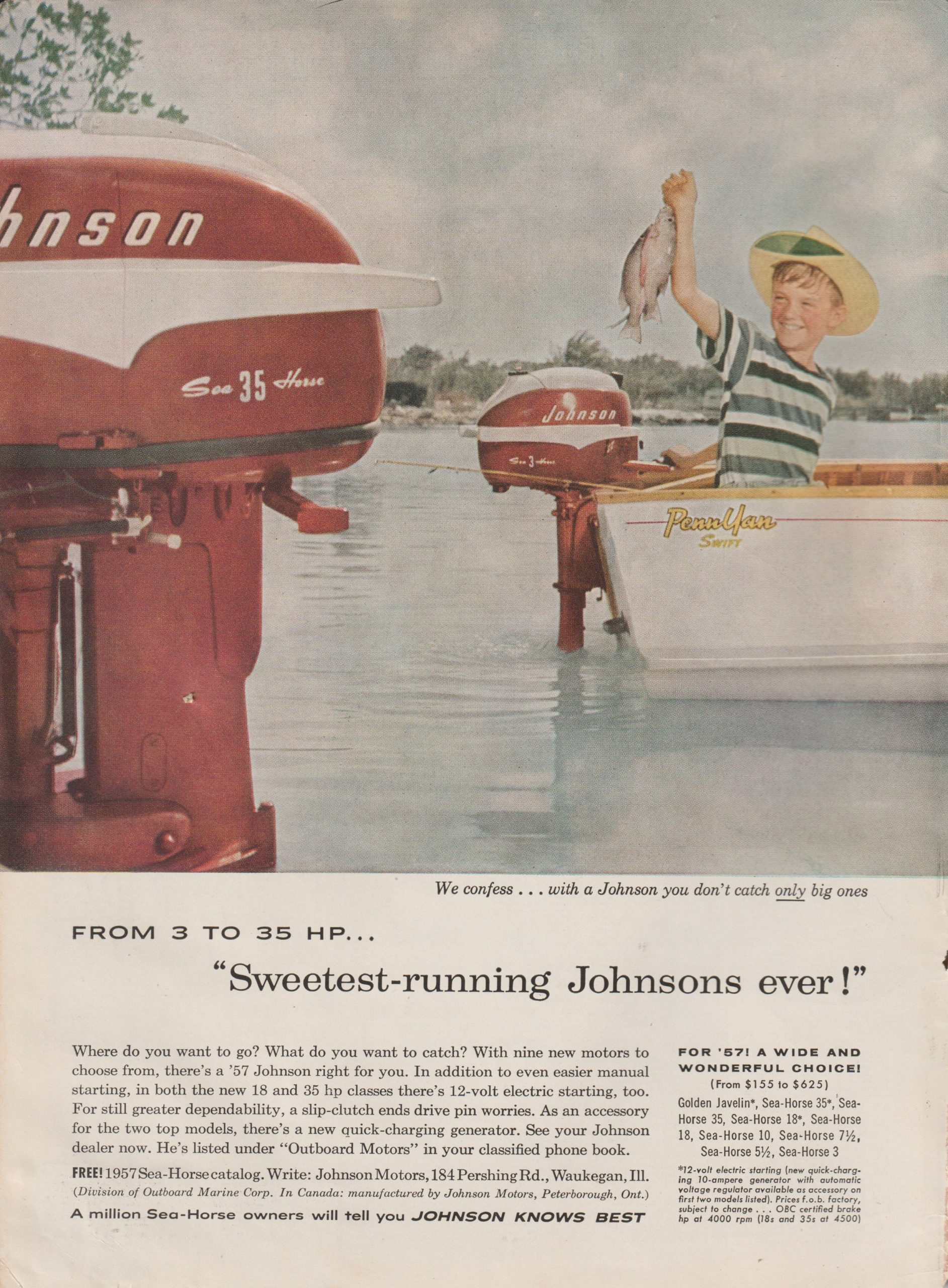
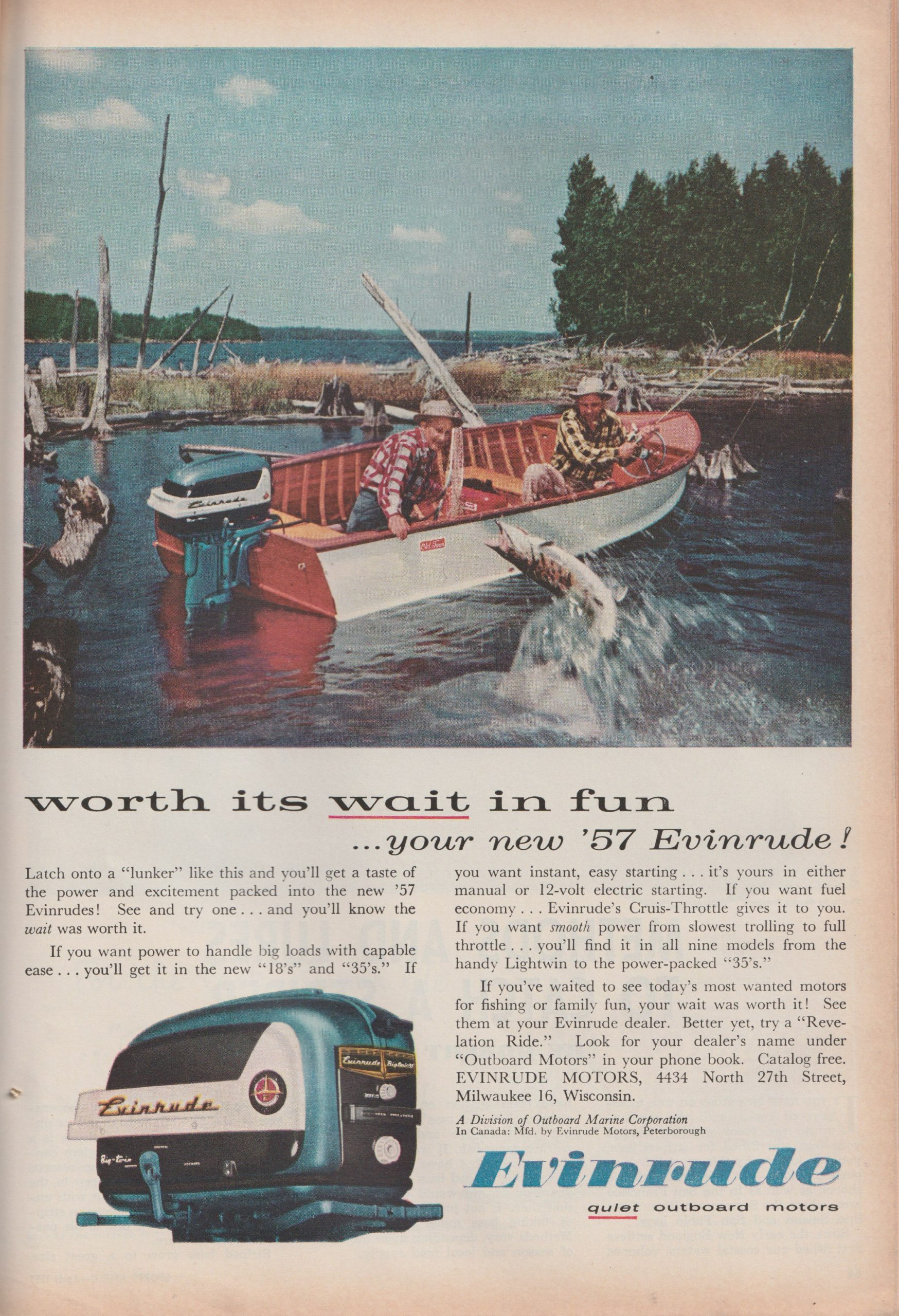
Now to those wonderful old fishing ads. I’m just going to show a few of them here, but there were plenty in this Sports Afield April 1957 issue. Firstly, I love the ad for the Johnson Sea Horse boat motor. Why? Because I happen to own a 35hp Sea Horse just like the one in the ad. They are gorgeous motors. Following the Johnson ad is an ad for Evinrude motors, and what a great photo of two anglers fighting a musky from a beautiful wooden boat. Johnson and Evinrude knew how to sell their products, by juxtaposing their motors with images of people using them and enjoying their time on the water.
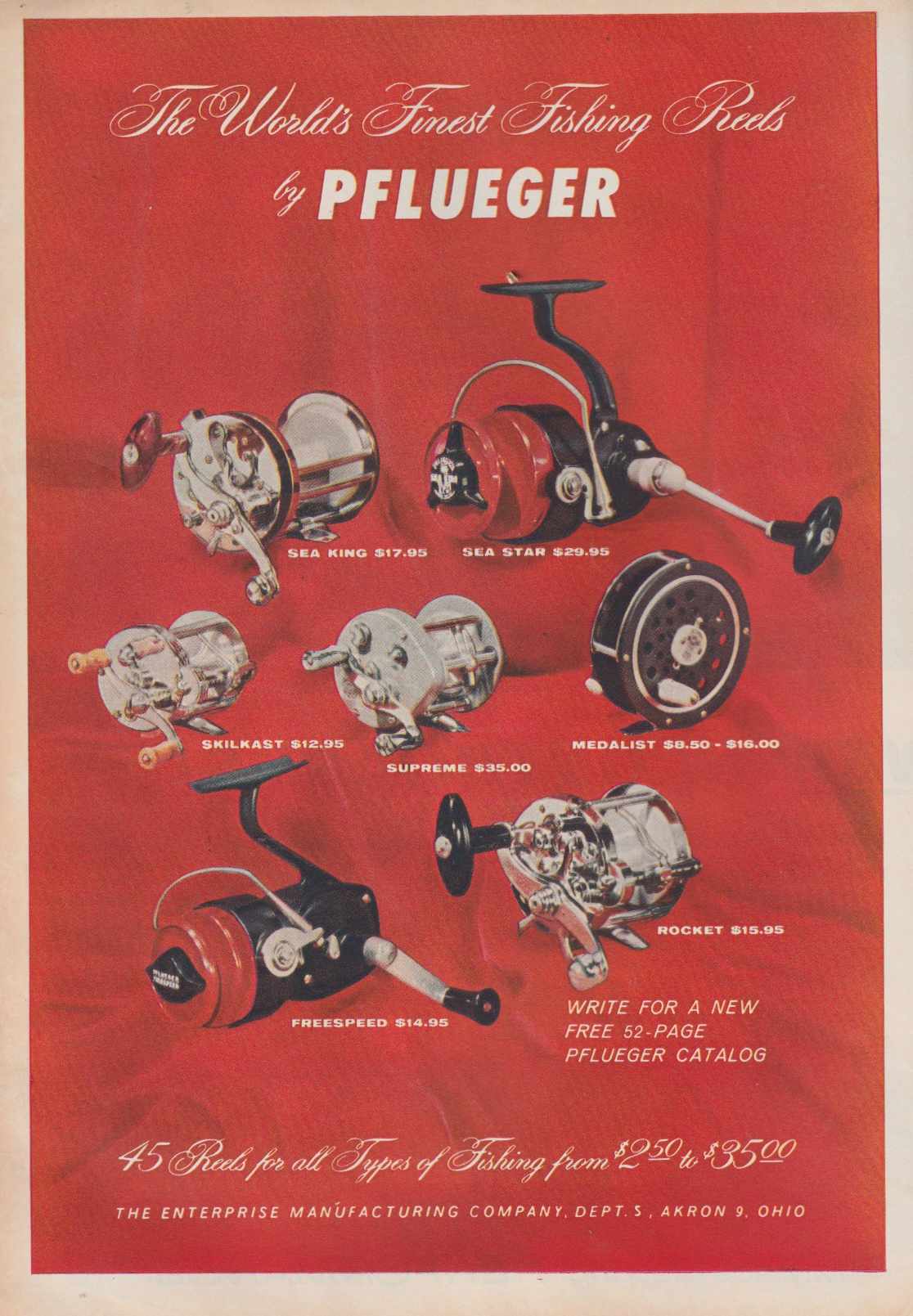
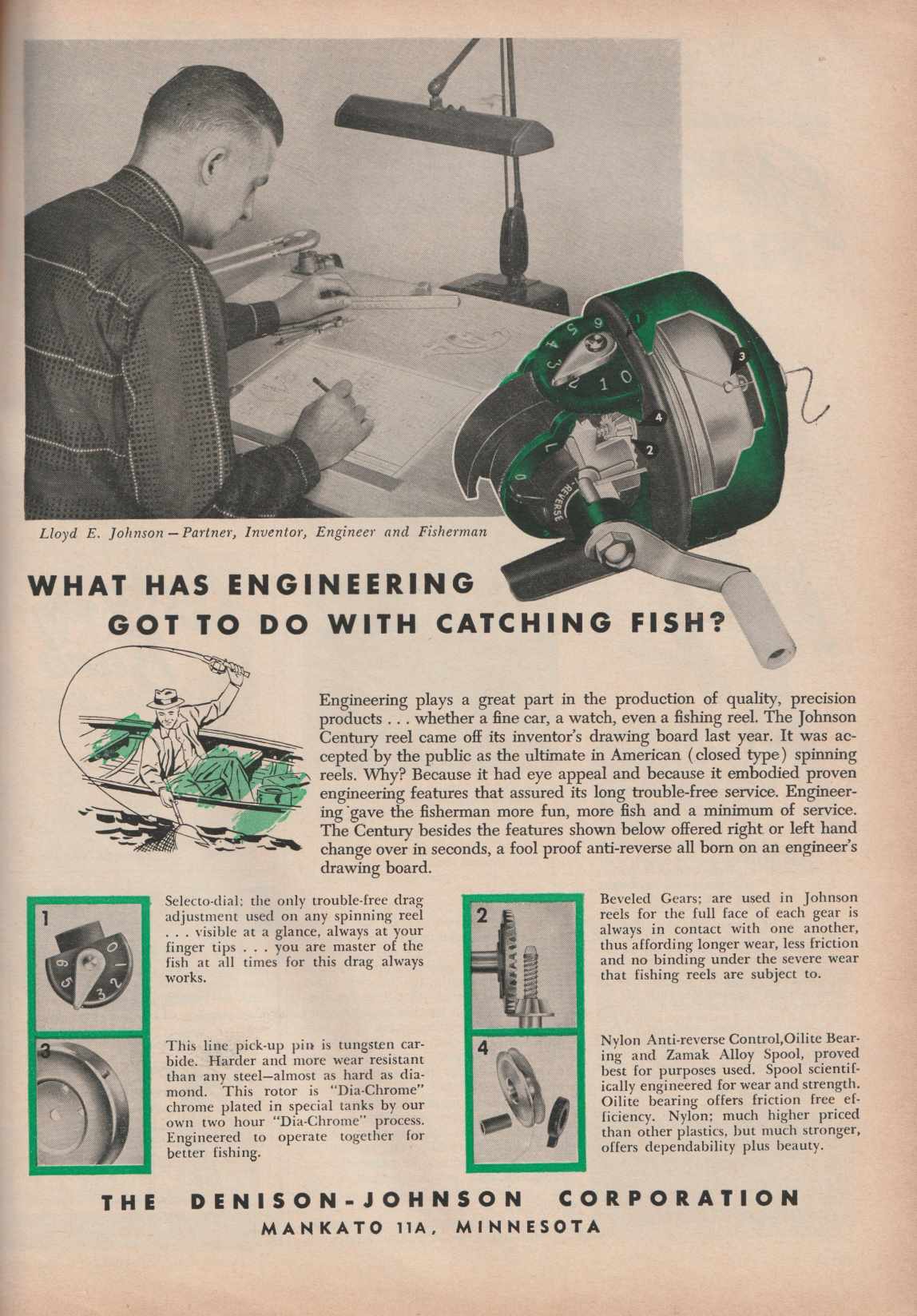
Contrast the two ads, below, for fishing reels. The Pflueger ad is certainly eye-catching, with little more than several of the company’s famous reels on a full page of deep red. The ad by Johnson for their Century spincasting reel is just the opposite, with lengthy text and an emphasis on the engineering behind the reel. Two very different marketing approaches, but both effective in their own right. As attention-grabbing as the Pflueger ad is, I think I give the nod to Johnson. While it’s not as visually appealing it does give you a lot of information, and no doubt appealed to the detail oriented fishing nerd…like me.
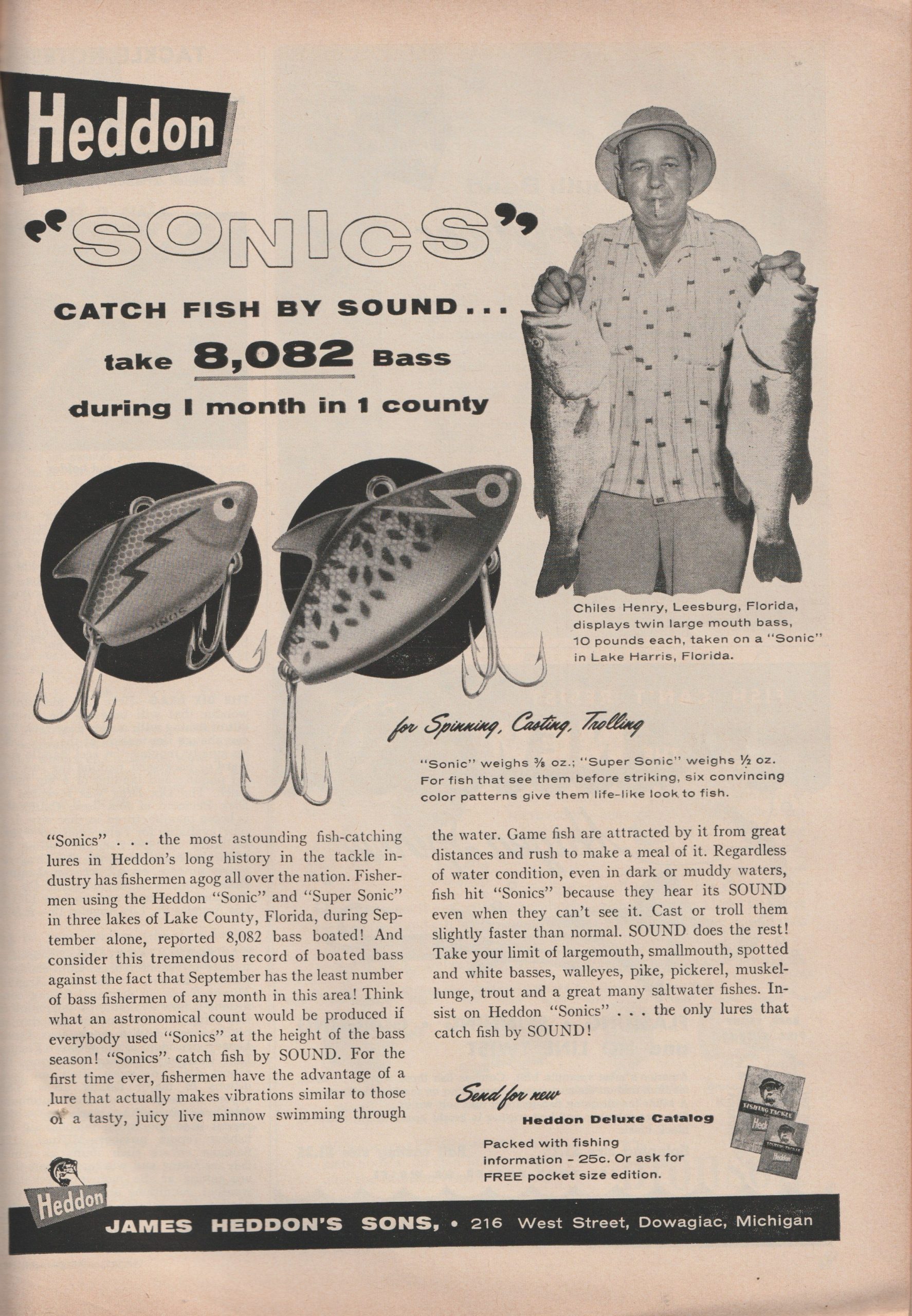
Next up is a full page ad from Heddon for their Sonic lure. The image of a pith hat-wearing, cigarette smoking Chiles Henry holding two 10-pound largemouth bass is worth a smile. The bass are impressive, but Mr. Henry looks more than a little tuckered out. At the bottom of the page is the usual pitch for you to request the company catalog. How does .25 cents for a Heddon Deluxe Catalog sound? Those catalogs sell for big money on eBay these days.
The ad for Western Auto’s Wizard Outboard Motor is a beauty as well. Wizard motors were actually built by Mercury Marine in the 1950s, through 1957. After 1957 they were made, consecutively, by Oliver, McCulloch, Chrysler and Eska. Western Auto was also the company that produced the famous Western Flyer bicycle. The company was purchased by Beneficial Corporation in 1961, which is probably only of interest to me, because my Dad worked for Beneficial for many years. By all accounts, Western Auto’s Wizard motors were very well made, and folks that own them today value them for their reliability.

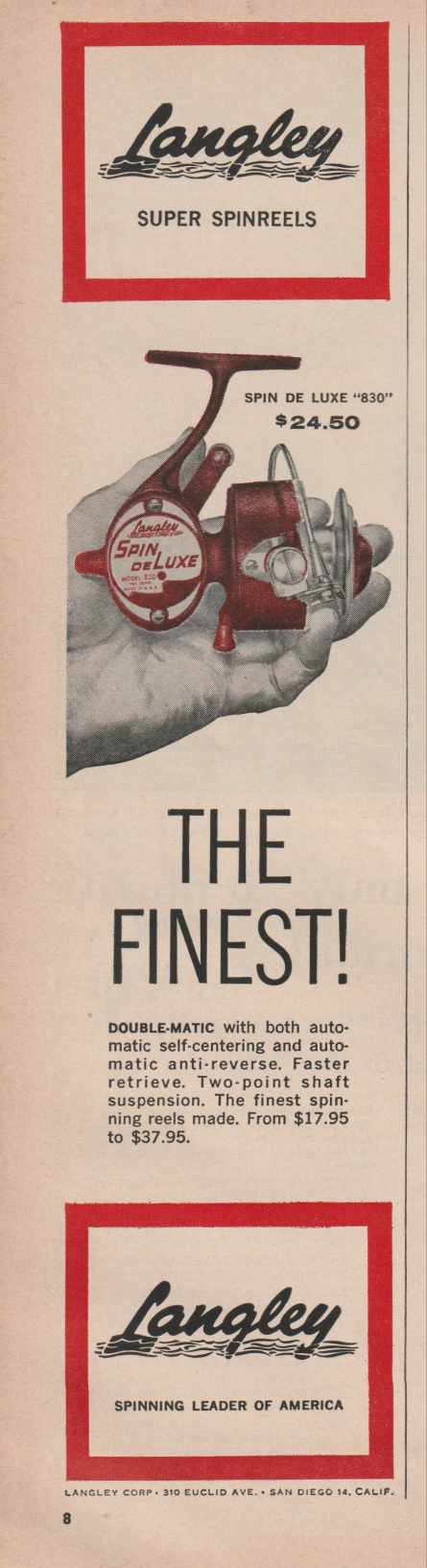
Below are a couple of vertical ads. The ad on the left is for the Langley Spin DeLuxe, one of six spinning reels produced by Langley. If you want to read my other article on Langley Spinning Reels, click here, and if you wish to read Terry Battisit’s excellent piece on Langley Baitcasting reels, click here. Suffice to say, we think very highly of Langley reels. The other ad caught my eye, not for its aesthetic – frankly it’s kind of visually boring – but rather because it advertises items you don’t normally see in a fishing tackle ad. It’s from Taylor Instrument Companies and shows three useful items that every scientific angler would want: a navigation compass, a barometer, and a water thermometer. I can’t help but think that this ad could use an illustration of an angler fighting a fish from a boat equipped with these three gadgets. The barometer comes with a plastic box stocked with some Heddon lures, so that’s a plus.
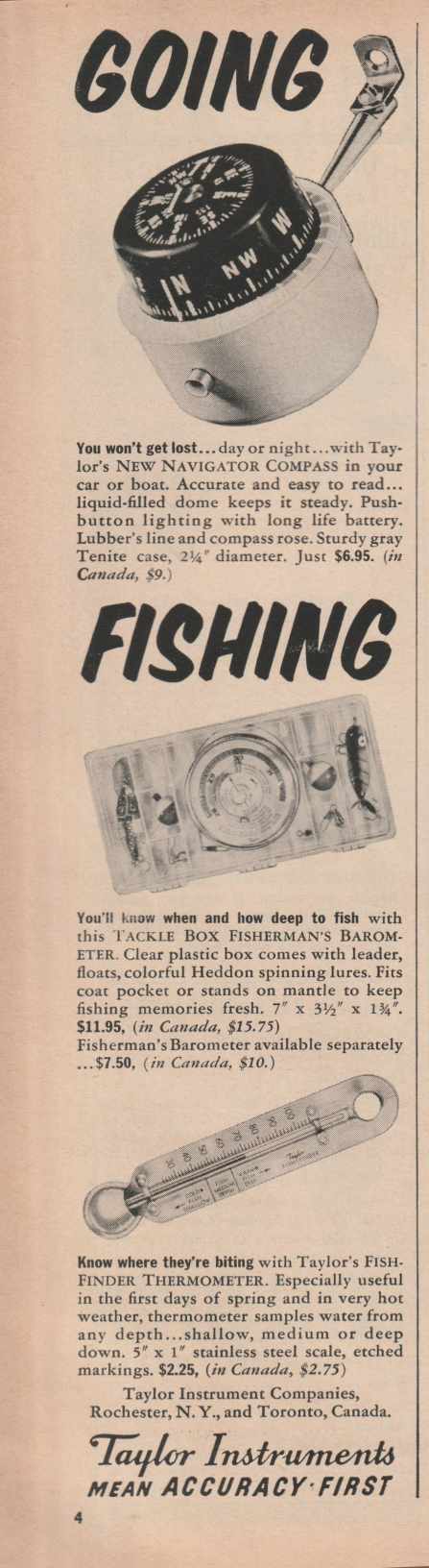
As I mentioned earlier, this magazine has a lot of lure and tackle ads, these are just a few.
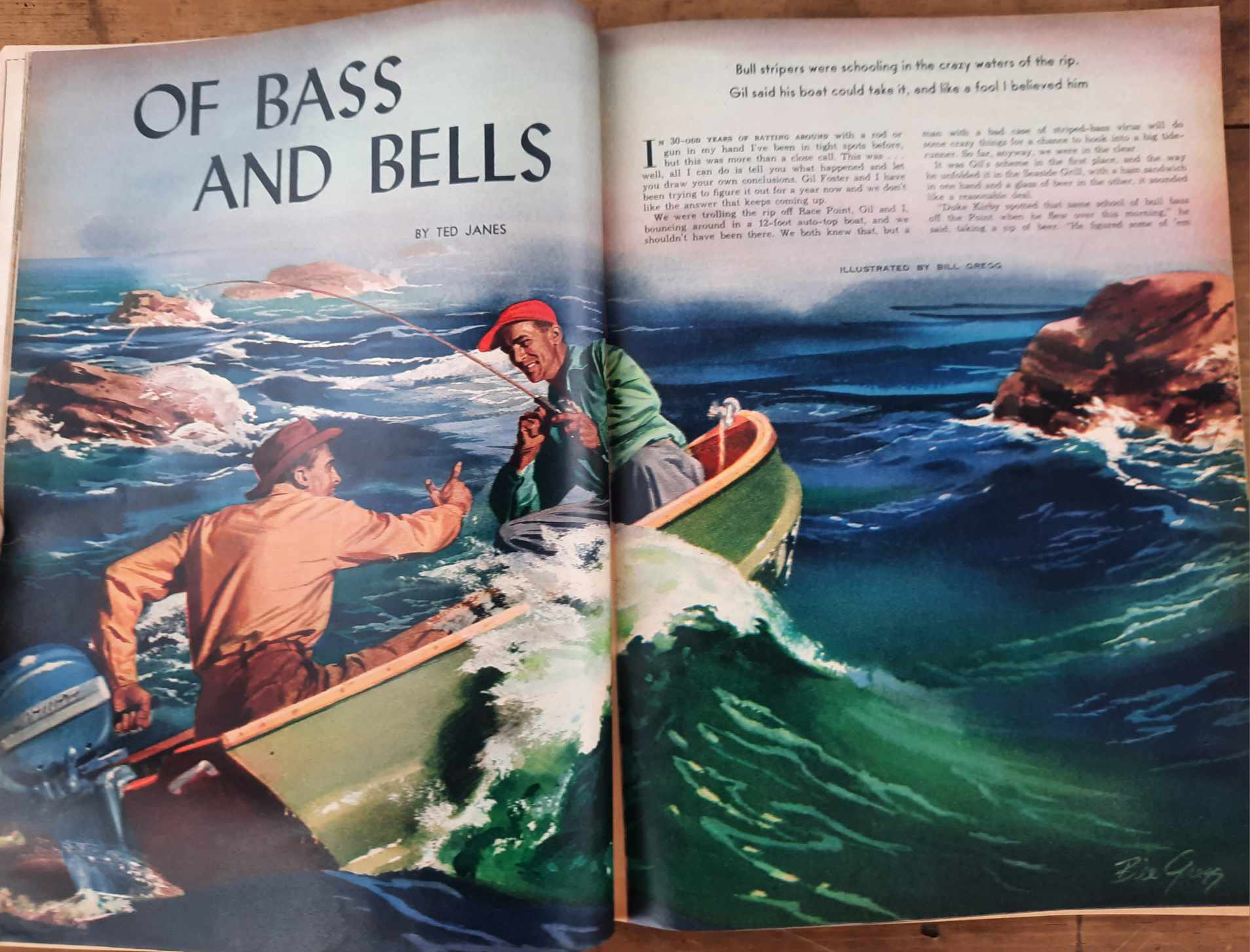
Lastly, I couldn’t share this issue without mentioning the artists who illustrated several of the non-fishing stories. I was talking to Terry Battisti about this issue, and I exaggerated that it seems to have more adventure stories and dramatic illustrations than a lot of vintage Men’s Adventure magazines of the time. You might be wondering what the heck do adventure images have to do with bass fishing? Answer: absolutely nothing, except that they’re in a magazine that is revered by anglers and has arguably the most influential bass angler and angling author of the 20th century on staff. The fearsome images of gigantic polar bears, below, are from a story titled “Top of the World.” Other stories in this Sports Afield issue with dramatic paintings include “Killer On a Trotline,” which shows an angler underwater fending off an alligator that has clamped onto his arm, and “The Carlin Affair,” with two renderings, one of a man bloodied and dragging himself across the snow and the other of two men struggling to survive a raging river. Finally there’s “Of Bass and Bells,” a story on striper fishing with an accompanying illustration that tells a tale of danger, where two anglers battle an angry sea in a small boat that threatens capsizing. After leafing through this issue I’m surprised I didn’t see an article titled “Largemouth Bass Ripped My Flesh!” with a painting of a bass fisherman holding a scantily clad female in one arm while fending off several ferocious bass with his fishing rod in the other hand.



This issue is in a fairly fragile state and I couldn’t scan many of the pages for fear of damaging the spine of the magazine, so I took several cell phone photos. But you get the idea. Seriously, the illustrations in this issue are fantastic. They just don’t make magazines like this anymore…if they make magazines at all anymore.
We hope these few pages from the Sports Afield April 1957 issue takes you back to a time, whether you were alive then or not, when authors of the caliber of Jason Lucas were writing, tackle companies courted anglers with their latest offerings, boats motors were designed by engineers with creative flair, and images of adventure sparked the imagination.