When anglers think of Smithwick, one lure usually comes to mind – the Devels Horse. The twin-propped topwater is one of the most iconic baits to ever grace the surface of the water and is still considered the topwater bait in Florida. Today in Smithwick 1977, though, we’re going to investigate some other baits Jack K. Smithwick and his son made.
In this string of ads, taken from three different publications, there isn’t a single Devels Horse mentioned. Instead, Smithwick was touting some of the other lures in their line-up. The first ad is a good example.
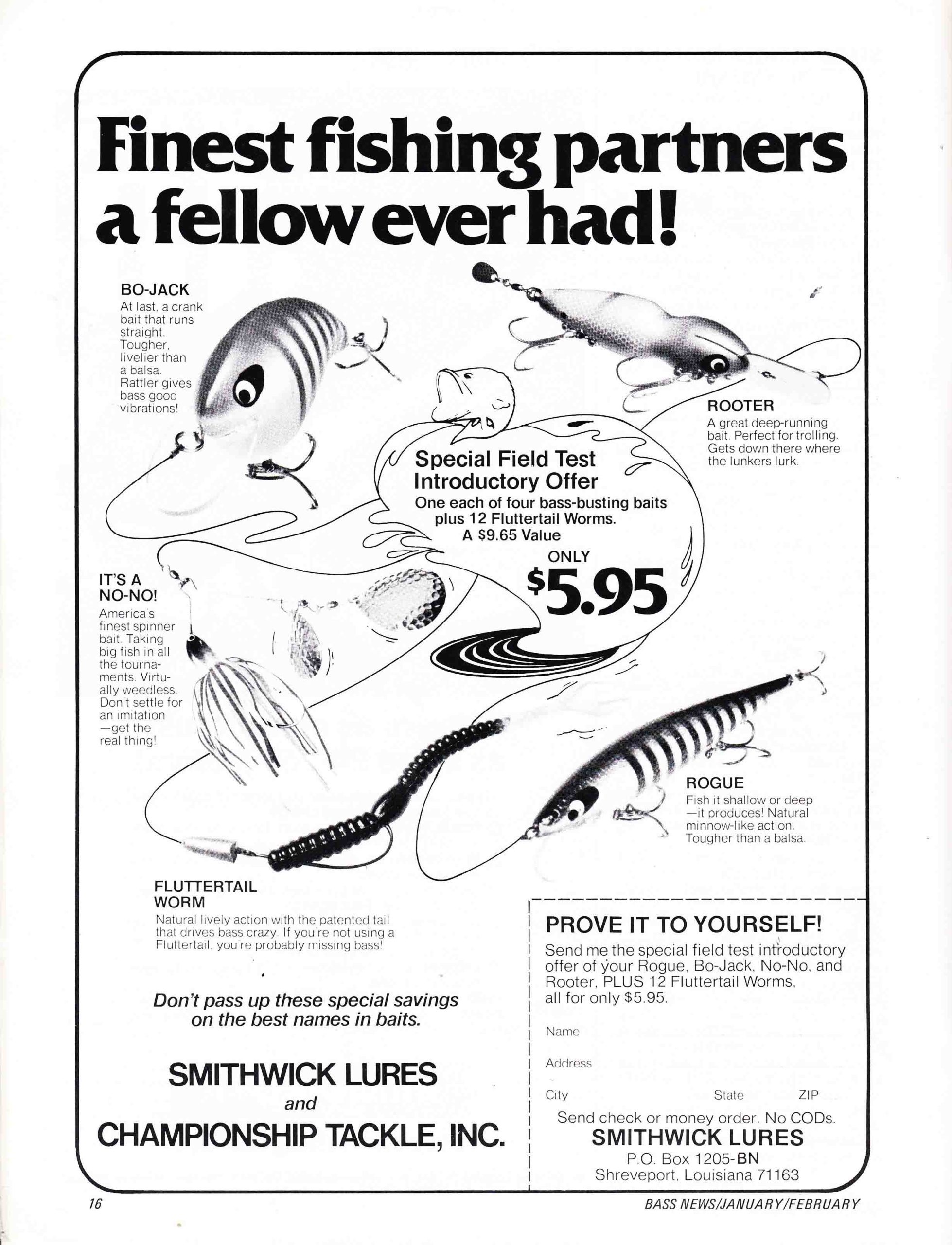
Taken from the January/February 1977 issue of Bass News, this ad featured the Bo-Jack, the Rooter, and the Rogue. Adding to that list they also added Championship Tackle’s Fluttertail Worm and the “It’s A No No” spinnerbait.
The Bo-Jack was introduced in 1976 and named after both Jack K. and Jack A. Smithwick. It had a “buzzing” rattle in and was touted, by Smithwick, as the only “true running” crankbait on the market. I’m not sure I agree with that last claim, but it did catch fish. Next was the Rooter, which over the years Smithwick made many versions of. Most were made to imitate the Bomber but the model E-700, shown in this ad, was Smithwick’s answer to the Hellbender. Although it resembled the famous bait from Sherman, Texas, it better resembled the Martins Lizard.
Continuing in the clockwise pattern we land on the Rogue. The Rogue made its debut in 1969 in three sizes, two floaters and one sinker. By 1977 they’d added another size to the lot. This add says, “Fish it shallow or deep..,” which makes me believe they’re talking both about the floater and sinker.
The last two items in the add were products they acquired when they purchased Championship Tackle in 1972. The Fluttertail Worm was just another plastic worm of the 70s, which didn’t gain much traction, at least in areas outside of Louisiana and east Texas.
The “It’s a No No” spinnerbait was an interesting bait in that the line tie was unique. I’ve only seen this feature on a couple other baits over the years and there’s a reason it didn’t catch on. The line tie was a swivel placed on the wire and shouldered by two chrome beads. Not sure the theory of this configuration but of the couple blades I’ve thrown that were built like this, none of them ran right.
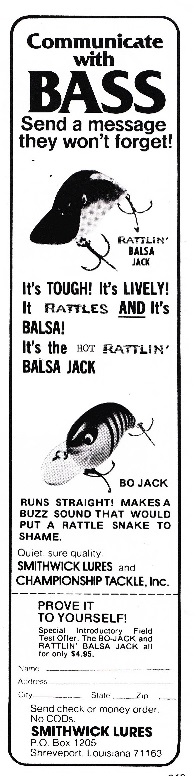
The next ad featured their two new crankbaits, the Rattlin’ Balsa Jack and the Bo-Jack. The Balsa Jack was obviously made to compete with the Balsa B and maybe the handmade Big-O by Fred Young.
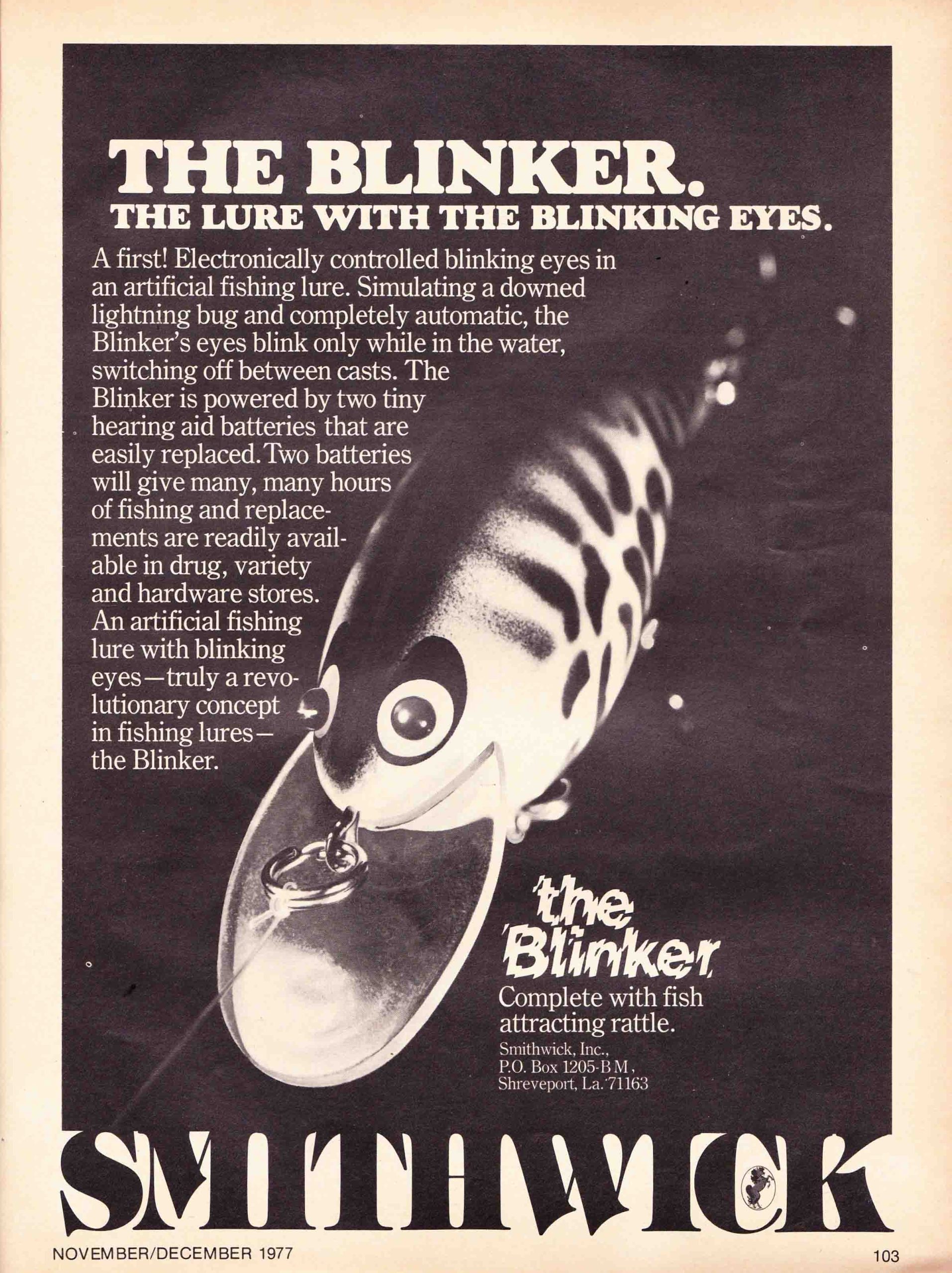
The next ad I came across we wrote about in December 2021, in Hardbaits – Batteries Not Included. The Blinker was one of the first contemporary crankbaits with battery operated blinking eyes. When in contact with water, a circuit was closed and the eyes blinked red, drawing in the fish for miles. The bat was introduced in 1977 and didn’t stick around too long, for obvious reasons.
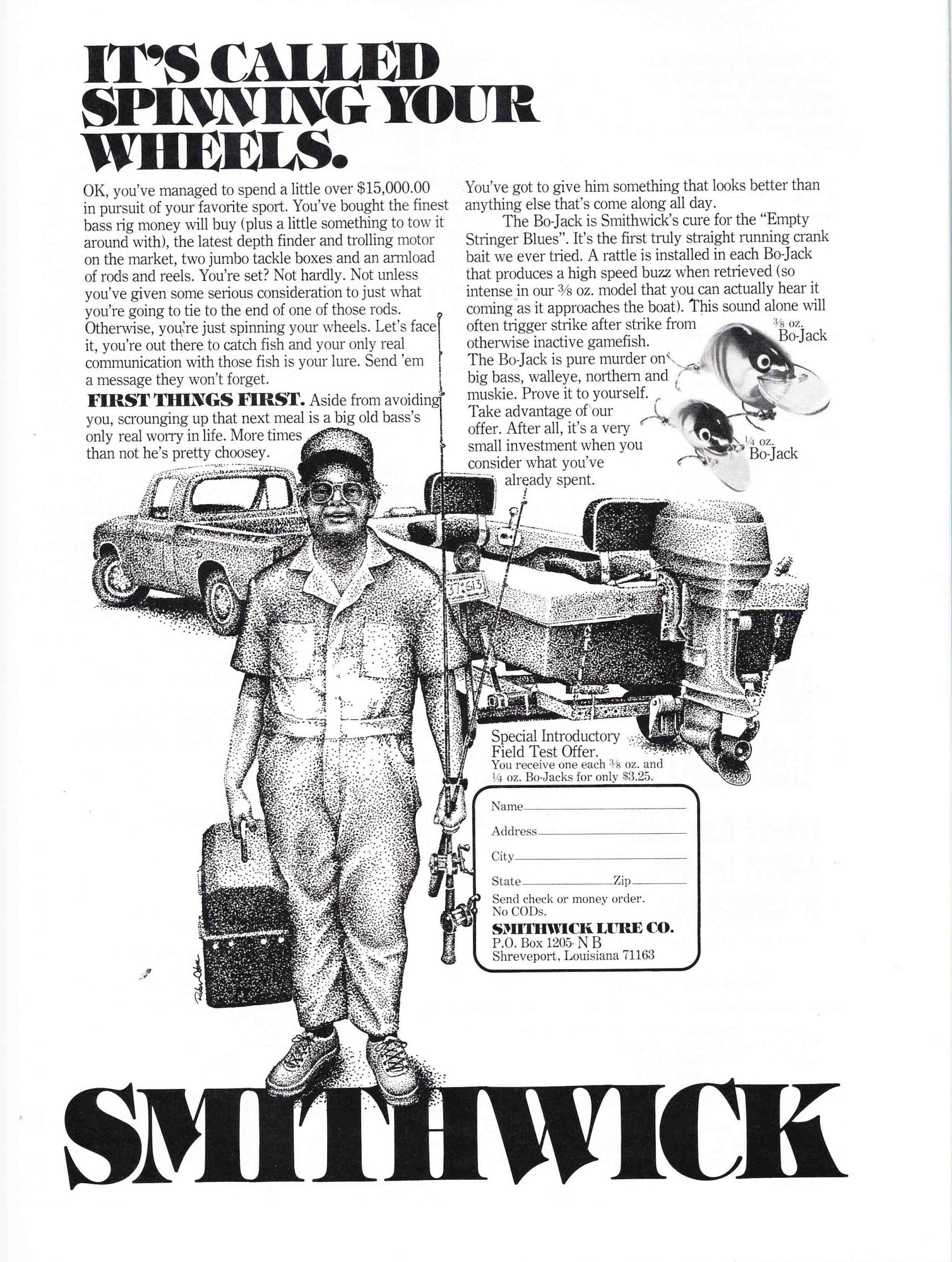
The final ad in this series looks nothing like a standard Smithwick ad, where the baits are generally front and center. In this ad, Smithwick is pitching their baits using a different technique. They said that since you’ve already spent $15,000 to get on the water (I wish a boat, truck, rods/reels, etc cost that), don’t skimp on what you tie on the end of your rods. Then they move right on into the Bo-Jack crankbaits, which are tucked into the ad and hard to see at first.
It’s a cool series of ads where it was obvious that they were concentrating on taking advantage of the crankbait craze going on at the time.
In 1992 Smithwick sold out to PRADCO and nearly every bait they made was discontinued except for the Rogue and the Devels Horse. Then the Rogue was discontinued in the late 1990s but brought back to life after Kevin VanDam won the 2005 Bassmasters Classic at the Three Rivers.
If you’re interested in Smithwick history, there’s a great website out there called Smithwick Collector.com. Alan Peters has put together one of the most comprehensive sites on the history of the company and it’s a place I visit whenever I need to clear up some Smithwick history.





Wow! $5.95 for 4 lures plus a package of plastic worms. Those were the days. Just like you, Terry, I remember taking advantage of many of these prevalent offers that have all but disappeared now. Sadly, I don’t remember cashing in on this killer deal. Still using both rogues and devel’s horses. Classic baits that never go out of style…..
I noticed that one too Mike! Wow! Sure do miss these offers…..
I love seeing the little coupon or cut out things we would cut out to order lures and things,that’s going way back lol
I’m glad I found this page. I was a member of a local bass fishing club and one of the older members was not going to keep fishing due to health concerns. He gave all his old fishing lures to the president of the club, to be divided among the members. He prepared zip lock bags of assorted lures that were in their original packaging and passed them out. My bag included a spinnerbait made by Smithwick Lures; It’s a No – No. I searched the web with no results until your page popped up. I’m not a collector of old lures but I connected with one on-line. He dismissed the value of such a find and offered me $5 to take it off my hands. I didn’t take his offer and glad I didn’t.