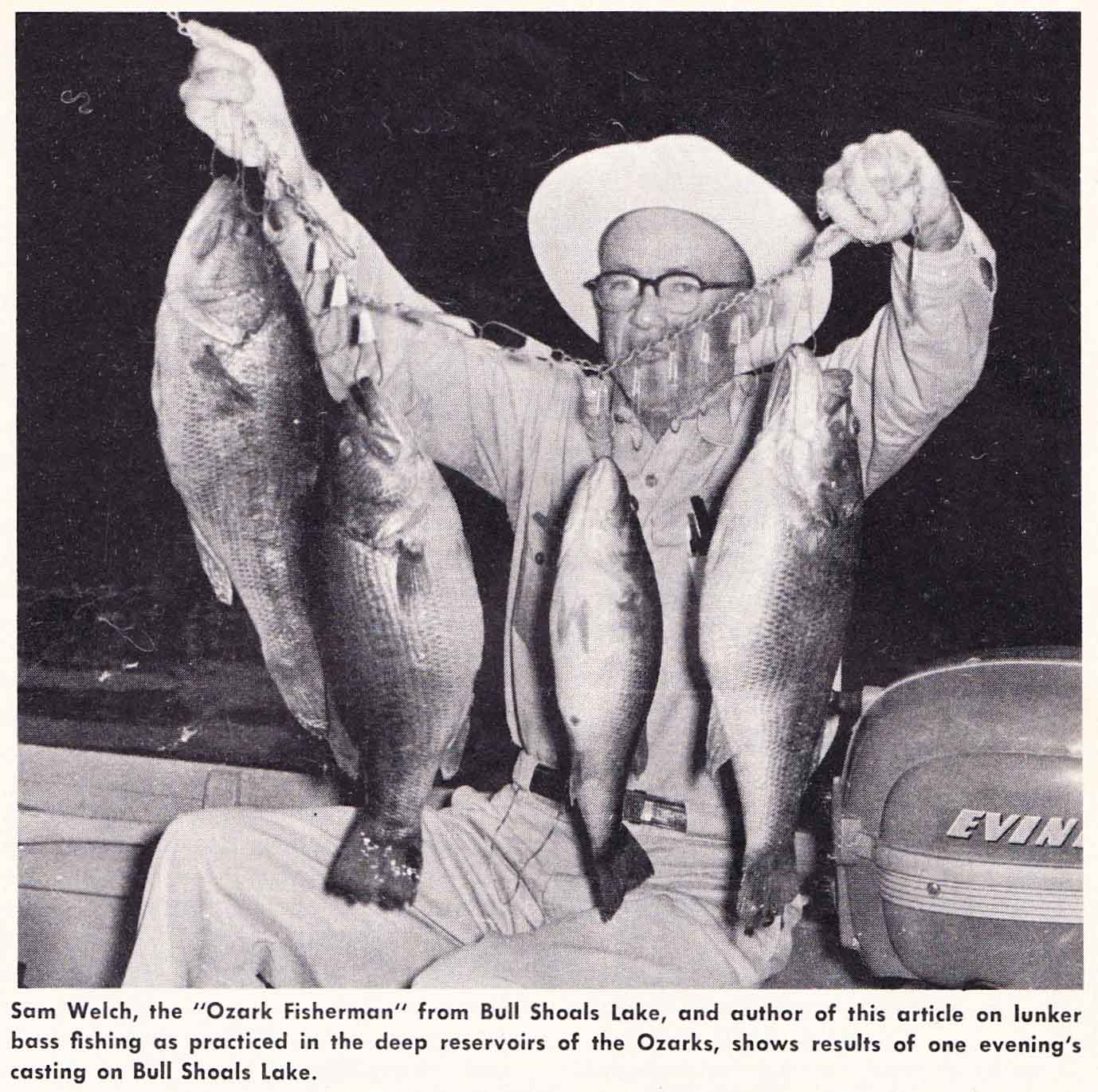
The roll call of famous Ozark bass anglers is long and illustrious. Virgil Ward, Glen Andrews, Forrest Wood, Johnny Morris, Charlie Campbell, Stacey King and Sam Welch. Sam who, you ask? Yes, Sam Welch, probably the greatest Ozark bassman you never heard of. Not being familiar with Mr. Welch myself, until coming across his name perusing old fishing-related media several years ago, I became intrigued with finding out just who he was. Having a passionate interest in the history of bass angling in the Ozark region, I was determined to start digging and find out all I could regarding his background. In Sam Welch-The Ozark Fisherman we’ll delve into the writing remnants he left behind that cement his legacy as a true Ozark bassin’ legend.
Dam Good Fishing
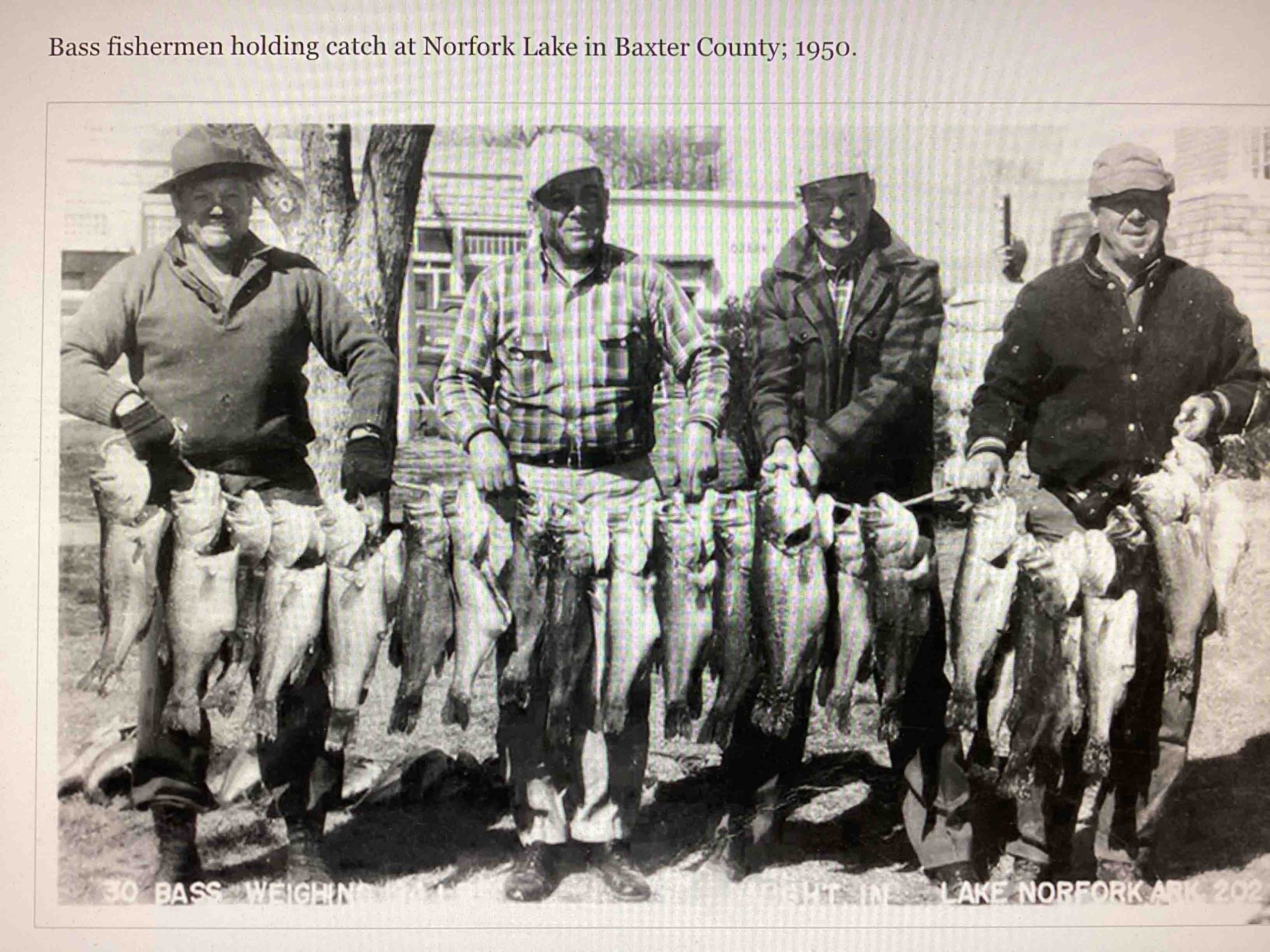
In the 1940s and early 1950s, the majestic White River and its tributaries that ran along the border of southern Missouri and northern Arkansas, saw the completion of two large dams designed for flood control and hydroelectric power. The first, Norfork Lake, was completed in 1944 and the larger, Bull Shoals Lake was completed in 1951.
Like all large reservoirs, the bass fishing was fantastic for several years after impoundment due to the initially nutrient rich and fertile waters. Adding to the longevity of the good fishing was the relative remoteness and size of both reservoirs. Even more amazing is the amount of large lunker bass these two reservoirs put out in the first ten to fifteen years of their existence. Sam Welch was the proverbial lucky soul who just happened to be in the right place at the right time.
Lunker Lists
My first exposure to the name, Sam Welch, came from the catalog insert included in the boxes of Martin’s Lizzard lures, which were popular in the Ozark region at this time (see the BFA post-“You Don’t Know Jack-The Martin’s Lizzard”). In these inserts, Welch was cited as the editor of The Ozark Fisherman and apparently a compiler of lunker bass data taken from both Norfork and Bull Shoals lakes.


Doing an internet search, I found a 2009 article from the Arkansas Democrat Gazette, detailing early tourism efforts in the Ozarks that mention, “Sam Welch, known as the Ozark Fisherman, sent a weekly newsletter to 115 news sources.” This newsletter started with the surge of lunkers caught at Norfork and continued with Bull Shoals as these catalog inserts attest.
Sam’s Biography in his own words
Recently, I was lucky enough to obtain a July 1963 copy of Outdoor Life, which included an article penned by Sam Welch, where he provides the following details of his background:
“I’ve been fishing for bass 40 years, much of that time in the Ozarks. I lived in Kansas City until the late 30’s and was on bass water somewhere in southern Missouri or northern Arkansas every chance I got. In 1948, I moved to Arkansas and fished two top impoundments, Lake Norfork and Bull Shoals, as often as time and health permitted, day and night, 12 months of the year. I wound up a fishing reporter, living in the town of Bull Shoals and keeping score and reporting catches for a group of resort owners, float-trip operators, and fishing docks.”
This last sentence references what must have been his weekly newsletter, The Ozark Fisherman, that despite innumerous searches, I have never been able to find a copy of.
Southern Angler’s and Hunter’s Guide
My first encounter with Sam’s longer form writing was in Don Fuelsch’s mostly annual editions of the Southern Angler’s and Hunter’s Guide. These guides were published in the 1960s and morphed into the Arkansas Angler’s Guide later in the 1980s. Chock full of photos of lunker bass and with ample coverage on the lakes and resorts in Missouri and Arkansas, these were a natural fit for the writings of Sam Welch.
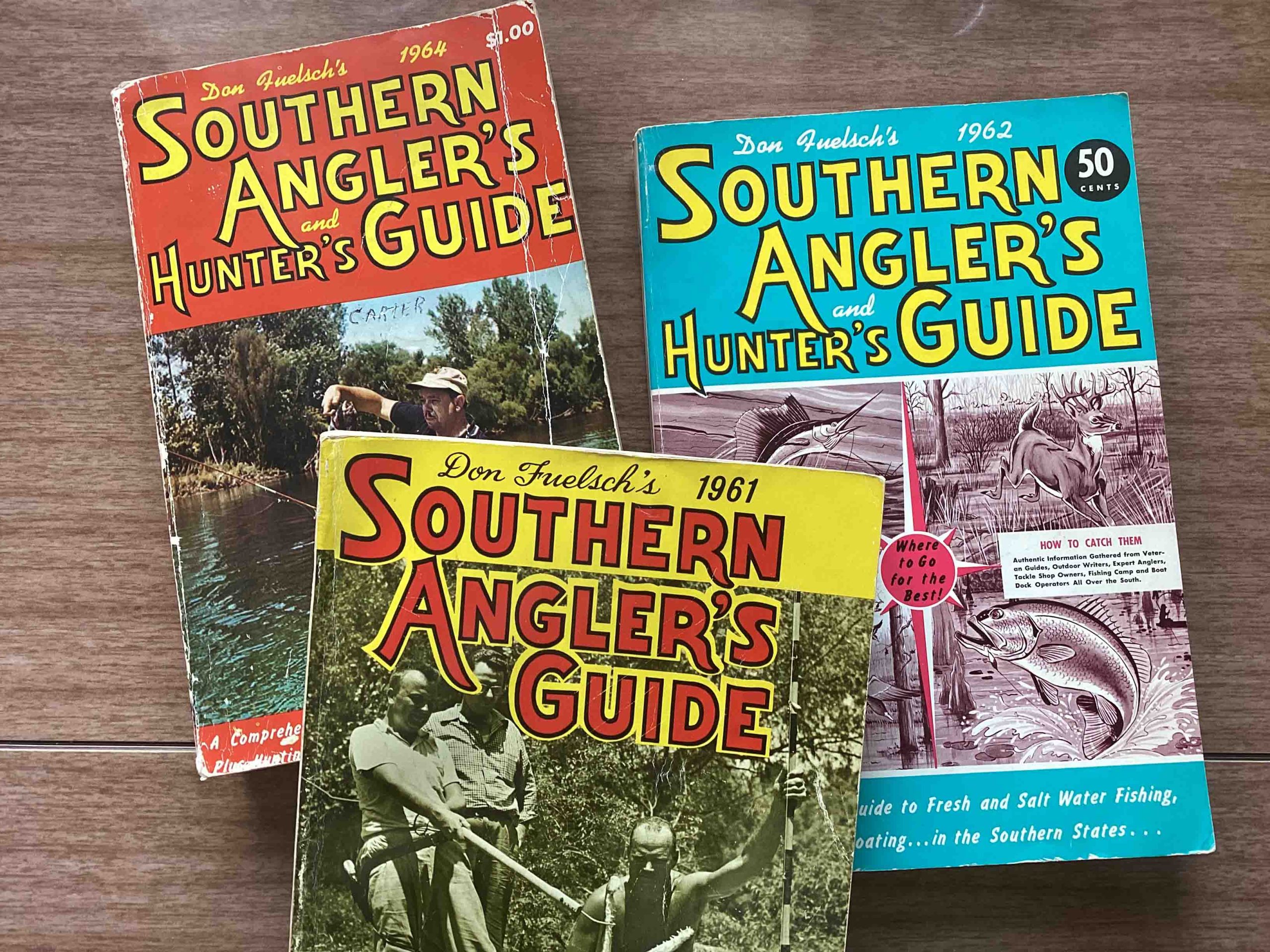
In these annual guides, Sam’s articles were either about pursuing lunker bass or tomes on bass fishing at Bull Shoals Lake. Some of the pieces remained essentially the same from year to year. His “ABC’s of Lunker Bass Fishing” appeared in 1963,1964 and the 1965-1966 editions pretty much unchanged.

In it he writes considerably about the success of night fishing and his fondness for the jig and eel as the best lunker bait. In his era, it wasn’t jig and pork frogs but large pork eels, often as big as 9 inches!
He also wrote fondly of bass fishing at his beloved Bull Shoals Lake. In these articles he went into detail about his methods for capturing lunker bass from this Ozark impoundment.
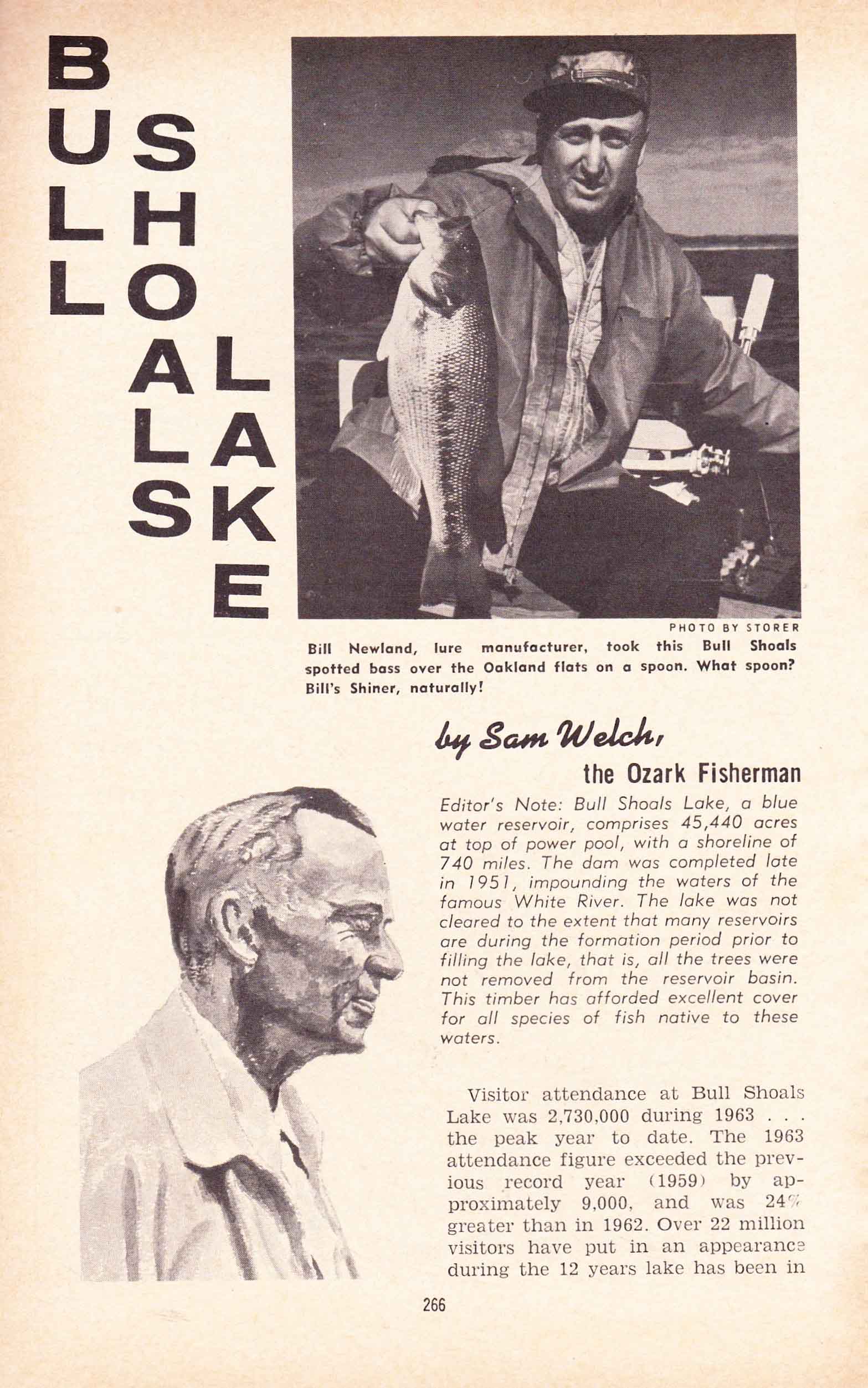
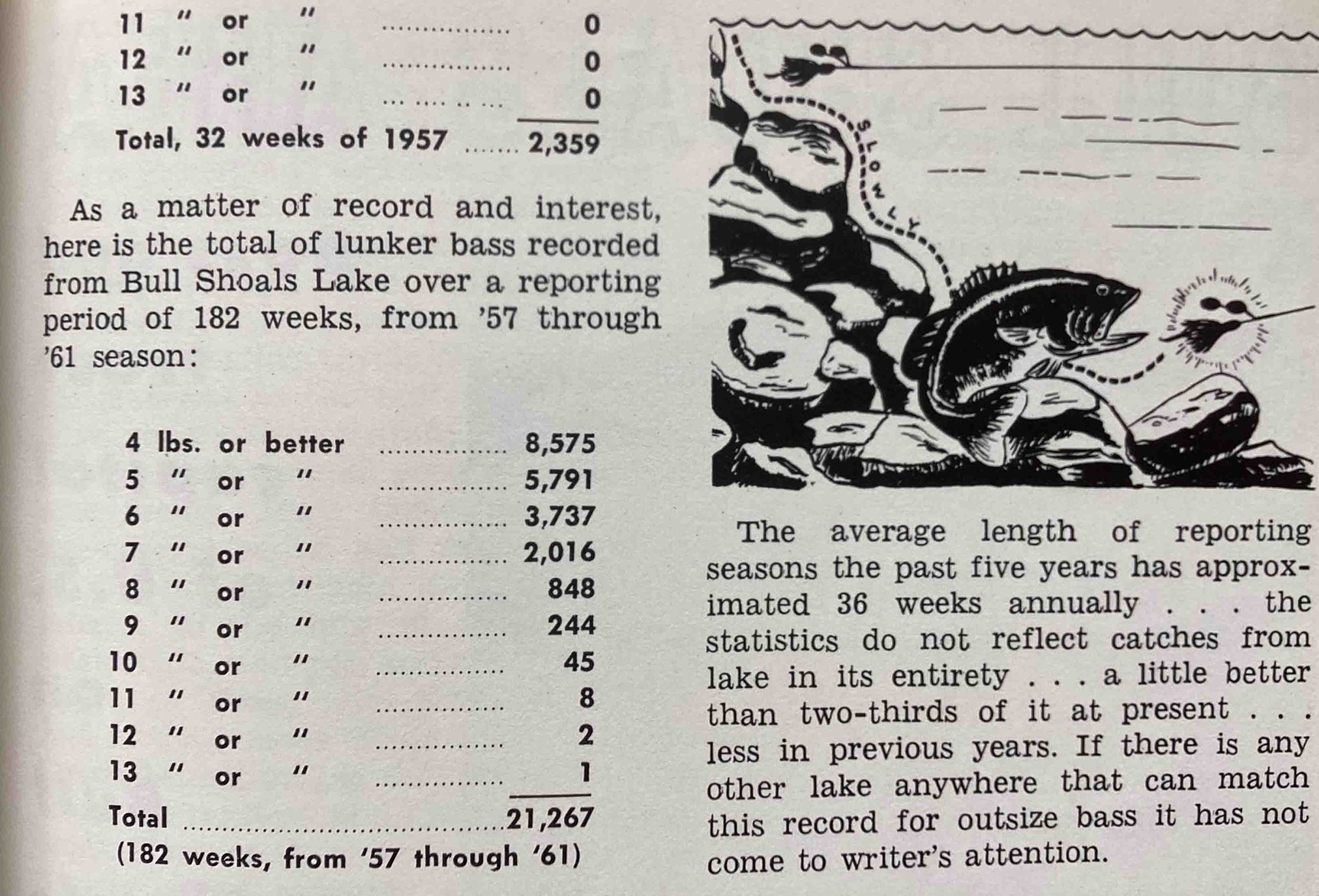
These annual Bull Shoals essays did get updated with new information, including data around astonishing lunker catch rates. As per the snapshot below from his article from the 1962 edition, he documented an incredible 3164 bass taken over 7 pounds, which included an impressive 56 bass over 10 pounds! All were taken in a five-year period from 1957 to 1961.
This total included, the still standing Missouri state record largemouth of 13 pounds, 14 ounces caught by Marvin Bushong in 1961.

Most impressive, is that all these lunkers came from a large reservoir nestled in the Ozark mountains and were northern strain largemouth which have shortened growing periods due to the climate they abide in.
Outdoor Life, July 1963
Sam’s writing hit the mainstream when he had an article published in one of the “Big 3”, Outdoor Life. He even got his article prominently mentioned right on the colorful cover!

Not surprisingly, the article featured Sam’s two favorite topics, lunker bass and Bull Shoals Lake. In the appropriately titled, “Bull Bass Are My Hobby”, he describes how chasing lunkers (what he considers to be any bass 4 pounds and up) became an obsession for him:
“My hobby is lunkers. Lunkers bass rarely come easy, but that only adds to the challenge. They are to the fisherman what trophy game is to the hunter. For me, bass fishing of any kind is superb sport, but fishing for lunker bass stands at the top.”
He goes on to detail that most anglers fish too shallow and too fast. He consistently scored on Bull Shoals fishing predominately at night, with a jig and eel, and in depths up to 60 feet at times:
“It takes determination and patience to spend three hours exploring a single point, but I have done it many times and made it pay. Depths from 15 to 60 feet should be probed, letting the lure sink all the way to the bottom and retrieving very, very slowly, so the jig-and-eel crawls upslope all the way to the boat.”
Garcia Fishing Annual 1965
Just one year later, he had an article published in the prestigious Garcia Fishing Annual that perennially included many of the top fishing writers of the era. Sam Welch was now included with writers like Tom McNally, Russell Tinsley, Byron Dalrymple and Stan Fagerstrom! No surprise what the topic was, the article was aptly titled “Ozark Paradise”.

While the article primarily focused on his lunker hunting on Bull Shoals, the latter part of the article shone a light on the amazing cold-water fishery in the White River below the dam.
“Prior to the construction of Bull Shoals Dam, the White River was noted for its excellence as a producer of smallmouth bass. But following completion of the dam early in 1952, the water flowing out from the base of the structure was so cold it was more suitable for trout than bass, and the river has become far more famous for rainbows than it ever was for smallmouth bass.”
To that end, it appeared that Sam expanded his horizons a bit from chasing lunker bass. There is an interesting photo, albeit not a great one, of Sam fishing below the dam with, at the time, a relatively unknown float operator and guide on the river, Jerry McKinnis.

Honesty or Hyperbole?
Given some of the amazing lunker totals reported by Welch over the years, it might be tempting to question their validity. Especially when his weekly newsletter was making the rounds among resort owners, dock operators and those with an interest in promoting the area to help their businesses.
Additionally, it would have been physically impossible to verify every catch reported to him from various sources, unless he required photographic evidence or multiple witness testimonies. And let us not forget, these catches were reported by fisherman, a category of enthusiasts not always known for their adherence to the strictest truth.
However, there are certainly other sources from this era that vouch for the incredible lunker potential of both Norfork and Bull Shoals lakes during Sam’s writing and reporting period. The esteemed author Robert Page Lincoln in his book from 1952, Black Bass Fishing, discussed the incredible bass fishing then taking place at Norfork:
“So, when Norfork Lake produces bass close to twelve pounds, I say that the thing is quite phenomenal and cannot be equaled anywhere in the country save in the state of Florida.”
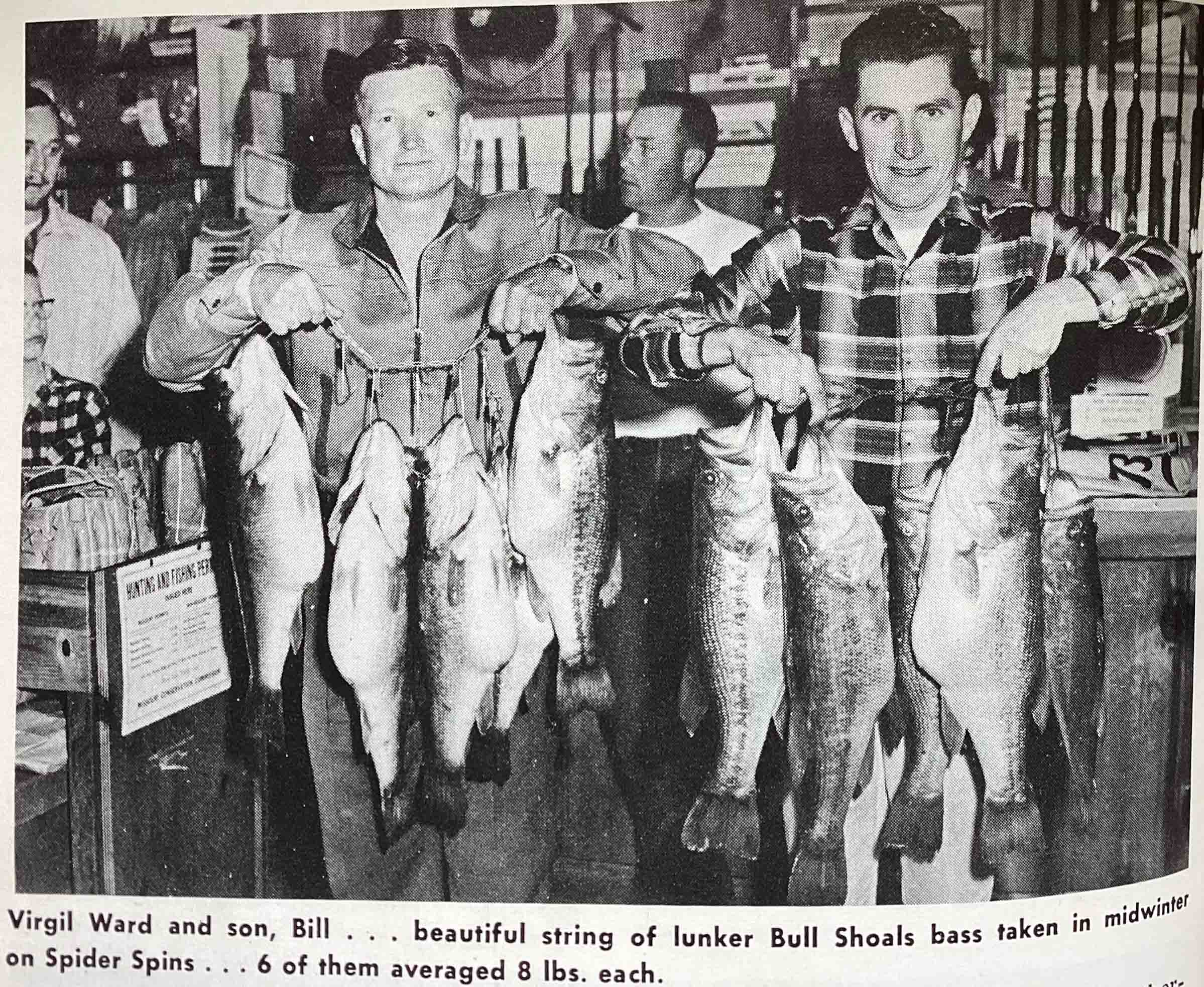
There is also ample photographic evidence of some of these amazing catches. One only needs to revisit the photo of the Missouri state record from above or take a gander at the photo below of Virgil and Bill Ward with an incredible string of wintertime Bull Shoals lunkers.
Lastly, the fact that Sam’s writing appeared in respected publications like Outdoor Life and Garcia’s Fishing Annual gave sufficient credence to his stories. In a 2012 In-Fisherman article titled “Legends of the Heartland,” Ned Kehde, of Ned-rig fame, referred to him as the great Sam Welch.
Final Thoughts
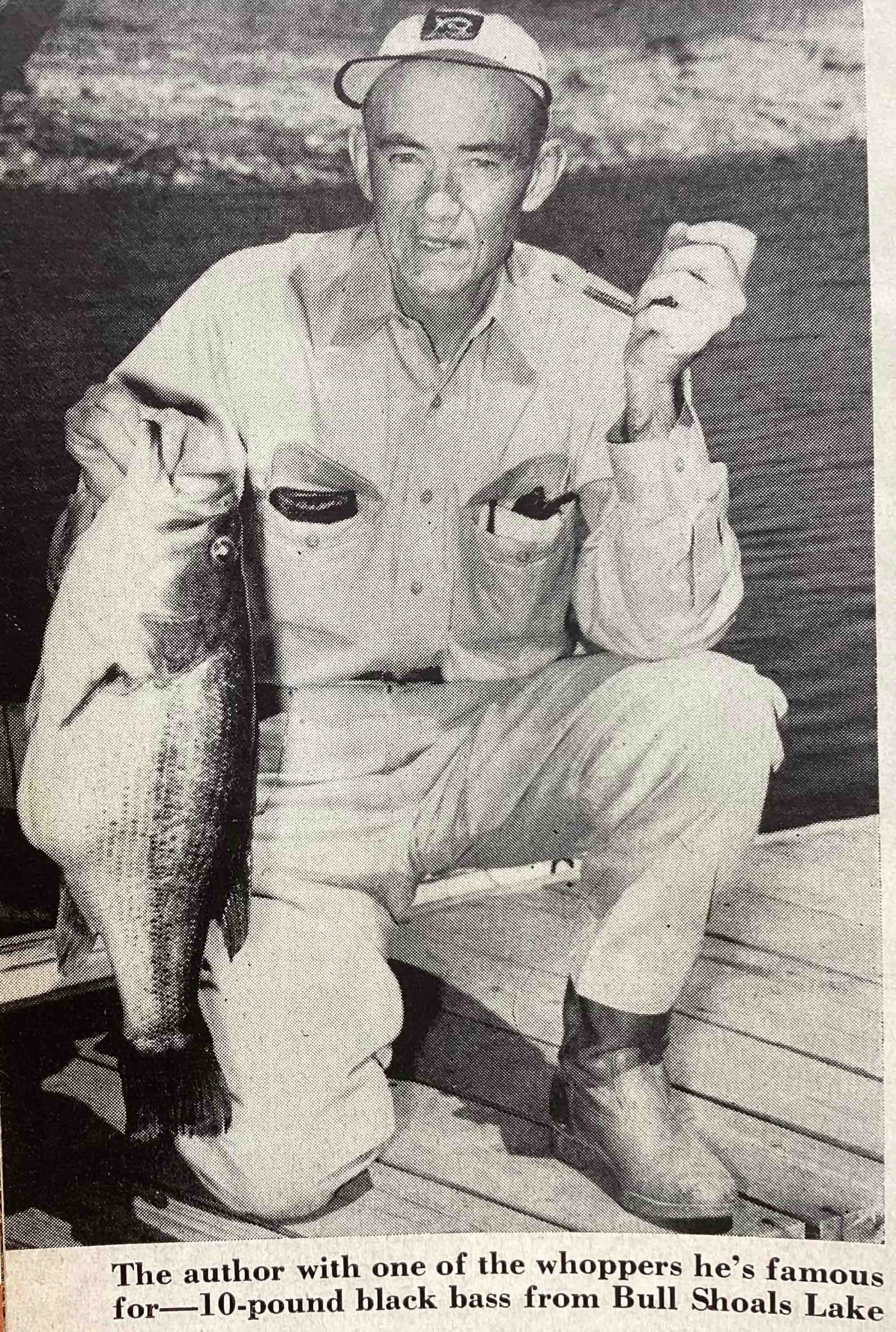
Much like his beloved Bull Shoals lunkers, Sam’s writings began fading into obscurity after 1965. The big bass heyday was nearing its end at Bull Shoals. Damning on the White River created two new lakes, Table Rock in the late 1950s and Beaver Lake in 1966. Good fishing exploded at both lakes as they enjoyed their prime early years, and many Bull Shoals anglers and guides set out for these new and more productive waters.
While good angling abounded at both lakes, the massive lunker hauls that occurred on Bull Shoals in the 1950s and early 1960s never materialized on either Table Rock or Beaver. Now all the White River lakes have aged, lost habitat, seen increased development and generally declined as trophy bass waters.
We owe Sam Welch a lot for documenting what was truly a magical time in the Ozarks, never to be repeated. He wasn’t a guide or a bass pro, but a dedicated bass angler with a penchant for storytelling and lunker bass. In an obviously much simpler era of bass fishing, his advice below is just as relevant today as much of the mystery of fishing is fading with today’s latest technologies:
“In any case, when I get a chance to go fishing, I’m going, regardless of forecasts. Nor do I want to limit my trips to the days or nights when I have special reason beforehand to expect a catch. In bass fishing, the uncertainty is half the fun.”
Well said, Sam Welch, well said.





Outstanding story, Mike, of a forgotten angler, writer and time. This is what uncovering out history is all about: resurrecting and keeping alive these great anglers and writers on the past. What a fun, fun, fun time it must have been to fish Bull Shoals in its heyday. That stringer held by Virgil Ward and his son is incredible (I had to do a double-take, as I didn’t recognize Virgil without his thick-rimmed glasses). Love the “bass boat” that Welch and Jerry McKinnis are fishing out of.
Thanks, David. I had a lot of fun researching and writing this post and imaging what an incredible big bass lake Bull Shoals was in the 1950’s and early 60’s. Thanks to individuals like Sam Welch, we have good documentation on just how productive it was. Unfortunately, my dad and I did not fish it until the mid 1970’s, and back then it was tough to catch even a 2 pounder! We were able to meet a few folks who had fished it in its prime, and they regaled us with stories of lunkers taken at night on Single Spins…….
Mike, I really enjoyed your article and found myself daydreaming about fishing days gone by at Bull Shoals Lake. I fished there as a teenager and have many fond memories, but not too many fish stories. Fishing there in the 70’s was always tough. Thanks for sharing a bit of fishing history and I look forward to reading you future articles about fishing!
Thanks for your comments, Jim. Sounds like we both hit Bull Shoals when it was past its prime. Thanks to Sam Welch, we can appreciate just how special it was in its heyday.