


It’s been a while since we looked back on some old bass boats of yesteryear. So, let’s get back to it. What we have here, to the best of my knowledge, is Ouachita’s 1974 Boat Catalog in full color. There is no date in the catalog wo I’m basing this assumption on advertisements we’ve shown in past articles on Old Bass Boats.
Back in the early ‘70s, Ouachita was one of the big manufacturers of bass boats and even sponsored Ricky Green on the Bassmaster and other tours of the day. In 1974 they offered nine models in several different lengths and configurations. Let’s start with the cover of the brochure.
The cover shows what I believe was the Contender 17, a 17-foot boat that has a ton of freeboard. On the cover they claim to be the “Nation’s Boat Builder” and the “Most Respected and Demanded Boat in the Nation.” I’m not so sure about that claim but every company has to toot their own horn, I guess.
Turn the page and you’re greeted by a scantily clad lady in one of their boats. Ouachita was known for using sex to sell back in the day and coming out of the 60s, they took full advantage of the times. The first page is a welcome and description of what they had to offer this year. Also listed are their standard features as well as how to find a dealer.
Page two provides information on Ouachita’s Fishing and Travel Club. This was Ouachita’s form of a “owner’s tournaments” set up around the U.S. for any owner of a Ouachita boat. I’m not sure who started owner’s events but this has to be one of the first companies to do it. A pretty smart idea and one that has continued with many boat companies through the time.
Advancer Series
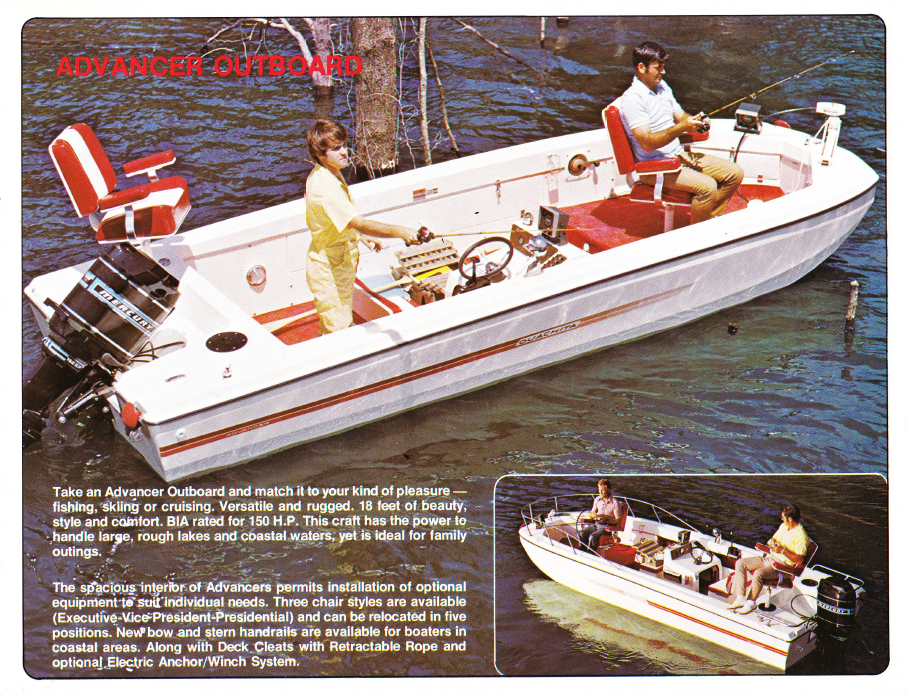
Pages three and four present the biggest boats in their lineup, the Advancer Series in both inboard and outboard. Both boats are 18-feet 4-3/4-inches long with the inboard rated for a 140 horsepower motor and the outboard rated for a 150 horsepower.
Each Advancer boat offers a front casting platform and rear deck, but these boats are far from what we’re used to seeing in a bass boat today. Try flipping out of that front deck or, God Forbid, you’re on the back deck when a wake boat decided to buzz you. The cockpit area is wide open with minimal storage. It really shows the vast amount of room there would be for the tackle boxes of the day, such as the UMCO Possum Belly.

Contender Series
Next in line are the Contender series of boats on pages five and six. These boats came in two lengths, 17-feet and 16-feet. These boats actually had a good amount of dry storage and rod lockers. But again, the front deck is positioned far below the gunwale. Also notice the rigging of the day. Lowrance flashers on the console and bow, trolling motor on the bow and the automatic anchor on the bow.
The interesting thing about the bow anchor is Ouachita has made the winch integral to the hull. This is shown really well on both the Contender 16 and 17. I wonder how many anchors spilt these boats between the cap and hull. Or, how much water was taken on if a wave was speared.

The Contenders measured out at 17-feet 2-1/2-inches and 16-feet 4-1/2-inches in length and were rated for 120 and 85 horsepower motor respectively.
Convincer Series
Next in the line of boats was the Convincer series with five different models ranging from 13-feet 11-inches to 16-feet 1-inch in length. First in the lineup was the UT Model at 16-feet 1-inch in length and a 68-inch beam. This boat was rated for a 95-horsepower motor and had console steering and a “slightly” raised from deck. There also appears to be dry storage in front of the console and I assume the livewell was located under the driver’s seat.
The next in the series was the JT Model at 16-feet in length with a 62-inch beam. This boat was rated for a 75-horsepower motor and weighed in at 624 pounds. The floor plan of the boat is nearly identical to the UT Model and neither offered a rod locker or much dry storage.
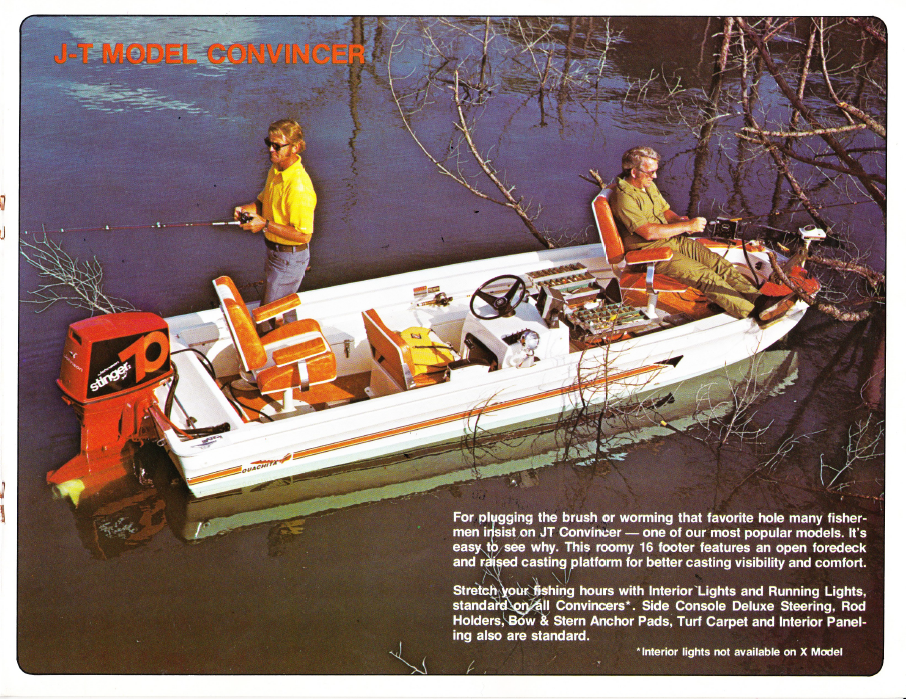
Pages nine and ten of the catalog feature the MP and M Models which came in at 15-feet in length, 62-1/2-inches in beam and were rated for a 70-horse motor. The difference between the boats was the MP Model had a rod locker and stern storage behind the driver’s seat.
The Spec sheet on the back cover is a bit confusing as they list the gunwale length for the M Model being 9 inches longer than the MP model but it’s obvious both boats are built off the same platform. There’s also an MB Model that isn’t shown in the catalog.
The M Model says it comes with optional stick steering, but the MP Model doesn’t refer to this as an option.
The final two models are shown on page 11 and were the K Model and the X Model. The K Model was 14-feet 4-inches in length, had a 58-1/2-inch beam, and was rated for a 50-horse motor. There’s no mention of stick steering available in the catalog but I’m pretty certain it was as one of our readers sent us in some pictures of his ’73 K Model with stick steering. More on that in a bit.
The X Model was the final boat offered in the Convincer series and it measured out at 13-feet 11-inches in length, had a 50-1/2-inch beam and was rated for a 25-horse motor. This boat was offered in both stick steer and console steer models and weighed in at 381 pounds. There are a lot of kayaks today that are longer than this boat, but I’d stick with the boat.
Options and Specifications
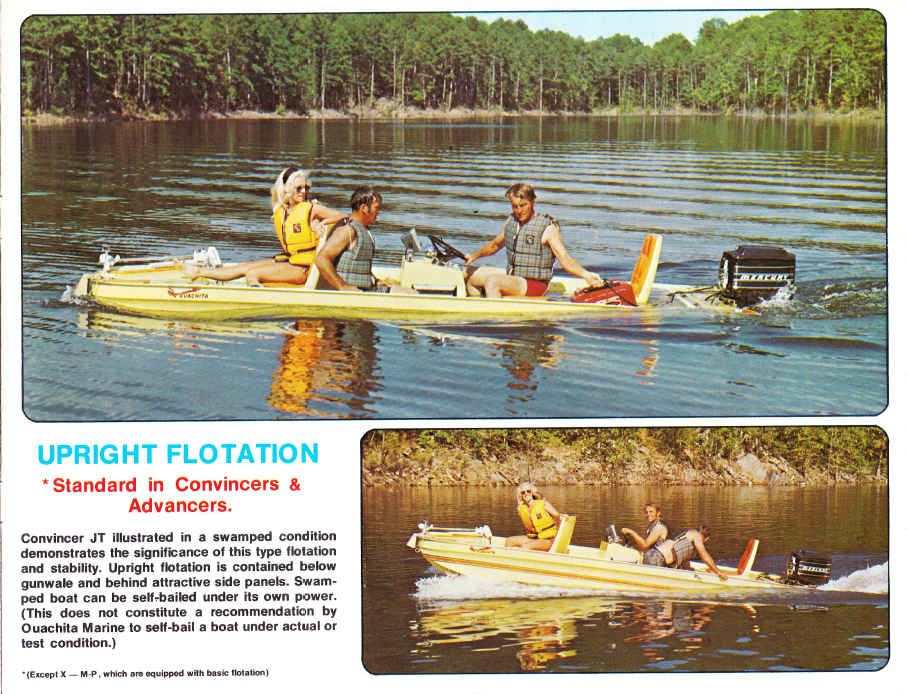
After displaying all their boat models, the next page is an advertisement of their level floatation. The JT Model Convincer in the top picture is beyond flooded, gas tank floating, and the boat is still upright. I’d hate to be that motor right at that point, but at least the boat hasn’t gone to the bottom.
The final two pages of the catalog feature what looks like options for the boats. Check out the chair options. It’s hard to believe, even after fishing during this time, that chairs were so in demand. I’m sure there will come a day when I have to sit, but until then I prefer to stand.

The back cover of the magazine listed all the specifications of each boat as well as color options and their warranty. Overall, it was a decent catalog and gave some good information on the products. They could have given more specifics, but I think they probably wanted you to get that from their dealers.
I mentioned above that we had a reader write in about their 1973 K Model Ouachita boat. Paul Smith of Missouri sent us a bunch of pictures of his ride from 1973 and it’s a cool story. I’ll be posting some pics of his boat, how he came to acquire it, and some of the conversations he had with the former V.P. of Ouachita shortly.
In the meantime, I hope you enjoy the picture gallery below. Click on the first picture to open the gallery.

1974 Ouachita Boat Catalog Front Cover

1974 Ouachita Boat Catalog Page 1

1974 Ouachita Boat Catalog Page 2

1974 Ouachita Boat Catalog Page 3
1974 Ouachita Boat Catalog Page 4

1974 Ouachita Boat Catalog Page 5

1974 Ouachita Boat Catalog Page 6

1974 Ouachita Boat Catalog Page 7

1974 Ouachita Boat Catalog Page 8

1974 Ouachita Boat Catalog Page 9

1974 Ouachita Boat Catalog Page 10

1974 Ouachita Boat Catalog Page 11
1974 Ouachita Boat Catalog Page 12

1974 Ouachita Boat Catalog Page 13

1974 Ouachita Boat Catalog Page 14

1974 Ouachita Boat Catalog Back Cover




I am working on fixing up Ouchita Model 12e (a 12 foot aluminum jon boat). I still have the original capacity plate which has a serial number and is why I know the model name. I do not see the 12e in the 1974 catalog. I was wondering if you had copies of others years that might have the 12e so that I can learn more about the boat.
Joe, we have a lot of Ouachita ads on the site under the category Old Bass Boats. You can either click on that category in the right sidebar or type Ouachita in the Search bar. Depending on whether you’re using your phone or a computer, the search bar is in the upper right (computer) or down half a page after the posts (phone). Here’s a link for the cataegory just to make sure you get there. https://bass-archives.com/category/old-bass-boats/
Anyone can feel free to comment!
I just discovered I have an Ouachita Jon Boat, and I’m in the process of trying to get it registered in Pa. I could barely make the writing out on the front side of the boat, and don’t find anything on the Transom at first glance. However, there is an old piece of wood the motor gets mounted to that may hold the secret to the Manufacturer’s serial number, and perhaps even the capacity plate, but the screws on the handles on the outside are so badly rusted, I’m afraid I’d have to cut them off to remove the handles and the wood. Is there any possibility that may be covering the
secret that I’m searching for, as there is nothing else I can find on the boat anywhere!, So, do you recommend I remove the back wood plate etc. to perhaps and everything to get the information I need to get a good title!
I’d guess it’s pretty old, and a little banged up, but doesn’t leak at all, and I am reconditioning it, so it would be good to know one way or another if I got a good deal, or someone stole it a “LONG” time ago!
Rod Humphrey
Rod Humphrey
Hi Rod, great find! I’m not sure about the capacity plate or where the serial number would have been on that boat. Not having any images also leaves me a little in the dark. You might also look on the outside of the hull for a plate if you haven’t already. I hope you can get it registered. It would be awful not to get that boat back on the water.
My father, Cary Gillespie, was the advertising manager for Ouachita from 1974-1976. The company was sold the day he walked in the door to start work in Arkadelphia. The out of state buyers used the company as a tax write off and ran it out of business. He told me that sales were strong right up until the end, but they were unable to purchase fiberglass and gelcoat to complete production.
That is Cameron and his twin brother Jeremy’s father, Cary Gillespie, on page 3 of the featured catalog of Ouachita boats! It was like a dream come true for Cary to become the Advertising Manager in 1974–just a few months before we were married. We lived in Little Rock and he commuted to Arkadelphia every day. I have pictures of the boys at 3 months old in a Ouachita boat on Lake Norfolk!!