

Several weeks ago I ran across an image of the June 1932 Hunting and Fishing magazine cover that I thought was quite arresting. It’s a cover that shows a fairly simple painting, of a shiny silver baitcasting reel and bamboo rod surrounded by a carefully arranged set of nine popular fishing lures of the time. It’s really a still life, but contains a lot of dynamism and even movement. The reel and lures are in pristine condition and each object sparkles with reflections of light. The background is dark, which makes everything pop even more. Anyway, I liked it so much that I looked for a decent copy on eBay and I bought it. It’s a beautiful rendering and I’ll be preserving this magazine in a frame and hanging it on a wall.
I also thought this cover might make for a fun article on the various lures in the picture, which were popular in 1932. So, I’m going to briefly discuss each lure in the painting and show some corresponding company ads from the magazine as well. And then I’ll conclude with a look at a column written by Hunting and Fishing’s Angling Editor Ray Bergman, where he writes about “Choosing the Bass Plug.”
A few weeks ago I wrote a piece for BFA titled “Best Fighting Bass Cover Ever,” about a 1934 issue of Hunting and Fishing magazine. At that time I was just beginning my research into artists for some of these old outdoors magazines, and I was unsure if that cover had been executed by either William Harnden Foster or Phillip Brown Parsons, because at first blush their styles seemed similar. I have since learned more about these artists, and I can safely declare that William Harnden Foster was the artist for both this June 1932 Hunting and Fishing magazine cover and that June 1934 fighting bass cover. As I surmised in that earlier story, the “F” at the bottom of the page was, in fact, the way that Foster signed many of his paintings for magazine covers.
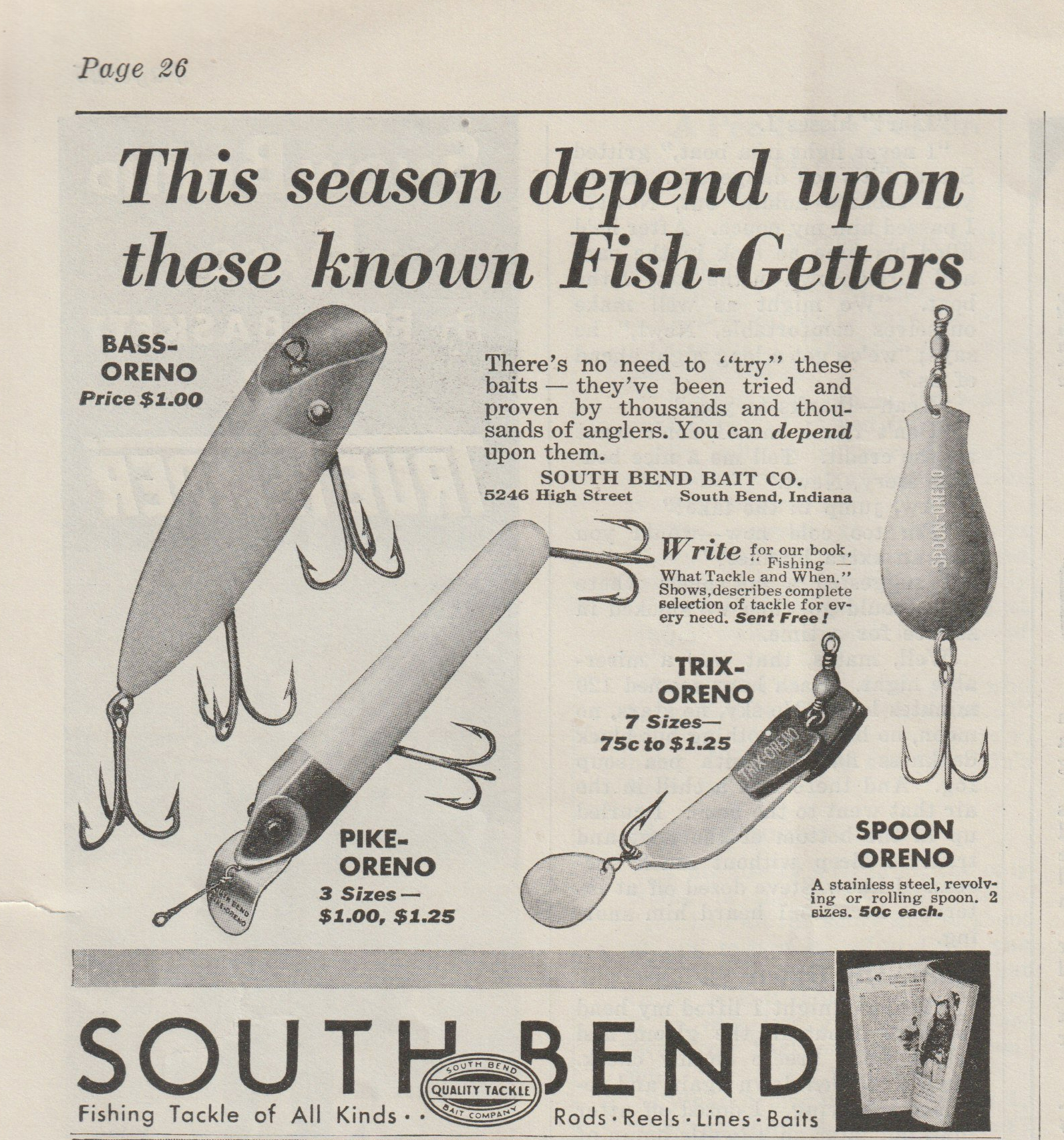
Starting in the upper left and moving clockwise, we first have a South Bend Bass-Oreno, in the black arrowhead color scheme. If you’ve been following my stories in Bass Fishing Archives you know I’m a big fan of the Bass-Oreno. I wrote a lengthy piece on the history of the Bass-Oreno, titled “Bass-Oreno, World’s Greatest Plug?” Please check it out. Briefly – I covered the history of the Bass-Oreno in more length in the afore-mentioned story – the Bass-Oreno was created around 1914 by Michigander James Stanley Olds when Olds was in his mid-40s. Olds sold his Wobbler lure to the South Bend Bait Company the next year. South Bend renamed it the Bass-Oreno and started producing it by the hundreds of thousands. The Bass-Oreno became their flagship lure and made the company one of the giants in the industry.
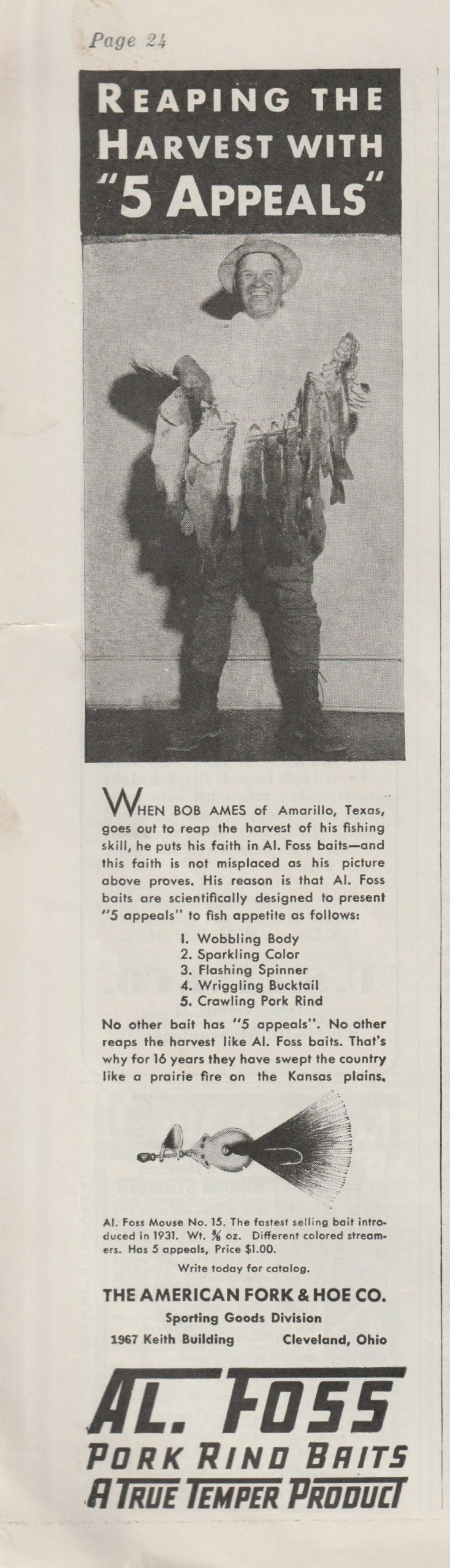
Next up we have the Al Foss Oriental Wiggler, introduced in 1917. The Oriental Wiggler was a lure meant to be used in conjunction with a pork rind strip. Was the Oriental Wiggle the first lure to be made in plastic? I don’t know about that, but Al Foss claimed that to be the case. In any event, it is an example of an early plastic lure. Foss also claimed, among several claims, that the Oriental Wiggler was “the first lure to really make a pork rind strip wiggle,” and that it was “the first lure to successfully operate in weeds, yet having no wire guard…” The first models had the hook molded inside the body, but later versions, like the one shown on this cover, had the hook embedded in a groove on the outside of the body and secured with a screw, which also served as a forward attachment spot for the pork rind. One of the coolest things about early Al Foss lures was the small red, blue, green and sometimes orange metal boxes they came in.
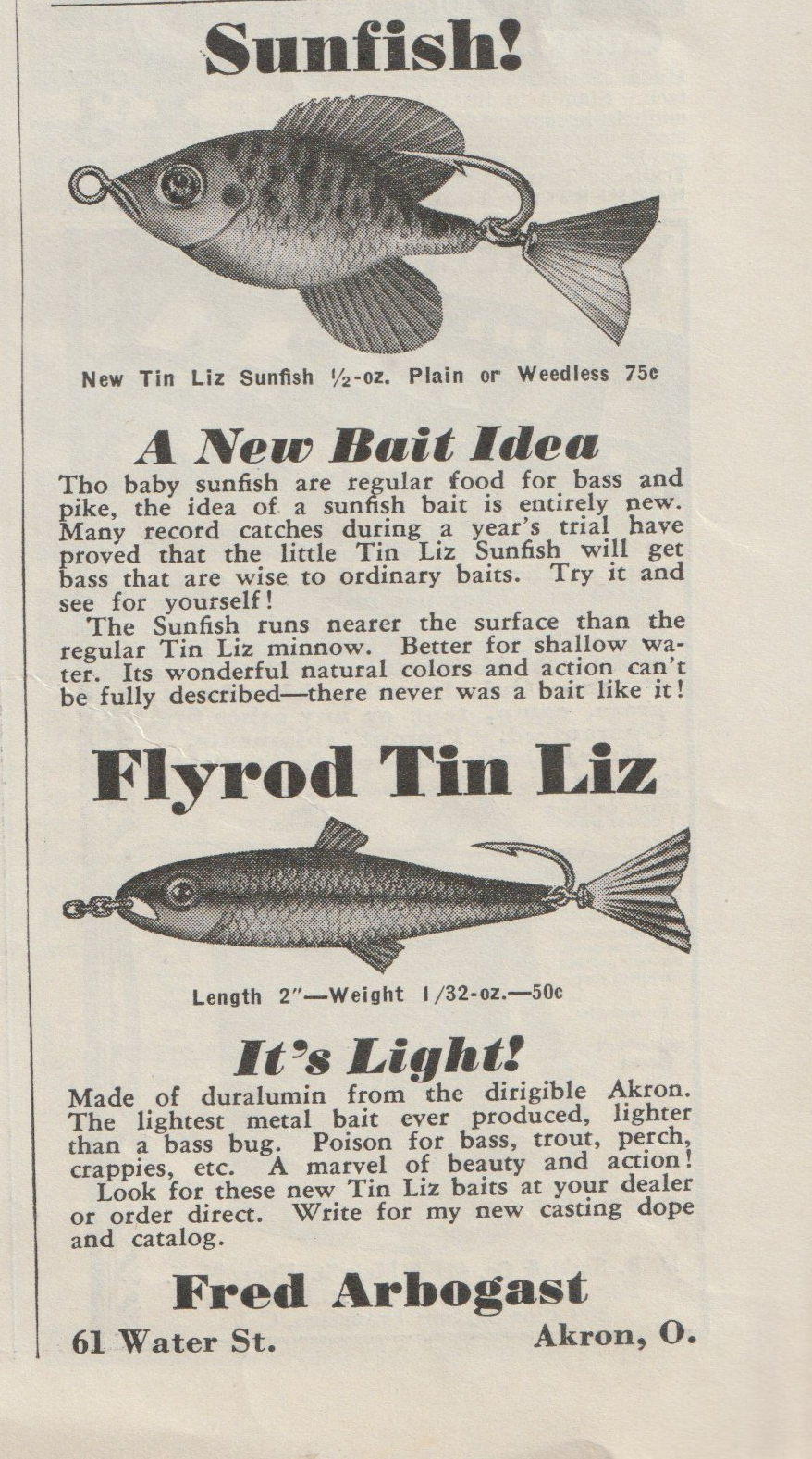
Immediately to the right of the Wiggler is a Fred Arbogast Tin Liz, trademarked the same year as this 1932 Hunting and Fishing magazine. It was the popularity of the Tin Liz that gave Fred the impetus to start his own bait company, and what a company it was. I’ve said it before and I’ll say it again, for my money Fred Arbogast was the most creative, innovative lure designer ever. If he made nothing but the Tin Liz his legacy would be secure, but you add the Hawaiian Wiggler, Jitterbug, and Hula Popper to that, along with all of the lures that were added after Arbogast’s death, and you’ve got a line of some of the most incredible fishing lures ever produced.
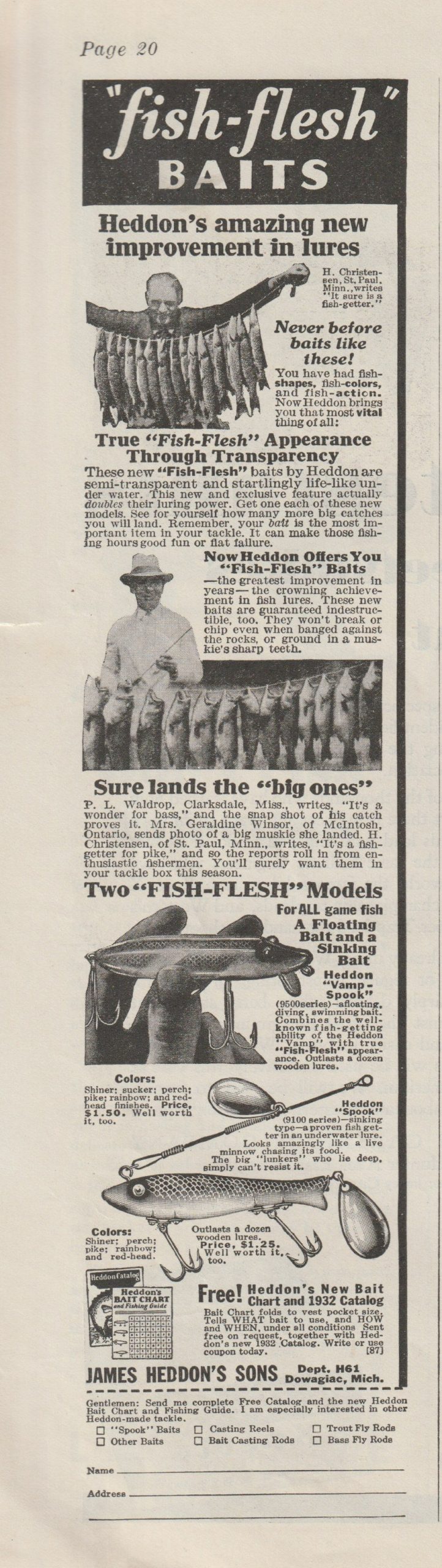
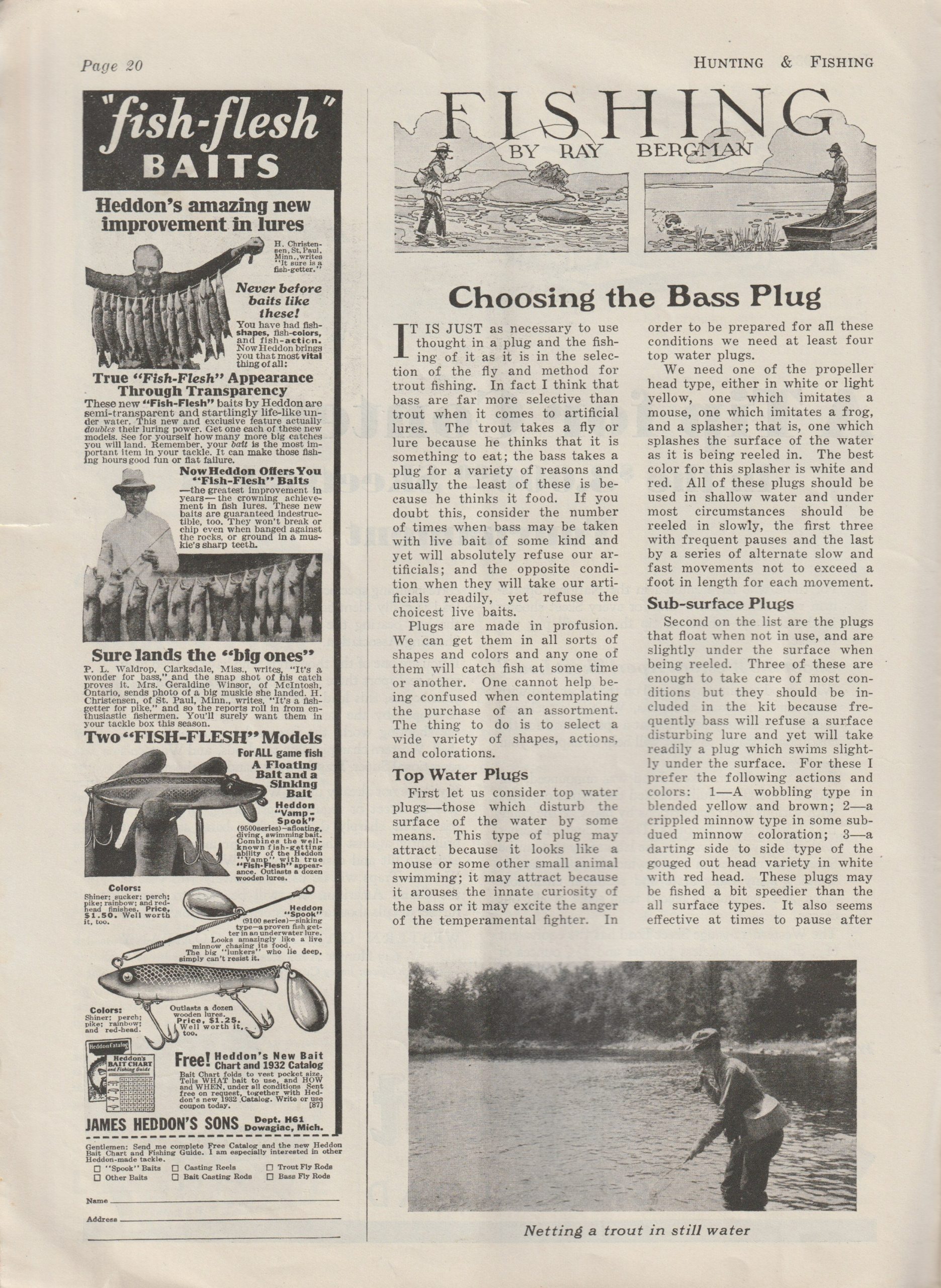
The last lure in the top row, on the far right, is a Heddon Vamp Spook or, in 1932, just as accurately described as either Fish-Flesh or Spook. Eventually Spook won out over Fish-Flesh. But you can see in the ad below that both terms are used to describe this new style of bait. The new translucent plastic caught fire on the market, and Spook lures, especially Heddon’s River Runt Spook that was released the following year, were probably in the majority of tackle boxes across the country. The transparent quality of this Vamp is beautifully depicted, with the rod it sits atop showing through the lure’s body. The Heddon ad (below) in this magazine makes a hard sell for the new and effective Fish Flesh/Spook lures.
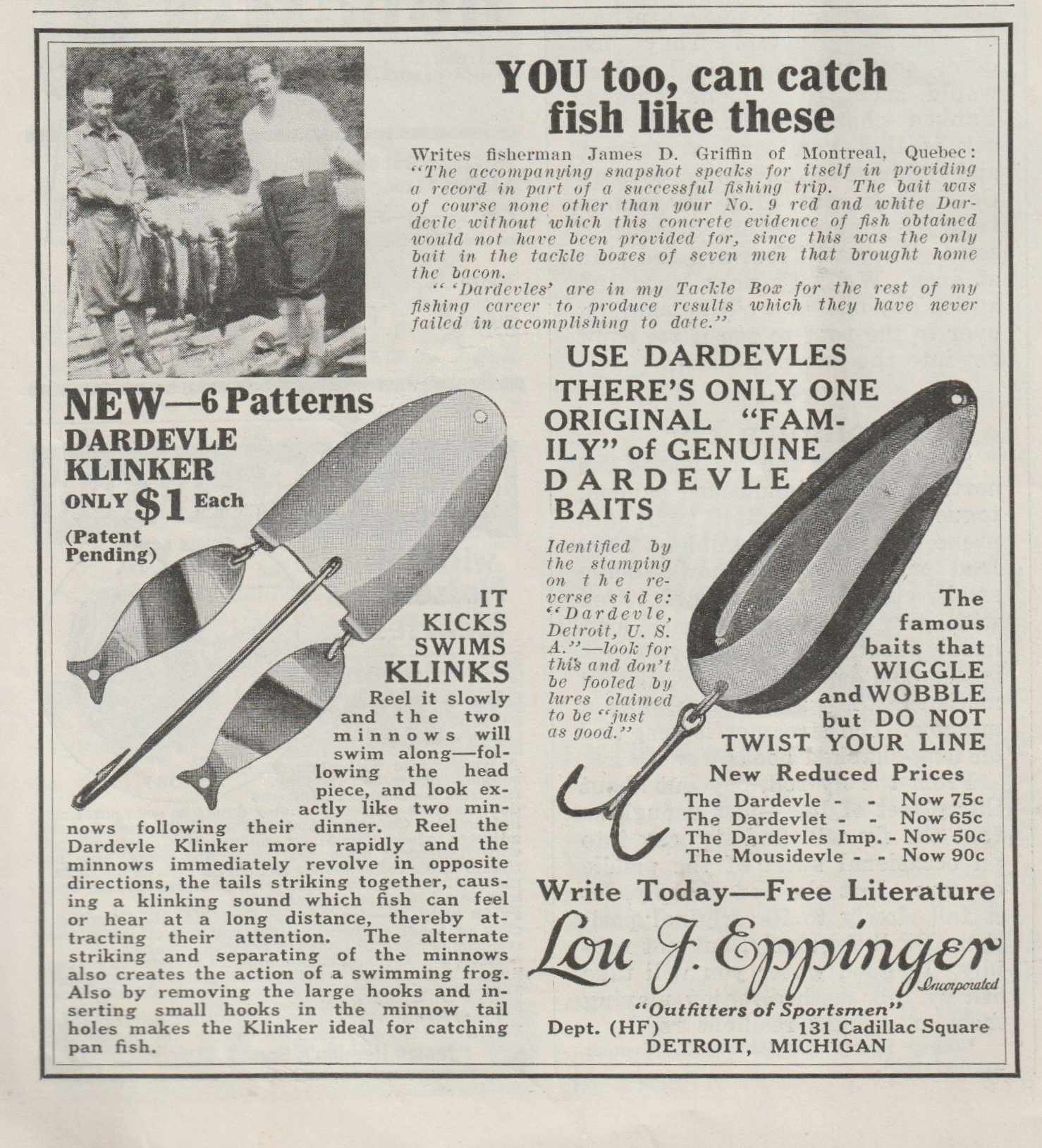
Moving below the fishing rod we come to the famous Eppinger Dardevle, in its most recognizable red and white color scheme. Of all the lures in this piece of cover art, the Dardevle is easily the most successful, in both longevity (it’s still being made today!) and in copycats or look-alikes. To get the history of the company and the spoon, read my BFA Eppinger Dardevle story here. I have to say, while the Dardevle has a ton of imitators I have yet to come across one that is manufactured with the same level of quality, and performs with the same enticing action as an original Dardevle.
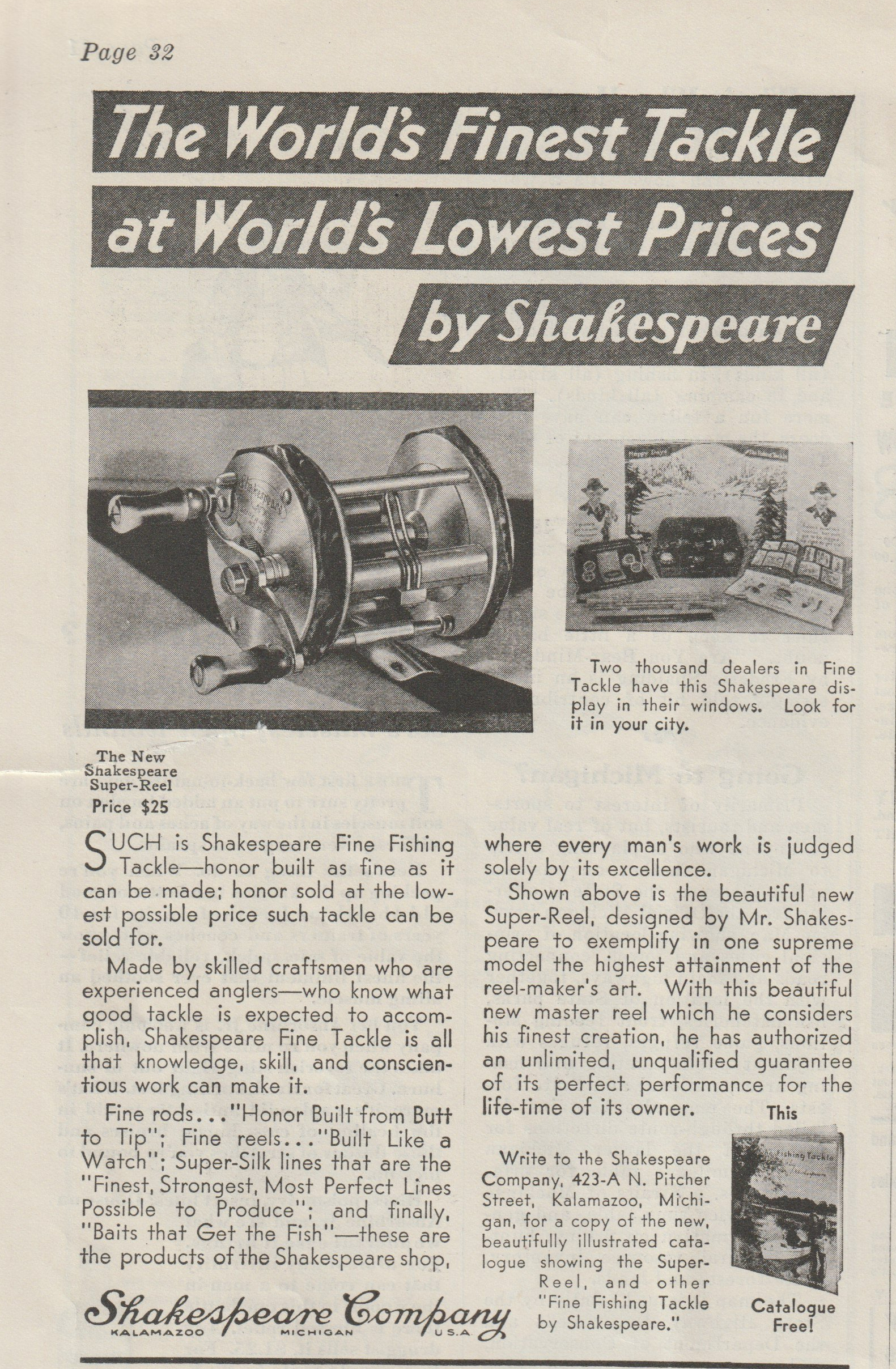
Directly beneath the Dardevle is a long, dressed spoon and spinner-type lure that runs horizontally across the picture. This is one that I had trouble identifying. It’s also the only one that I don’t personally have in my collection. So, I turned to the Facebook group, Identify Your Pre-1980 Fishing Lures, for help. I got several responses, and I especially want to thank Joe Stagnitti as well as the other group members who correctly identified this lure for me. It’s a Shakespeare Darb-A-Lure. I found a 1932 Shakespeare catalog that included the Darb-A-Lure. The entry under the lure said, in part, “The new Shakespeare Darb-A-Lure is so constructed that the body has an independent wobbling action in addition to the spinning of the spoon. It is also practically weedless and it does catch fish. It plays no favorites. It takes ‘em all…” and “Enthusiastic anglers tell us that fish strike this bait more savagely and hook themselves deeper…”
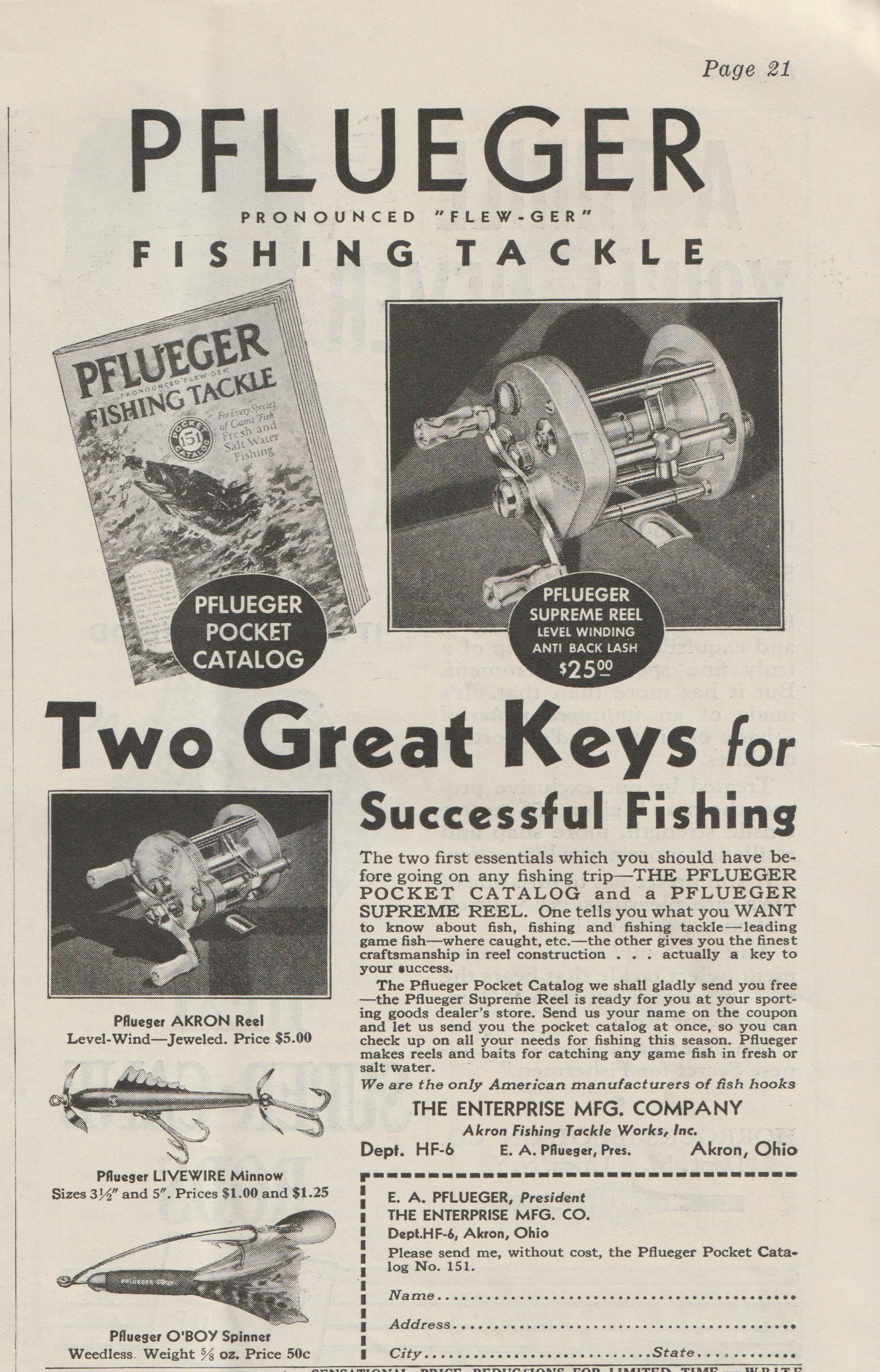
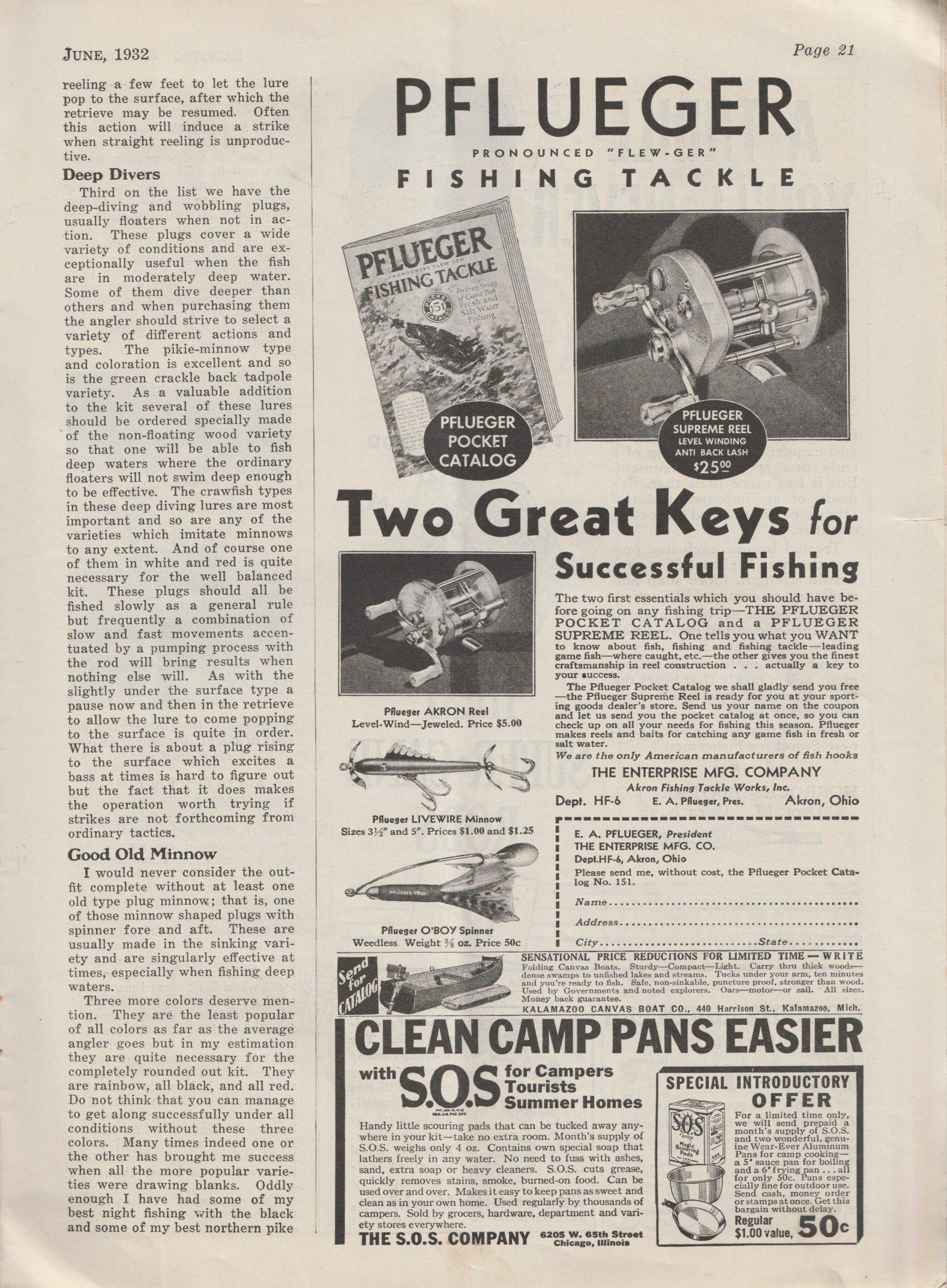
At the 5:00 position is the popular Pflueger Tandem Spinner. Pflueger made their Tandem Spinners in a number of sizes and they were manufactured for decades. Pflueger Catalog No. 196, published in 1960, said of the Tandem Spinner, “One of the most imitated baits in the fishing industry. America’s most flexible bait – cast it, troll, jig or skitter it, or fly cast it. A size and style for all types of fishing.” I’ve thrown this lure myself, and I can attest that it is indeed effective on bass and northern pike.
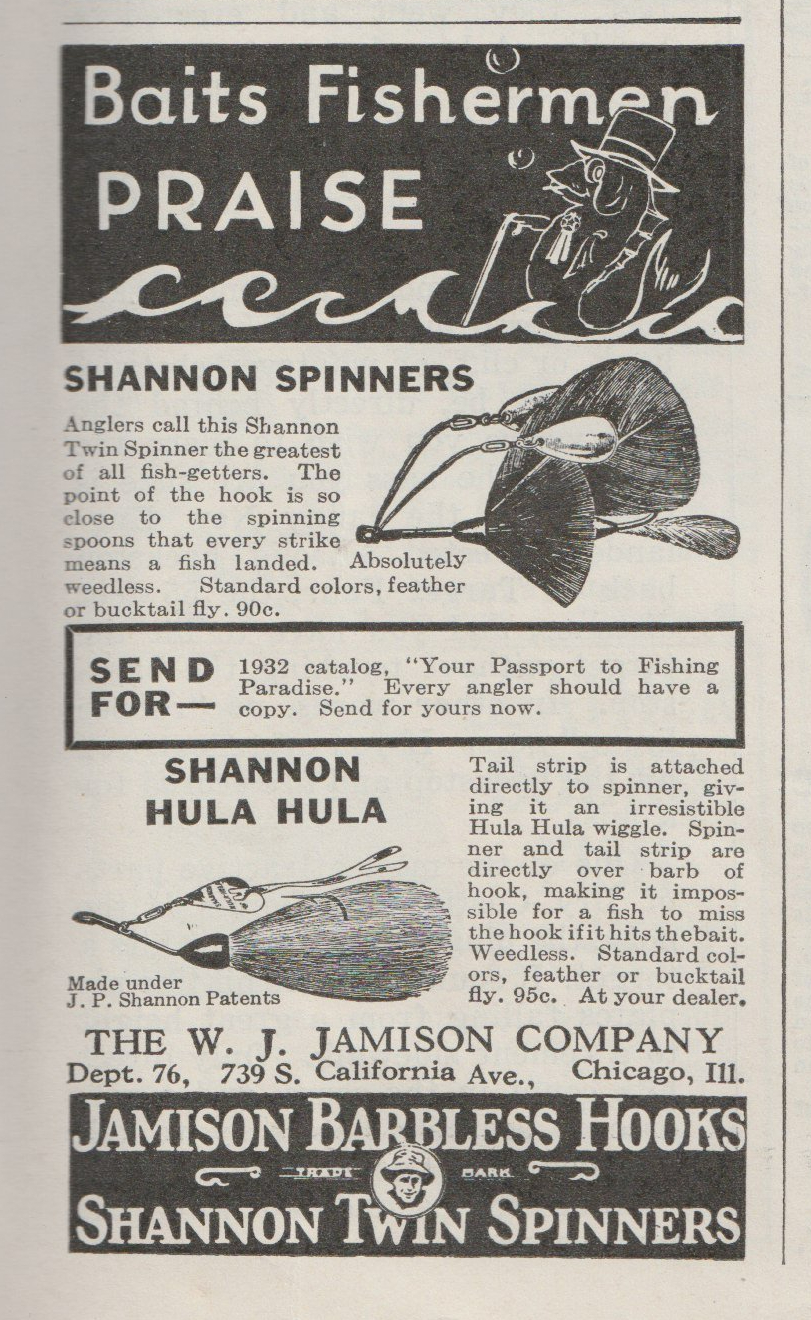
Next up, at 6:00, is the Shannon Twin Spin. Terry Battisti wrote a nice piece a few years ago, with the help of Bill Sonnett, on the background of the Twin Spin. Read it at the link I just gave, it’s very interesting. There are a few companies currently making twin spin lures like the original Shannon Twin Spin. One is McCoy Fishing in Minnesota. Another company, Slow Town Custom Lures in Arkansas, puts out a twin spin on steroids. It’s a 4-bladed spinner in the original Shannon configuration that they call the “4 Stroke Spinnerbait.” A third company was HooDoo Lures out of Wisconsin, but they are no longer in business. I purchased a few of their lures while they were still available. It just goes to show you that nothing is really new in the world of fishing lures and good ideas get recycled over and over.
And finally, William Harnden Foster depicts the old tried and true Creek Chub Pikie Minnow. Introduced in 1919 or 1920, the Pikie Minnow was lucky number seven for the Creek Chub Bait Company, being the 7th lure introduced by the company. The success of the Pikie put CCBC on the fast track to becoming a giant in the tackle industry. I’d bet dollars to donuts that every pre-1975 tackle box in America carried at least one Pikie Minnow. It was the bait that caught the big ones, including a few world record musky, which Creek Chub was more than happy to herald in their magazine ads. The Creek Chub ad in this June 1932 Hunting and Fishing magazine doesn’t talk about a world record, although they certainly would in 1940 when John Coleman caught the then-world record.
I’m afraid I don’t know what rod and reel Foster used as his model for this painting. The rod does look like some of the rods shown in early Shakespeare catalogs, and the reel could be a Shakespeare as well. In any event, this is an example of the kind of wonderful cover art we’ve come to associate with these early magazines. I don’t know about you but I feel like I’m holding something extra-special every time I look at one of these artist-illustrated covers.
I should also briefly discuss a really great bit of writing from the magazine’s Angling Editor Ray Bergman. It’s an article from Bergman’s Fishing column titled “Choosing the Bass Plug.” I didn’t know that Bergman had this article in the magazine when I bought it (I bought solely for the cover art), so I was pleasantly surprised to find it inside. It’s a great piece of writing and offers some solid advice for anglers looking to properly stock their tackleboxes with effective lures. Bergman’s introduction is concise, witty and direct, before he gets to the meat and potatoes of his thesis, which he separates into four plug type groups: Top Water, Sub-Surface, Deep Divers, and Good Old Minnow.
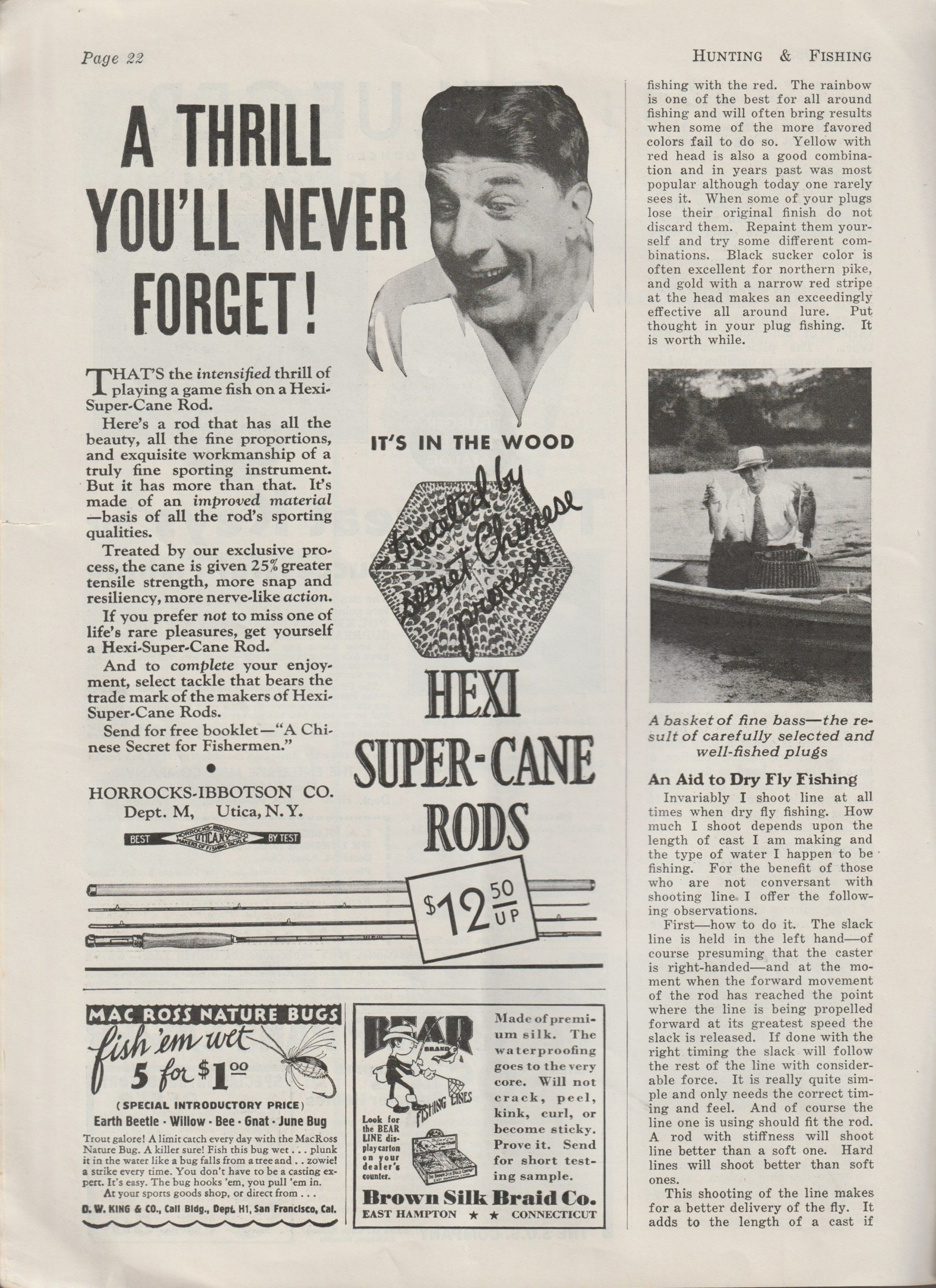
Bergman gives specific examples of necessary plugs in each category, without naming brand-specific lures. He describes each type and gives his advice on the best colors for each. For example, in the Top Water category, Bergman recommends, “We need one of the propellor head type, either in white or light yellow, one which imitates a mouse, one which imitates a frog, and a splasher; that is, one which splashes the surface of the water as it is being reeled in.” The Good Old Minnow category is interesting, and speaks to the time and to the lures that were popular back then. Bergman says, “I would never consider the outfit complete without at least one old type plug minnow; that is, one of those minnow shaped plugs with spinner fore and aft.” His suggestions of colors for each group are specific and adamant. In the Good Old Minnow group he says after declaring that “rainbow, all black, and all red” are the colors to have, “Do not think that you can manage to get along successfully under all conditions without these three colors.” That is the kind of advice that I would appreciate if I were a beginning bass angler – tell me exactly what I need, but allow me to pick the lures that conform to those parameters. It’s a great how-to article.
I hope you enjoy this brilliant cover of the June 1932 Hunting and Fishing magazine, along with Ray Bergman’s fine article on bass plugs. These old magazines are simply treasures, and I’m grateful anytime I get to share them with fellow bass anglers and vintage fishing enthusiasts.




A thoughtful and thorough probe into an interesting cover from a fishing magazine of yesteryear. Before the instant access to information from the internet, these were the primary sources of informing and stimulating the bass fishing passion. Always great to revisit them. Especially when they are fondly remembered and documented via posts like yours; great job as always, David.
Thanks Mike! Yes, it takes a little bit of effort to unlock those memories of a time before instant information, when everything was snail mail, 3 channels on television, and taking turns on a phone tethered to the wall. lol!