


Here’s the excerpt from the manual:
360-DEGREE SCANNING
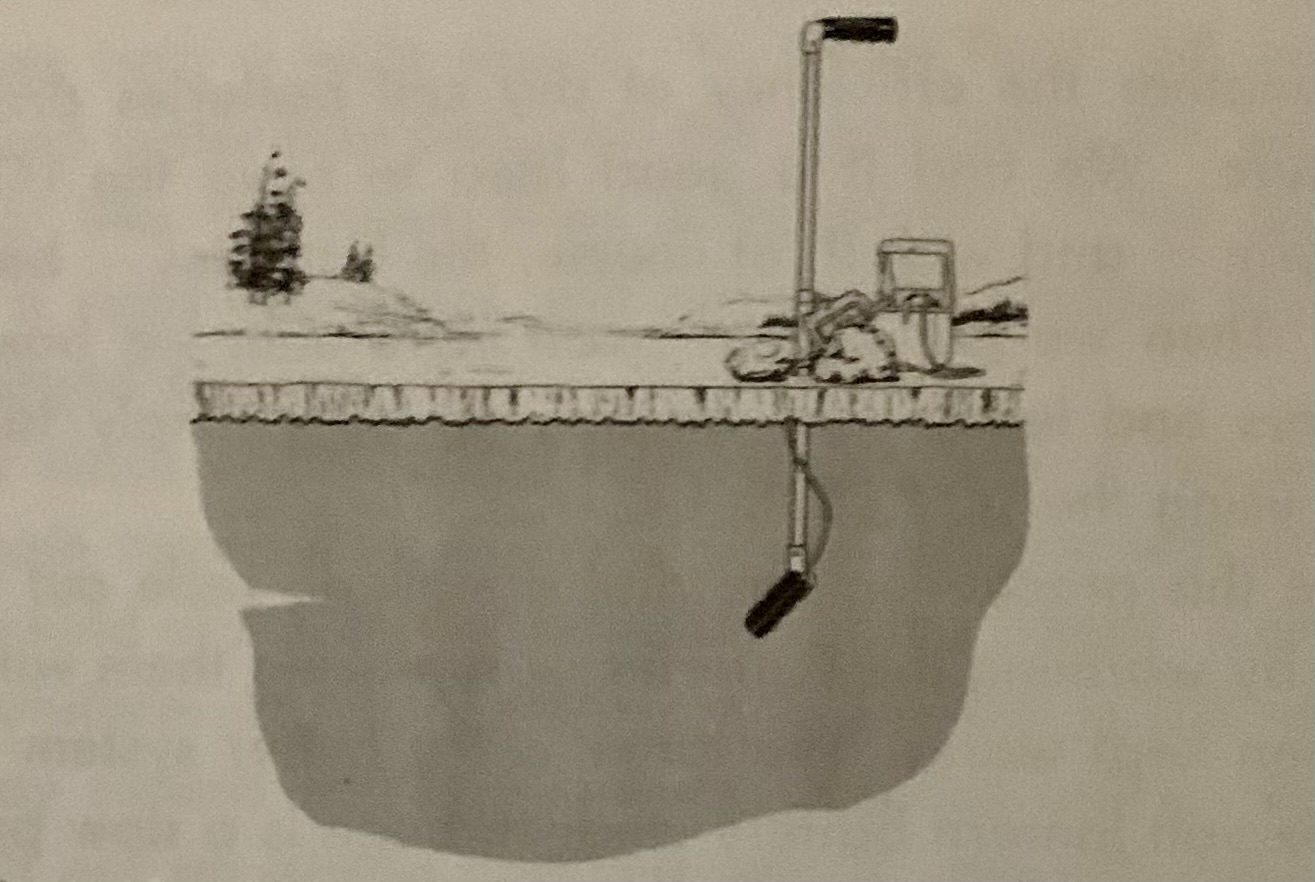
One of the most valuable uses of the FISH LO-K-TOR is finding schools of fish by scanning horizontally with the transducer, either from a boat or beneath the ice in winter. Here, instead of showing fish only between the transducer and the bottom as in conventional operation, you can pick them up anywhere around your position.
You’ll need a little practice to get the hang of this, so study the diagram carefully. Using the Lowrance Delux Transducer Bracket (or a broomstick!) to hold the transducer below the ice or the surface of the water, adjust it to point down at about 45 degrees when the bracket is vertical. (If the cone of high-frequency sound waves hit either the surface or the bottom at a long angle you’ll get too many confusing signals on the dial, the same as when you pass over a high, sharply sloping drop-off with the transducer vertical).
For the same reason, don’t set the gain too high. If you do, the cone of sound will extend out across the bottom for 100 feet or more and give you signals all around the dial. We have found that adjusting the sensitivity to give a clear bottom reading at a depth of 30 to 40 feet – no more – is usually best for this job. But after some practice you’ll find that the deeper the water the more gain you can use, always remembering that with the gain high you can pick up a steep shoreline as far away as 300 feet.
In this scanning, your LO-K-TOR dial doesn’t show a bottom signal. Fish show up well, even with the gain set low, however, because the sound waves hit them broadside. The larger surfaces send back stronger return signals.
Once you master the knack of scanning you can prove that when the fish suddenly “quit biting” they usually have simply moved on like grazing cattle. We have followed many different kinds of fish surprising distances while using the scanning technique – bluegills for 100 yards, crappies for a quarter mile; white bass for three miles; bluefish and stripers even farther.”





Great and mighty coincidental piece today. I recently dug out my Dad’s old sonar, found it to be non-functional, and so turned to eBay to try to find a working Fish Lo-K-Tor. Have my eye on a couple right now.
Thanks – I have two, both from eBay. One I take out and use on the boat, the other stays in it’s original box as a collectors item.