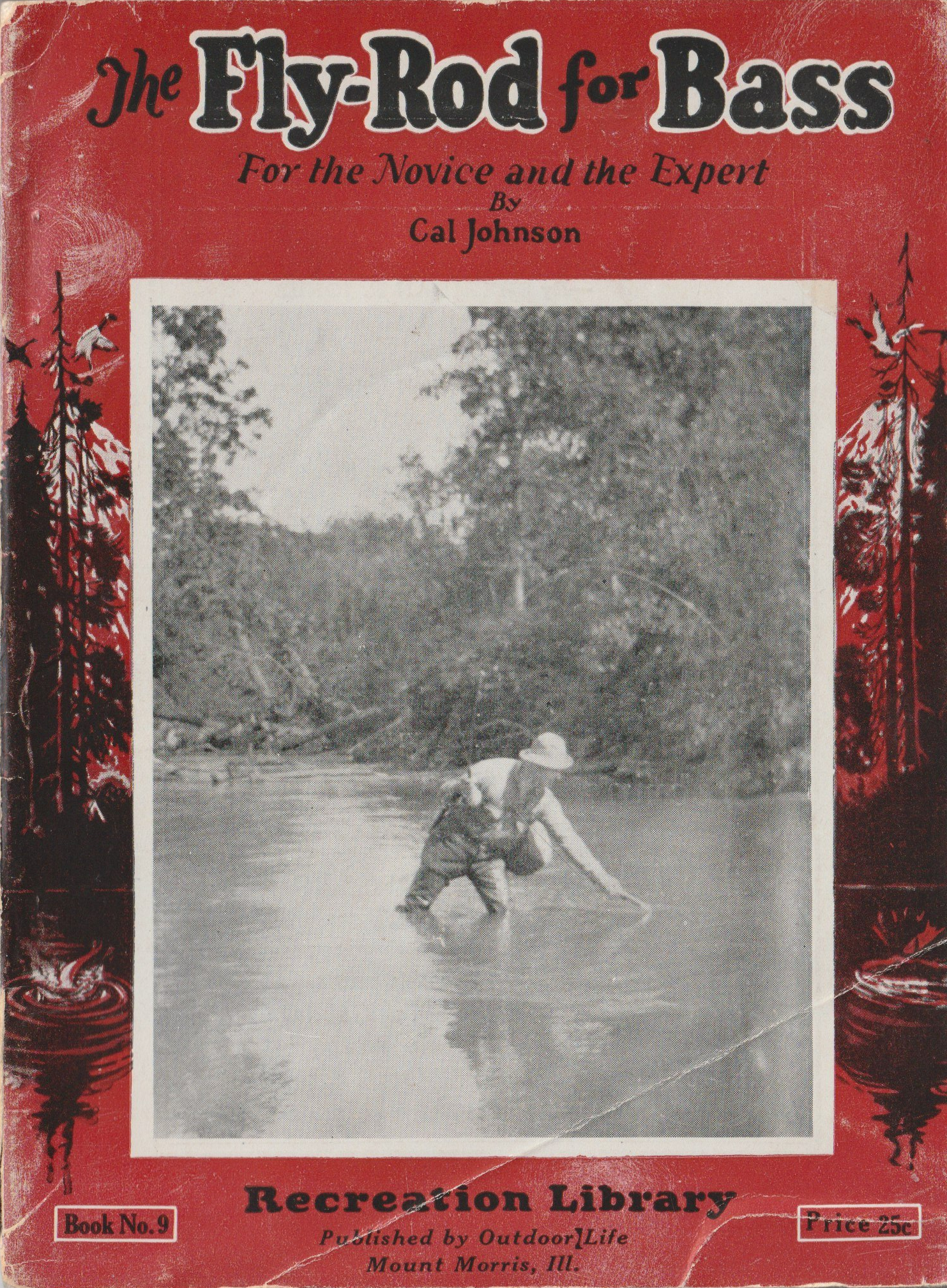
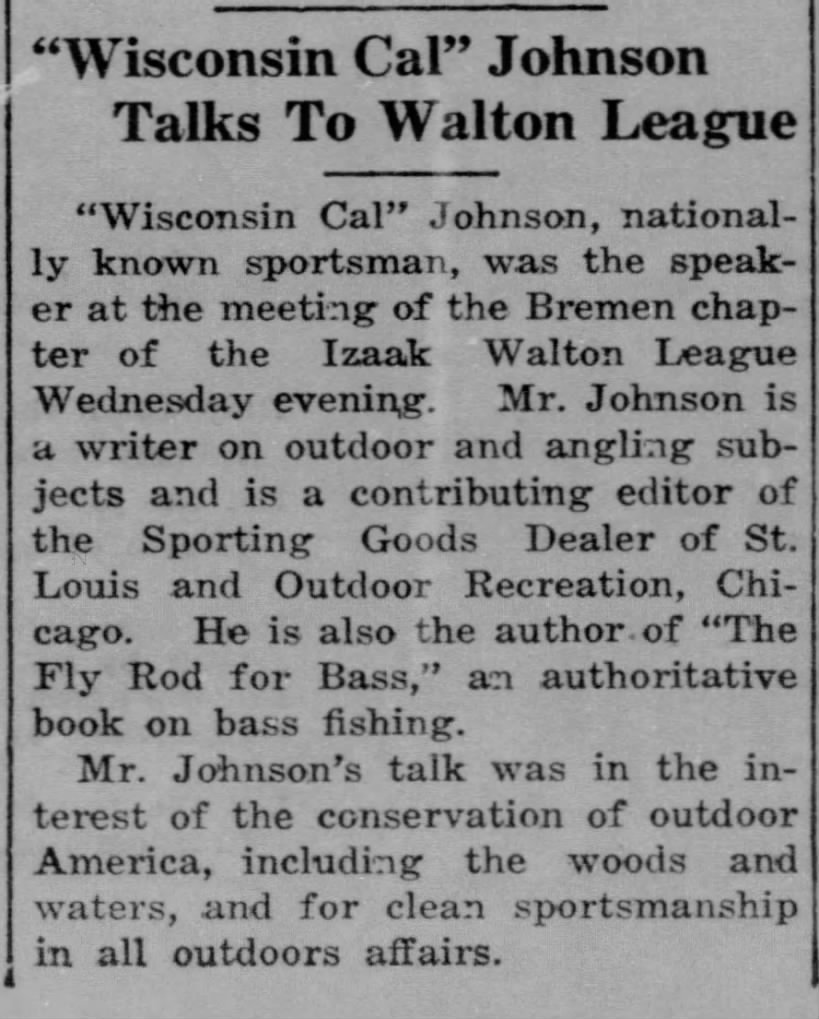
I’ve written about Cal Johnson, former Sports Afield angling editor and World Record Musky holder, a couple of times this past year. I’ve made no secret that I have an admiration for Johnson and his contributions to the fishing and outdoor field. He was a prolific and highly sought writer, whose by-line added credibility to just about any story or company he wrote for. I got my hands on a small book Johnson wrote for the Recreation Publishing Company when he was a relatively young man, titled The Fly-Rod for Bass, For the Novice and the Expert. The book was published in 1925 as part of the popular Recreation Outdoor Library series of hunting, fishing and camping paperbacks. Recreation Publishing and Outdoor Life Publishing copyrighted the book in 1925 and 1928, and reprinted it in 1934, which is the copy I have.
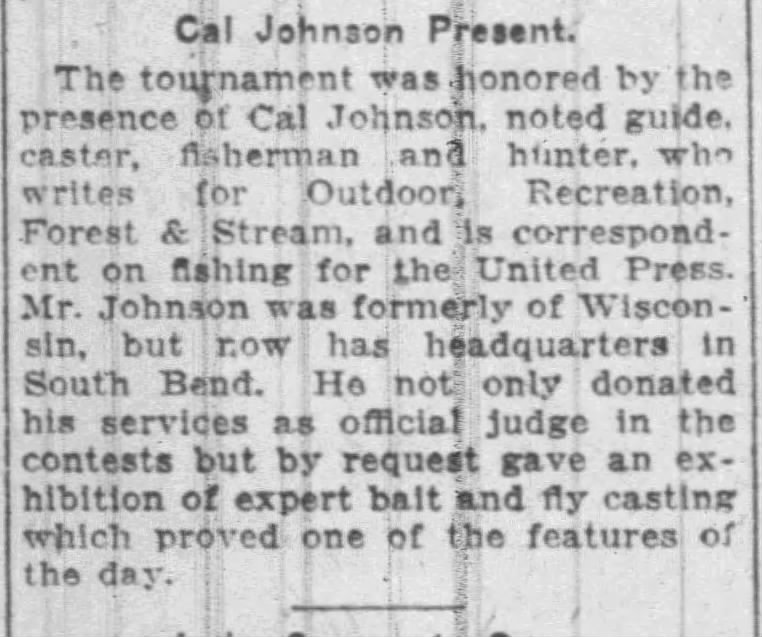
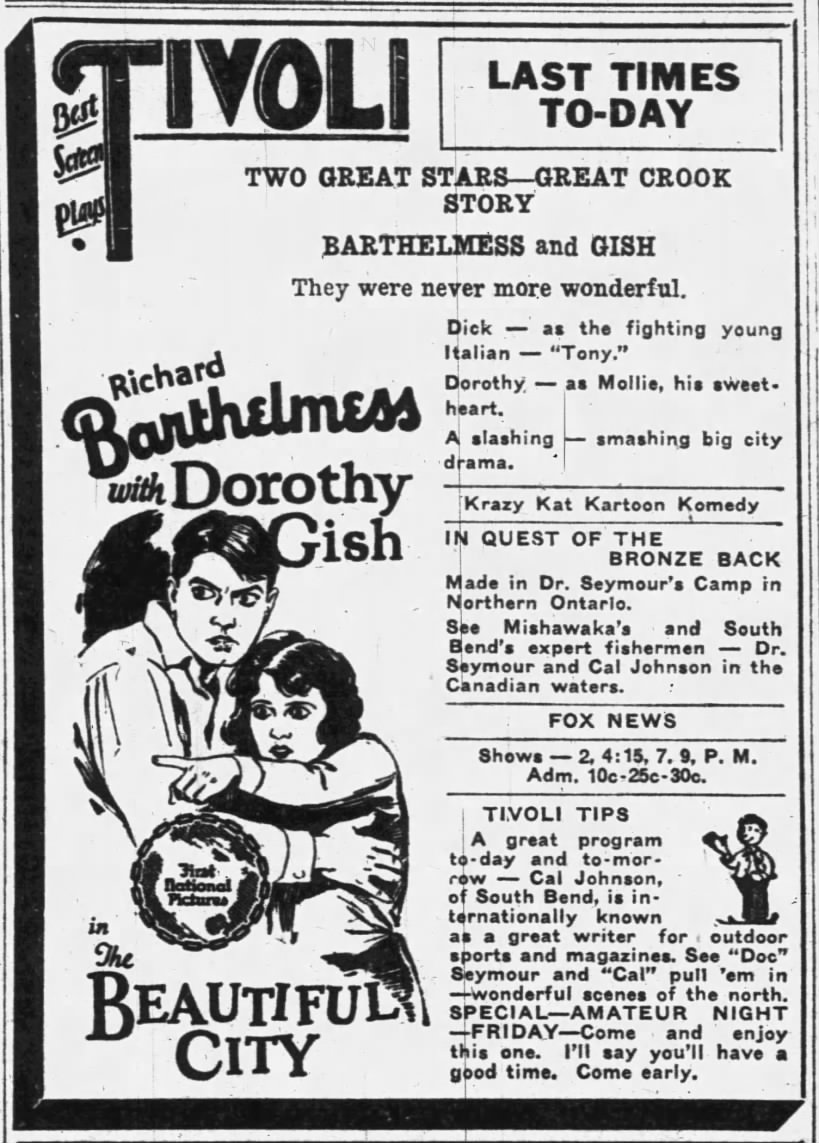
In 1925 at the time of publishing Johnson would have been 34 years old. He was born Calmer Lansworth Johnson on December 15, 1891, in Phillips, Wisconsin, about 60 miles southeast of where he would eventually catch his world record musky in Lac Courte Oreilles near Hayward, Wisconsin. But in early 1925 Johnson was living in South Bend, Indiana and was working for the South Bend Bait Company, as well as writing for other companies. He was a nationally recognized bait and fly casting champion, as well a talented writer and proponent of largemouth and smallmouth bass fishing. This made him the perfect choice to write The Fly-Rod for Bass. Another interesting tidbit is that Johnson was one of the first celebrity anglers to be featured in film, one of which was titled “In Quest of the Bronze Back,” and which was a popular film at the time. If anyone has any information on where we might acquire or view a copy of this historic Canadian smallmouth bass fishing film we here at BFA would be most keen on getting that information.
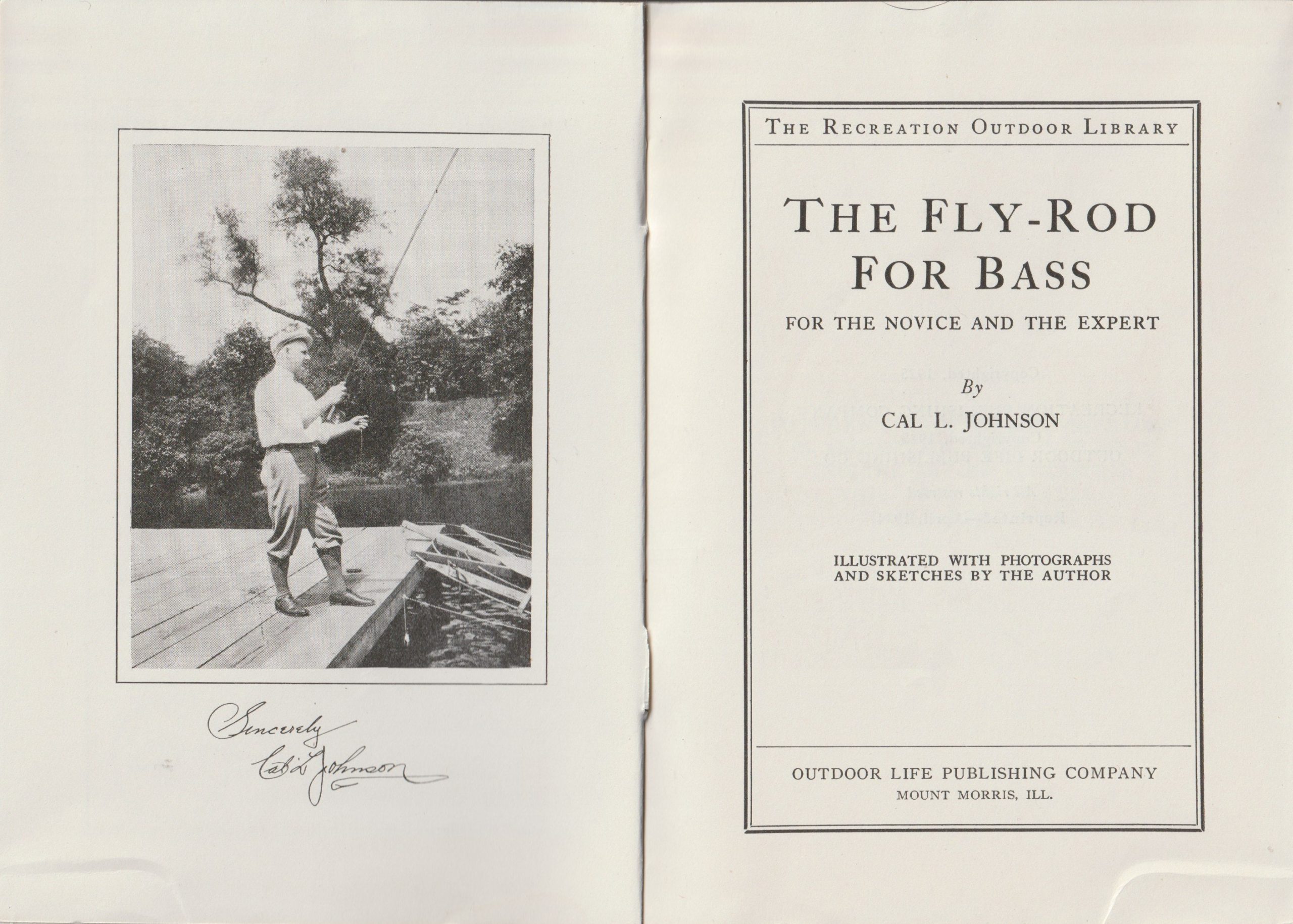
So, let’s dive into The Fly-Rod for Bass. It’s a small, 90-page paperback book, with relatively few illustrations. The first interior image shows a young Cal Johnson standing on a dock with fly rod in hand. He’s dressed in the style of the time in white, buttoned shirt with rolled-up sleeves, knickers just below the knees, knee-high wool stockings, laced leather shoes, and sporting a newsboy cap. I have to admit, he looks pretty dapper. He has opened the book with his signature, “Sincerely Cal L. Johnson.”
The book also opens with a dedication, presumably written by Johnson, that has a courtly, poetic aire to it:
“To the knights of the rod, whose love of angling has aided in elevating the art of fly-casting this book is fraternally dedicated.”
In his introduction, Johnson ended with, “Naturally, it is the desire of every angler to get out of his sport the greatest possible degree of pleasure, and I believe that I may say, without prejudice to the short rod, that this ambition can be best attained through the use of the fly rod.”
The book is divided into 11 chapters, with 1 through 4 being about equipment selection (rods, reels, line, leader). As surely most BFA readers are baitcast and spinning enthusiasts we won’t spend a lot of time in these chapters. Suffice to say that split bamboo was the rule of the day, although Johnson does make special mention of the new hollow steel fly rods, particularly for salmon and heavy fish. But for bass, Johnson goes into some detail when discussing bamboo. As for reels, Johnson says that a 3½ to 4 inch diameter reel weighing 1½ times the weight of the rod will generally bring the combo into balance, which is the ultimate goal of any set-up. As for fly lines, this is the era of silk and enamel lines. Recently we published an article on Gladding Lines from the 1940s. Check that one out to see the silk, nylon, and linen lines available back then. One thing I found interesting in Johnson’s discussion of line is his recommendation to dress line with deer fat.
Chapter 5, “The Art of Fly-Casting for Black Bass,” offers a thorough, excellent breakdown of how to cast a fly rod, without illustrations! I got the feeling that this chapter is the one that Cal Johnson gave the most thought and attention to in how to effectively outline the casting process. It seems clear that he was both an accomplished caster and that he was good at teaching people how to cast effectively. In my opinion, this is the best outline I’ve read so far on how to learn to fly cast.
The next two chapters, “Fly-rod Lures for Bass” and “Where and How to Fly Fish for Bass,” are the most fun. This is where the rubber meets the road, or where the bass bug meets the water. Johnson breaks up fly fishing lures into several categories: Heckle and Feather Lures, Bass Bugs, Wet and Dry Flies, Buck-tail Flies, Spinners, Fly-rod Wigglers. Wigglers, he says, are simply smaller versions of the larger baitcasting counterparts. With spinners he talks about the spinner shapes and benefits associated with each of them. These he advises using in conjunction with a bass fly to increase the effectiveness of the fly, and especially on dark days.
He also mentions “pearl spinners,” by which I assume he means mother-of-pearl, a fairly hard to come by material these days. “Pearl spinners are used by many anglers when the waters are roily or darkened from heavy rains, as their whitish body can be seen for some distance.” This line sparked a vision in me, of holding a vintage bamboo fly rod, standing in a wooden boat and casting a bass fly and connected tiny mother-of-pearl spinner blade. The only thing I’d need to make the picture complete would be a set of knickers, felt hat and smoking pipe.
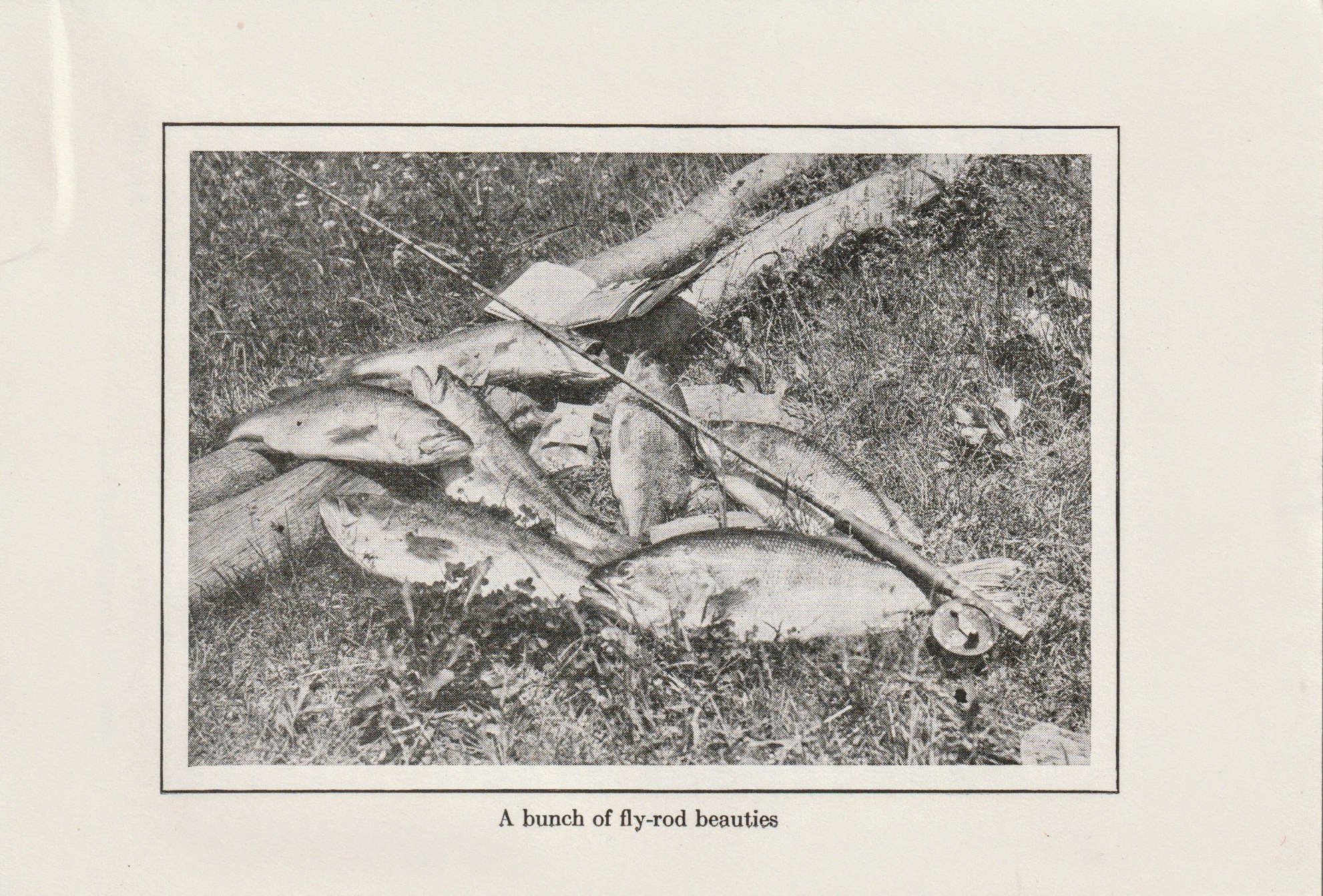
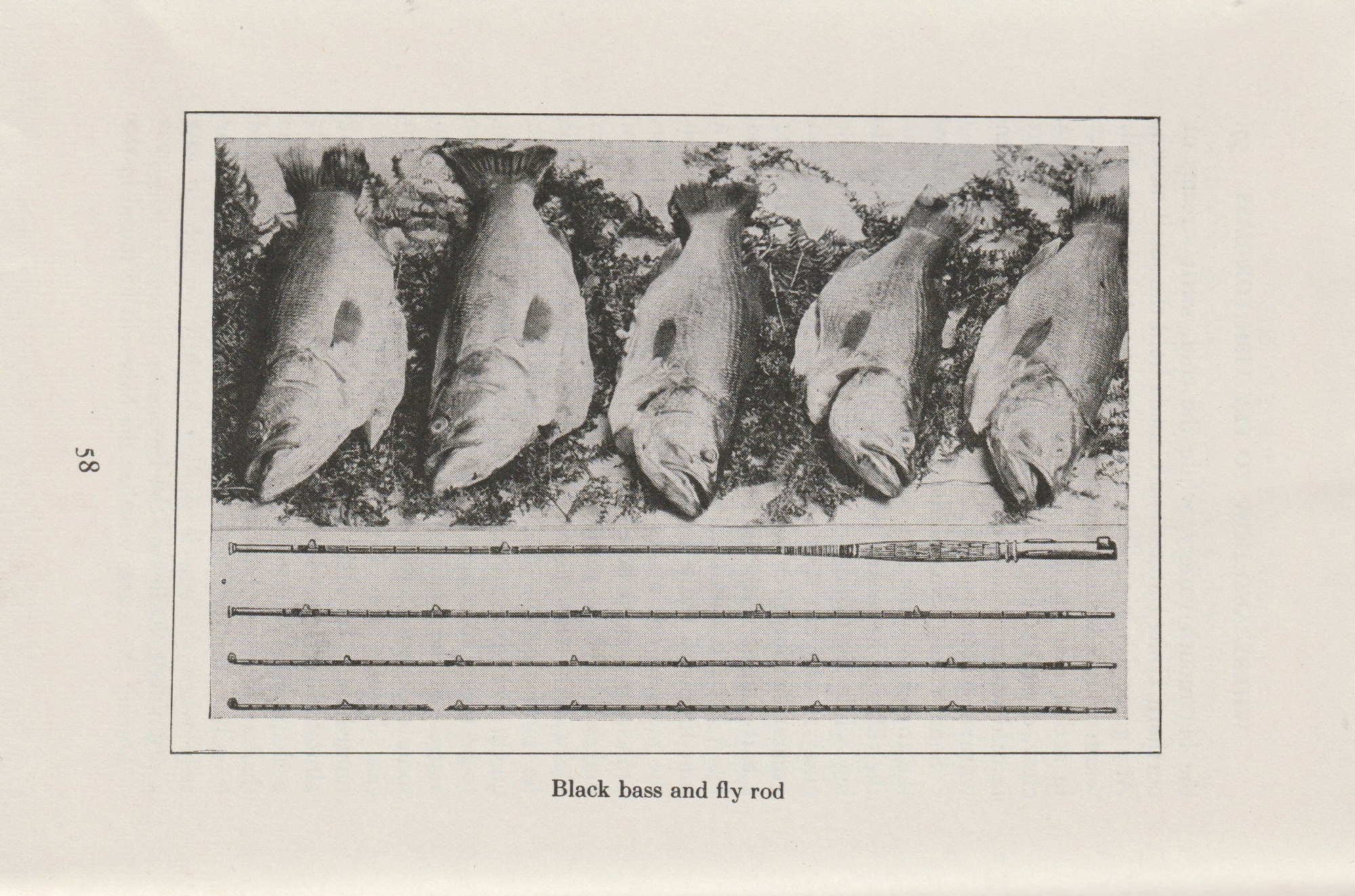
As for bass bugs, Johnson says that, “Bugging for bass has become a very popular method of fly-rod angling and great sport can be derived from using them. The bass leaps upwards as he strikes the bass-bug and a far more spectacular battle results than when he strikes under water.”
Chapter 7, “Where and How to Fly Fish for Bass,” is surely the chapter where Cal felt his writing muse most strongly. He waxes romantically about the fighting features of largemouth and smallmouth bass, particularly on fly gear.
“The lack of resistance offered by the fly rod and light feathered lure allows the bass great freedom, and as a result it will perform more aerial antics than when hooked with the larger lures and the short and heavier rod. Nothing is more exciting and invigorating than to watch from a canoe a fighting smallmouth bass leap clear of the waters and dance for a moment on the tip of his tail in an effort to free himself from the fly.”
He parses this chapter basically into river and stream fishing for smallmouth, lake fishing for largemouth – although there is some overlap between the two species – weather conditions, dry and wet fly fishing techniques, and how to use a bass-bug. This chapter reeks of personal observation, experience and expertise…and of joy in recalling those experiences which inform it. If I could, I’d reprint the entirety of the chapter here. It’s one of the most enjoyable pieces of writing I’ve read on bass fishing.


One thing I did find interesting was Johnson’s omission of small pork rind fly lures. Pork rind was a popular lure in the 1920s, but it was used mainly as a baitcasting lure. But only 15-20 years later Johnson would write a pamphlet for Uncle Josh, in which he touted small fly fishing pork rind lures as deadly bass catchers. Perhaps in 1925 pork rind companies did not yet produce tiny pork for fly anglers, I don’t know. In 1952 Robert Page Lincoln also wrote extensively on pork rind, including small fly fishing pork rind lures.
Johnson ends the book with four short sections on tackle care, clothing and accessories (as you might guess, in 1925 wool was a biggie, but is just as effective today as it was back then), recipes for bass, and finally a couple pages of general tips and advice.
Overall, I found The Fly-Rod for Bass to be a delight, which kind of surprised me. I knew that Cal Johnson was a good writer, but as I’m not a skilled fly fisherman I thought that much of it would come off as dry and uninspiring. But after wading through his initial equipment explanations I found the rest of the book to be lively, informative and a joy to read.