

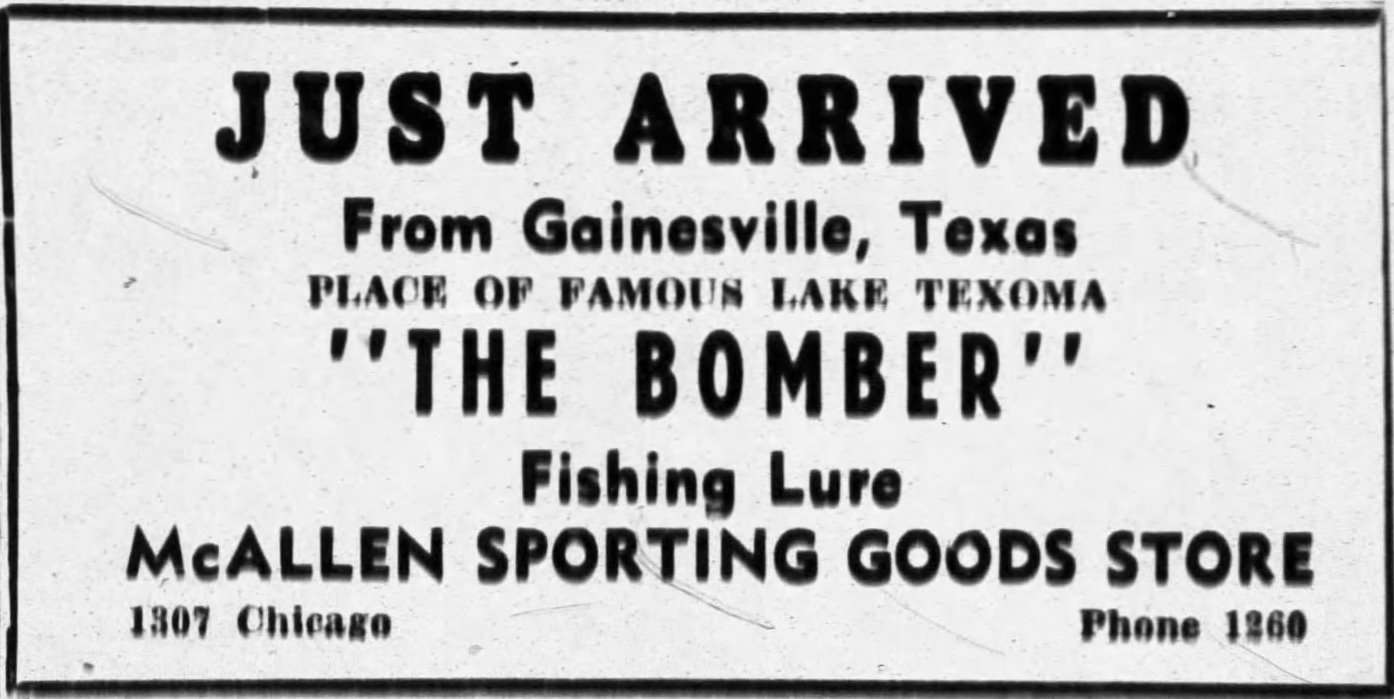
Over the last couple years, we’ve posted several articles on the Bomber Bait Company out of Gainesville, Texas. Today in Bomber Baits 1949, we’re going to continue that trend with this ad from 1949 that came out of Sports Afield’s May issue.
I’ve always been intrigued with the Bomber Bait Company. As a young aspiring angler, my mom would take me to the old-school tackle stores, the ones where you could smell the bait tanks as soon as you cracked the door. At one shop in particular, the baits would be laid out on top of the counter, brown and orange boxes sticking out like a sore thumb. I’d carefully pick up a box, slide it open, and just marvel at the paint. They just looked cool.
The old original Bomber was one of the first artificial lures I bought, other than some flies and maybe a spinner or two. I had no clue what to do with it at the age of eight or nine, but I knew it was something special.
Now, since growing into the upper-middle part of my time here, I still have a love for the original company and the baits they made. But today, I’m more interested in the history of the Gainesville, Texas bait company. Hence today’s ad.
If you’ve been poking around here the last few weeks you’ve noticed we’ve gotten off on a bit of a tangent here with respect to World War Two era tackle. If this isn’t your gig, don’t worry, we’re not abandoning the 70s and on. I just have a stack of 40s and 50s era magazines that have some really good history in them that I’d like to share.
But let’s get back to this ad.
The ad at the top of the screen is the earliest ad I’ve seen in a national magazine to date. I’m not saying there aren’t earlier ones, I just haven’t seen one. This ad was placed roughly 5 1/2 years after Ralph Wham, Ike Walker, and Clarence Turbeville started making the Original Bomber in late 1943.
In order to get a better idea of the history of the bait, I went to one of the newspaper archive sites I use as well as Dr. Todd Larsen’s Fishing for History site, and was pleasantly surprised with the information I found.
It turns out the bait was originally carved by Wham who was a fishing partner with both Walker and Turbeville. A fourth partner, John H. Parker, came on after Wham was bought out, sometime around 1945 or early 1946.
What started out as a way for the original trio to rid themselves of live bait, turned into a business quickly. Their catches at the north Texas and southern Oklahoma lakes were legend and quickly, a long line of potential customers formed.
The earliest article I found was in The Daily Oklahoman, April 2, 1944, and was just a fish report. In the report, it stated, “Fifteen bass totaling 43 pounds were taken jointly by anglers Ralph Whom (sic) and Clarence Turbeville of Gainesville.” There’s no talk about the Bomber but it does place Wham with Turbeville in 1944.

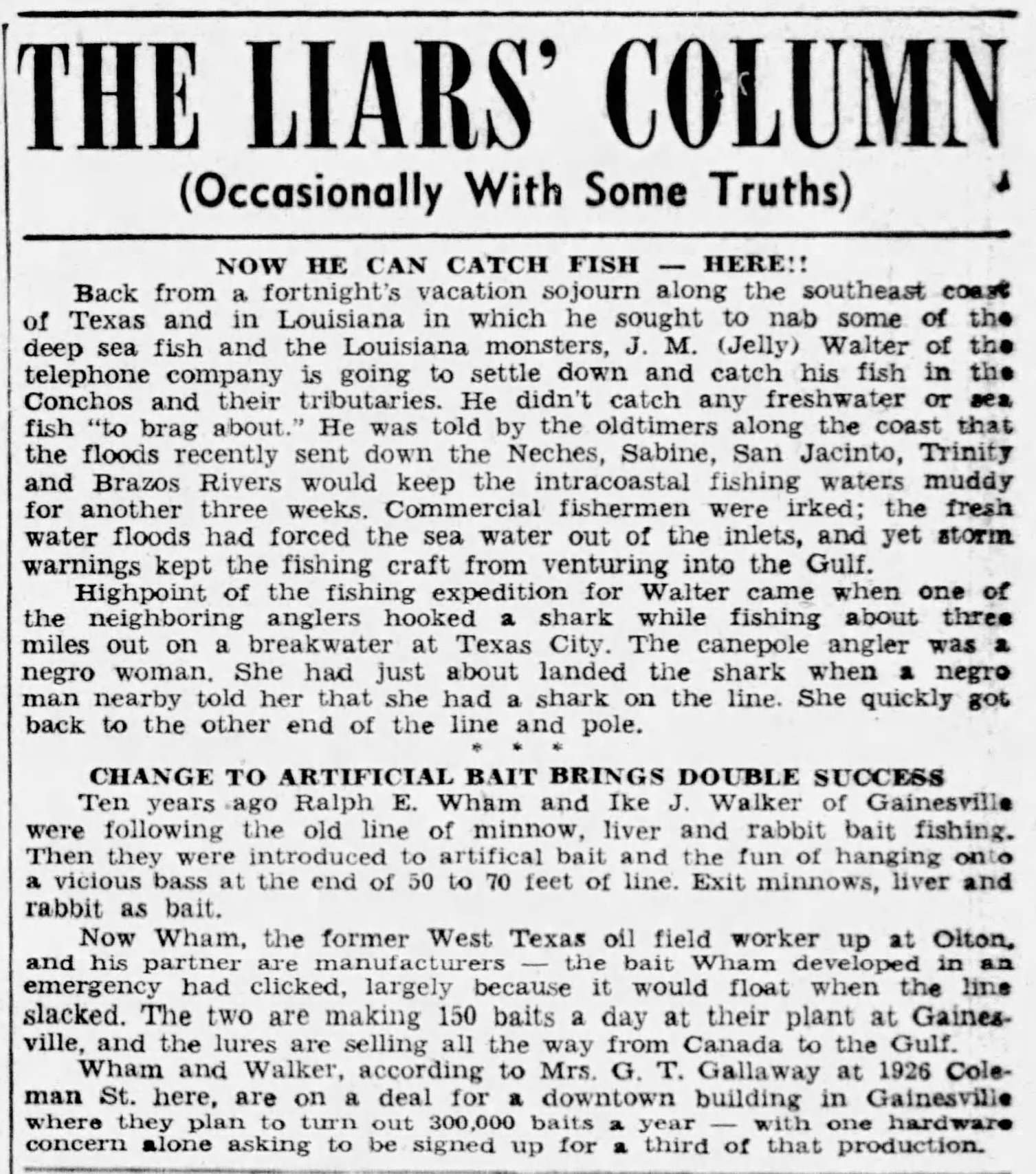
The next earliest piece I found was from the San Angelo Standard Times, June 19, 1946. Again, Ralph Wham is mentioned, this time with Ike Parker as the two who started the Bomber Bait Company. There is no mention of Turbeville, although we know he was associated with Wham.

What is mentioned is their plant in Gainesville and that they were looking to expand into a downtown building, also in Gainesville. At the time they were making 150 baits a day but looking to expand to 300,000 baits per year, a ten-fold increase.
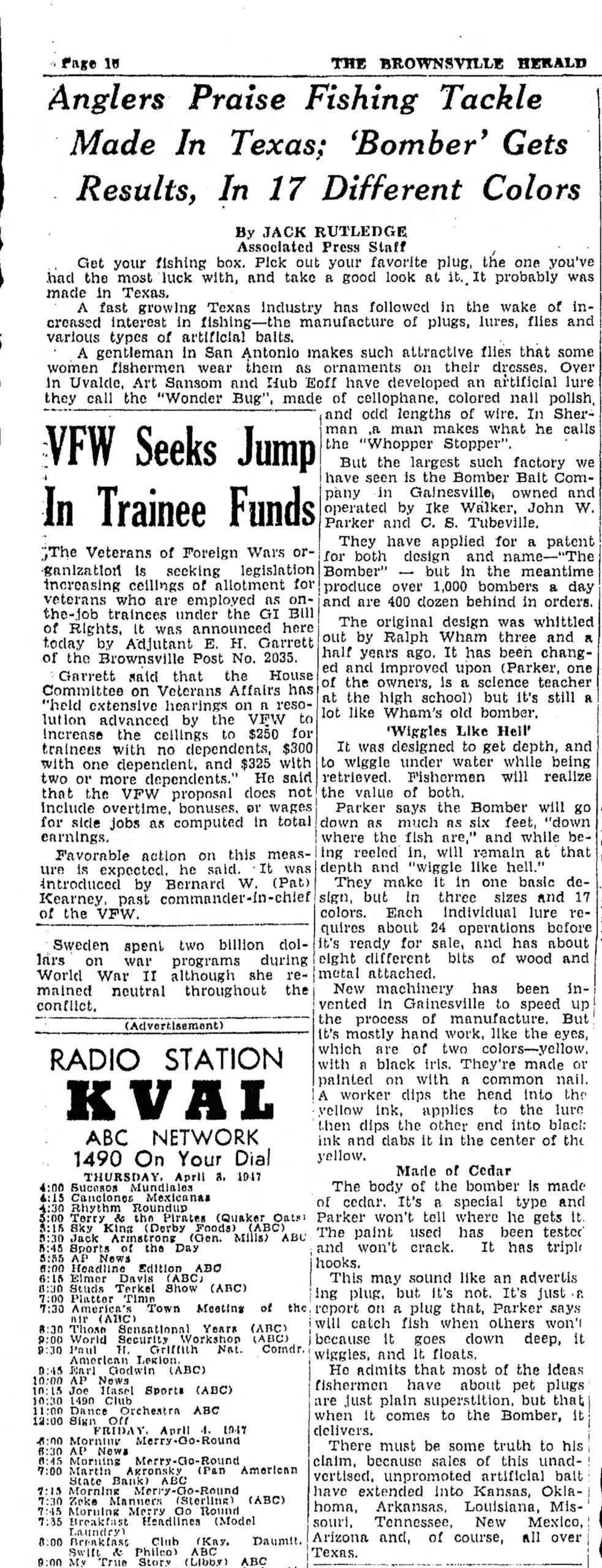
A later article, from the Brownsville Herald, April 3, 1947, stated at the time the Bomber Factory was producing 1,000 Bombers a day and they were 400 dozen baits behind in orders. 1,000 baits a day is short of their 300,000 baits per year goal by a lot more than 400 dozen.
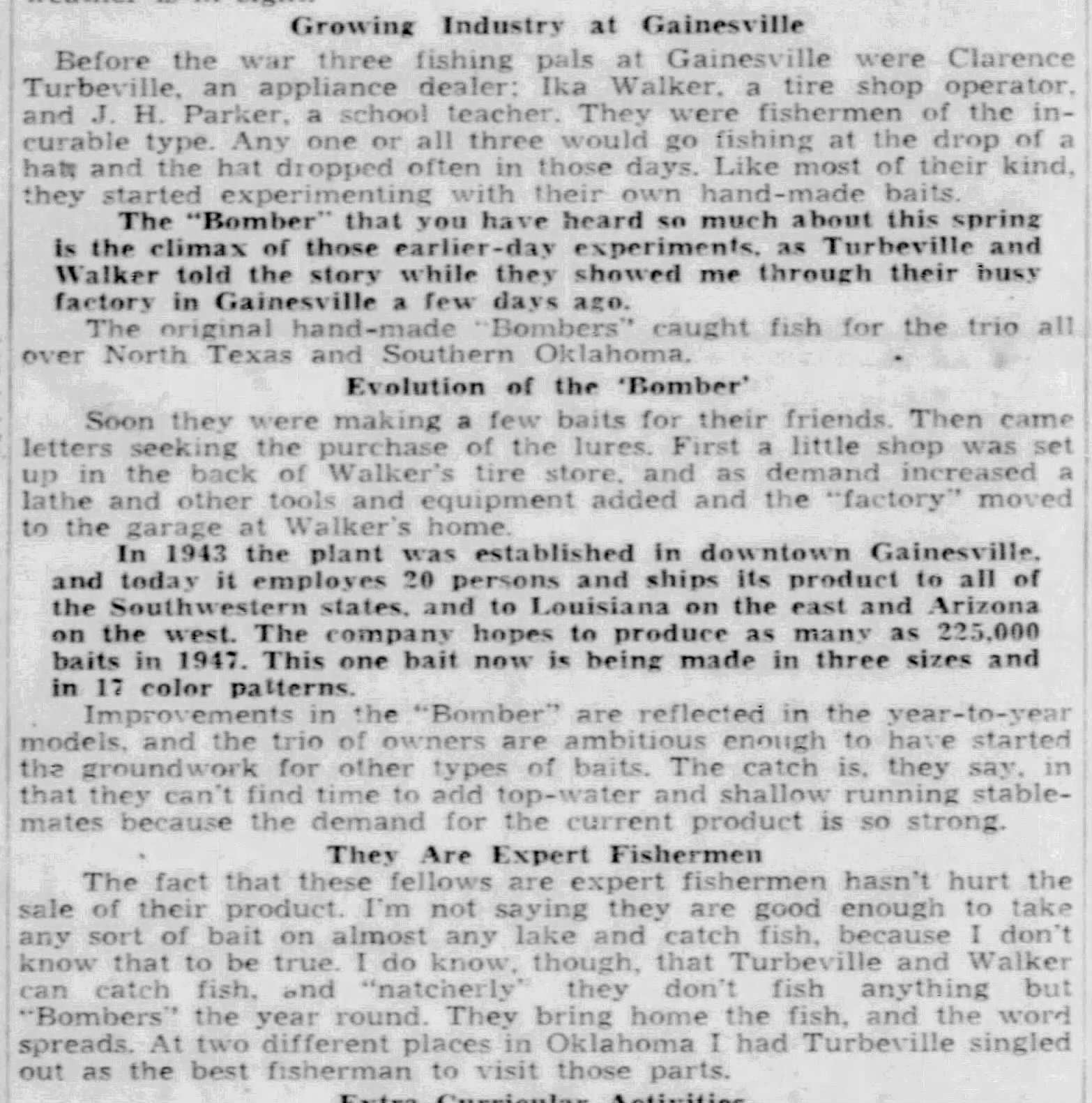
The first shop was in the back of Ike Walker’s tire shop but according to one article in the Wichita Falls Times, dated June 8, 1947, they moved to their first building in Gainesville in 1943. This has to be a typo. At the time of the article, it stated they had 20 employees and shipped to all the southwestern states as well as Arizona.
It wasn’t until the 1947 articles came out that Wham was no longer mentioned, and John H. Parker came on the scene. From then on, only Parker, Turbeville and Walker are mentioned in any newsprint.
The trio’s backgrounds were also impressive. Turbeville had a degree in science, Walker had a degree in agriculture, and Parker had both science and law degrees and was a science teacher at the local high school.
One of the latest articles I found, from the Fort Worth Star Telegram, January 23, 1949, went through the history of the company, not even mentioning Wham. It stated that the trio, Turbeville, Walker, and Parker, talked, whittled, and tested until they came up with the answer. Now this could be true in relation to other baits they’d designed or different sizes of the Original Bomber, but to leave Wham completely out of the story is a bit misleading.
That’s about all I have for Bomber today. I’ll keep digging for information because the whole story about Wham has really intrigued me. Until then, if you have any information on the early days of the Bomber Bait Company, please leave a comment below.

For those who would like to read more on the Bomber bait Company, check out this link for several articles that have been posted here.





As a long time Bomber collector, I am very impressed by the information you unearthed concerning the early days of the company. Great detective work and excellent post that adds to the historical legacy of this great American lure company!
What is the History of the A model Bombers .I am particularly curios about the screw tail versionsthat I suspect are an older design. I’d like to know the timeline of all Bomber Baits.
Hi John, Thanks for the comment. The history of all Bomber baits is a long subject that we are trying to tie together here with the catalogs. So far we have five catalogs up and are working on the others. It’s the catalogs that have all the history in them but they take a lot of time and money to find them and write a post. I hope you can appreciate that. So far we have posted the years 1953, 1971, 1975, and 1980/81, and 1981/82. I currently have in inventory to post 1954, 1964, 1968, 1969, 1970, 1972, 1973/74, 1977, 1983, 1984, 1985, 1986/87, 1990, 1991, and 1992.
From looking at the catalogs, it seems as if the screwtail was replaced by the standard hook hanger sometime around 1990. Most likely this was a range of years as they had tons of stock of all their baits that were in need of the eye screw. It’s my understanding that new molds needed to be made for the baits and instead of replacing the molds with the screw hole and needing the labor to insert the eye screw, they designed the new molds to accommodate the figure 8 hook hanger. So, as they ran out of old stock baits, they started bringing forth the new bait without the eye screw. I have this question out to several Bomber experts right now and if they have a different answer, I’ll let you know here.