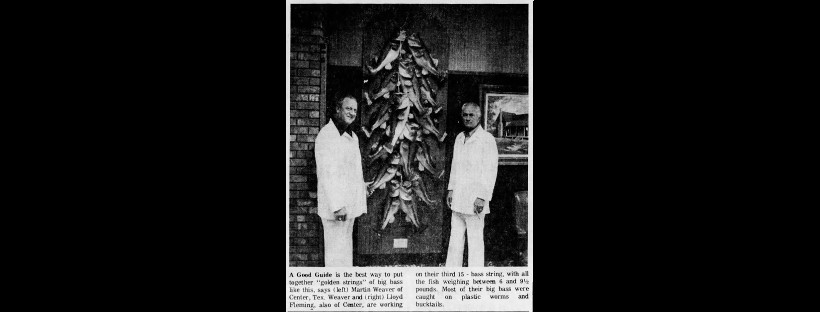
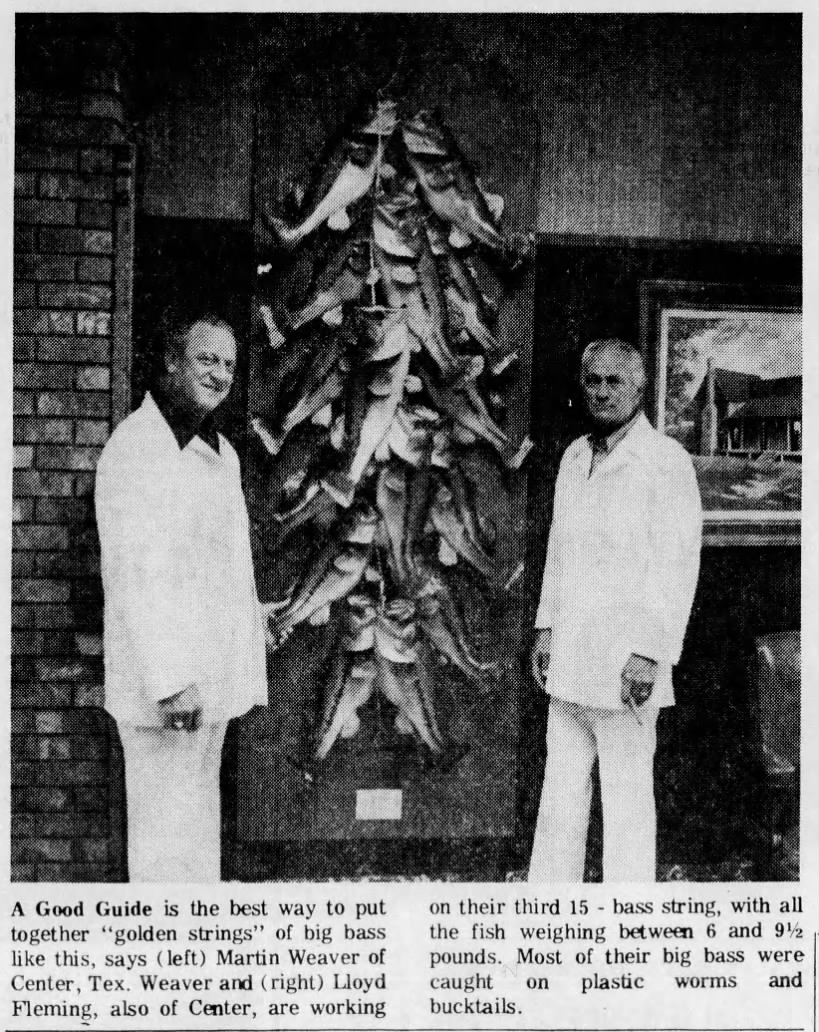
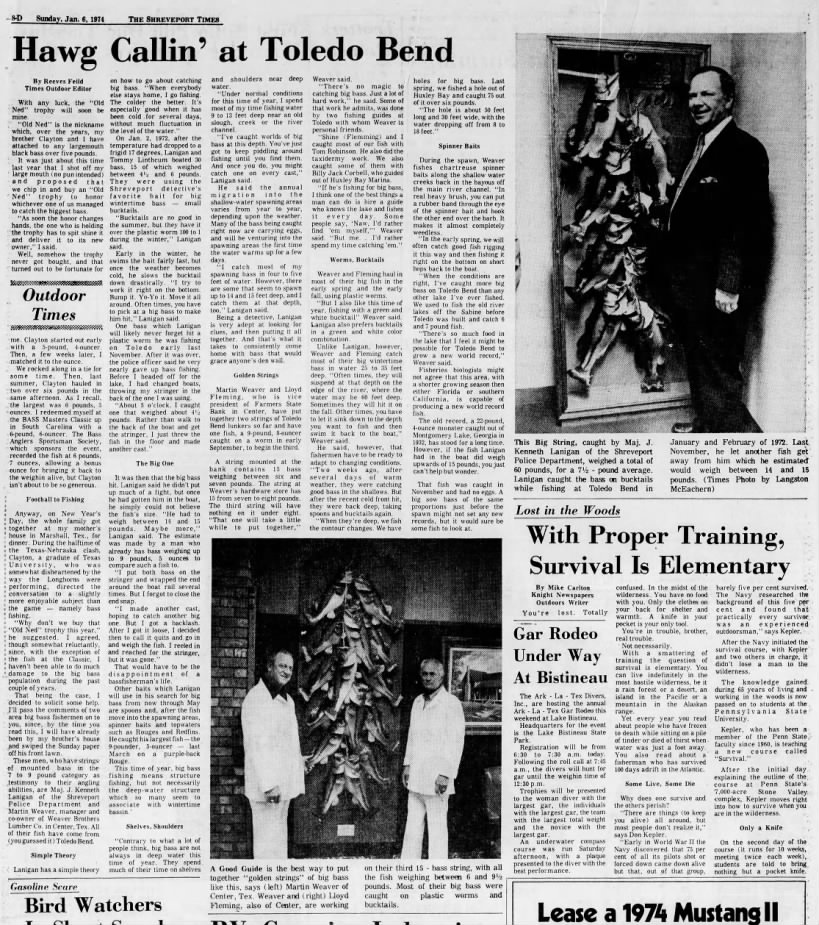
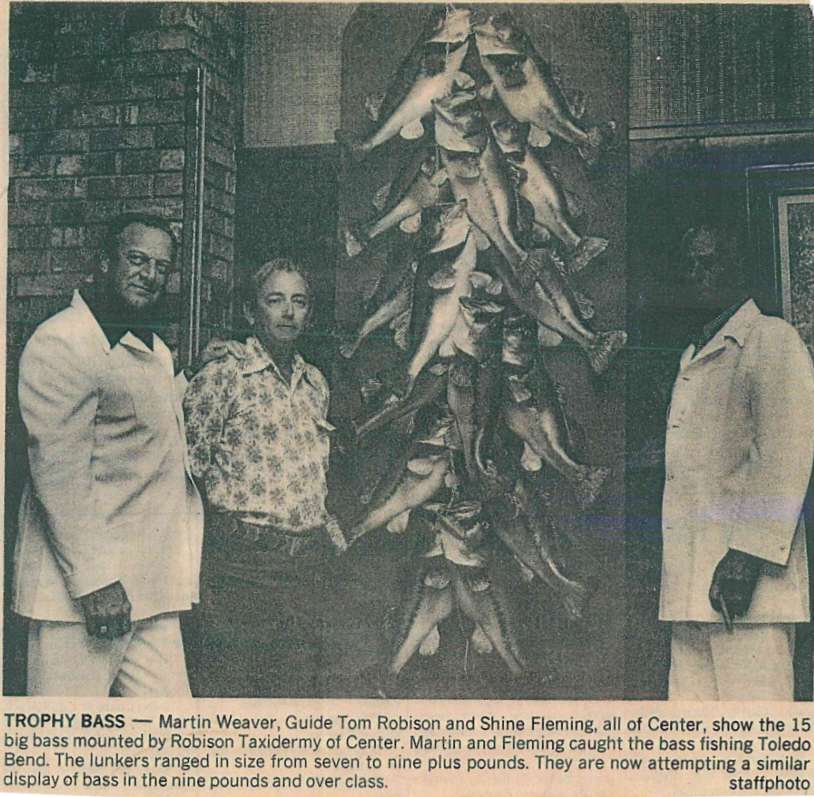
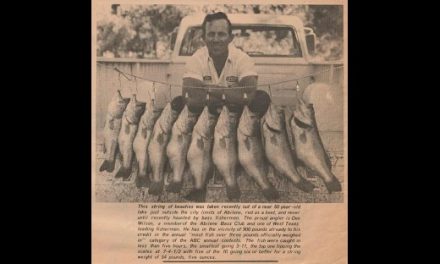
I came across a 50 year-old Shreveport Times newspaper story with a couple of photos that really caught my eye. Like a lot of anglers, any time I see a taxidermy mount of stringers of big fish, I just have to stop and stare. The two pictures of big bass boards from 1974 that accompanied this article certainly merited a wide-eyed jaw drop. As you can see in the introductory image, this stringer is more than impressive. The article itself is a gem as well, written by then-well-known outdoor writer Reeves Feild, the feature offers not only the story of the mounted bass stringers but some excellent bass fishing advice and tips as well.
Because of the length of this story, I’m going to divide it into two separate pieces. This one is what you might call the biographical part, as I want to give you a glimpse into the lives of the extraordinary anglers who caught the fish that make up these big bass boards. In the second installment we’ll take a closer look at Feild’s article and get into the actual fishing techniques these men used to catch big largemouth bass.
But let’s spend a few lines talking about those magnificent stringers. Martin Weaver and Lloyd “Shine” Fleming, of Center, Texas, are the two anglers who are shown in the above photo on either side of one of their big bass stringers. That particular stringer holds 15 bass weighing between six and seven pounds. It hung in the Farmers State Bank in Center, where Fleming was the Vice-President. Their second stringer hung in Weaver’s Lumber/Hardware store, and it too held 15 fish, weighing between seven and eight pounds each. At the time of this old newspaper article the pair were working on a third stringer, with eight pounds being each bass’s minimum weight. More on Weaver and Fleming in a moment.
J. Kenneth Lanigan
The article’s second “hawg” stringer comes from J. Kenneth Lanigan and holds eight bass weighing a total of 60 pounds. That’s an average of 7½ pounds per fish. Lanigan’s non-fishing life merits some attention. Following a stint as an Army Sergeant in WWII, Lanigan became a highly decorated career police officer, rising through the ranks from patrolman to Chief of the Shreveport Police Department. He was statistically the top homicide detective in the country in 1973, solving 52 of 53 homicide cases that year. In 1954 Lanigan was involved in a shootout, where he was shot in the face with a .38-caliber revolver. He spent six weeks recovering in a hospital. In 1956 he was voted the Toughest Policeman in America. In 1980 Lanigan considered retiring from the police force, and in an interview he complained that he hadn’t “been bass fishing for 3½ years.” I find it fascinating that a highly decorated policeman – the Toughest Policeman in America, no less – took to bass fishing as, presumably, a way to relax and get away from the stress associated with police work. But it seems obvious that Lanigan brought to fishing the same dedication and attention to detail that he had in his professional career, enough to allow him to put together at least one big bass stringer. He must have been a very interesting fellow. Lanigan passed away in 2008 at the age of 84.
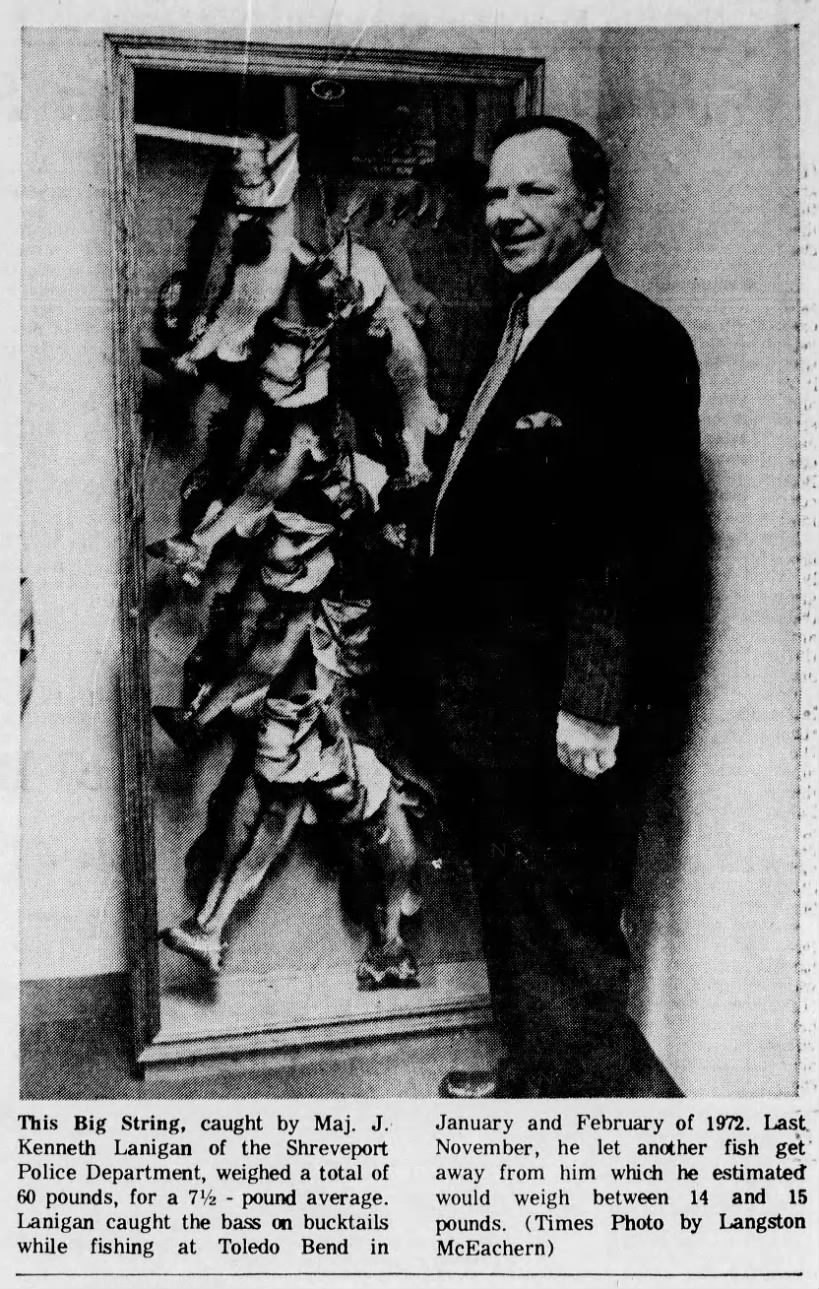
All of the bass caught by Weaver, Fleming, and Lanigan were caught from Toledo Bend Reservoir, on the Texas-Louisiana border. Each of the anglers favored bucktails, plastic worms and spinnerbaits. Toledo Bend was and still is a hot-bed for bass. It’s been written about countless times and is one of the most famous big water fisheries in the world. As a big bass producer, the proof is in the pudding. The Toledo Bend Lunker Bass Program was founded to preserve, document and archive big bass – weighing a minimum of 10 pounds – caught in the reservoir. Since the program’s inception in 1992 over 1,100 bass 10 pounds or better have been recorded. Plus, the fact that anglers like Weaver, Fleming and Lanigan could put together several stringers of trophy bass from that water speaks volumes for its big bass producing qualities.
As for Martin Weaver and Lloyd “Shine” Fleming, let’s take a brief look into the lives of these two anglers.
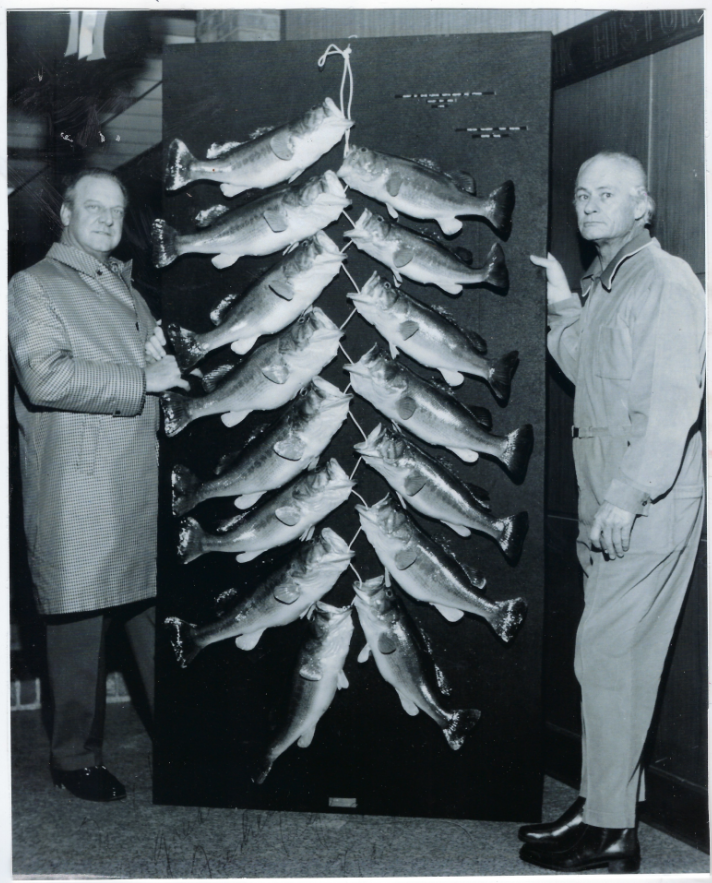
Martin Weaver
This is really a very abbreviated synopsis of the life of Mr. Weaver. His daughter, Joy Ann, sent me a great deal of information on her father’s life and accomplishments. He and the Weaver family were instrumental to the growth and success of the city of Center and Shelby County, Texas. Briefly, Martin Weaver was born in 1921 in Center, Texas. He served as a Second Lieutenant in the U.S. Infantry in Japan during the Second World War, and upon his return home he founded the Veterans of Foreign Wars in Shelby County. He was also instrumental in founding the poultry business in Shelby and surrounding counties. Following his father’s death, Martin and his brother Malcolm took over the Weaver Brothers Lumber business, from which he designed and built more than 2,000 poultry houses in the region, as well as homes for farmers and workers. Weaver and other like-minded businessmen essentially turned an economically struggling region into one of the top chicken producing areas in the country. Weaver was also a man of faith who gave liberally of his time and financial resources to his community.
There are several stories of Weaver’s kindness and selflessness. One such story involved a disabled friend of Weaver, Tom Barton. As a youth Barton had broken his neck while diving, and had become mostly paralyzed from the neck down as a result. He had some limited movement in his hands, but required assistance for the most rudimentary of tasks. And yet, Barton loved to fish and by all accounts was pretty darn good at it. Weaver and a friend lifted Barton from his wheelchair into Weaver’s boat, strapped a rod and reel to his arm, and off they went, fishing with only minor interruptions to remove fish from Barton’s line or tie on a new lure. Weaver talked of Barton in a 1968 newspaper story by Ken Foree: “Tom makes me humble,” he said. “Any time I think I’ve got troubles I think of this boy paralyzed by a dive, outfishing me, driving 400 miles with a club of a fist in a spinner to sell road supplies to contractors and being self-sufficient. What a boy! No, what a man!”

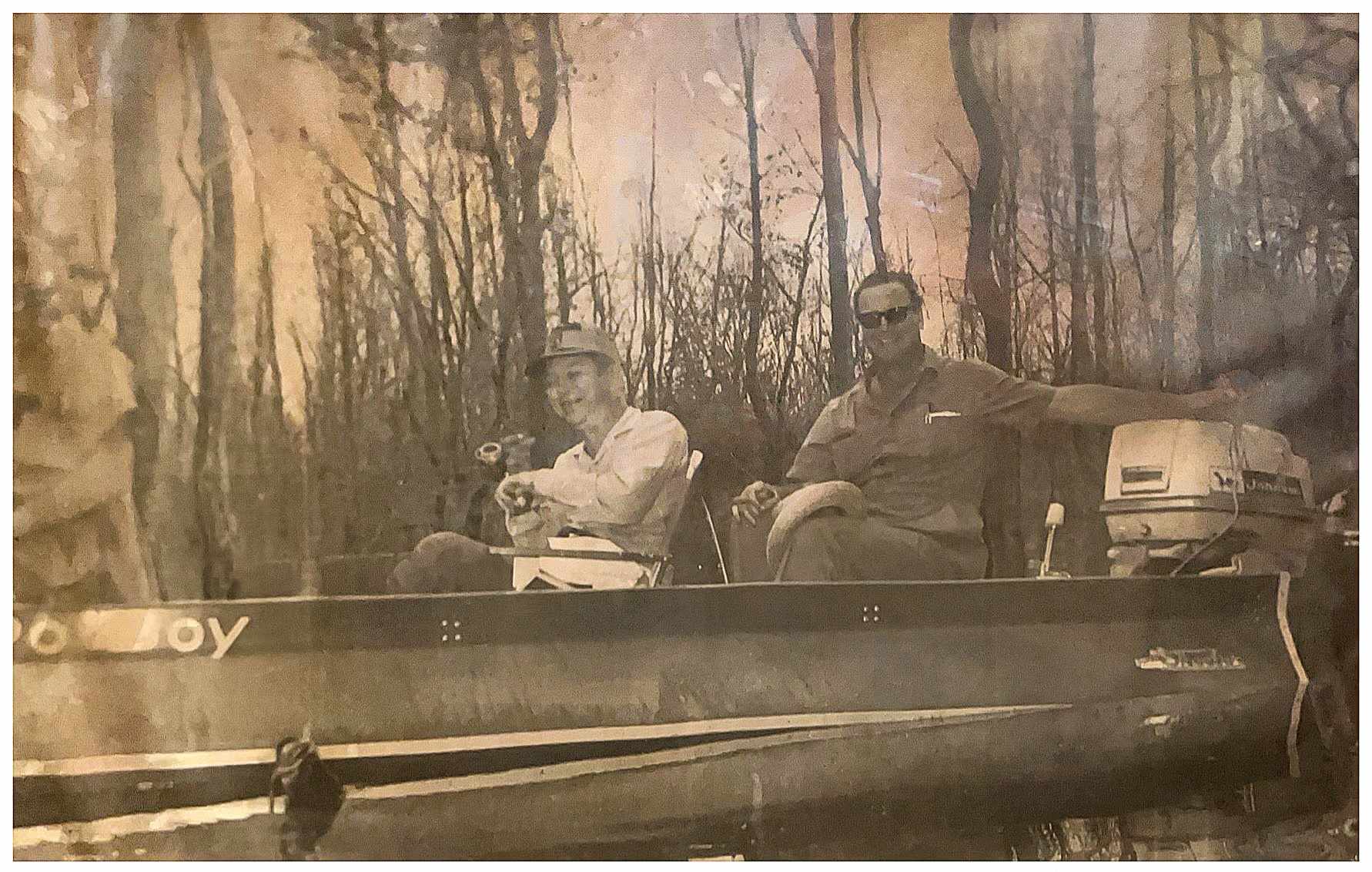
One other story that moved me told of Weaver’s yearly delivery of orchids at Christmas, to nursing homes and home-bound elderly folks. At Weaver’s funeral there was a bouquet of flowers from two elderly women, with an attached card that read, “To Martin, the only one that ever sent flowers to us. Thank you for making our Christmas each year.” Martin Weaver passed away on June 10, 1982 at the age of only 61 years.
As it relates to bass fishing Weaver was just as much the promoter of the outdoors lifestyle as he was of his other interests. Joy Ann sent me her submission for her Dad’s selection to the Center High School Hall of Honor. Here’s the slightly edited text of a portion of that submission:
When Toledo Bend Dam was built, Martin set out to promote awareness of the lake and its fishing. He built and financed Huxley Bay Marina, Hotel and Restaurant, which was the first “full service hotel and marina” in Shelby County.
As a member of the Dallas Woods and Water Club, he used his contacts to solicit sports writers from the Dallas Morning News, and other newspapers throughout Texas, Louisiana and Oklahoma to “Come to God’s Country,” which was what he always called his beloved East Texas. And come they did! He and his wife, Joy Ellington Weaver, entertained scores of these guests in their home, and Martin took them fishing. In return they wrote glowing reports in their publications about Center, its people and the amazing fishing in Toledo Bend Lake.
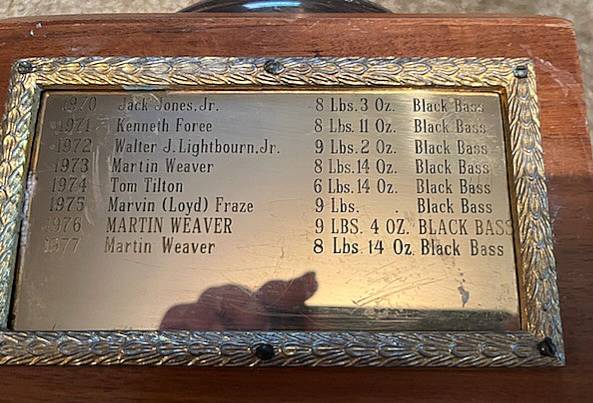
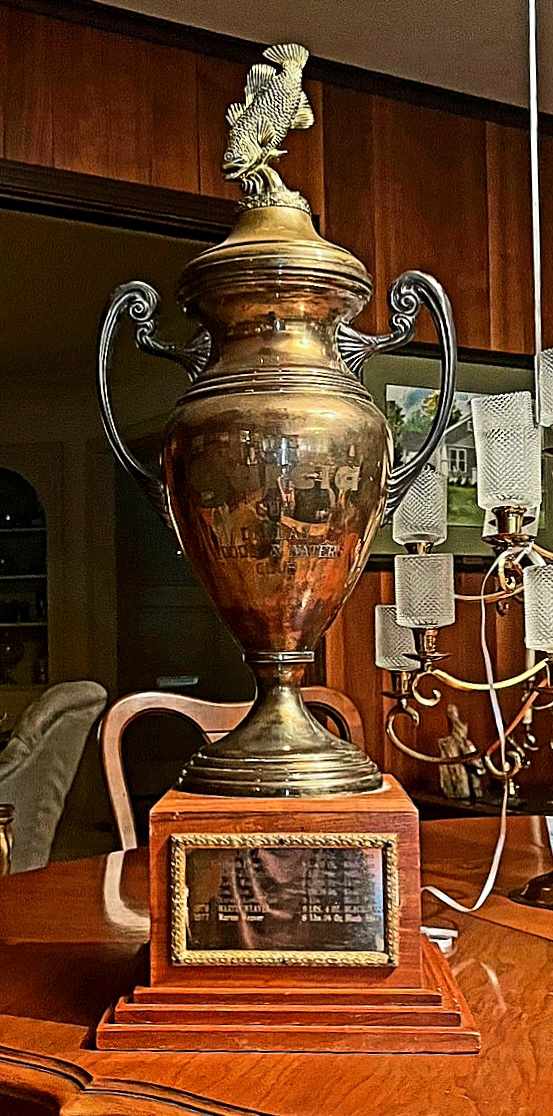
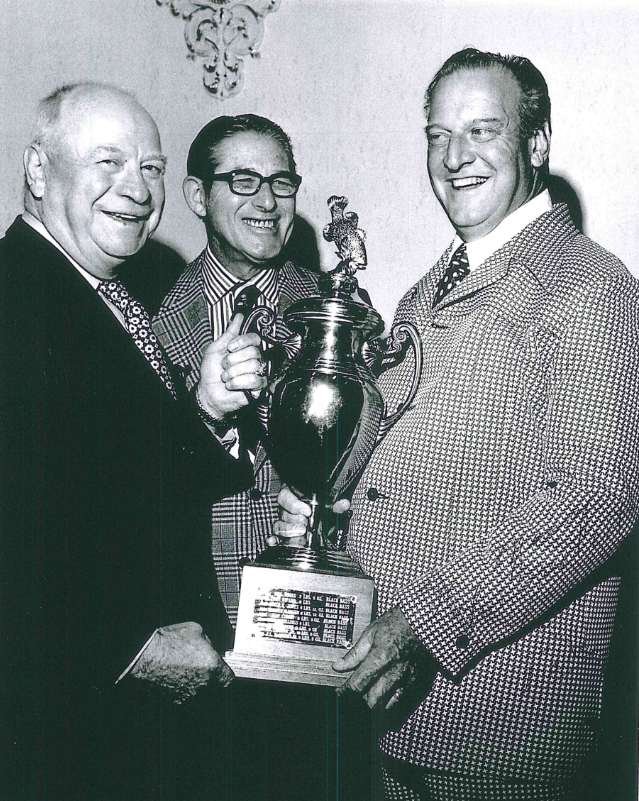
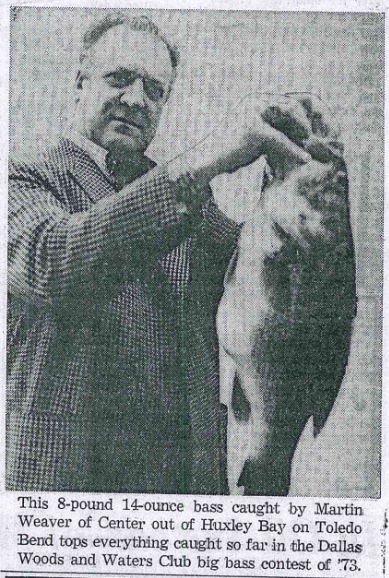
Weaver also brought acclaim to Toledo Bend when he won the Dallas Woods and Water Club trophy for the “Largest Bass Caught in the State of Texas” for three consecutive years. Of course, the bass were caught in Toledo Bend. This award was presented annually by the club at a luncheon in Dallas. During the banquet when Mr. Weaver won the award for his third consecutive year, the club retired the trophy and permanently gave it to him engraved with the words “Our respect and admiration for a feat never before accomplished.”
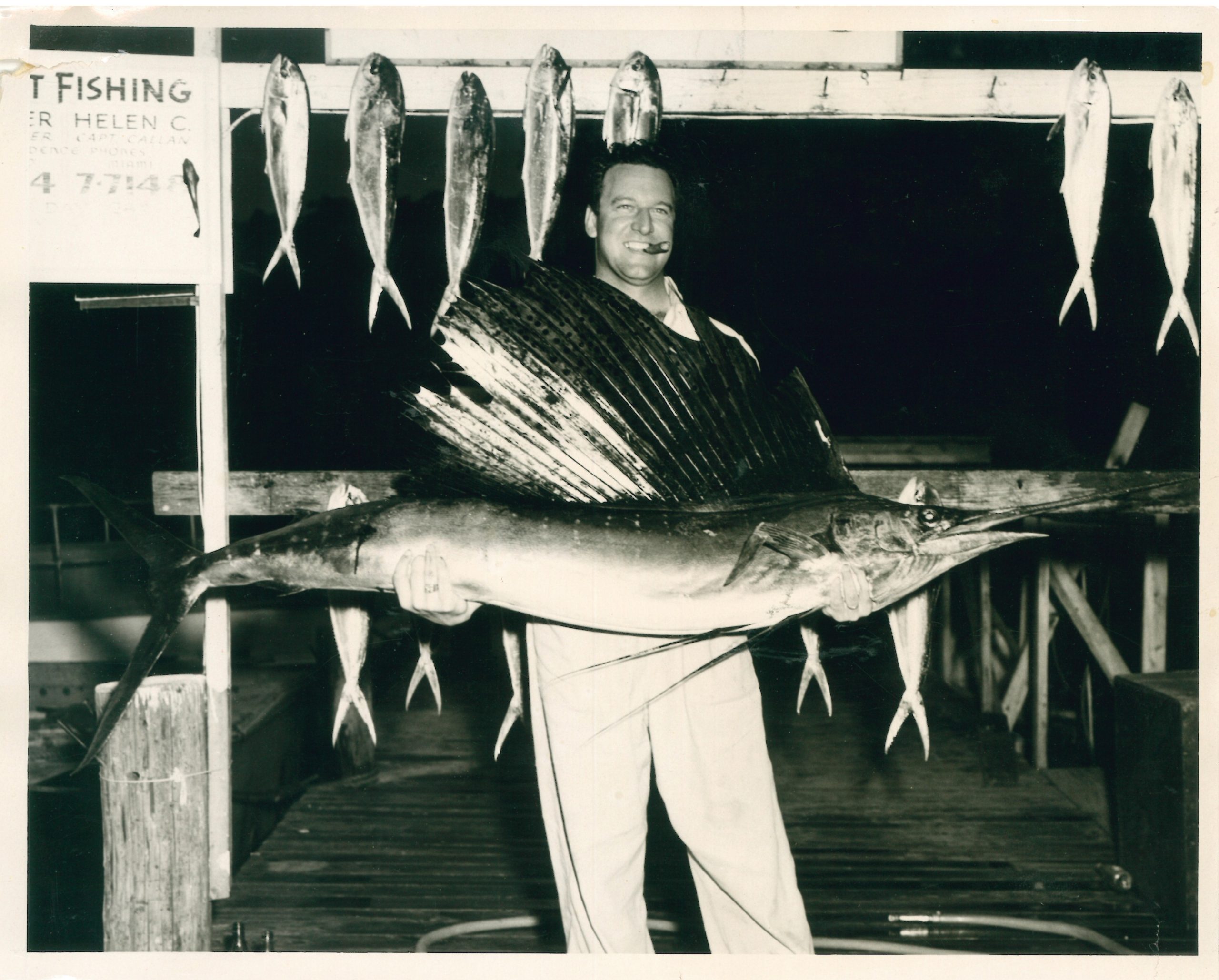
Lloyd “Shine” Fleming
I spoke with Lloyd Fleming’s son Scott. Scott remembered the bass boards and said that his father and Martin Weaver had also been working on a striped bass board, although he didn’t know the current whereabouts of that board. Lloyd Sunfield Fleming – I assume Lloyd’s middle name, Sunfield, is where he got his nickname “Shine” – was born March 12, 1918 and was the seventh of eight children. The attack on Pearl Harbor compelled Shine and two of his brothers to join the fight. Shine enlisted in the US Army, where he served in the 152nd Infantry Regiment of the famed 38th Infantry Division that fought in the Pacific Theater. Lloyd survived the fierce fighting on the Bataan Peninsula and was awarded the Bronze Star and several other commendations. He returned home, while suffering from malaria, to his young bride and their son, Scott.
Lloyd eventually became the Vice President of the Farmers State Bank, where one of his and friend Martin Weaver’s big bass boards was displayed for many years. Lloyd Fleming passed away in 1988 at the age of 70.
One brief newspaper clipping that talked about Weaver’s 1973 DWWC record bass, mentioned that he, Shine and “Little Scott” Fleming each caught Bass that went onto the stringer boards. When I spoke with Scott about his dad, he said that indeed he did go fishing with both Shine and Martin fairly regularly. But he neglected to mention if any of his bass were on the boards. Scott spoke lovingly and respectfully of his father, and seemed pleased and eager to offer any assistance he could with this story. Unfortunately for Bass Fishing Archive readers, Scott wasn’t the obsessive fisherman his dad was, and rather than recounting specific fishing stories he just seemed to thoroughly enjoy spending time with his dad in the boat. But Scott clearly had bass fishing skills, because he was an important part of many fishing trips.
Tommy Robison
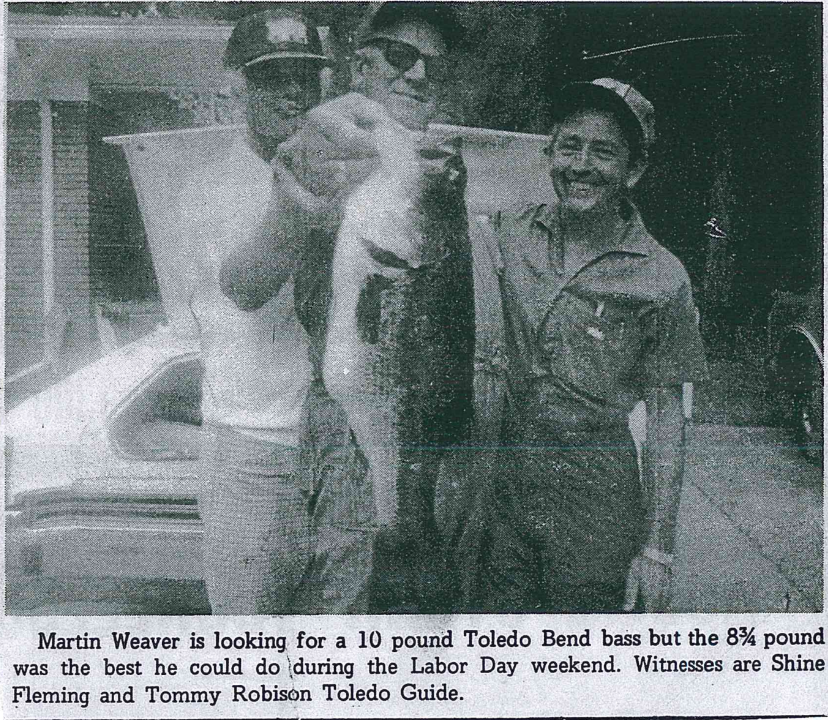
Scott suggested I call Tommy Robison, the man responsible for guiding the two anglers on Toledo Bend and also the man who mounted the fish on the big bass boards. Tommy is currently 88 years old and is as sharp as a tack. He told me that most of the big bass Martin, Shine and he caught on Toledo Bend were “caught in the dead heat of summer, in the afternoon.” Robison knew exactly where the bass could be found and he knew exactly what was under the water, because he knew the land before the reservoir was flooded. “I knew all the old logging roads and farms and the lay of the land,” he said. “I used to hunt squirrels in a lot of those places, before they were all covered with water.”
“We named the holes where we knew fish could be caught. The old bridge in one spot we called the ‘cement pond’.” He told me about one time when the three men were out and Shine hooked a large bass. “We were fishing in 18 feet of water. Shine set the hook and I knew it was a big one. It got wrapped up and Shine said he’d give me $100 if I dove in and got it. It was a joke. $100 was quite a lot of money in those days. Early 1970s. Well, I stripped down and dove in. Came up with that bass and when I got back in the boat, sure enough, Shine gave me a $100 bill.”
Tommy told me that the two men were serious fishermen, and their equipment confirmed that. “They used Ambassadeur reels and Fenwick rods. Good gear.” He also said he knew several lure makers and was friends with celebrity bass anglers like Bill Dance, who he guided several times. “We used a lot of plastic worms. I knew Bill Stembrige. He made the Fliptail Worm. I’d get worms from him. And from John Fox, who made the Fluttertail Worm. They [Fluttertail Worms] worked too, but the Fliptail was probably better. We used a lot of purple and black. Black was good on dark days.”
Robison said they would generally fish in 18-20 feet of water, just above the thermocline. The bass would school there and the men had great success. He told me a funny story about his friend Bill Dance. Robinson was fishing Lake Guerrero in Mexico. He was getting his boat ready when he felt a tap on his shoulder. He turned around and it was Bill Dance, who also happened to be at Guerrero, unbeknownst to Robison. Robison recounted, “Bill said, ‘Tommy, come over here. I want you to meet someone.’ So I followed him over to his boat and he introduced me to Jerry Reed. They were down there fishing. Reed was just like you see him in the movies. Funny guy.”
Tommy was more than kind with his time. He said, “Come on down to Texas, David. I’ve got photo albums full of pictures. We’ll spend the day looking through them and talk about the old days.” I’d dearly love to take him up on that invitation.
Well, that’s a mighty slim portrait of some very interesting anglers, men whose lives were rich and full, who saw bass fishing as not only a challenge and respite for themselves, but used the sport to enrich their communities and bond with their neighbors. Next time we’ll take a look at the techniques that enabled them to be so successful at catching big bass.





Fantastic story David. Very enjoyable. Fun to read about the heyday of bass fishing. Comradery was strong back in that era. Cool to see the super Skeeter as well. Have a 1966 just like it.
Thanks Mike! I really appreciate your comment, and I’m happy you enjoyed this story. Cool note on your ’66 Skeeter too.