

Well, we’re back at going through some old magazines, this time from 1940. Today in Bass Lures 1940, we’re going to take a look at six different companies and some of what they had to offer for the year.
So far, we’ve covered a few specific companies that were giants amongst the industry from 1940 in separate posts. Companies like Heddon, Fred Arbogast, and South Bend. All of these companies placed multiple ads in the magazines and therefore it warranted a company-specific piece. Today what we have are some of the other companies that didn’t have enough ads to warrant one post on their own.
Here they are.
Millsite Steel & Wire Works, INC.
Millsite, out of Howell, Michigan, was known as one of the first companies to embrace plastic in bait manufacturing. It’s stated that they never produced a wood lure, going solely into the business with plastic. Specifically Tenite.
The first ad, above, was in nearly half the issues I came across for the year. At the time, Millsite was a pretty big player in the bass lure business.
The ad featured the Millsite Rattlebug with “Under-Water Vibration.” The ad is confusing because they make the case the bait rattles in one sentence, then claim its vibration is the sound in the next sentence. Which is it Millsite?
From my understanding, and the fact this bait was advertised a lot over the years, the bait was very popular. Whether it caught fish is another question.

The second ad featured here was promoting their “Indestructible Baits” and the bait appears to be their Millsite Minnow. Unfortunately, according to one of my reference books, the bait didn’t come in a 3/8-ounce size, which is advertised here.
The one thing you notice right off the bat is the shape. Almost a dead ringer to a Heddon River Runt. Copycats were alive and well in the early days of bait making.
Pachner and Koller, INC
Here is another company that was fairly large back in the middle of the 20th century, yet has been long forgotten. Pachner and Koller of Chicago, Illinois, or P&K for short. P&K made all sorts of bass lures and other tackle but were known for their terrestrial and amphibious baits. These two ads are a prime example.
Both ads contain the same products, just presented in a different manner. The two lures they were advertising were Softy, The Wonder Crab and Spotty The Wonder Frog.
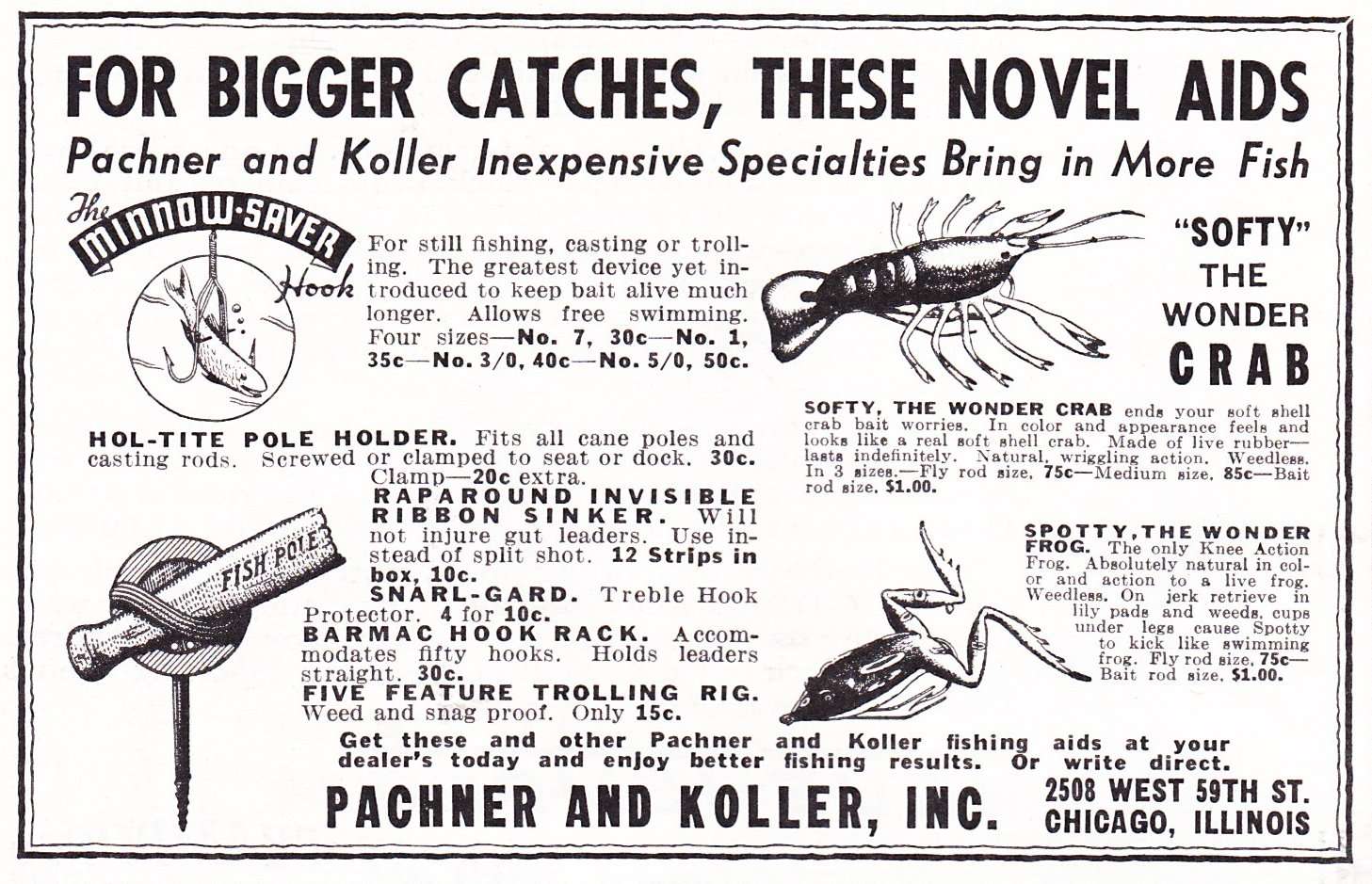
Softy The Wonder Crab was made from “soft” rubber and was billed as the end-all of your softshell crab needs. It came in a natural color and in three sizes with natural “wriggling” action.
Spotty The Wonder Frog also came in a natural frog pattern and was advertised as the only frog lure with “knee action”. The frog has a lot of features that Snag Proof’s original frog had, which makes me wonder if Snag Proof patterned their bait after this.
Both the Frog and Crab had weedless hooks.
Paw Paw Bait Company
Paw Paw Bait Company didn’t start as such but was known as the Moonlight Bait Company from 1909-to 1930. In 1930, the name changed to Paw Paw Bait Company.
Moonlight and Paw Paw made several different baits over the years they were in operation and these two ads only feature a small number they produced.


The first advertisement was all about their “Caster” baits. Two-piece and one-piece configurations, which, according to my reference book, came out in 1941, six months after this ad. The ad does not state that the baits were new, and it even says for anglers to ask their dealer to see them.
The second ad contains two more of their designs, the Wotta-Frog and the Go-Diva. The Wotta-Frog, released formally in 1941, has become quite a collector’s item over the years and based on the number of Wotta-Frog ads I’ve run into, it must have been a popular bait. The Go-Diva, on the other hand, isn’t in any of my reference books.
Shakespeare
Although tackle powerhouse Shakespeare had several ads in the 1940 magazines, I was only able to find one that was about their lures. In this case, it was the Dopey, a tiny 1-5/16-inch crankbait that weighed a little less than a half ounce. For being such a small bait, its weight is heavy, which leads me to believe it was weighted. Whether it was made from plastic or wood, the ad doesn’t give any clue.

That ends it for this round of bass lures from 1940. Believe it or not, there’s still more to go. Thanks for joining in this history of bass baits and let us know if this type of content is something you’d like to see us continue.