

With all the talk about electronics over the past few years, I felt it appropriate to look back on the state of electronics some 40-plus years ago. Today in Bass Fishing Electronics 1980, we’re going to look at the two leading producers of the time were offering and give a little perspective on each of them and what they offered.
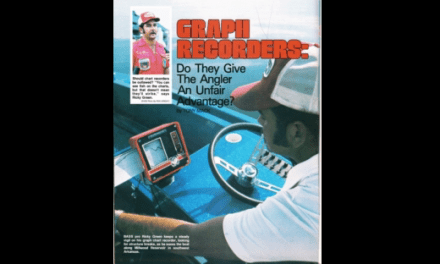
The lead-in image shows an ad run in the November-December issue of Bassmaster Magazine for Humminbird’s new CH1000A straight-line graph recorder. The ad states that these units had just survived the rigors of the 1980 BASS Masters Classic held on the St. Lawrence River in New York.
Let’s take a closer look into the standard Classic boat up to this time. Up to this point, B.A.S.S. had primarily used Lowrance units for every Classic boat and all that was offered were two flashers, one fore and one aft. Classic X would mark the first time a paper graph would be placed on each Classic boat.
The switch to ‘Bird was a big deal, but evidently Humminbird made the push due to their new graph. This must have been part of the deal Humminbird gave B.A.S.S. to showcase their new product.
But let’s get back to the ad.
The ad states clearly that the Humminbird CH1000A “passed the [Classic] test with flying colors.”
“With high winds and a 2-foot chop you might expect problems with a normal depth sounder.”
“At the 1980 Classic, every boat was equipped with a CH1000A Chart. And not one single unit failed to perform.”

Having talked with several of the anglers that fished the event over the years, one thing was common among them all. Not one angler had turned the units on in the event. No wonder they didn’t fail to perform.
Another advantage they point out in the ad was a 400% increase in sensitivity. What they don’t say is 400% over what. Their last unit? A Lowrance comparable unit? I doubt that last one.
The second ad, which was found a few months prior to the lead-in ad in the March-April 1980 issue of Bassmaster, talks about the benefits of the CH1000 chart recorder. For one thing, like all “Bird units, they claim to be able to take readings at speeds greater than 55 mph. That was standard for ‘bird and they were the first to overcome that challenge.
The second upgrade they discussed was their attempt to challenge Lowrance’s grayline feature, which really helped distinguish hard bottom from soft bottom or rocks. ‘Bird’s version of this was not as good as Lowrance’s.
Next they talked about sealed electronics to thwart shorting from carbon dust released by the thermal paper, but all companies by this time had sealed their electronics packages.
Having worked at the tackle shop for three years by this time, I’d installed several paper graph units and taken many in for repair. Our number-one selling unit was the Lowrance 1510, followed by the Vexilar. Humminbird units, although we had in stock but rarely sold any of them. We did take several of them in for repair, though.

The Lowrance 1510 was the workhorse of the straightline paper graph, especially in the west where we constantly fished water deeper than 50 feet. Then in 1980, Lowrance released the 1510B, which is shown in the final ad in this post.
The problem with the 1510 wasn’t power, sensitivity, or ability to separate fish from the bottom. It was fabulous at all that. What drove customers nuts was its penchant for the paper to stop scrolling across the screen due to an engineering design flaw so small it was overlooked. Here’s where the problem lies.
The graph paper was rolled onto a thick cardboard roll. That roll was then placed between two discs that had a nipple that fit inside the hole of the roll. The tension on the roll was provided by two small springs and the paper was drawn off the supply roll and onto an empty roll by a gear system on the take-up side. Easy.
The problem was once the paper on the take-up side was about 1/4 full, its weight was too much for the small pressure springs and the take-up roll would slip between the disks, thus stopping the progress of the paper across the screen.
The solution for the 1510 was to use double sided tape on one of the discs but that had its downside too. Sometimes the paper would bind on the tape, creating its own problem.
Lowrance came up with the solution and started slotting the cardboard roll and then designed one of the tension discs with the male version of the slot. This solved the problem of slipping paper and was introduced into the new 1510B version of the graph. Lowrance also offered the upgraded disc to repair shops to replace for free to anyone who had a 1510.
That was the only difference between the 1510 and 1510B.
The competition between Lowrance and Humminbird continued and still goes on today. Back in the 1970s through the early 2000s, Lowrance had what I’d call most of the market share in freshwater electronics. Then in the mid-2000s, Humminbird changed the face of sonar with Sidescan, and then 360. After that, everyone has been trying to catch up to Garmin and their forward facing sonar.