
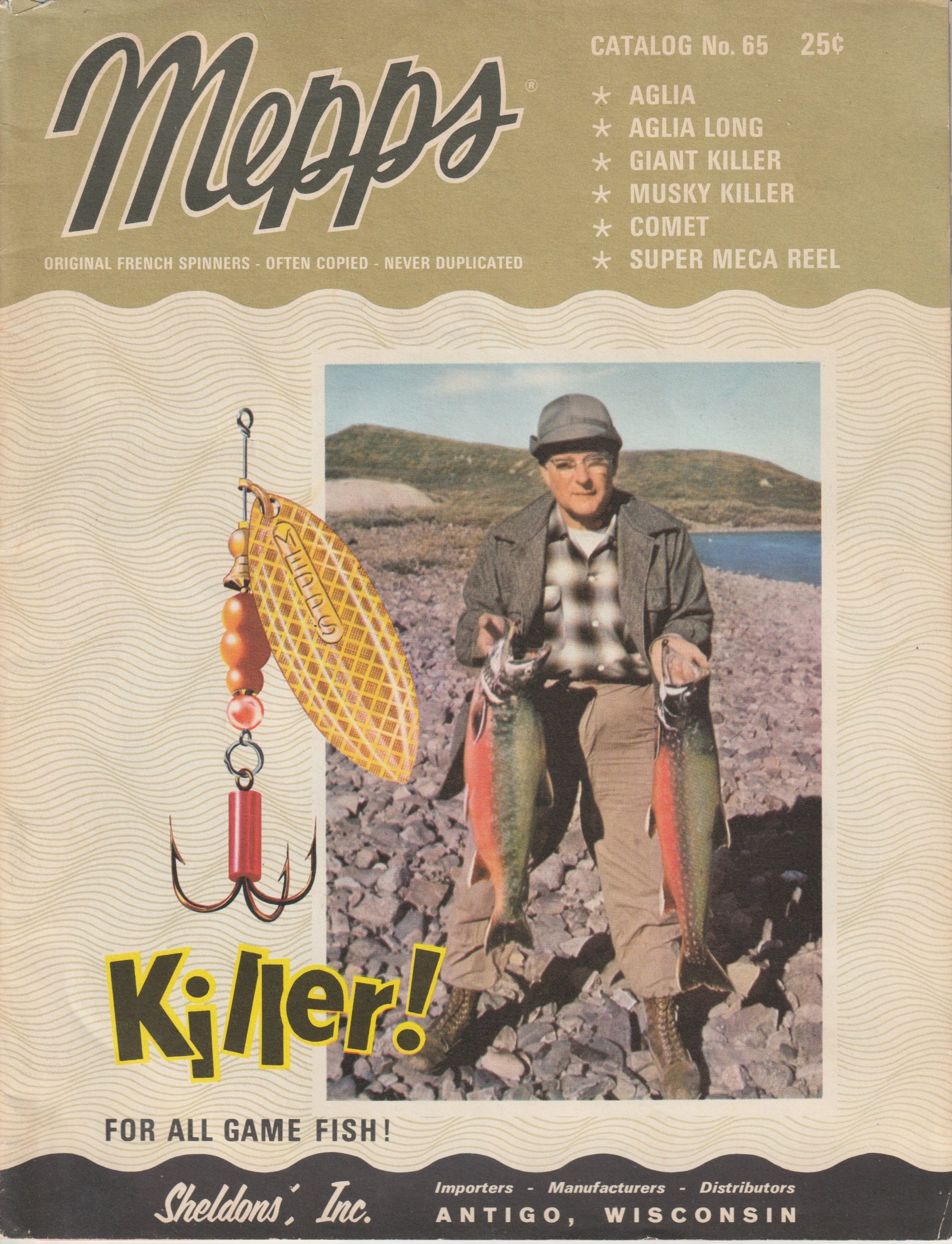
I’ve got a pretty decent collection of Mepps catalogs, dating from 1970 to the present day. Mepps president Mike Sheldon was kind enough to send me several to fill some gaps in the collection. I also spent some time sitting on the floor of the Mepps company history room with the company gatekeeper, a friendly woman named Bev, going through several boxes of old catalogs. The one area where I’m lacking catalogs is prior to 1970. So, I’ve been keeping my eyes peeled for any that might show up online and that aren’t prohibitively expensive. I recently acquired this 1965 Mepps catalog off of eBay and it’s a real beauty.
I chatted with Mike Sheldon and he told me that he believes that the first catalog may have been released in 1960, when Todd Sheldon bought out his former partner, George Boehm. Although, the outward switch from the Boehm-Sheldon name to Sheldons’ alone would take a year or two. Ads in 1962 still displayed Boehm-Sheldon, and a Nov. 11, 1962 Green Bay Press Gazette newspaper story indicated that while Sheldon bought Boehm’s interest on Feb. 1, 1960, the company name remained Boehm-Sheldon Inc. in print until April 1962, when Todd changed it to Sheldons’ Inc. In this article I’ll be using Mepps and Sheldons’ Inc. interchangeably. Sheldons’ is the company that imports, from France, most of the parts for Mepps spinners, and they assemble them in their facility in Antigo, Wisconsin. When people think of Mepps they associate the lure with the company in Wisconsin (Sheldons’ Inc.) that owns rights to the lure, so in essence Mepps and Sheldons’ are the same, but technically Sheldons’ Inc. owns the Mepps brand.
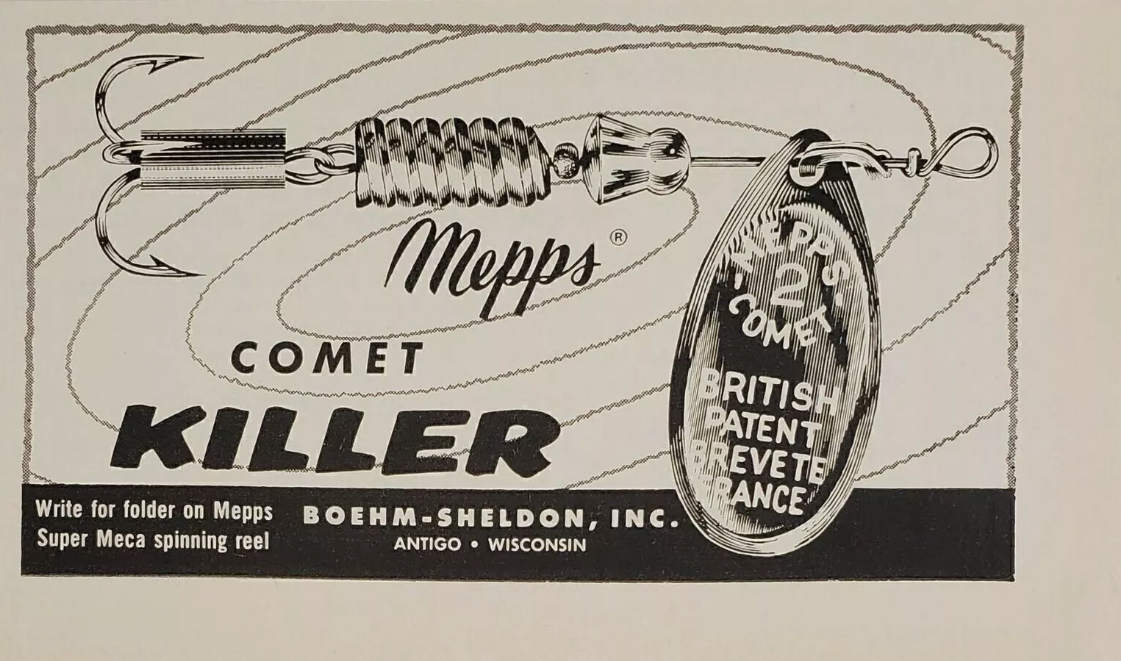
Also, we’re not certain of the year that the famous Mepps catalog first entered the field. As mentioned above, Mike believes it may have been in or around 1960, and they may indeed have released a catalog in that year, but I have yet to uncover an example of one. The first catalog I’ve actually seen is catalog No. 12, from 1961/62, which lists the company as Boehm-Sheldon Inc. Interestingly, the first ad I’ve been able to find that mentions a catalog is one from 1963, with Sheldons’ Inc. as the company name. The text reads, “Send for free colored catalog.” Prior to that, in 1962, an ad with Boehm-Sheldon Inc. reads “Write for folder in Mepps Super Meca spinning reel” but makes no mention of a catalog. Mike told me that he believed that prior to color catalog printing, the company probably relied on “posters, easels, and brochures” to promote their inventory. Bottom line: there’s a little confusion concerning dates and cross-over between full catalogs and other promotional material, that I’m still trying to work out.
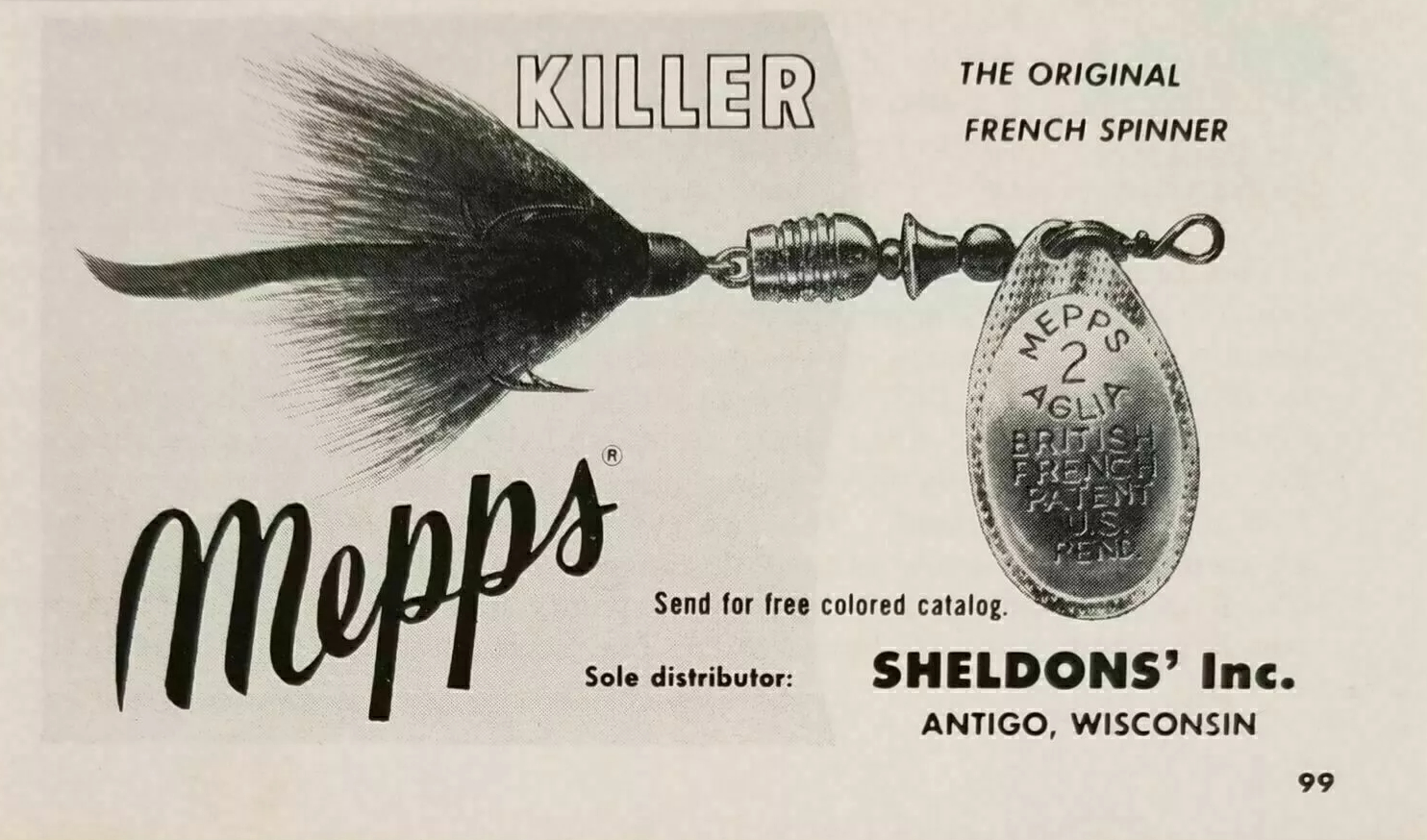
So, thus far we know for sure that catalog No. 12 (1961/62) exists. The jury is still out on any catalogs existing prior to that. The next catalog we know for sure exists is the one we’re highlighting in this article, catalog No. 65, from 1965. I assume that there were catalogs in 1963 and 1964, but until we can prove it one way or another, that will remain an assumption.
Let’s move on to this 1965 Mepps catalog. It’s a short catalog, by today’s standards, with only 20 pages, including the front and back covers. And of those 20 pages only six showcase lures, five of which are Mepps spinners and one which is a spinner called the Calico Cat, made by another company. The Mepps lures include the Aglia, Comet, Aglia Long, Giant Killer, and Musky Killer. Each lure page shows a few sizes and configurations of each model, with blade color and dressed or plain hooks being the main options within a size category. That’s slim pickings compared to today’s Mepps catalogs, which show literally hundreds of blade and tail colors to choose from. But frankly, I find the minimalistic layouts in these older catalogs extremely attractive and even better at selling me on the lure than I do with the layouts in modern Mepps catalogs. Less is more, and lures sparsely depicted seem to carry more weight, figuratively speaking, and impact than 50 or 100 thumbnail-size lures in every conceivable color on a page. I get why current catalogs show large numbers of lures, and it is fun to have a big selection to choose from. Here’s my suggestion to Mepps: Publish a catalog that combines both the old style and the new, with half the catalog replicating the old style and the other half piggybacking on those pages by showing all available color combinations. How fun would that be?! That’s my nickel’s worth of opinion anyway.
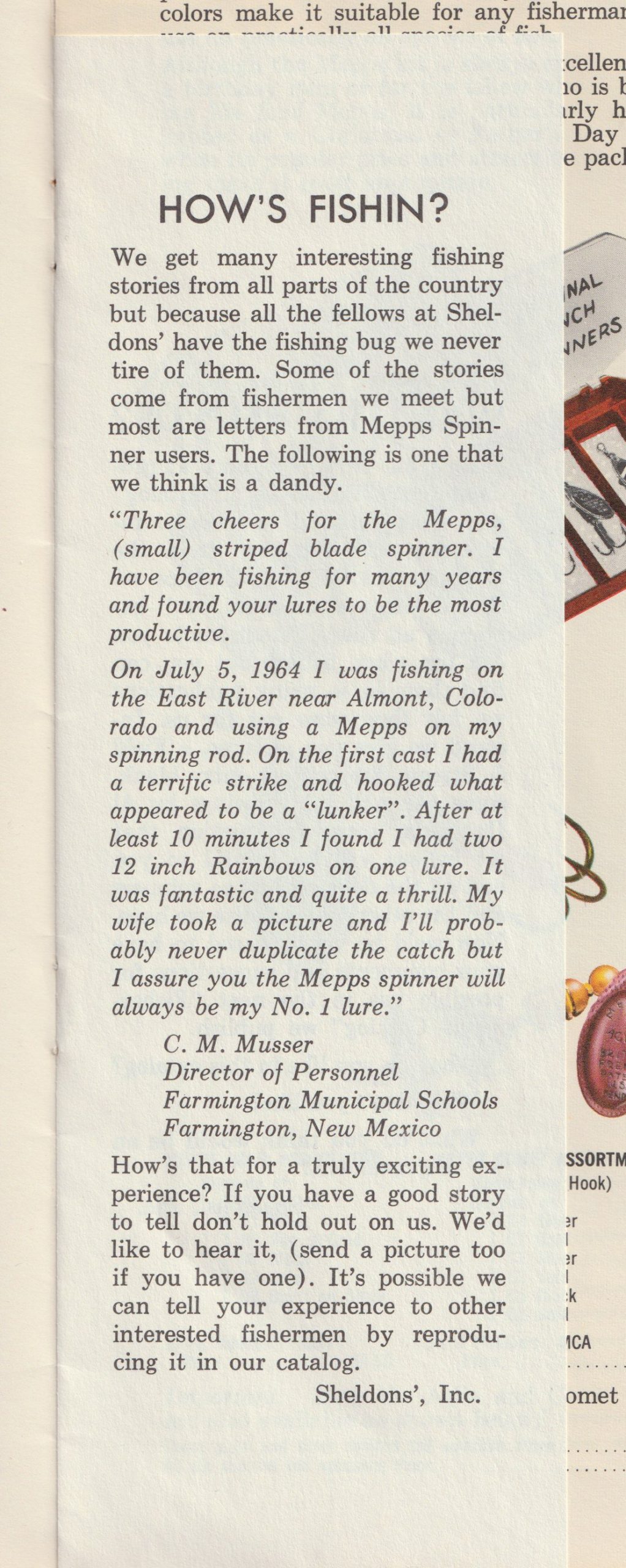
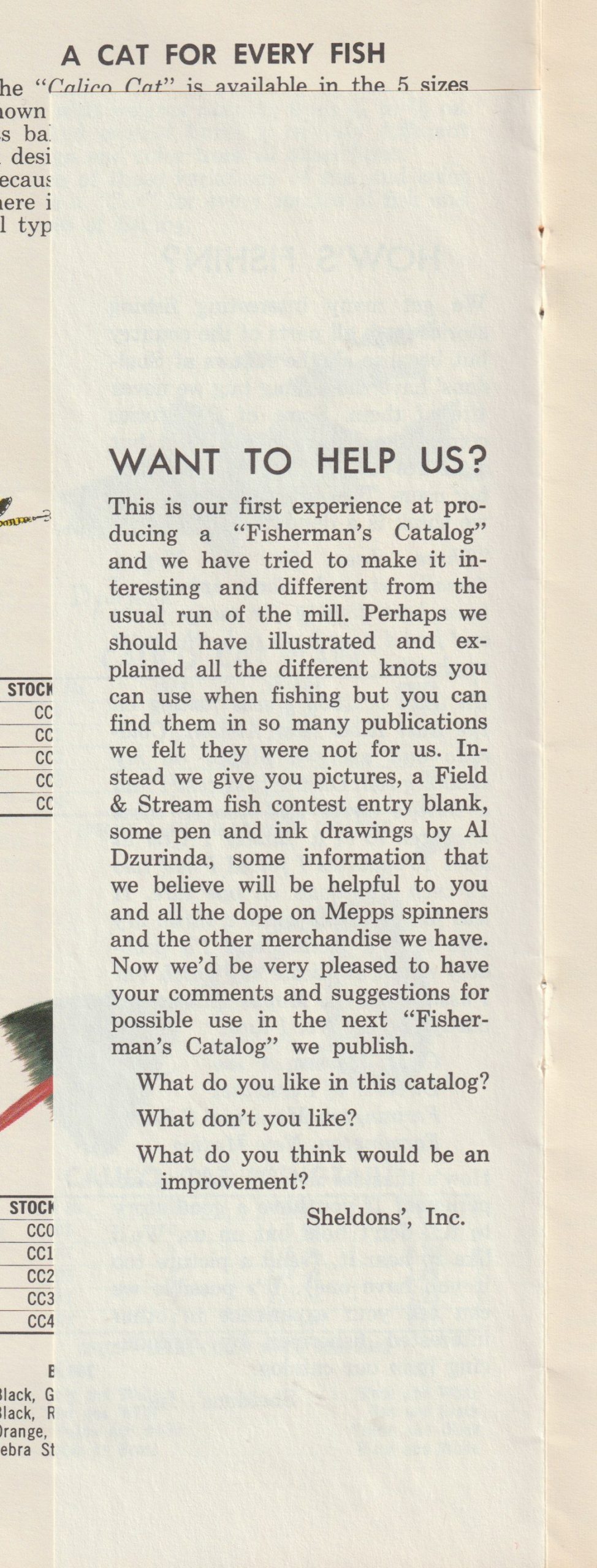
A few other things are worth noting in this 1965 Mepps catalog. One is the slim, two-sided insert between pages 8 and 9. One side shares a story of a fisherman hooking two trout at the same time on a Mepps spinner, and a request for more stories from successful anglers. The other side has a message from Sheldons’ revealing that this is their first “Fisherman’s Catalog,” and a request for angler opinions on how to make the catalog better. I assume, from this statement, that this was the first catalog the company produced that was more than a simple listing of products. It was also a celebration of successful anglers, how-to information and tips, a contest entry form, some art work, and a lot of angler photos. In other words, it was a catalog with personality, and the format they created with this catalog would become the Sheldons’ Mepps standard catalog format from here on.
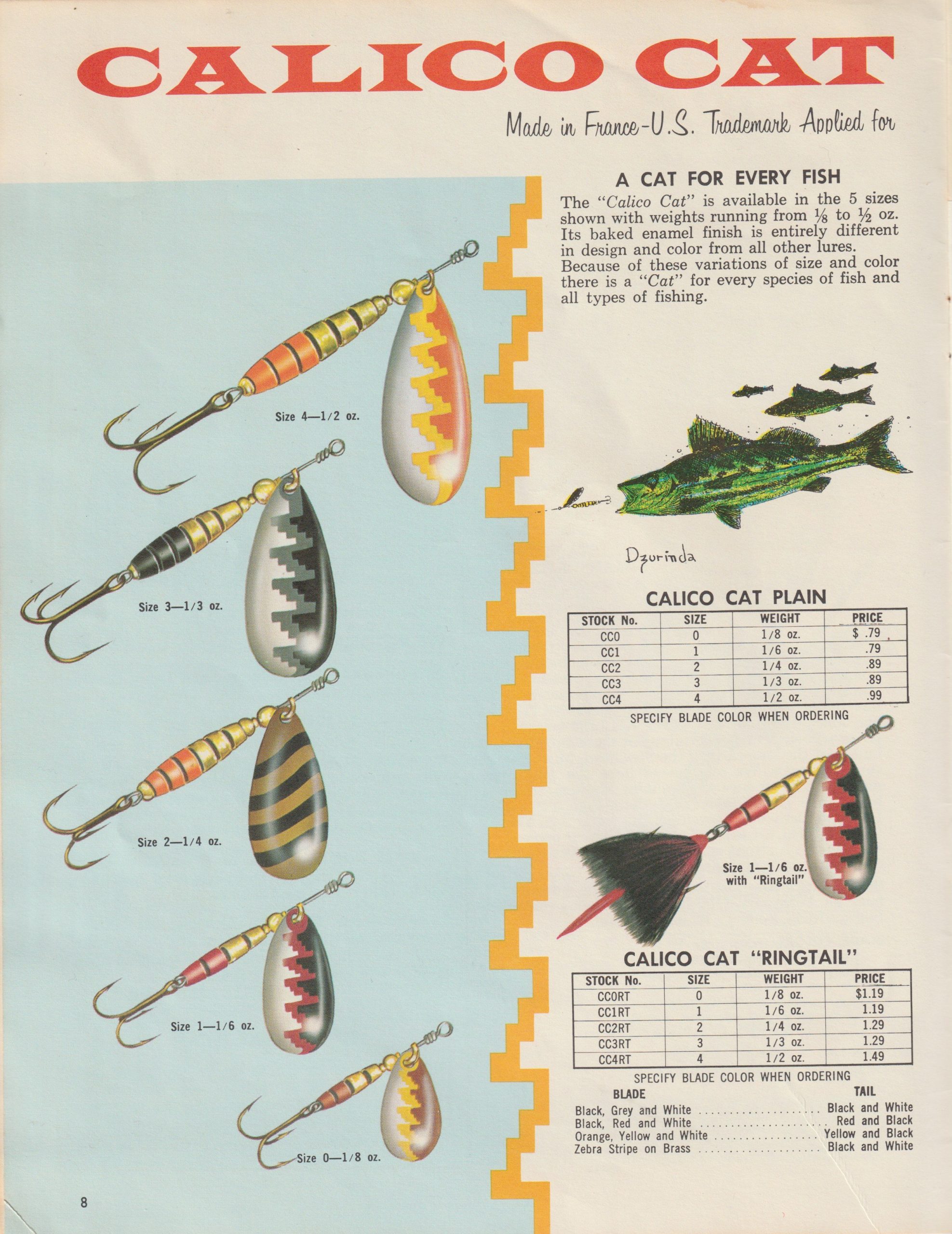
Another noteworthy catalog entry is the page advertising Calico Cat spinners. The Calico Cat was not a Mepps spinner. It was one of the non-Mepps spinner products that Sheldons’ Inc. sold in their early years, along with the Tornado Shotgun Cleaning Brush and various Lion D’Or hooks. Mike Sheldon told me that he believed that the “Calico Cat was a spinner sold by the Cannelle Company. That was the company that we bought our fish hooks from. The [Calico Cat] lure had beautiful designs and paint jobs, but not the quality of Mepps. I think the Tornado gun brushes were also a Cannelle product. My dad offered to try to sell Cannelle hooks to other companies here in the U.S. I remember him talking about calling on other manufacturers and selling hooks to them. At some point he said he had orders for over a million hooks. That was a big deal at the time. The Cannelle company failed to deliver the first hook. As Mepps became more important the various Cannelle products were discontinued.”
I have found a contemporary company – Fishing-Lures Outlet Shop – located in Oklahoma that sells the Calico Cat spinner. I’ve also found online a 2019 Cannelle Fish Hooks International Catalog. Mike recalls that around 20 years ago the VMC hook company purchased Cannelle, and it appears that both Cannelle and VMC share the same zip code in Morvillars, France. He also said that “The Cannelle name has always been associated with quality.”
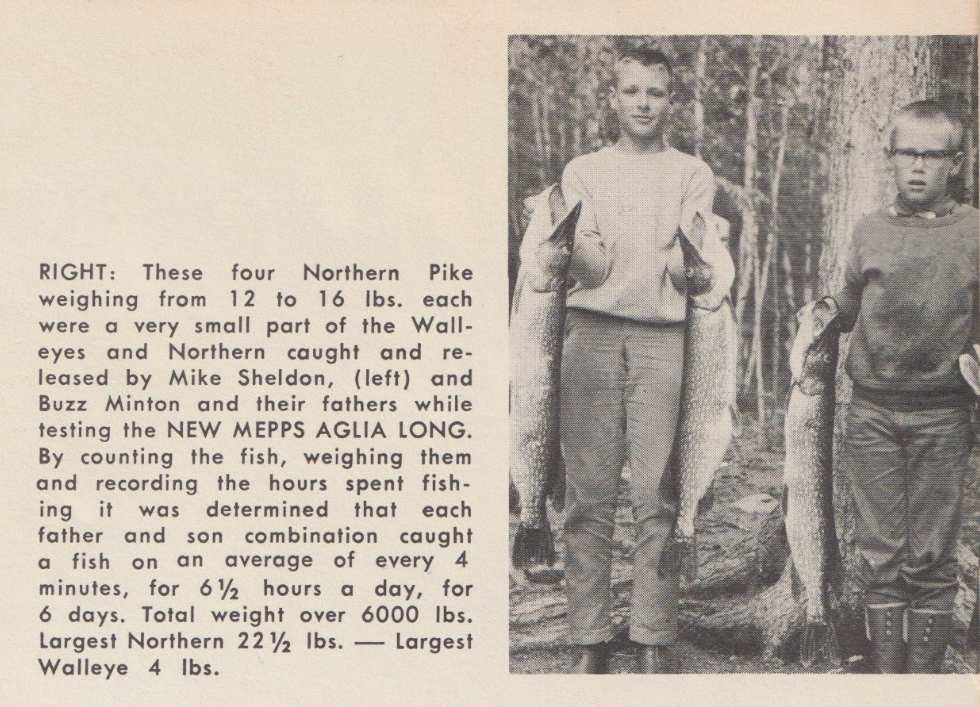
There are also a couple of photos that stand out among the many in this catalog. One is on page 2 and shows the original creator of the Mepps spinner, Andre Meulnart, “Mr. Mepps,” clad in waders and holding a spinning outfit. It is a great image that I had not seen before. The other photo is at the top of page 5, which begins the catalog’s “Fishing Tips” section, and shows a very young Mike Sheldon with a boyhood friend, and Mike is holding a couple of nice northern pike caught on Mepps Aglia Long spinners.

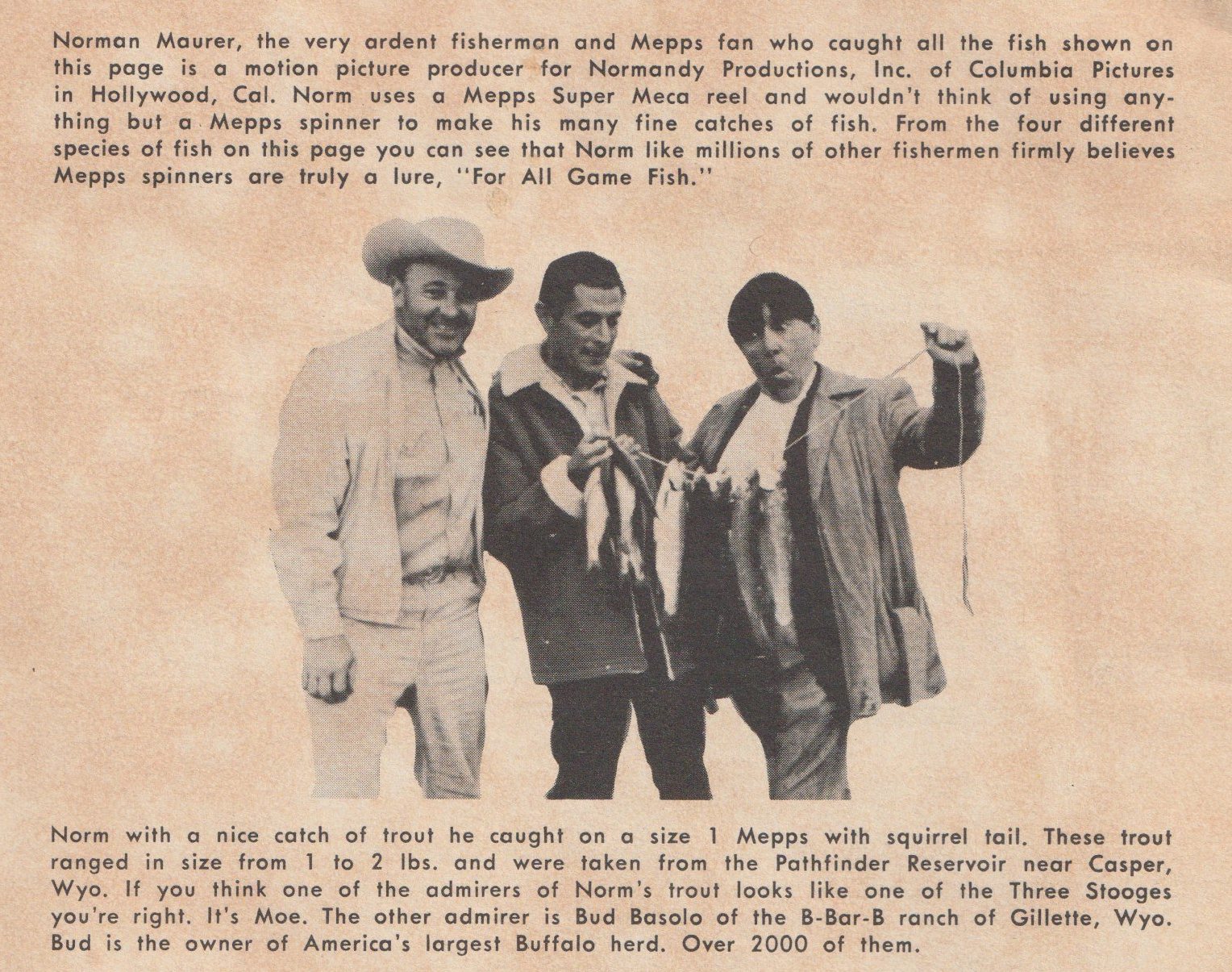
Adding a bit of trivia, there’s an interesting series of photos on the back cover featuring Norman Maurer, a Hollywood director and producer, cartoonist and writer, holding fish caught on Mepps lures. In the photo below, Maurer is in the center, with a mugging Moe Howard of Three Stooges fame on the right. Maurer was perhaps best known for his professional and personal association with The Three Stooges, having produced and directed several Stooges films in the 1960s and marrying Moe Howard’s daughter Joan.
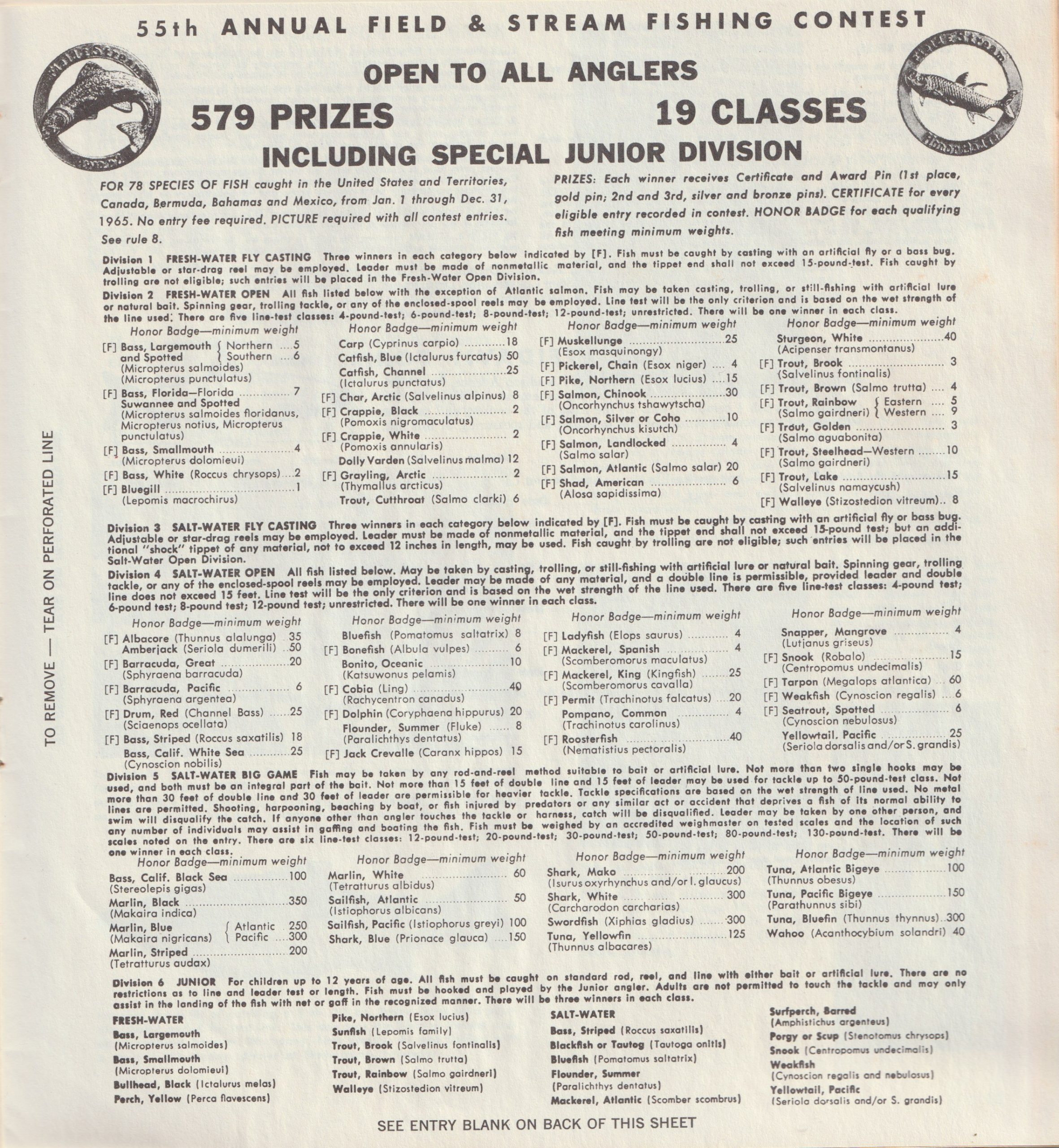
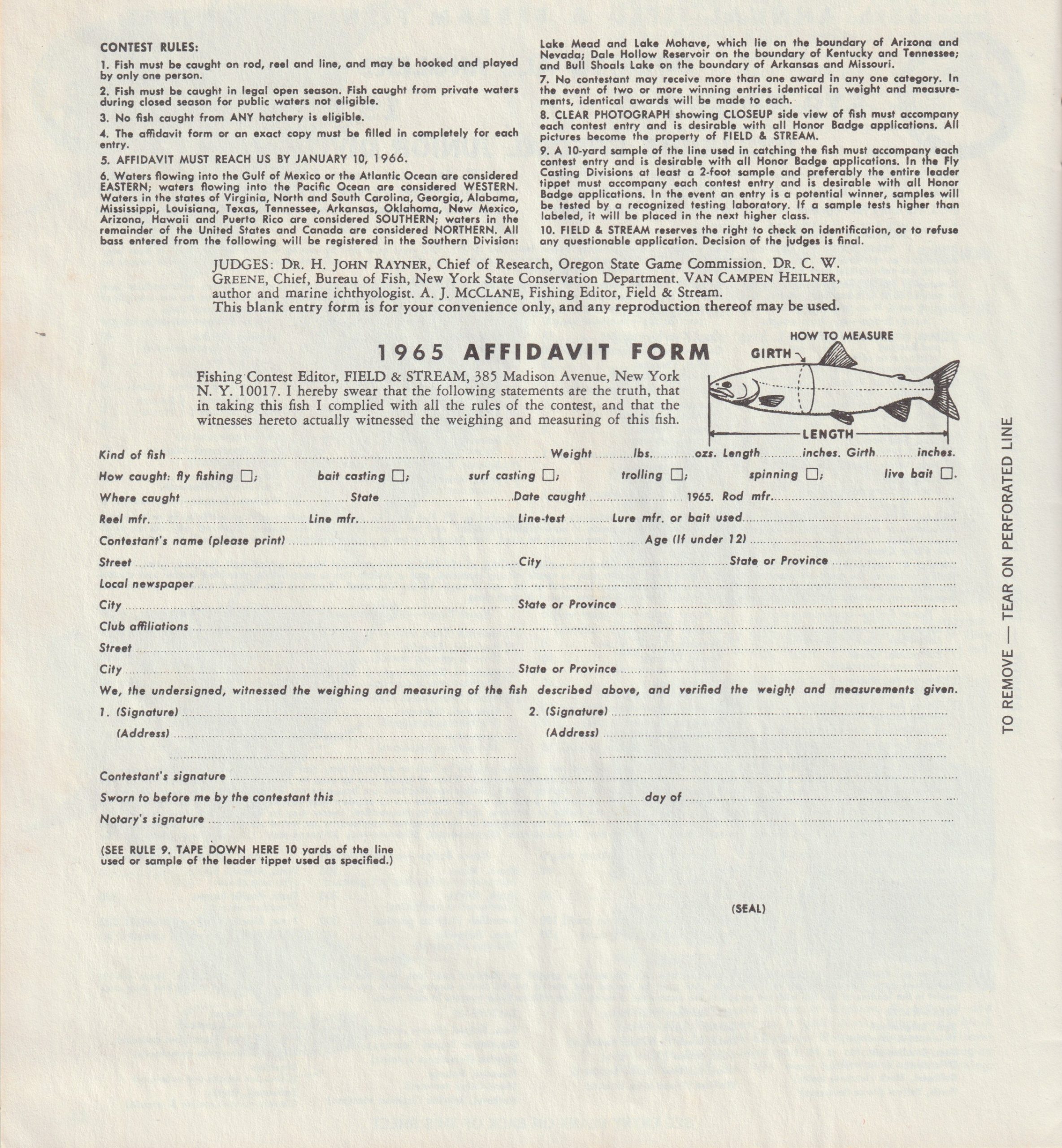
There is also included in this catalog an entry form and affidavit for the 55th Annual Field & Stream Fishing Contest. Mepps lures routinely won several prizes in all of the major magazine fishing contests practically every year since they first came into the American market. Including this entry form with the catalog was a stroke of inspiration and just good marketing.
The catalog closes with the famous Mepps call for squirrel tails. Sheldons’ has developed a great relationship and supply system with hunters and anglers over the years, in order to receive millions and millions of squirrel tails. The page not only talks about how important squirrel tails are to Sheldons’ Inc. but also shows a folksy rendering of a treed squirrel and a hunter from featured artist Al Dzurinda, whose drawings are shown throughout the catalog. At the time of this catalog, in 1965, Sheldons’ was using over 100,000 squirrel tails a year to dress their Mepps spinners. Just six years later, in 1971, the company would be using 2½ times that many, over 250,000 squirrel tails per year. And the demand continued to grow.
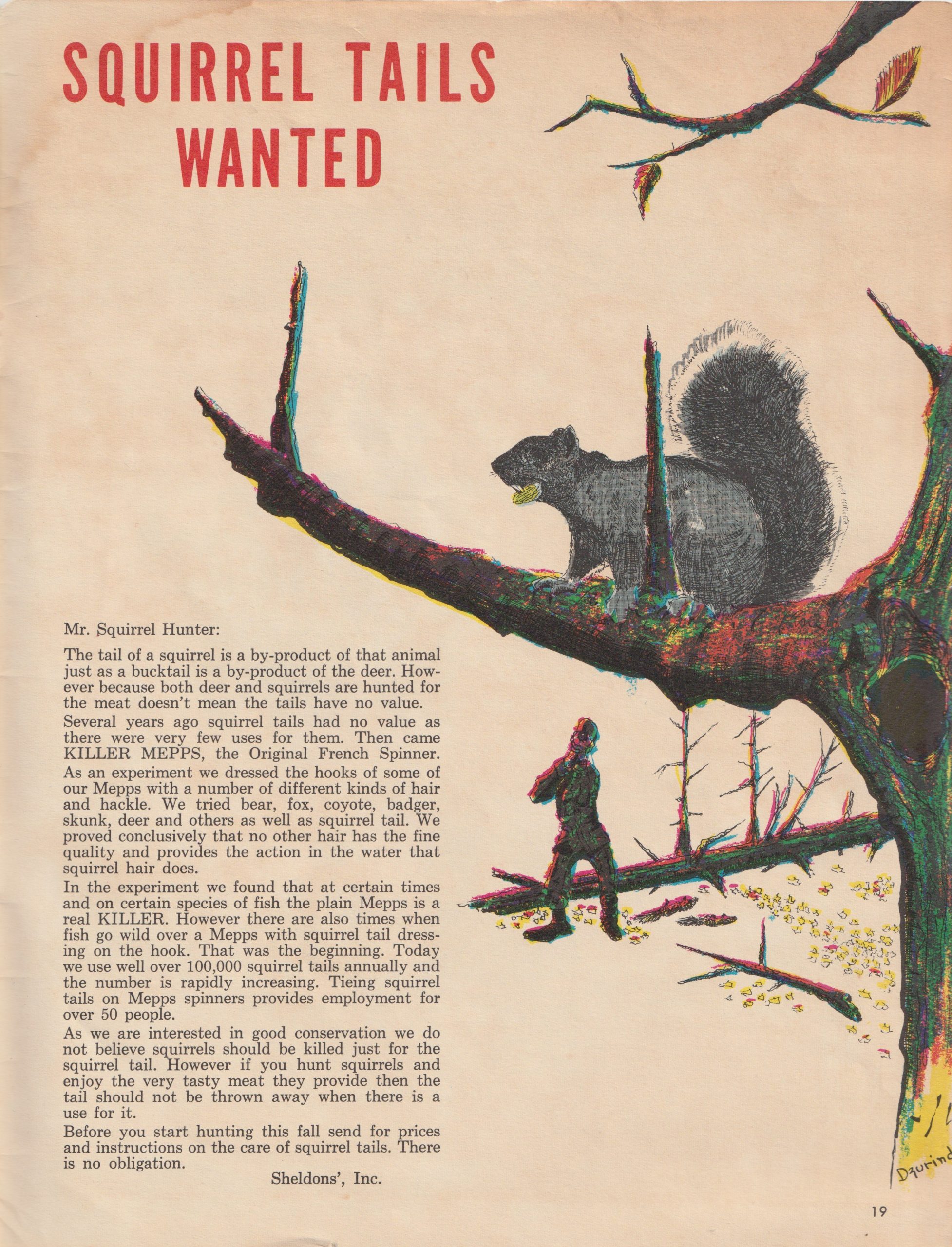
We hope you enjoyed looking into this unusual 1965 Mepps catalog. To page through the entire 20-page catalog just click on the first image below and use the arrows to scroll through it.
GALLERY – 1965 MEPPS CATALOG
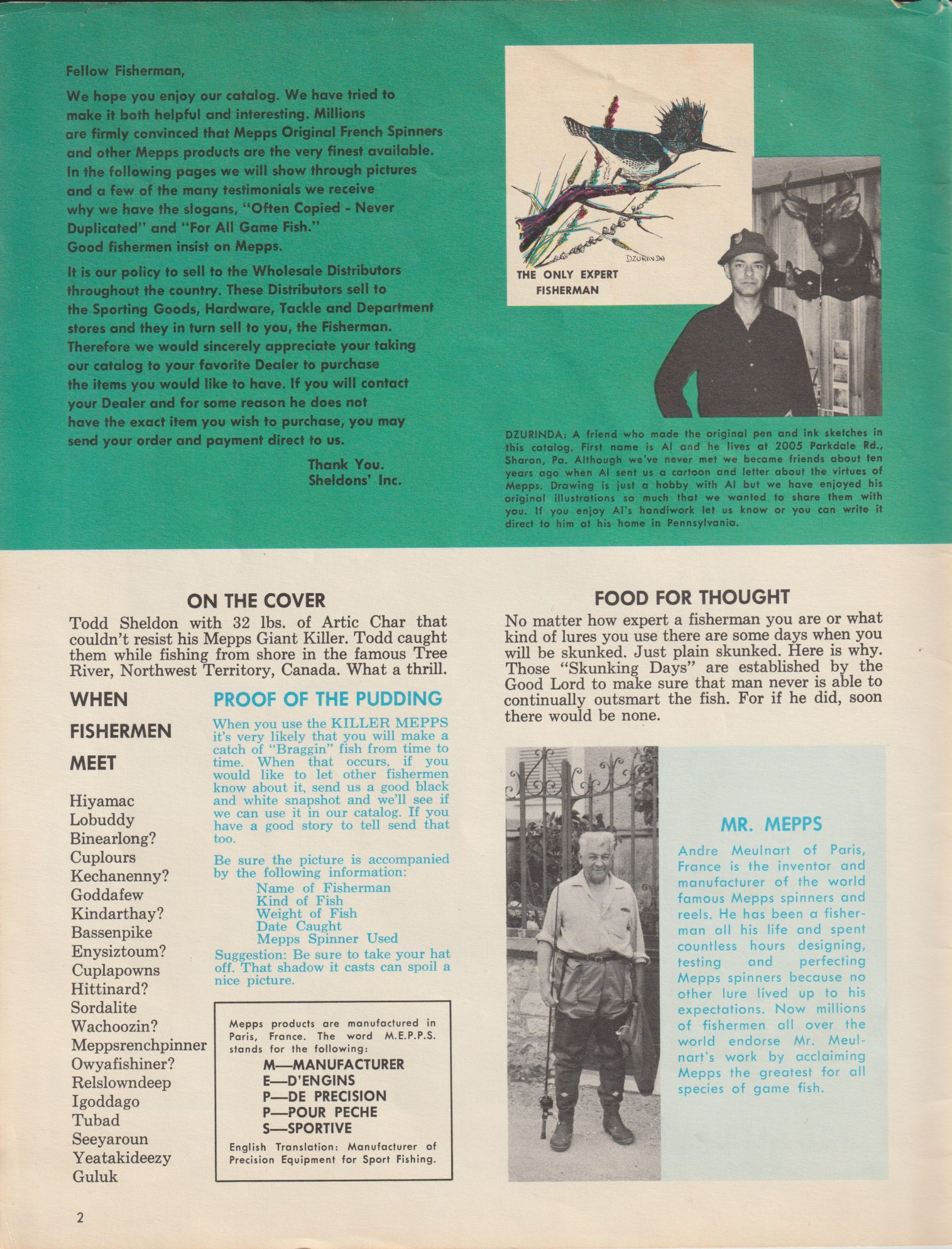
Mepps Catalog No. 65, 1965. Page 2.
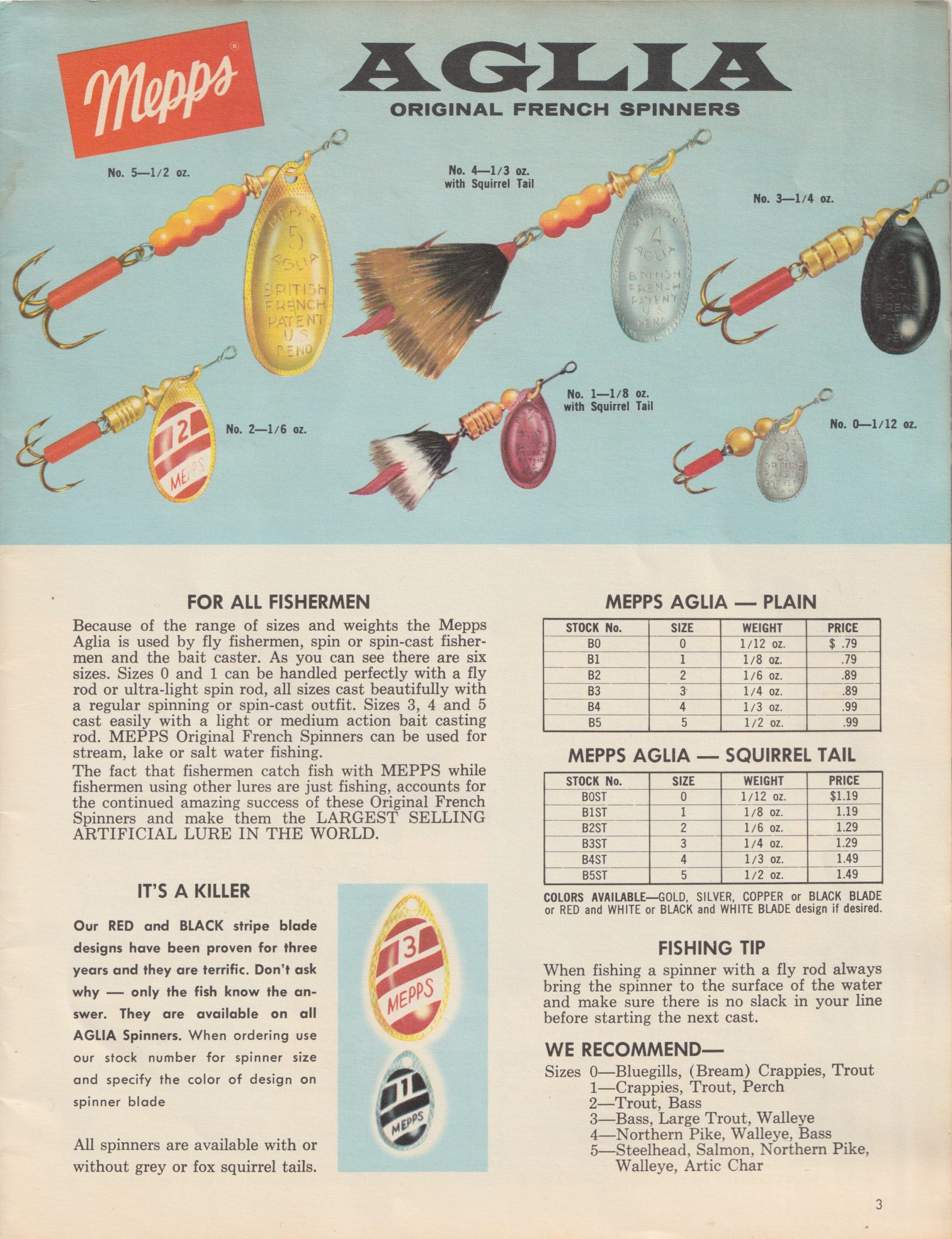
Mepps Catalog No. 65, 1965. Page 3.
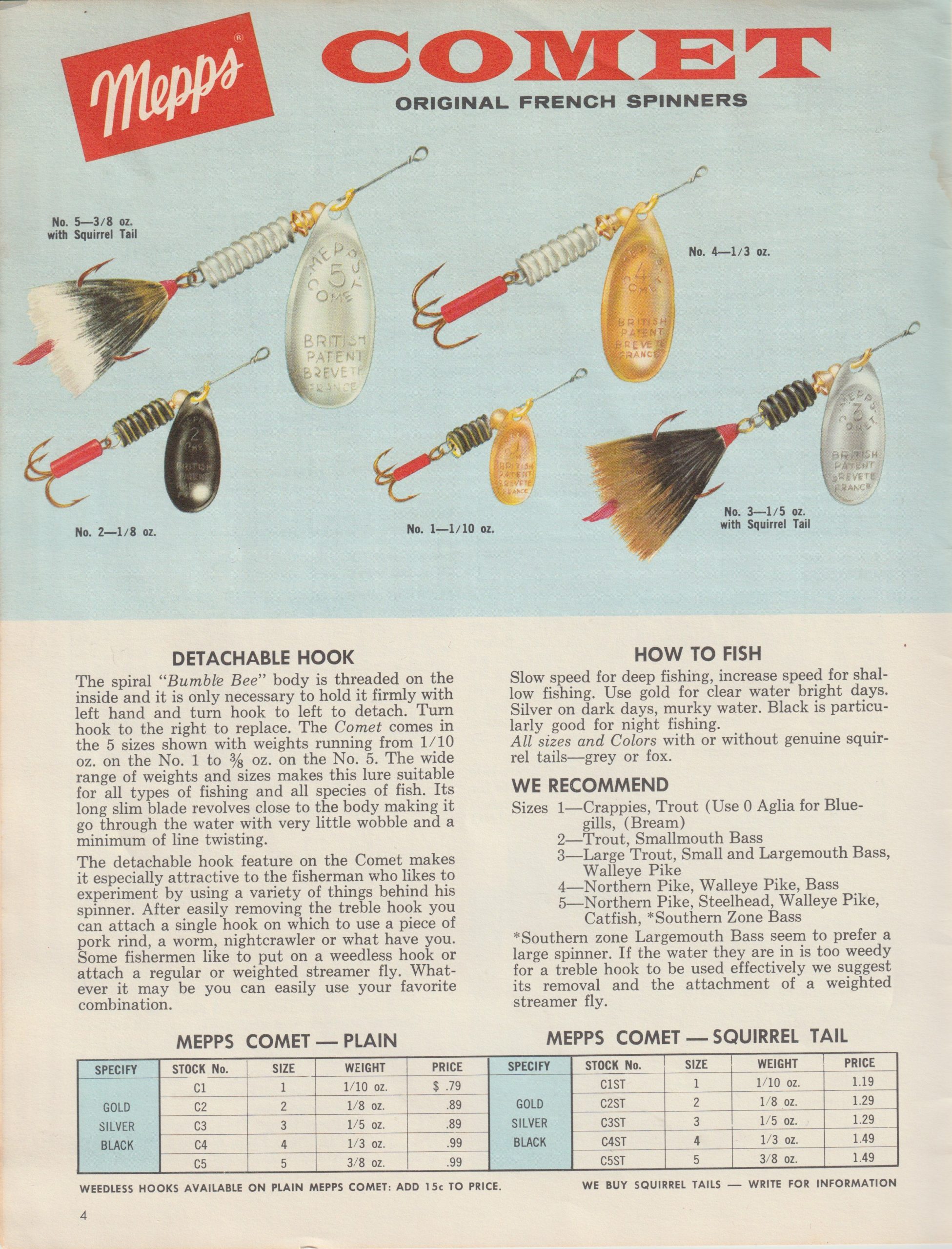
Mepps Catalog No. 65, 1965. Page 4.
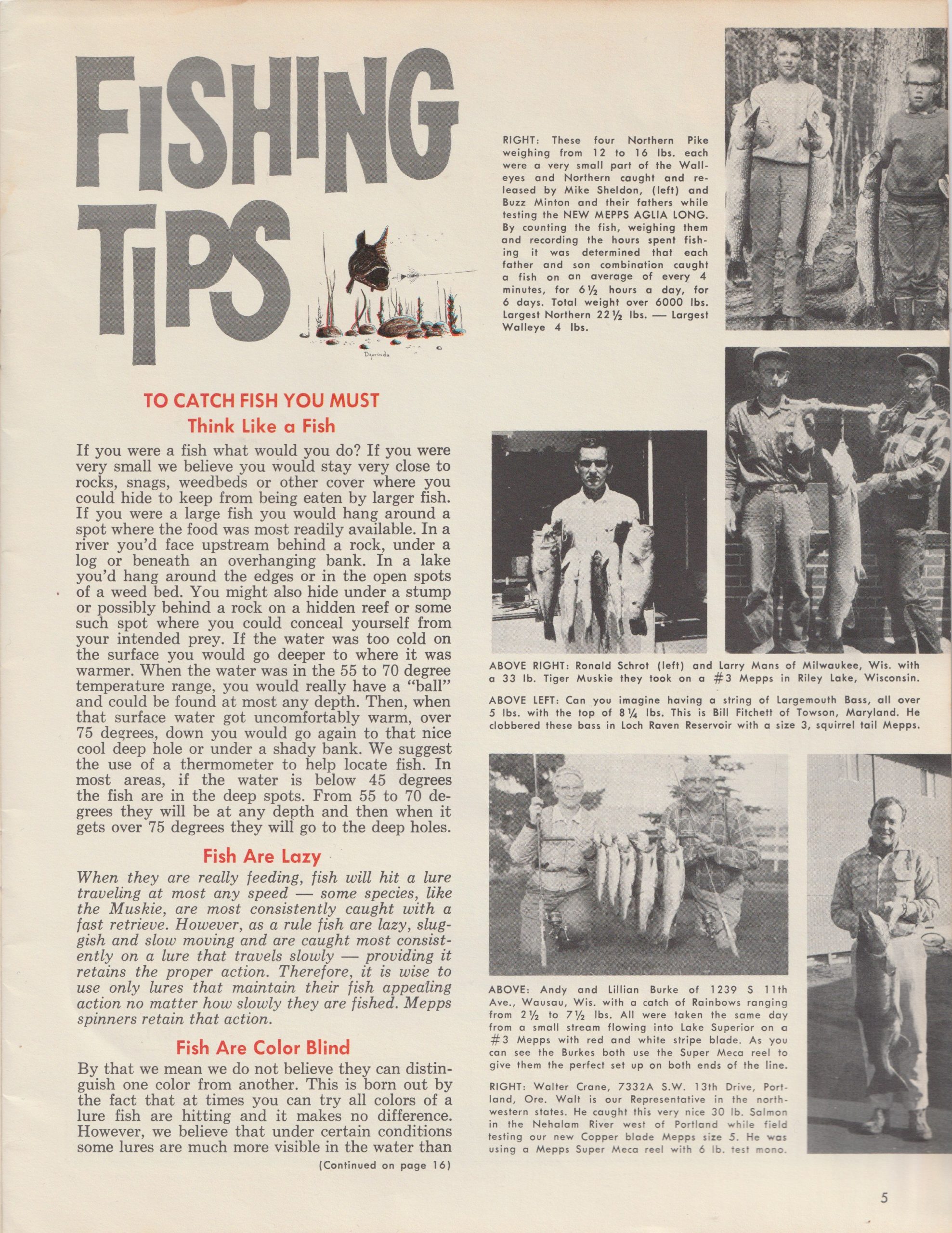
Mepps Catalog No. 65, 1965. Page 5.
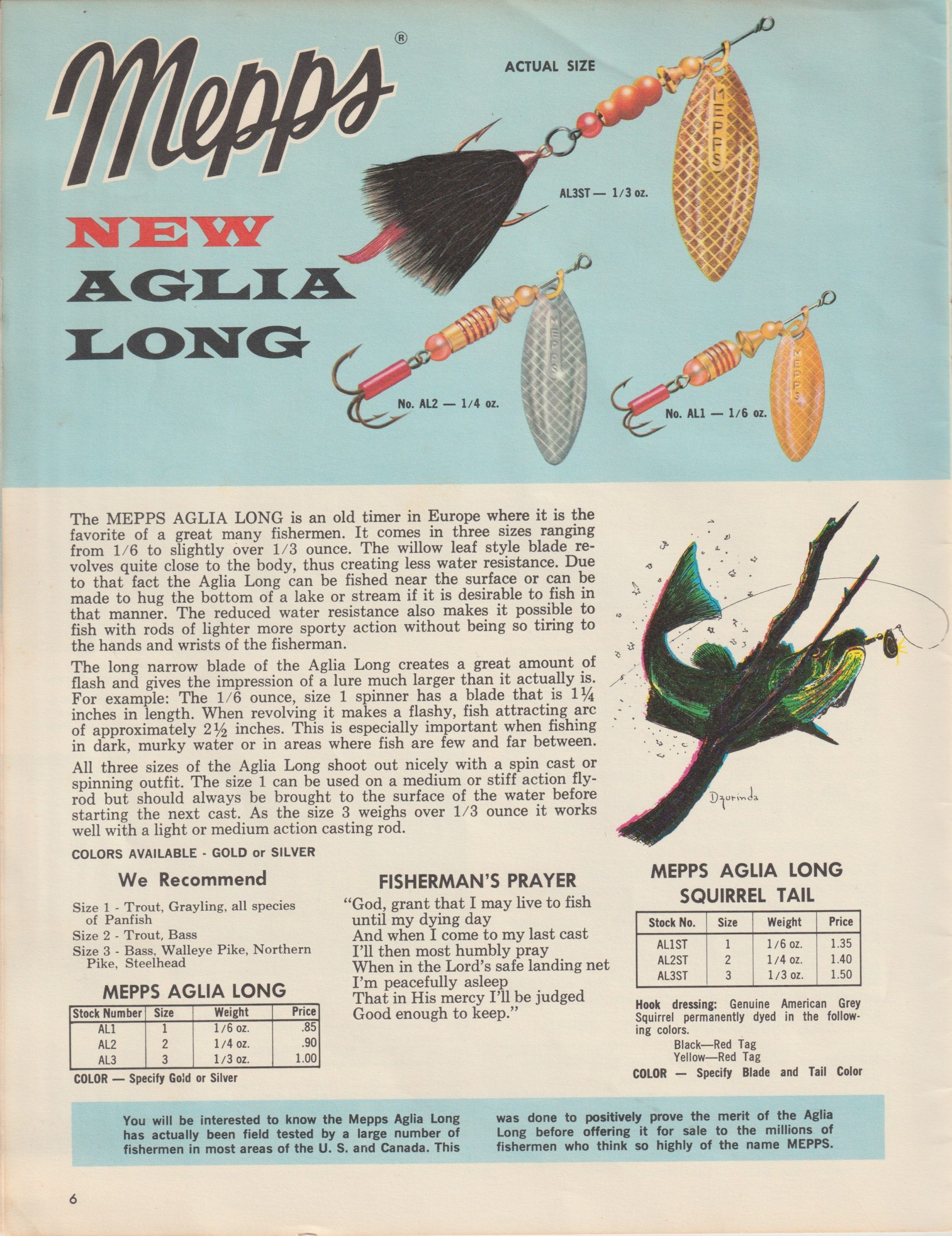
Mepps Catalog No. 65, 1965. Page 6.
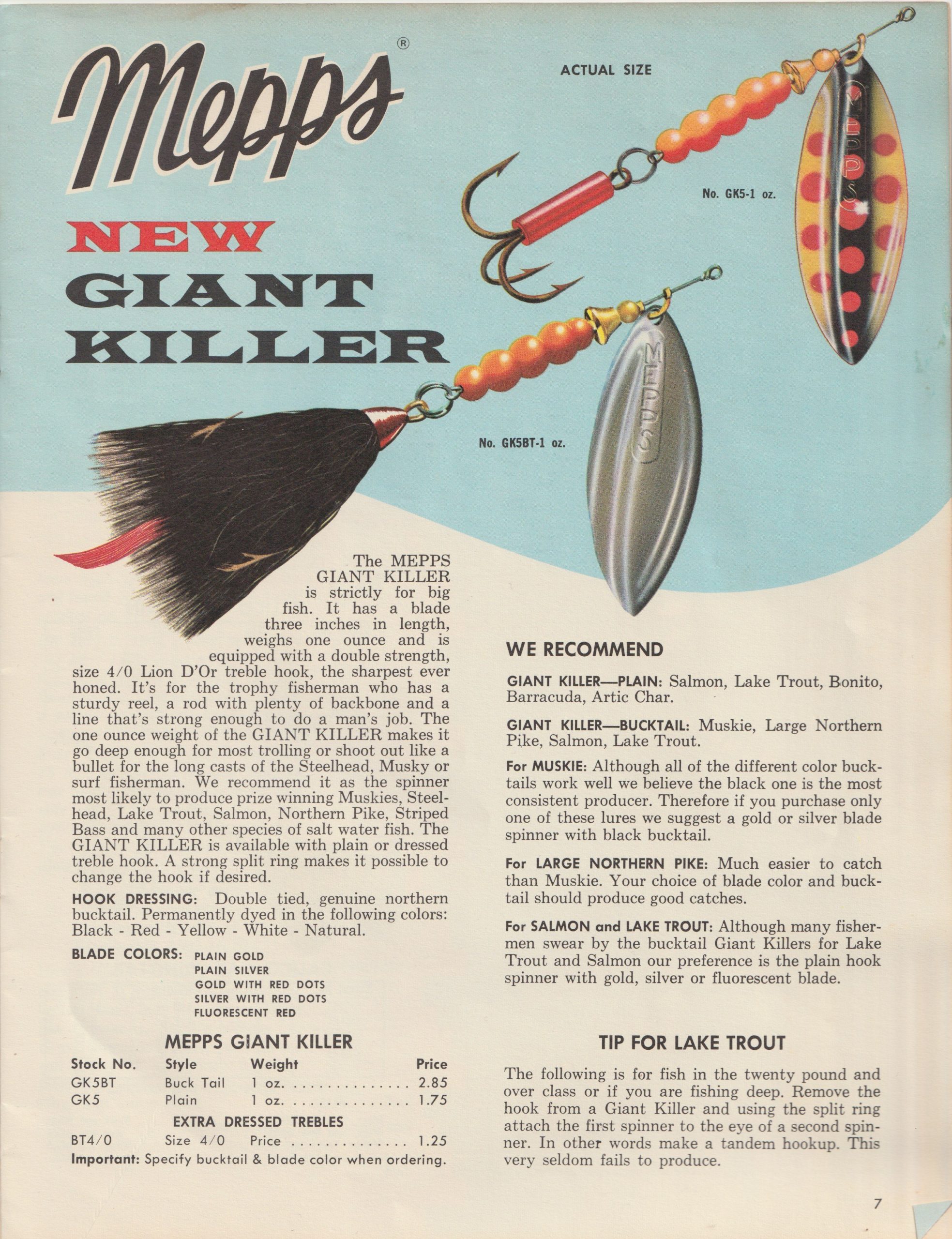
Mepps Catalog No. 65, 1965. Page 7.
Mepps Catalog No. 65, 1965. Page 8.
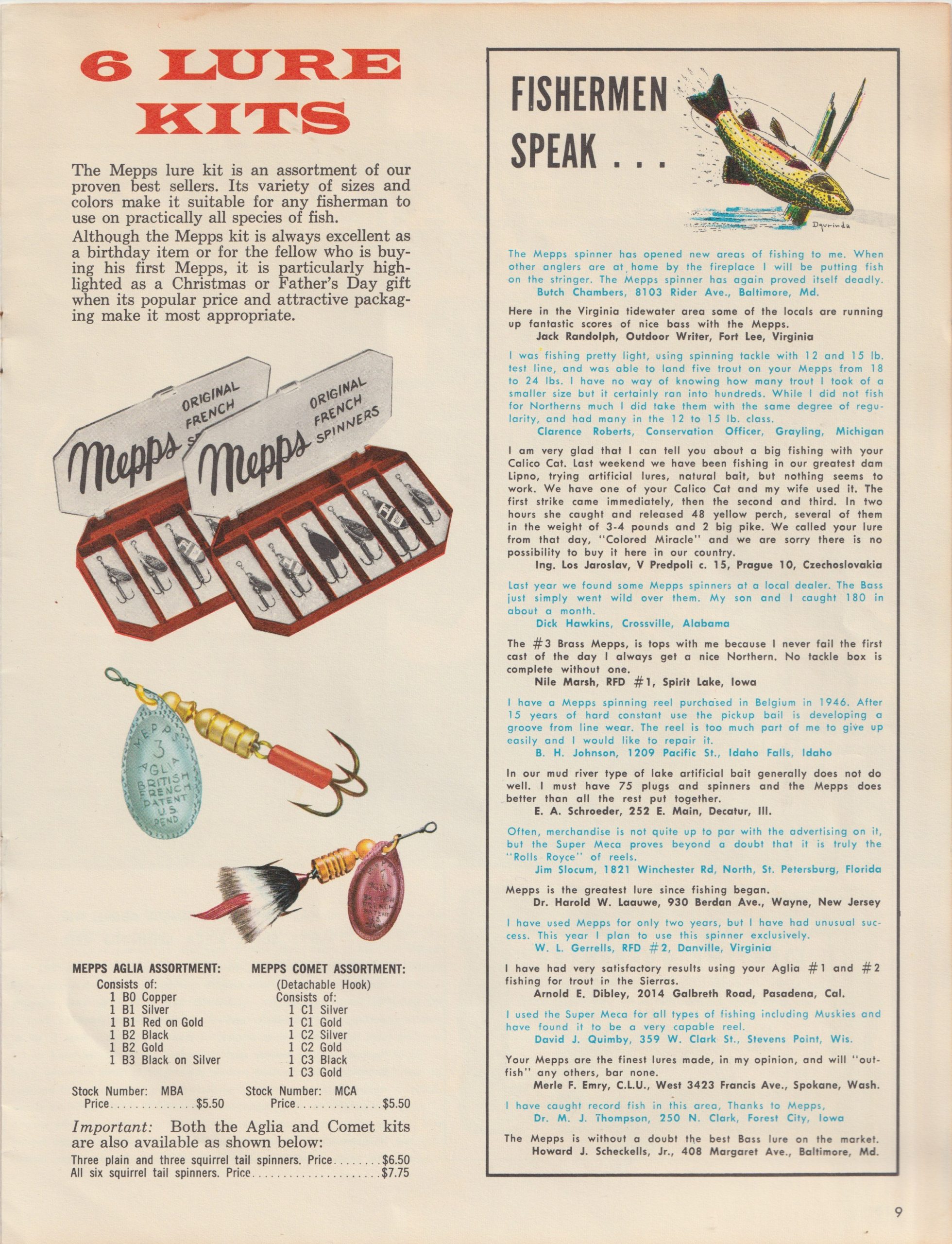
Mepps Catalog No. 65, 1965. Page 9.
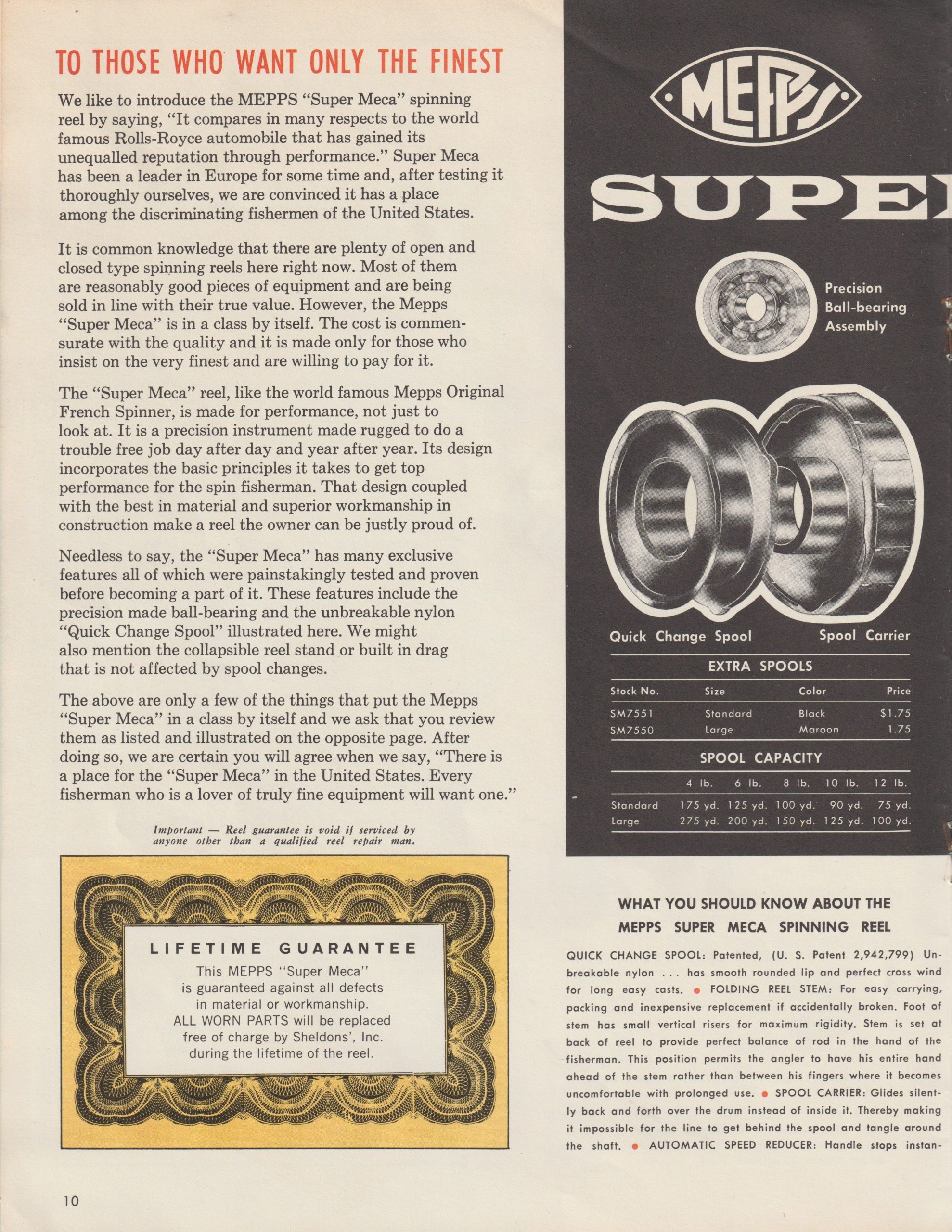
Mepps Catalog No. 65, 1965. Page 10.
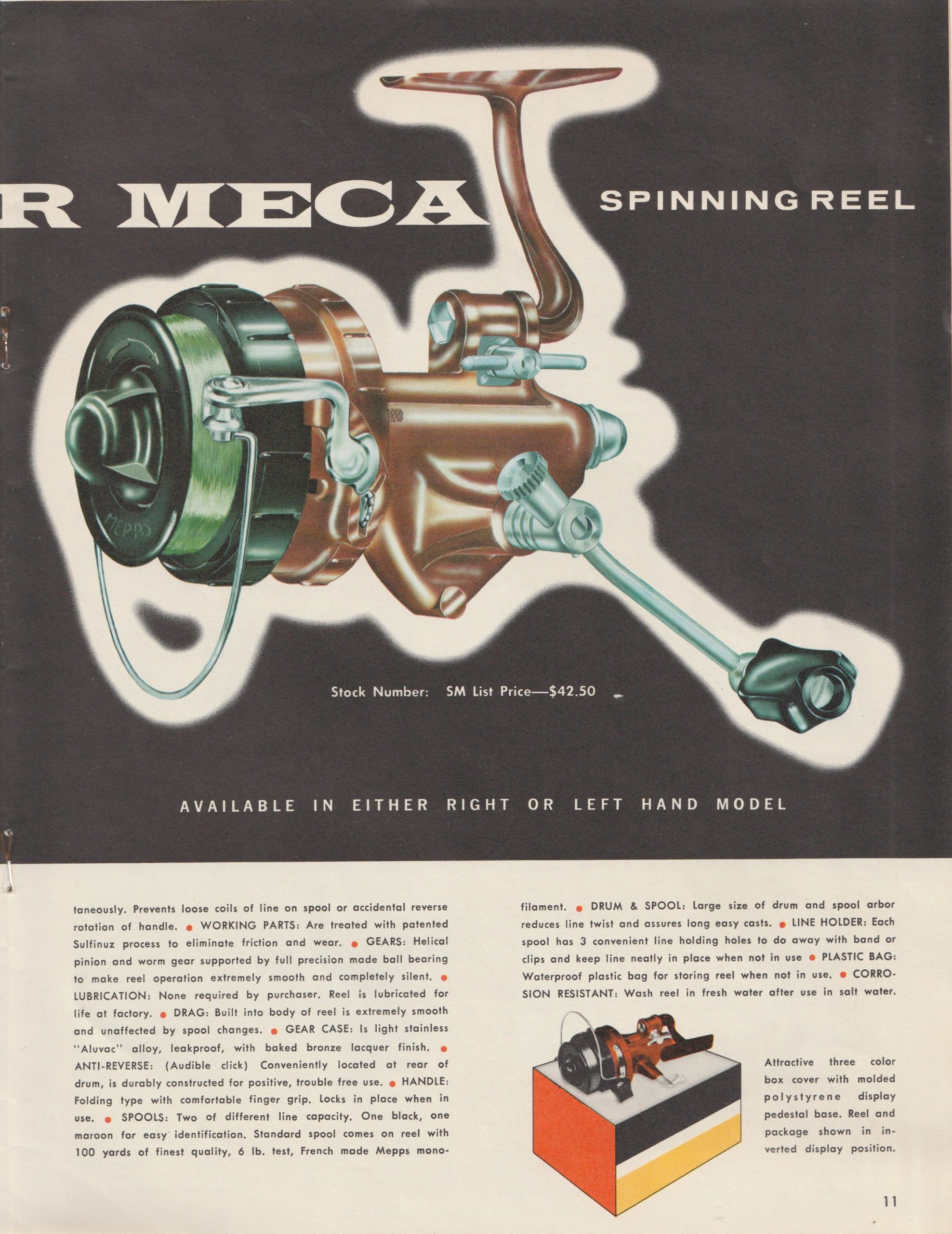
Mepps Catalog No. 65, 1965. Page 11.

Mepps Catalog No. 65, 1965. Page 12.

Mepps Catalog No. 65, 1965. Page 13.
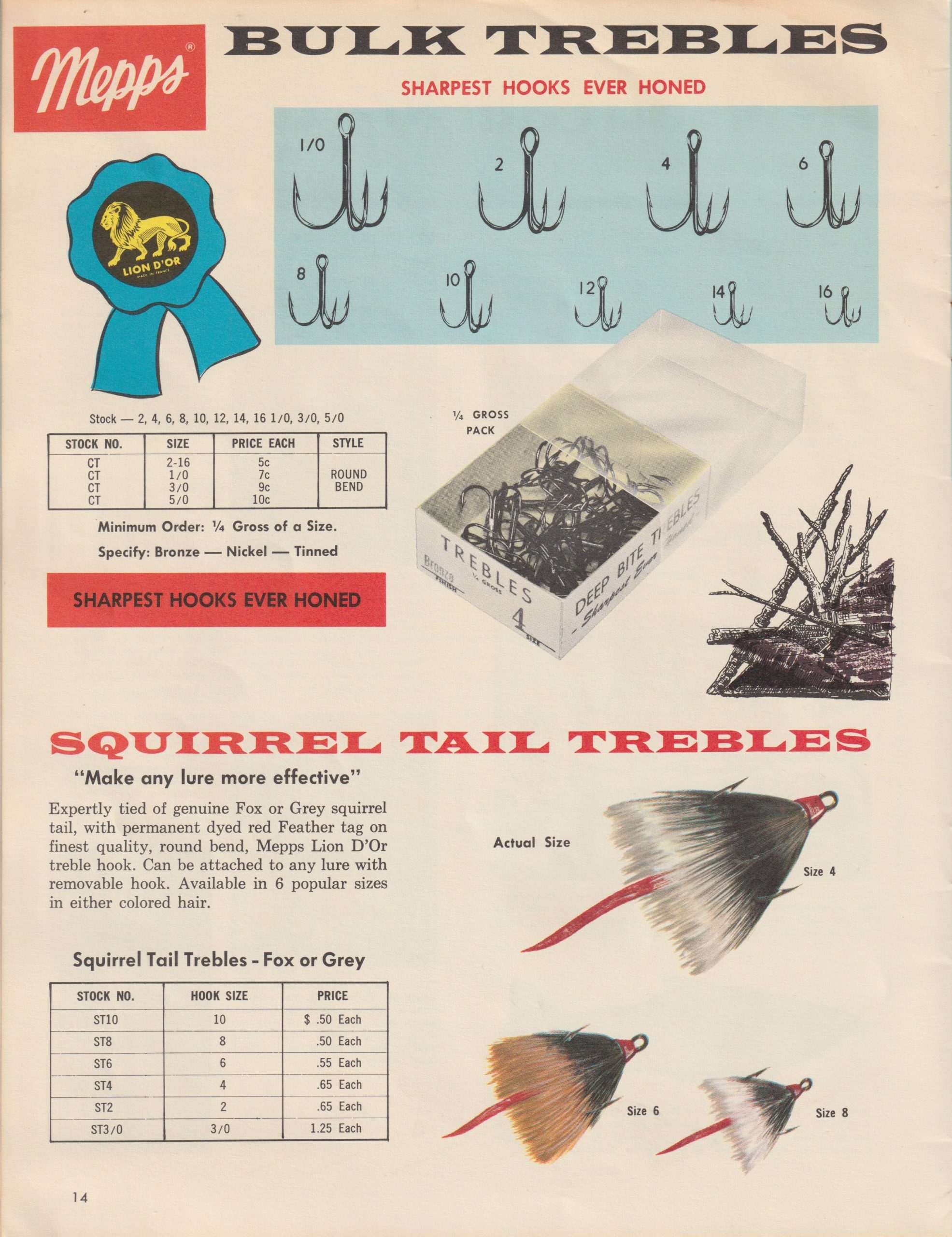
Mepps Catalog No. 65, 1965. Page 14.

Mepps Catalog No. 65, 1965. Page 15.
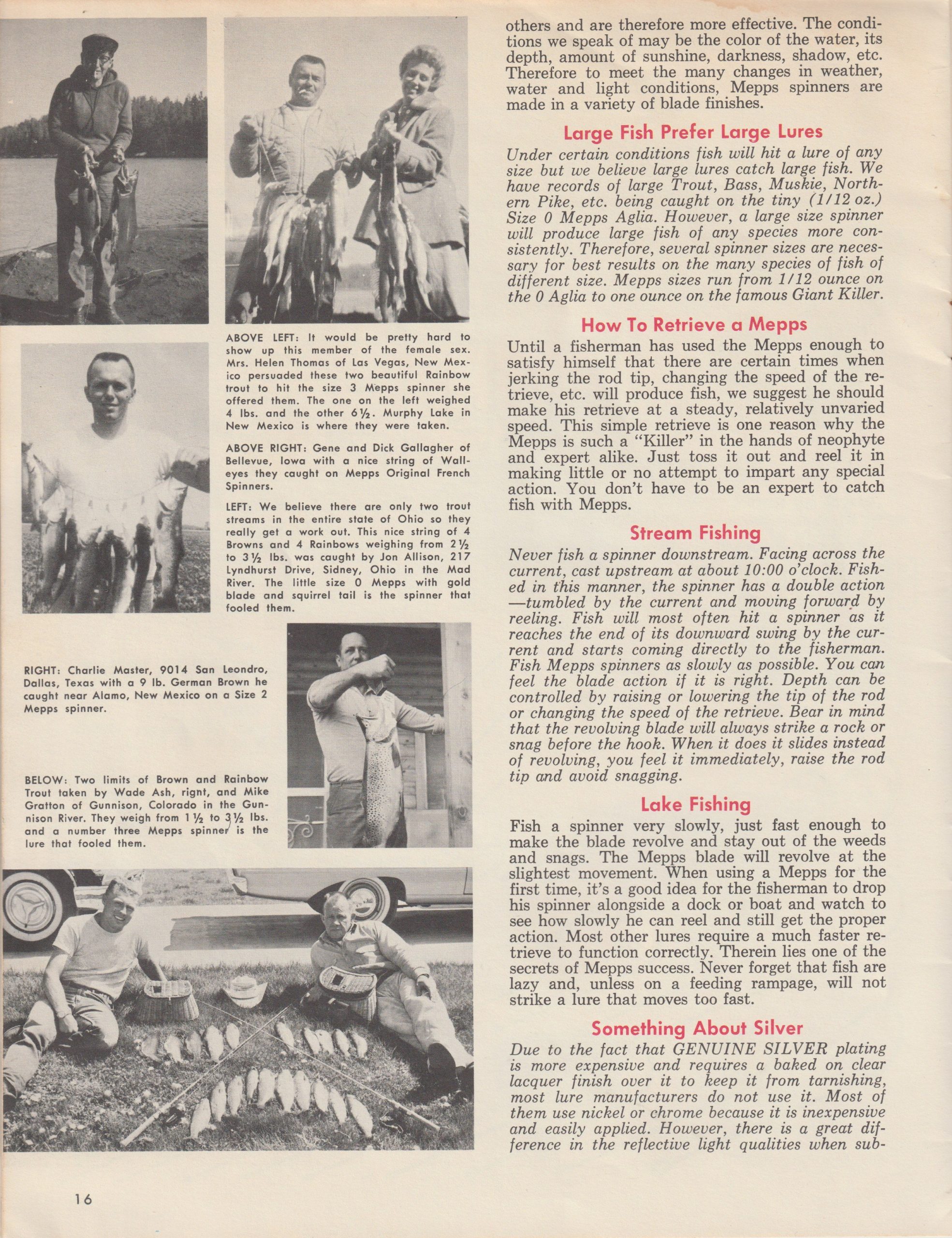
Mepps Catalog No. 65, 1965. Page 16.
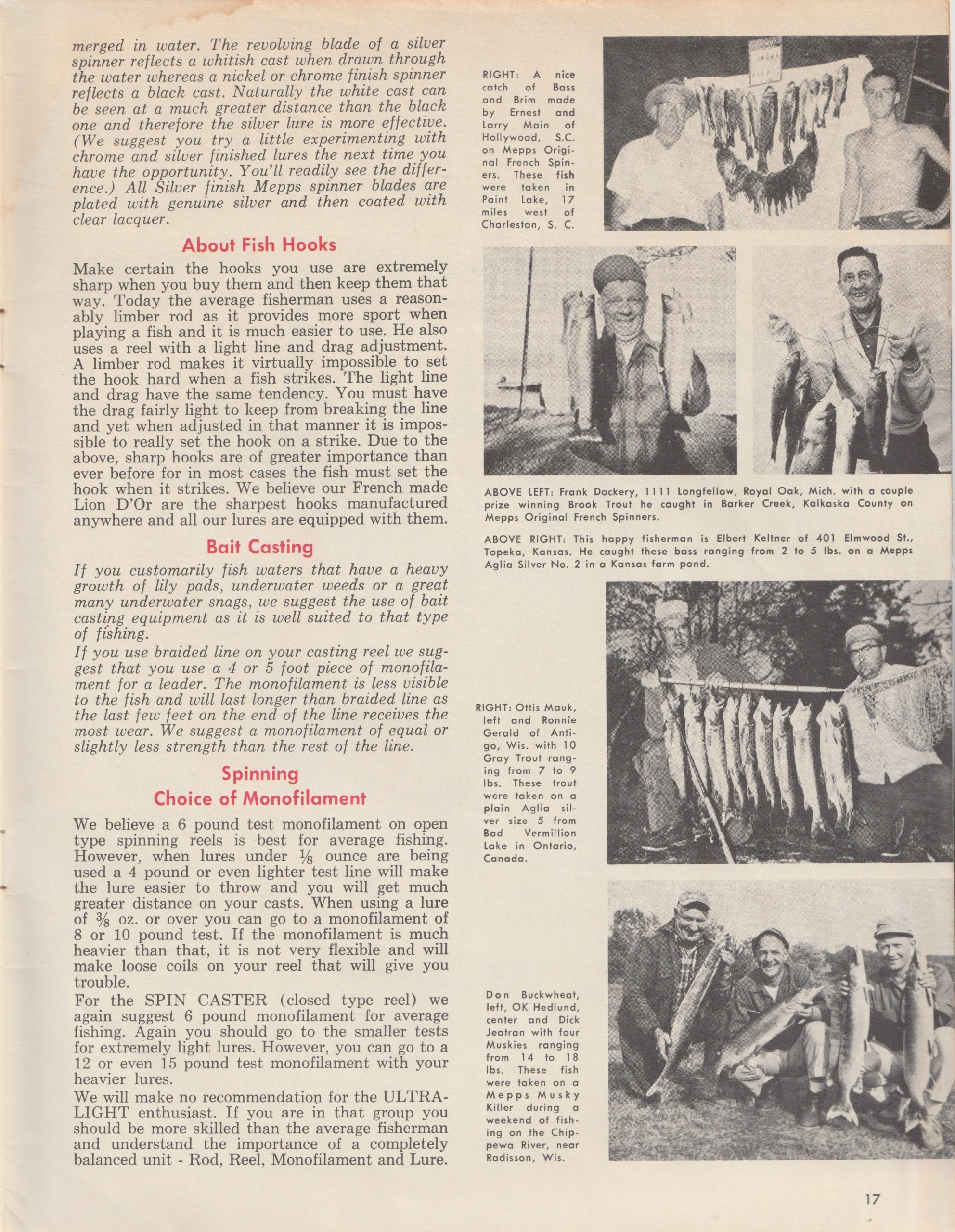
Mepps Catalog No. 65, 1965. Page 17.

Mepps Catalog No. 65, 1965. Page 18.
Mepps Catalog No. 65, 1965. Page 19, inside back cover.

Mepps Catalog No. 65, 1965. Back cover.