

Today, in 1952 Eppinger Dardevle Brochure, we’re going to look at a rare mid-20th century fold-out promotional pamphlet from the Eppinger Manufacturing company or, more accurately, the Lou J. Eppinger company. This is an interesting brochure because it appears to come directly from the desk, so to speak, of founder Lou Eppinger. It’s a short brochure or catalog – only 12 pages, including front and back covers – so let’s go through it page by page.
The front cover page shows the inside of a wooden boat, with nine or ten big northern pike lying along the bottom and on the seats. The title text reads, “Dardevle…the wiggling, wobbling fish-getting lure!” The text balloon underneath that text shows a Dardevle with the words, “Part of a catch of 56 northern pike – 15 to 22 lbs. each – caught on genuine Dardevles.” 56 northern pike weighing 15 to 22 pounds…that is incredible. But of course we don’t know the whole story or many of the details associated with that catch. Were all 56 pike caught in one outing? From one body of water? By how many anglers? And why are only nine or ten of the pike shown? Oh well, it is indeed an adrenaline-pumping picture and account, what there is of it.
Someone had written 1952 on the cover, which I assume is the date of the publication. The bottom chyron provides the company name, which interestingly reads, “Manufactured by Lou J. Eppinger” along with the address in Detroit, Michigan. I wasn’t certain when the company name changed from Lou J. Eppinger to Eppinger Manufacturing, so I contacted current Eppinger Controller Jennifer Bustamante, who manages the operation of the company. Jennifer told me that Lou retired in the late 1940s but maintained ownership until his death in 1959. During that 10-year period between Lou’s retirement and his passing, Ed Eppinger ran the day-to-day operation. Ed was running the company until Lou’s passing, about 10 years. Jennifer responded to my inquiry, “My mom (Karen Eppinger) said that she remembers only seeing Lou J. a few times when she was around 5 years old. She was born in 1942. So that is why she said the late ‘40’s (for Lou’s retirement). It was in Lou’s will that Ed received the company upon buying out shares of the company from other people that owned them.” Jennifer also said that the company changed its name to Eppinger Manufacturing in the late 1970s.
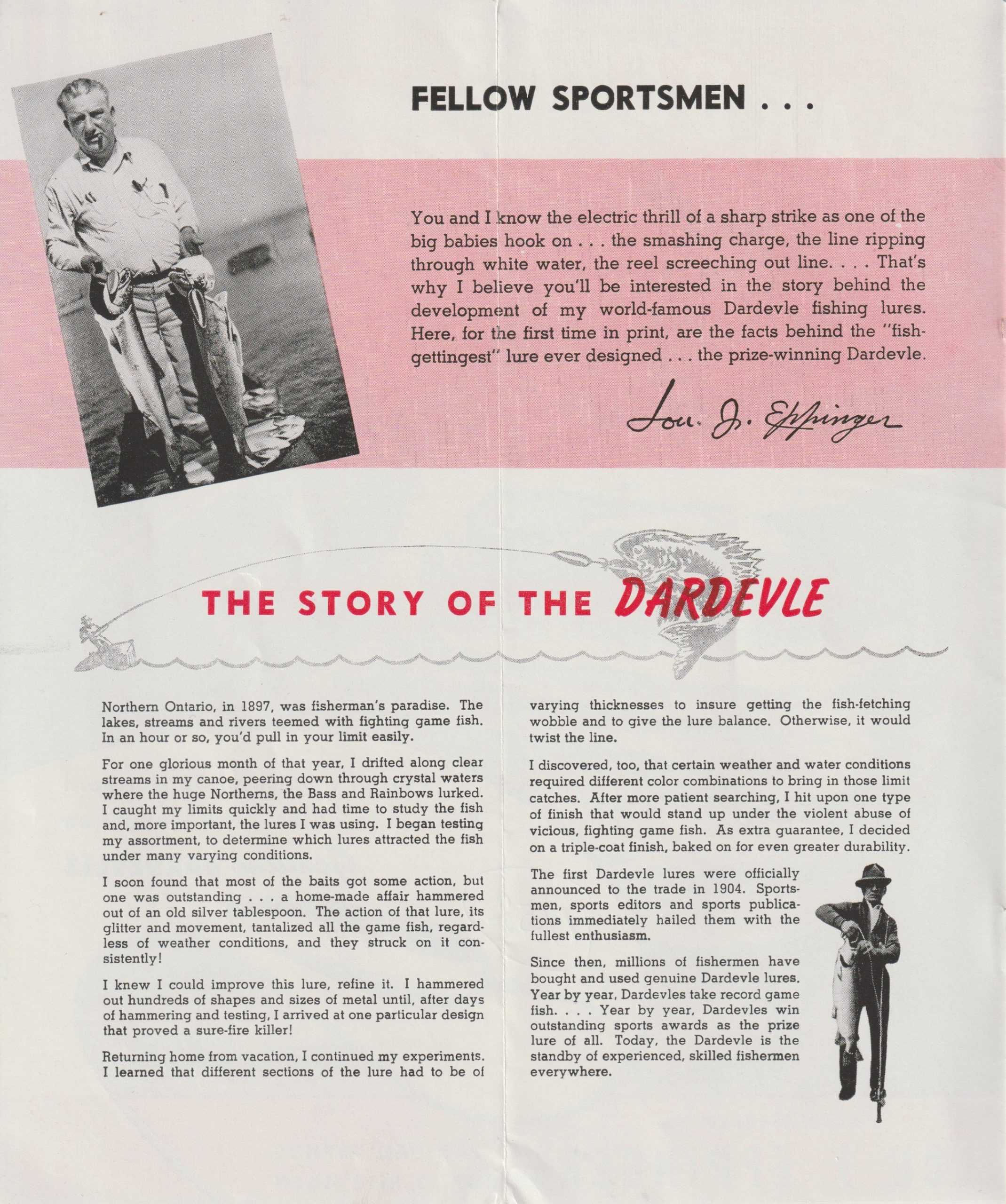
Page one is Lou Eppinger’s introduction, with a brief note where Lou, shown holding two big trout, identifies with readers and fellow anglers and declares that he’s about to tell the story, “for the first time in print,” of how he created and perfected the Dardevle spoon. This brochure gives the impression that Lou Eppinger was a great promoter and salesman, and not above adding or omitting certain details if they made the story more appealing. While some of the details might be a wee bit fuzzy, his tale of the creation of the Dardevle basically lines up with other accounts. It is a great story (below).
Eppinger continues on page two with the manufacturing process, and explains in detail each step in the production of the spoon. This process was an obvious source of pride for the company, and the steps outlined indicate that a heckuva lot of quality control and attention went into the making of each and every Dardevle. Lou also explains that Dardevles were produced in three basic size configurations – the Dardevle, Dardevle Imp, and Dardevlet – with each configuration being made for three basic casting rod actions and stiffnesses.

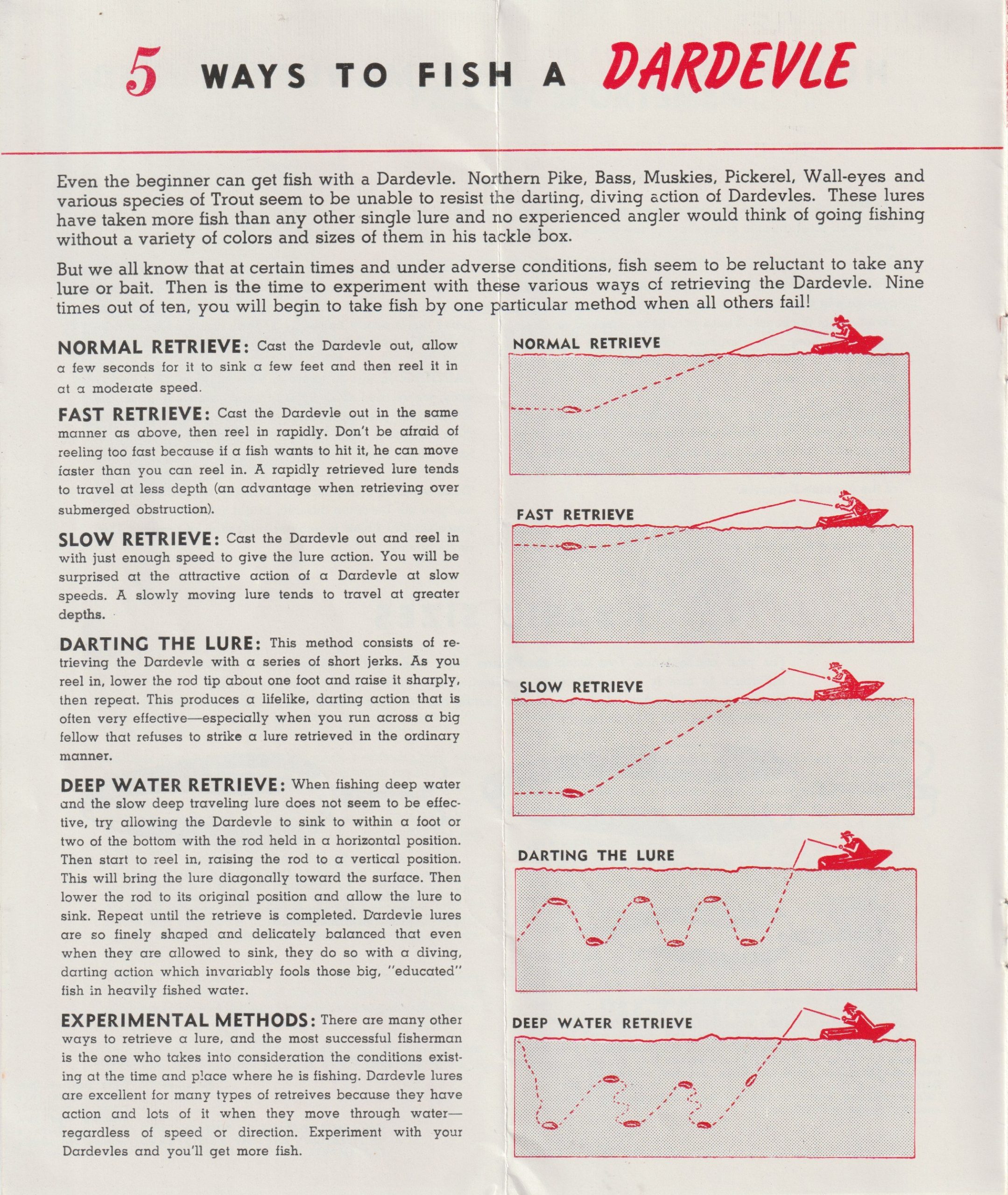
Page three shows different retrieves that an angler may employ to fish an Eppinger Dardevle at different depths. This is really basic stuff – regular, fast, and slow straight retrievals depending on where in the water column you want to fish, and then darting the lure or lifting it and letting it fall during the retrieve. It’s interesting from a promotional point-of-view that Lou Eppinger makes sure to encourage anglers to have a variety of different colors and sizes of Dardevles available to use. Sales!
Page four highlights what must have been a recent innovation to the Dardevle, the “feathered weedless Dardevle.” Lou writes, “The Feathered Dardevle is the latest edition to the world-famous line of Dardevle lures. I’ve taken my original fish-getting, easy-casting, non-twisting Dardevle and added two features: A single hook that’s practically weedless, and quality feathers the fish can’t miss! The weedless hook lets you cast right into those weed beds where the big fellows lie…and the feathers stream out behind with life-like kicking action, to make Dardevle irresistible.” That’s some solid marketing text, simple and dynamic. I love the scale pattern on these old Feathered Dardevles. The company still offers their feathered weedless Dardevle and you can still get the vintage scale pattern finish on a few color options, with the perch finish being my personal old school favorite. Unfortunately, they do not currently have available the red/white, black/white, and green/white patterns shown in this brochure in scale finishes.

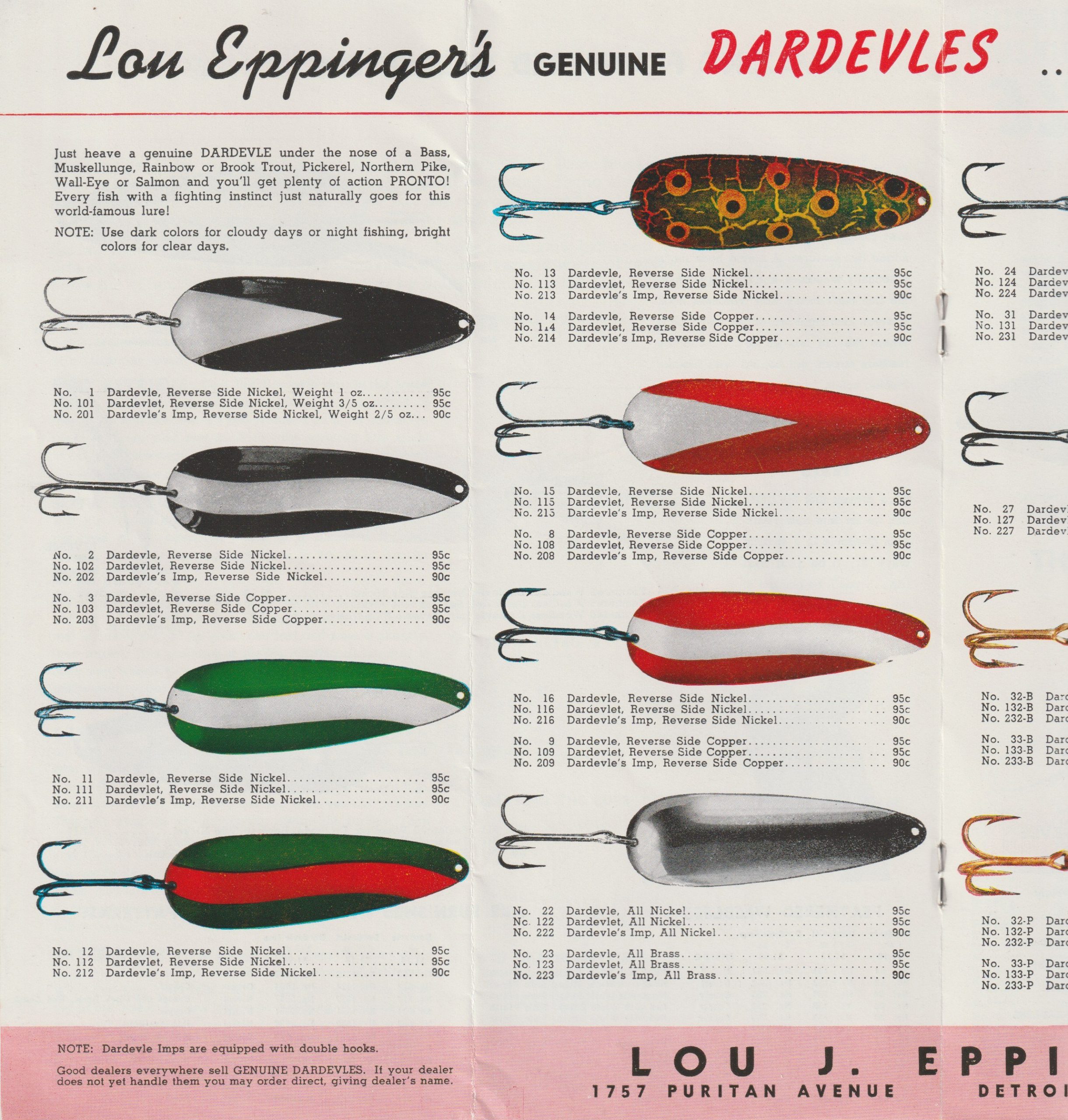
Pages five and six show the line-up of available Dardevle colors and patterns. A couple things to note here. One, the colors are identified by numbers alone and not numbers and names like they are today. For example, #27 in 1952 is #27, orange potato bug, today, and #15 in 1952 is #15, red white chunk today. It’s great to see that so many of those old original colors are still in the line-up today, like #13, crackle frog, and #32, perch, but I’d also love to see some of those old colors return that are no longer in production, like #12, green with red stripe. Also, notably absent is the popular #17, five of diamonds. I wonder when that pattern came into the picture, or if it was simply left out of this brochure for space considerations. There’s also the repeated emphasis that these are genuine Dardevles. Dardevles may well have been the most widely imitated lure of the time, and Lou Eppinger was emphatic in declaring that others were cheap and ineffective imitations.

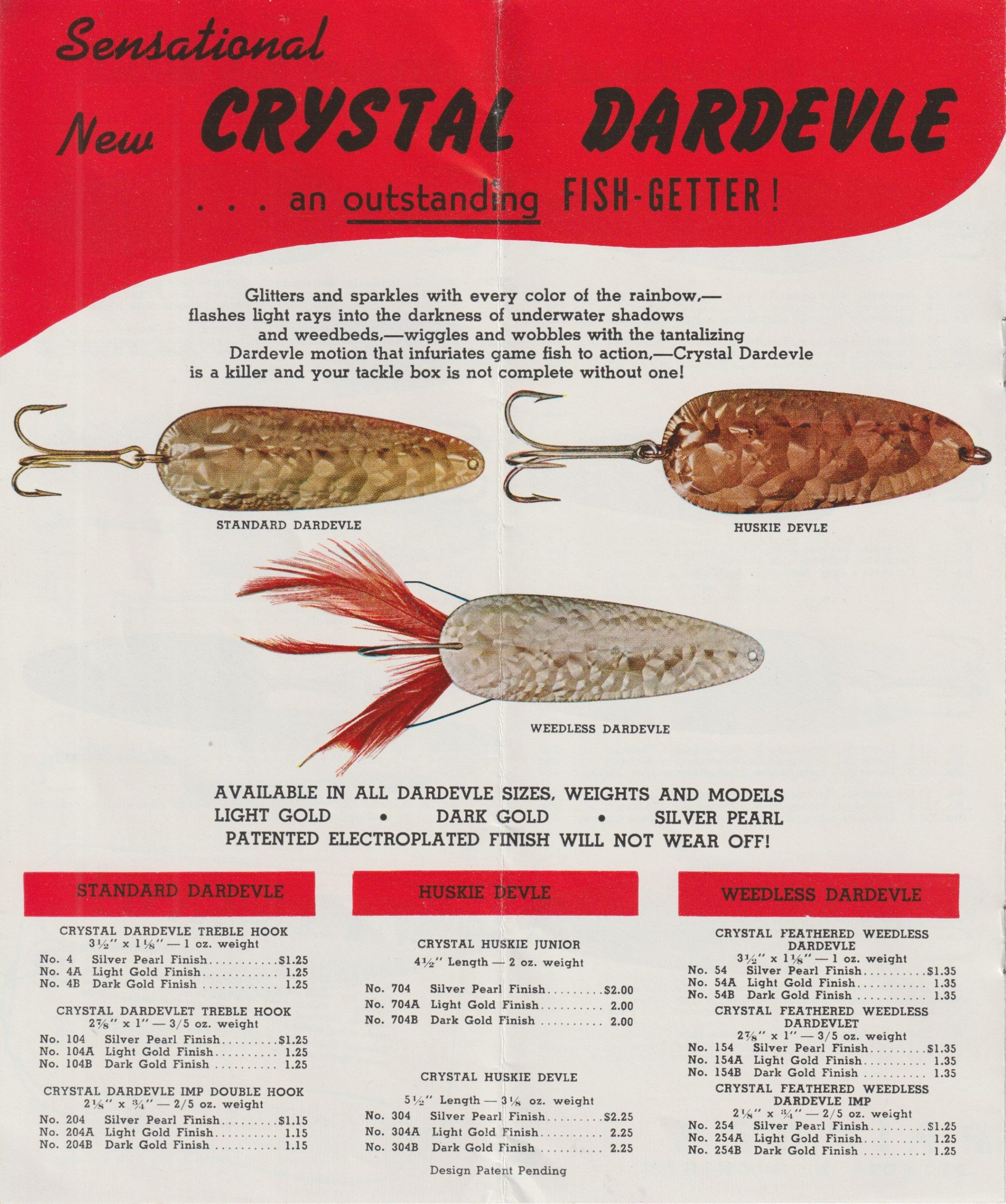
Page seven hits one of my all-time favorite Dardevles, the crystal spoon. These spoons have such an interesting and unique finish, with each one being like a snowflake, in that no two are exactly the same. The process to “crystalize” the spoons is such that each spoon is unique. I recall chatting with Jennifer a couple years ago about their crystal Dardevles, and she told me that they no longer produce them because they jobbed out the crystalizing process, and that company stopped production. You can still find Crystal Dardevles regularly on eBay. I have several in different sizes and configurations (weedless, imps, husky, etc.), and I always keep one or two in my tackle box, ready for action.
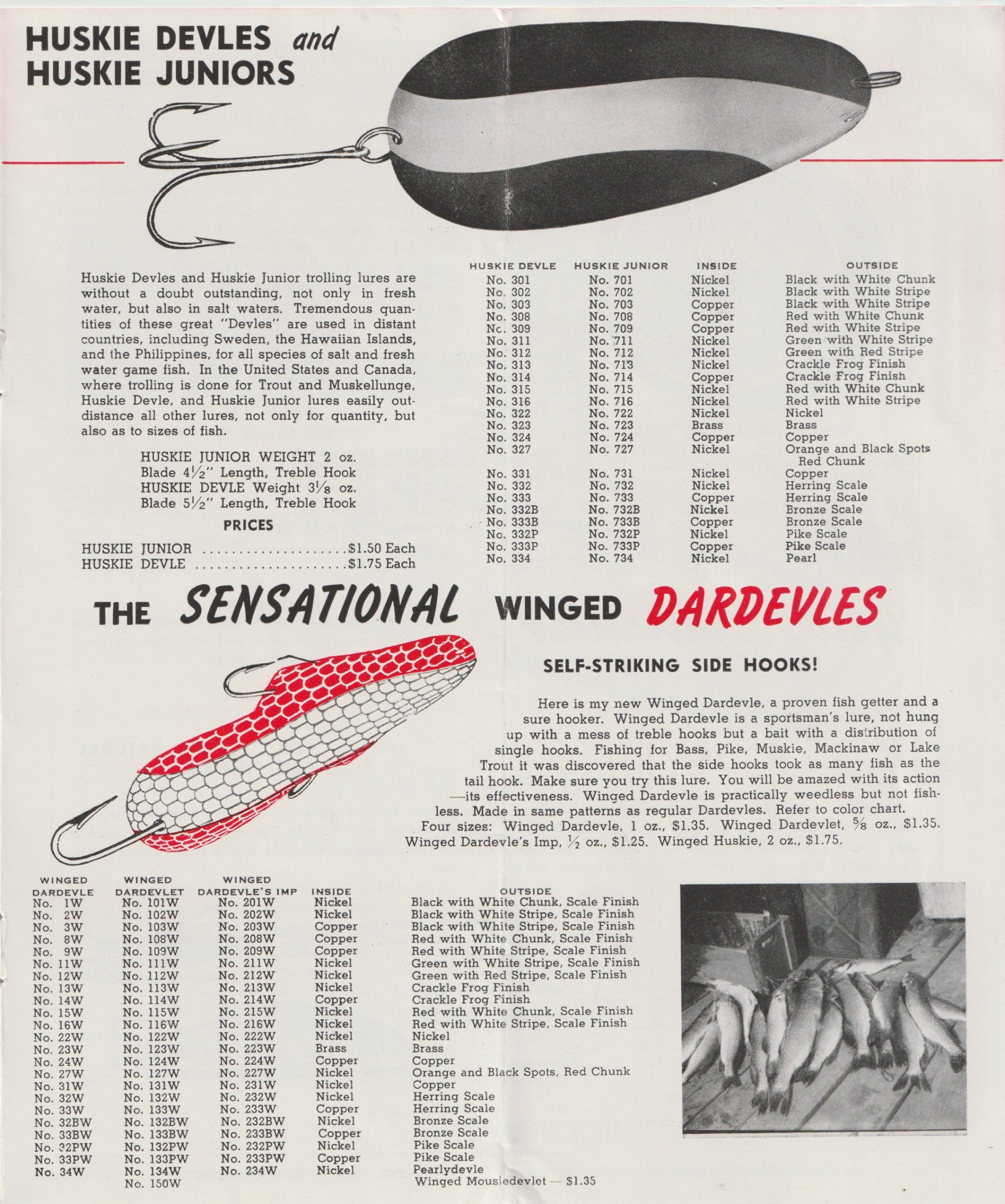
Page eight promotes the impressive Husky Junior and Husky Devle spoons, and the oddly shaped Winged Dardevle. The Husky Dardevles are monsters, used in fishing for big musky and pike, salmon and other large fish. The Junior is a 4½” long, 2 oz. spoon and the Devle boasts a massive 5½” blade and weighs 3⅛ oz. Back in 1952 you could get a Husky Junior for $1.50, and a Husky Devle for $1.75. Today they’ll cost you around $16 and $19, respectively. No self-respecting musky angler would be without a few of these big Dardevles in their kit. Plus, they look great on the wall of your cabin.
The Winged Dardevle is a mighty interesting spoon, with a bumped out projection on either side of the spoon, each projection fitted with a single hook. So, with the two side hooks and the single tail hook, you’ve got three single hooks spread around the lure. The text reads “Self-Striking Side Hooks!,” although what exactly that means is anybody’s guess. The Winged Dardevle is a beautifully odd spoon, looking both cumbersome and graceful at the same time.
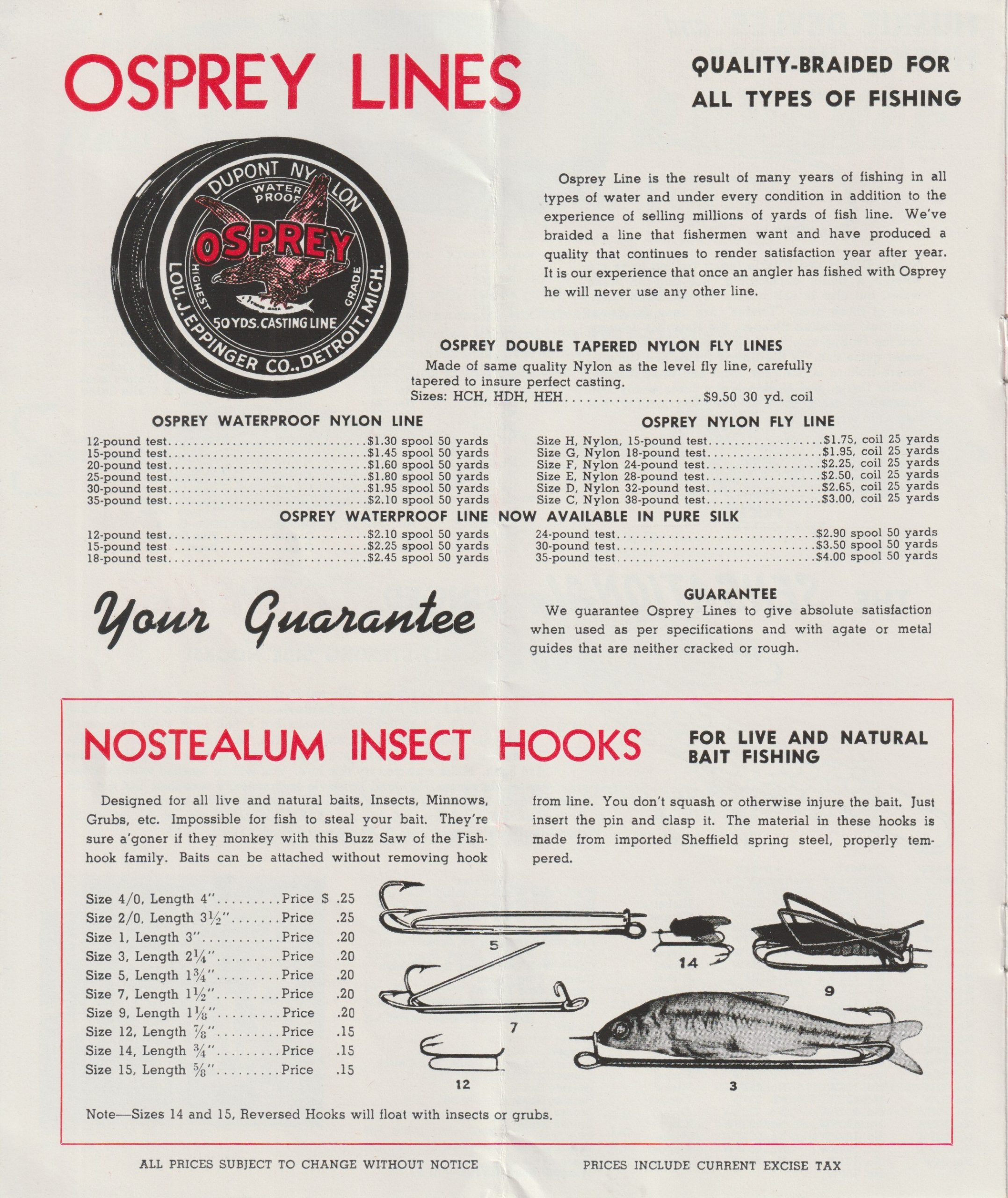
Page nine shows a couple of unusual products that Eppinger marketed for a while, their Osprey fishing line and Nostealum Insect hooks. The Osprey line, like most lines on the market 75 or 80 years ago, came in 25-yard and 50-yard spools, and was either nylon or silk for casting or fly fishing. Terry Battisti penned an interesting piece on vintage fishing lines, circa 1945, that you can read here.
The Nostealum (“no-steal-um”…get it?) live bait hook seems like an odd product for Eppinger to have in their line-up. I’m really not sure what to make of it, other than it seems like an item with a fairly brief life in the Eppinger line of products.
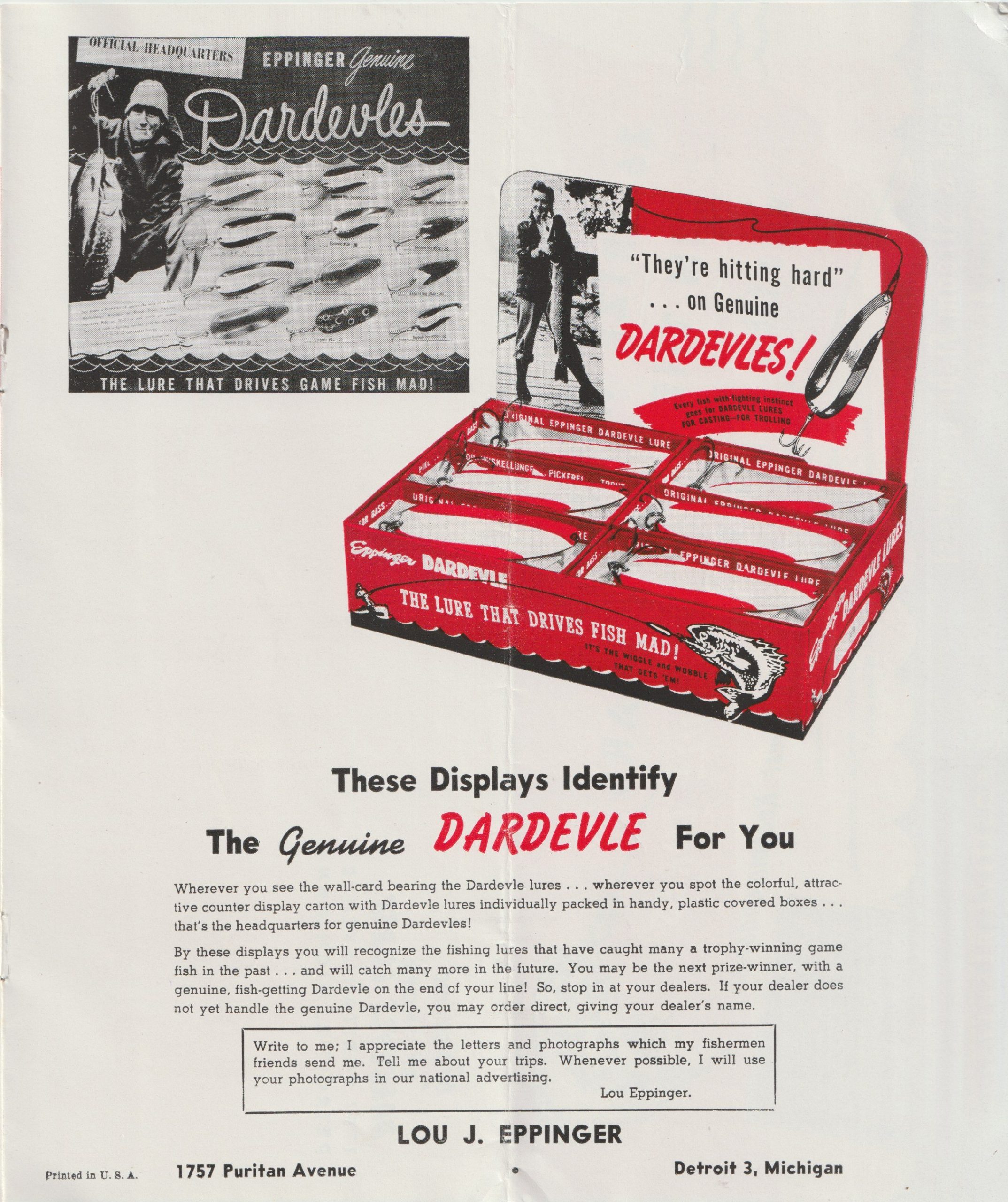
Page ten is a bit of pure promotion and advertising for the Eppinger company. It reminds the angler of the iconic Dardevle red and white color scheme, and identifies those colors with quality and fish-catching reliability. It shows a counter display box full of individually boxed Dardevle spoons. Wouldn’t it be fantastic to have one of these original countertop display boxes in your collection? The text reads,
“Wherever you see the wall-card bearing the Dardevle lures…wherever you spot the colorful, attractive counter display carton with Dardevle lures individually packed in handy, plastic covered boxes…that’s the headquarters for genuine Dardevles!”
“By these displays you will recognize the fishing lures that have caught many a trophy-winning game fish in the past…and will catch many more in the future. You may be the next prize-winner, with a genuine, fish-getting Dardevle on the end of your line! So, stop in at your dealers. If your dealer does not yet handle the genuine Dardevle, you may order direct, giving your dealer’s name.”
Then, below that in a text box is a personal note and request from Lou Eppinger himself:
“Write to me; I appreciate the letters and photographs which my fishermen friends send me. Tell me about your trips. Whenever possible, I will use your photographs in our national advertising.”
That’s pretty cool, and is also a clever marketing strategy to get anglers using the Dardevle lure. I think Lou took a page from Fred Arbogast’s notebook. You can’t beat the testimonial of real anglers showing real fish caught with your lure.
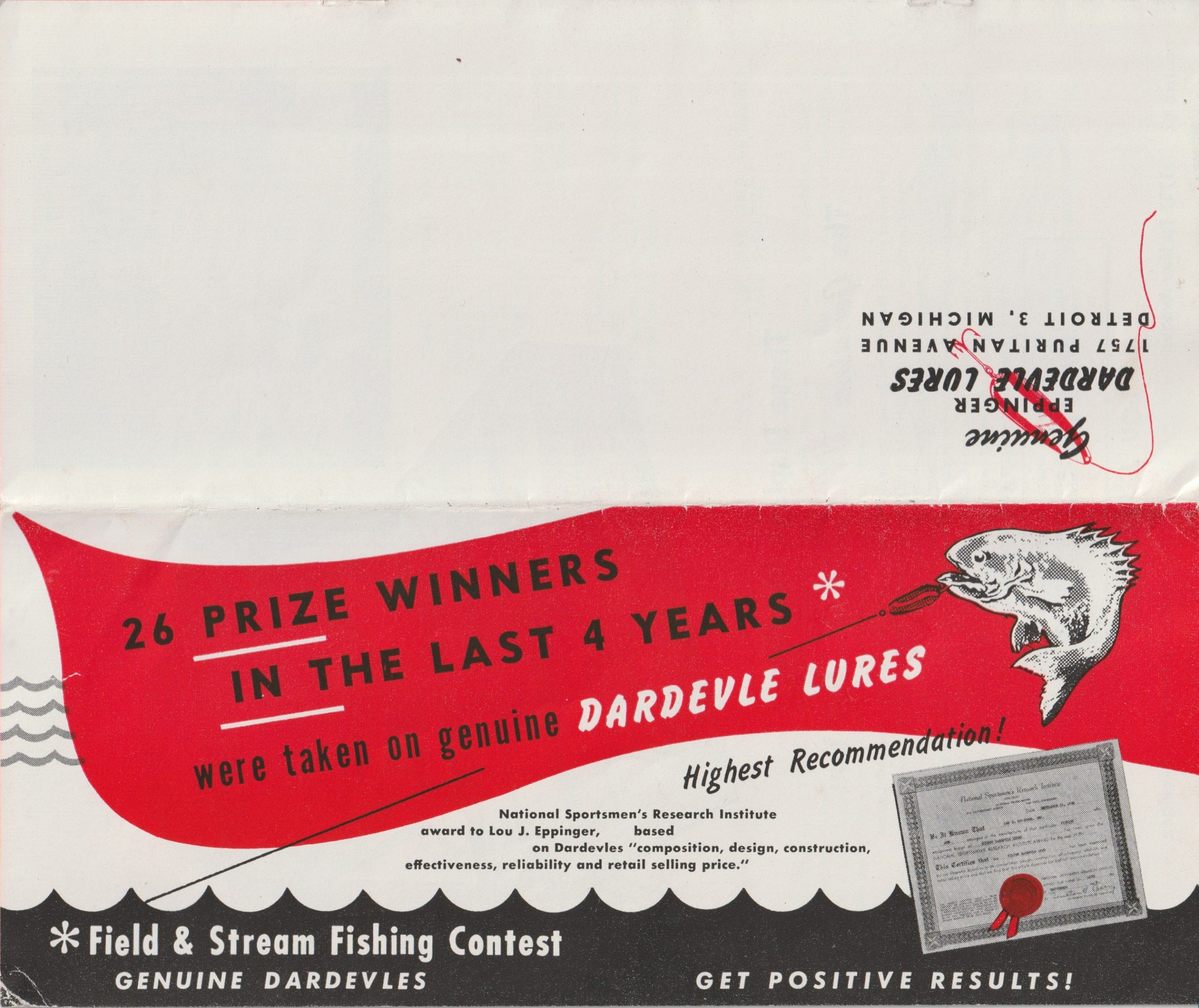
The final back cover page is a testimony to the effectiveness of the Eppinger Dardevle, with bold mention of the number of Field and Stream Fishing Contest winners of the past few years who used Dardevles to achieve their wins. There’s also a small note and image of a certificate announcing that Lou Eppinger’s Dardevle was awarded recognition from the prestigious-sounding National Sportsmen’s Research Institute. The NSRI was a non-profit group that we’ll have to do a future article on, because it sounds like a very interesting organization.
This is a great little brochure, full of history, heavy with marketing and promotion, and imbued with the personality of Lou Eppinger.




The 1904 date is questionable. Searching by many experienced researchers over many years has turned up the earliest Daredevil advertisement to date. May 1919.
I agree, Bill. In my earlier BFA article on the development of the Osprey/Dardevle I had uncovered that Lou went to Canada in 1906 and caught fish on a rudimentary spoon that ultimately became the Dardevle. He also, according to sources, started selling the lure in his shop in 1917 or 1918. But there are at least four different versions of the story, that I recount, none of which puts the introduction of the lure at 1904. I’d love to know if this 1904 date was a misprint, or if Lou had some specific reason for citing it.